
What Is Real Estate Investing? A Beginner's Guide
- Bud Evans

- Jun 16
- 8 min read

Real estate investing is the practice of acquiring, owning, or controlling property assets to generate income and build long-term wealth. Unlike stocks or bonds, property gives you a tangible asset that can produce monthly cash flow, appreciate in value over time, and even reduce your tax burden through depreciation. For many Americans, it represents the most direct path to financial independence. Whether you own a single rental home or hold shares in a Real Estate Investment Trust (REIT), the core principle stays the same: put capital into property and let it work for you.
What is real estate investing and how does it work?
Real estate investing is defined as any strategy that uses property ownership or control to produce a financial return. That return comes from three primary sources: rental income, property appreciation, and debt paydown by tenants. Homeownership alone can represent up to 60% of a household’s net worth, which shows just how central real estate is to American wealth building.
The mechanism is straightforward. You acquire a property, either directly or through a fund, and that asset generates returns over time. Direct ownership means you control the property and make all decisions. Indirect ownership, through vehicles like REITs or real estate crowdfunding platforms, lets you participate in property markets without managing a physical building. Both paths count as real estate investing, and both can build serious wealth when executed with discipline.
What separates real estate from other asset classes is its dual return structure. Real estate combines rental income and appreciation, balancing short-term cash flow with long-term asset growth. That combination makes it one of the few investments that can pay you monthly while simultaneously growing in value.

What are the main types of real estate investments?
Understanding your options is the first step in real estate investment basics. The field splits cleanly into two categories: direct and indirect ownership.
Direct ownership puts you in control of a physical property. The most common forms include:
Rental properties: You buy a home or apartment building and collect monthly rent. This is the most popular entry point for individual investors.
House hacking: You live in one unit of a multi-family property and rent out the others. Your tenants effectively cover your mortgage.
House flipping: You buy a distressed property, renovate it, and sell it for a profit. This is active, capital-intensive work with real upside and real risk.
Indirect ownership gives you exposure to real estate without managing a physical asset. Key vehicles include:
REITs (Real Estate Investment Trusts): Publicly traded companies that own income-producing properties. REIT investing is accessible to beginners, with brokerage accounts set up in under 15 minutes.
Real estate mutual funds and ETFs: Pooled funds that hold REITs or real estate company stocks, offering broad diversification.
Crowdfunding platforms: Platforms like Fundrise and RealtyMogul let you invest in specific properties or portfolios with relatively low minimums.
Here is a quick comparison to help you match your profile to the right vehicle:
Investment Type | Time Commitment | Liquidity | Minimum Capital | Risk Level |
Rental Property | High | Low | $20,000+ | Medium |
House Flipping | Very High | Low | $30,000+ | High |
REITs | Low | High | $1+ | Low to Medium |
Real Estate ETFs | Low | High | $1+ | Low to Medium |
Crowdfunding | Low to Medium | Medium | $500+ | Medium |
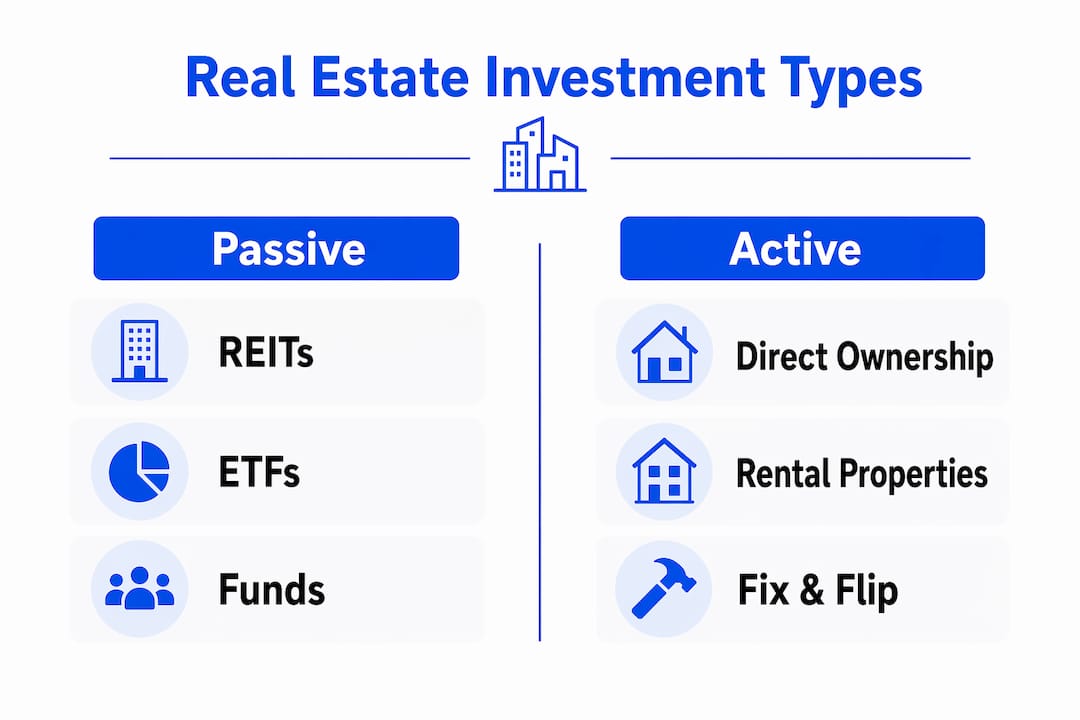
Passive investments like REITs suit investors who want less hands-on management and more liquidity. Direct ownership suits investors who want maximum control and are willing to put in the work. Neither is universally better. The right choice depends on your capital, your schedule, and your appetite for involvement.
Pro Tip: If you are new to real estate, consider starting with a REIT or ETF to learn how property markets move before committing capital to a physical asset.
What are the benefits and risks of real estate investing?
The benefits of real estate investing are well documented, but they come with real trade-offs. Knowing both sides protects you from costly surprises.
Core benefits include:
Rental income: Rental homes offer consistent monthly cash flow and are considered one of the strongest vehicles for steady income among all investment types.
Appreciation: Property values tend to rise over time, building equity you can tap through refinancing or a sale.
Portfolio diversification: Real estate serves as a hedge against stock market volatility and inflation, making it a stabilizing force in a broader investment portfolio.
Tax advantages: Depreciation, mortgage interest deductions, and 1031 exchanges can significantly reduce your tax liability.
Risks you must account for:
Market fluctuations can reduce property values, especially in overheated markets.
Tenant management creates operational headaches, from late payments to property damage.
Real estate is illiquid. You cannot sell a rental property in an afternoon the way you can sell a stock.
Unexpected maintenance costs can wipe out months of cash flow if you are not prepared.
Pro Tip: Set aside a maintenance reserve of at least 5–10% of annual rental income before you count any property as profitable. Maintenance reserves are critical and routinely overlooked by first-time investors.
What real estate investment strategies work best for beginners?
Real estate investment strategies range from fully passive to intensely active. The best strategy for you depends on your capital, your time, and your financial goals. Here are four proven approaches worth understanding:
Buy and hold rental properties. Purchase a property, rent it out, and hold it for years. Target a cash-on-cash return of 7–10% as your performance benchmark. Cash-on-cash return measures actual cash earned against actual cash invested, which is a far more honest metric than gross rent yield alone.
House flipping. Buy a distressed property below market value, renovate it, and sell it at a profit. Successful flipping requires net profits that cover renovation costs plus a meaningful buffer. If the numbers do not work on paper before you buy, they will not work in practice after you renovate.
Buying in emerging markets. Break-even properties in emerging neighborhoods can capture significant appreciation with manageable risk. You accept thin early cash flow in exchange for long-term equity growth. This works best in cities with strong job growth, population inflows, and limited housing supply.
Passive investing through REITs or funds. If you want exposure to real estate without managing tenants or toilets, REITs and real estate ETFs deliver market-rate returns with full liquidity. This approach fits investors who prioritize simplicity and time freedom over maximum yield.
Pro Tip: Do not confuse activity with progress. Owning five mediocre properties is not better than owning two excellent ones. Discipline in property selection matters more than deal volume.
For a deeper look at building wealth through real estate strategies, the right framework always starts with your personal financial goals, not the hottest trend in the market.
How do you get started with real estate investing?
Knowing how to invest in real estate starts with a clear personal plan, not a property search. Follow these steps to build a solid foundation:
Define your goals. Are you building monthly cash flow, long-term equity, or both? Your answer shapes every decision that follows, from property type to financing structure.
Assess your capital and financing options. Most conventional rental property loans require 15–25% down. FHA loans allow lower down payments for owner-occupied properties, which makes house hacking a strong entry point for capital-constrained beginners.
Research your target market. Study vacancy rates, median rents, job growth, and population trends in your target city. A property in a declining market will underperform regardless of how good the deal looks on paper.
Evaluate properties with the right metrics. Use cash-on-cash return, net operating income (NOI), and cap rate to compare opportunities. Evaluating a property using only purchase price is like comparing cars using only horsepower. You need the full picture.
Decide on your management approach. Self-managing saves money but costs time. Hiring a professional property manager costs 8–12% of monthly rent but removes the operational burden entirely. For investors scaling beyond one or two properties, professional management is rarely optional.
Make your offer and close. Work with a real estate attorney and a buyer’s agent experienced in investment properties. Review all inspection reports, title documents, and rent rolls before signing.
A beginner’s guide to real estate investments can help you map out each of these steps in detail before you commit capital. The best real estate investment for any individual depends on their capital, willingness to manage, and timing in the market cycle.
Key takeaways
Real estate investing builds wealth through rental income, appreciation, and tax advantages, but only when you match the right strategy to your capital and goals.
Point | Details |
Core return sources | Rental income, appreciation, and debt paydown are the three pillars of real estate returns. |
Investment vehicle choice | Match your vehicle to your lifestyle: REITs for passive investors, rentals for hands-on wealth builders. |
Performance benchmark | Target a 7–10% cash-on-cash return as your baseline for evaluating rental property performance. |
Risk management | Set aside a maintenance reserve of 5–10% of annual rent to protect cash flow from unexpected costs. |
Starting point | Define your financial goals before searching for properties. Strategy precedes deal-hunting every time. |
What i have learned after years of watching investors win and lose
Most beginners approach real estate investing the wrong way. They start with a property and work backward to justify it. The investors who build real wealth do the opposite. They start with a financial target, build a strategy around it, and then find the property that fits.
The second mistake I see constantly is treating all real estate as the same asset class. A single-family rental in a growing suburb, a REIT on the New York Stock Exchange, and a flip in a transitional neighborhood are three completely different businesses. They require different skills, different capital, and different risk tolerances. Lumping them together confuses movement with progress.
Patience is not a soft skill in this business. It is a competitive advantage. The investors who hold quality assets through market cycles consistently outperform the ones who chase short-term trends. Real estate rewards discipline more than it rewards hustle.
One more thing: do not underestimate the value of professional management once you scale. Self-managing one property is a learning experience. Self-managing five is a second job. Knowing when to delegate is what separates investors who grow from investors who plateau.
— Main
How 2ndstreetpropertymanagement supports your investment goals
Owning rental property is one of the most reliable ways to build wealth. Managing it well is what separates profitable portfolios from stressful ones.

2ndstreetpropertymanagement is built by investors, for investors. The team handles tenant screening, rent collection, maintenance coordination, and financial reporting so you can focus on growing your portfolio instead of fielding maintenance calls. Whether you own one property or ten, professional management protects your returns and your time. Explore how property management services from 2ndstreetpropertymanagement can reduce your landlord burden and keep your investments performing at their full potential.
FAQ
What is real estate investing in simple terms?
Real estate investing is the practice of using property to generate income or build wealth, through rental payments, property appreciation, or both.
How much money do i need to start investing in real estate?
Direct ownership typically requires $20,000 or more for a down payment, but REITs and real estate ETFs allow you to start with as little as $1 through a standard brokerage account.
What are real estate funds and how do they work?
Real estate funds are pooled investment vehicles, including REITs and real estate ETFs, that hold income-producing properties and distribute returns to shareholders without requiring direct property ownership.
What is a good return on a rental property?
A cash-on-cash return of 7–10% is considered strong for rental properties in the current market, measuring actual cash earned against actual cash invested.
Is real estate a good hedge against inflation?
Real estate is a proven inflation hedge because property values and rents tend to rise alongside inflation, preserving purchasing power over time.
Recommended

Comments