
Role of Rental Application: Tenant's 2026 Guide


A rental application is the formal document that collects a prospective tenant’s personal, financial, and rental history information while granting the landlord legal permission to run credit, background, and eviction screenings. Most renters treat it as a formality. It is not. The role of rental application in the leasing process is closer to a legal contract than a simple form. Get it right and you move to the top of the list. Get it wrong and you may never hear back.
What is the role of a rental application?
A rental application is the foundation for tenant screening, gathering key data and signed authorization before any credit or background checks can be legally run. Without a signed application, a landlord cannot legally obtain or use consumer reports to make a rental decision. That single fact changes how you should think about every field on the form.
The application serves two distinct purposes. First, it collects the information a landlord needs to evaluate whether you are a reliable tenant. Second, it creates the legal authorization that allows the landlord to verify that information through third-party screening services. Both functions are equally important, and neither works without the other.

Think of it this way: the application is your first impression and your legal handshake at the same time. Submitting it incomplete is like showing up to a job interview without your resume and then refusing to sign the background check consent form.
What information does a rental application collect?
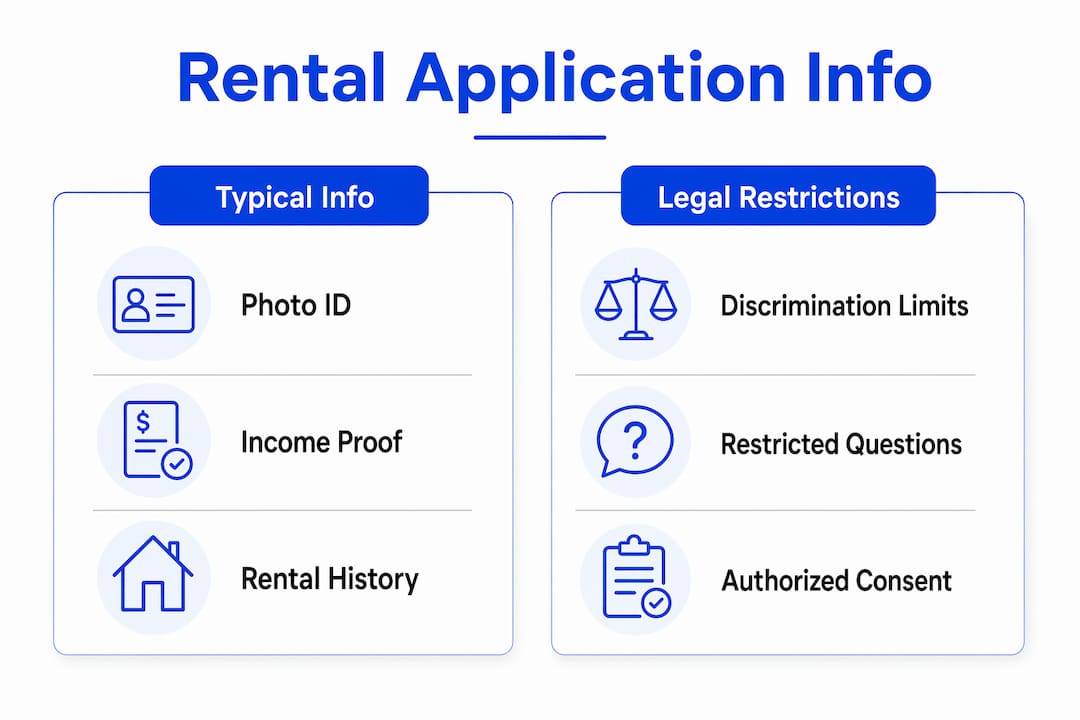
Typical rental applications request a government-issued photo ID, proof of income such as pay stubs, rental history with landlord contact information, and personal or professional references. Each category serves a specific verification purpose, and landlords weigh them differently depending on the property and local market.
Here is what landlords are actually looking for behind each document type:
Government-issued photo ID: Confirms your identity and matches it to the credit and background check results.
Proof of income: Verifies you earn enough to cover rent, typically 2.5 to 3 times the monthly rent amount.
Rental history: Shows your track record as a tenant, including whether you paid on time and left properties in good condition.
References: Provides a human layer of verification that documents alone cannot supply.
Not every jurisdiction allows landlords to ask for anything they want. In Victoria, Australia, rental providers are legally required to use a prescribed application form that limits information requests to identity confirmation and ability to pay rent as of March 31, 2026. That regulation shows a global trend toward protecting applicant privacy while keeping the process functional.
Typical Information Requested | Information Often Legally Restricted |
Government-issued photo ID | Race, ethnicity, or national origin |
Proof of income (pay stubs, bank statements) | Religion or marital status |
Rental history and landlord references | Disability status or medical history |
Personal or professional references | Immigration status (varies by jurisdiction) |
Social Security Number (for credit check) | Arrests without convictions (varies by state) |
Pro Tip: Stick to answering only the fields on the form. In jurisdictions with prescribed application forms, providing unsolicited details can create compliance issues or slow down your application.
How does a rental application enable legal tenant screening?
The rental application is not just data collection. It is a legal authorization tool that makes compliant tenant screening possible under laws like the Fair Credit Reporting Act (FCRA). Without your signed consent on the application, a landlord cannot legally pull your credit report or run a background check through a Consumer Reporting Agency (CRA).
Here is how the screening workflow connects directly to the application:
You submit a completed, signed application. The signature is the legal authorization. Missing it stops the process.
The landlord orders a consumer report from a CRA using the information you provided, including your Social Security Number and date of birth.
The CRA returns credit, background, and eviction data that the landlord uses alongside your application documents.
The landlord makes a decision. If the decision is negative and a consumer report played any role, federal law requires action.
An adverse action notice is issued. Under the FCRA, landlords must provide a notice that names the CRA used and informs you of your right to dispute the information within 60 days.
“The rental application is the legal bridge between a prospective tenant and a compliant screening process. Without it, landlords operate blind and outside the law.”
Missed or incomplete signed authorization on rental applications can stall or prevent legal screening processes entirely. This is especially true when multiple applicants or cosigners are involved, where each party typically needs to sign separately. Treat the authorization section of any application as the most critical field on the form.
Pro Tip: Before you submit, confirm that every signature field is signed and every date field is filled. A landlord who cannot legally run your screening will simply move to the next applicant.
What red flags do landlords look for on rental applications?
Landlords review applications looking for patterns that predict risk. Understanding what those patterns are gives you the ability to address them before they become a problem.
Common red flags include:
Prior evictions: An eviction record is the single most damaging item on a rental application. It signals that a previous landlord went through a legal process to remove you, which is a significant undertaking.
Frequent moves: Moving every six to twelve months without clear reasons raises questions about your reliability and whether you left on good terms.
Inconsistent or unverifiable income: If your stated income does not match your pay stubs or bank statements, it creates doubt about your ability to pay rent consistently.
Gaps in rental history: Periods where you cannot account for your housing situation prompt questions a landlord will want answered.
Poor references: A former landlord who gives vague or lukewarm responses is often worse than no reference at all.
Applicants with steady income and rental history but imperfect credit can still succeed by providing thorough references and clear documentation. Landlords are generally looking for reliability signals, not perfection. A strong reference from a previous landlord who confirms you paid on time and maintained the property can offset a lower credit score in many cases.
Honesty matters more than you might expect. Landlords verify the information you provide. If your application says you left your last rental voluntarily but the landlord reference tells a different story, you lose the application and the landlord’s trust simultaneously. A brief, honest explanation of a past issue is almost always better than a discrepancy the landlord discovers during screening.
You can also review the tenant screening checklist that 2ndstreetpropertymanagement uses to understand exactly what landlords evaluate during the review process.
How does the rental application process work step by step?
Understanding how rental applications work from submission to decision helps you move faster and avoid common mistakes. Processing times for credit, income, and rental history verification typically range between 24 and 72 hours. Complete, consistent applications speed that timeline. Incomplete ones extend it, sometimes long enough for another applicant to get the unit.
Here is the standard process from your side of the table:
Gather your documents before you start searching. Have your photo ID, two to three recent pay stubs, your rental history with landlord contact information, and two references ready to go.
Complete the application fully and accurately. Every blank field is a reason to follow up with you, which slows the process.
Sign every authorization field. This is non-negotiable for legal screening to proceed.
Submit early. Most landlords review applications in the order they arrive. Submitting the same day you view the property gives you a real advantage.
Alert your references. A reference who is surprised by a call from a landlord gives a weaker response than one who is prepared.
Respond quickly to follow-up requests. If a landlord asks for an additional document, a same-day response keeps you at the front of the line.
Pro Tip: Digital applications with integrated screening software process faster than paper forms. When a landlord offers an online application option, submit documents digitally as clear, readable PDFs rather than photos taken at an angle in bad lighting.
The importance of rental applications extends beyond the documents themselves. The way you handle the process signals to the landlord what kind of tenant you will be. Responsive, organized applicants tend to become responsive, organized tenants. Landlords know this, and they factor it in.
Key takeaways
A complete, signed rental application is the legal and practical foundation of every successful tenancy, and how you prepare it directly determines your approval chances.
Point | Details |
Application is a legal document | Your signature authorizes credit and background checks; missing it stops screening entirely. |
Completeness speeds approval | Applications with all documents attached process in 24–72 hours versus days for incomplete ones. |
Red flags can be addressed | Honest explanations and strong references offset imperfect credit or gaps in rental history. |
Know what landlords can ask | Jurisdictional rules limit what information landlords may legally request on applications. |
Preparation is your advantage | Having ID, pay stubs, and references ready before you search puts you ahead of other applicants. |
The application is your opening move, not a formality
After working alongside property investors and watching hundreds of applications come through the screening process, one pattern stands out clearly. Tenants who treat the rental application as a formality lose to tenants who treat it as a strategy.
The most common mistake I see is applicants who submit incomplete forms and then wonder why they did not get the unit. They assume the landlord will call to collect missing information. Most landlords will not. They move to the next complete application because their time and their vacancy costs are real.
The second mistake is underestimating the authorization section. Some applicants skip or skim the consent fields because they feel uncomfortable authorizing a background check. That discomfort is understandable. But an unsigned authorization means the landlord cannot legally screen you, which means they cannot approve you. The FCRA disclosure requirements exist to protect you, not to create obstacles.
My honest view is that the rental application process rewards preparation and penalizes passivity. You do not need perfect credit or a spotless rental history. You need a complete, honest, well-documented application submitted faster than the competition. That is a controllable variable, and it is entirely in your hands.
— Main
How 2ndstreetpropertymanagement makes the process work for you
Navigating the rental application process is easier when the system on the other side is built for speed and compliance.
2ndstreetpropertymanagement uses online application platforms with integrated screening tools that process credit, background, and rental history checks within the standard 24 to 72 hour window. Every application is reviewed against a consistent, documented standard, which means decisions are faster and applicants are treated fairly. If you are a prospective tenant ready to apply, or an investor looking for a property management partner who handles screening the right way, explore our services to see how the process works from both sides of the lease.
FAQ
What is a rental application used for?
A rental application collects a prospective tenant’s personal, financial, and rental history information and provides the signed authorization a landlord needs to legally run credit and background checks. Without it, no compliant screening can take place.
How long does the rental application process take?
Verification of credit, income, and rental history typically takes 24 to 72 hours when an application is complete and consistent. Incomplete applications extend that timeline significantly.
What documents should i have ready for a rental application?
You should prepare a government-issued photo ID, recent pay stubs or proof of income, your rental history with landlord contact details, and at least two references before you start applying.
Can a landlord deny me based on a background check?
Yes, but under the FCRA, if a consumer report contributed to the denial, the landlord must send you an adverse action notice naming the Consumer Reporting Agency and explaining your right to dispute the findings within 60 days.
What can i do if my credit is not strong?
Thorough references and clear documentation of steady income can offset imperfect credit in many cases. Landlords look for overall reliability signals, and a strong landlord reference often carries more weight than a credit score alone.
Recommended
Comments