
Protect Margin: Vendor Performance Management for Procurement (7 KPIs)
- Rey Rey Rodriguez

- 14 hours ago
- 13 min read

Vendor performance management is the ongoing practice of measuring, scoring, and improving how well suppliers deliver against cost, quality, delivery, and risk commitments. Done right, it gives you visibility to act, catch a slipping vendor before it costs you a client, protect margin before it erodes, and improve service before someone else notices first. The rest of this guide covers the KPIs, scorecards, review cadence, and tools that make that visibility real.
TL;DR:
Focus on high-impact KPIs like quality, delivery, and cost variance, especially for critical vendors that could disrupt operations if performance declines.
Implement threshold-based scoring with clear action plans for scores below 75 and automatic transition reviews if scores fall under 60, aligned with contractual clauses.
Prioritize linking vendor performance data with spend and total cost of ownership to detect issues early and negotiate better terms during renewal.
Use tiering based on business criticality, spend concentration, and risk exposure to focus management efforts on the most impactful vendor relationships.
Centralize key vendor documents and pilot scorecards on top-risk vendors to build operational discipline before broader rollout.
Table of Contents
What Is Vendor Performance Management and Why Does Procurement Need It?
What Review Cadence and Remediation Process Should You Follow?
How Does Vendor Performance Connect to Spend and Total Cost of Ownership?
How Do You Build Continuous Improvement Into Vendor Relationships?
What Common Mistakes Undermine Vendor Performance Management?
How Does Vendor Performance Management Fit Into Broader Supplier Relationship Management?
How Does Vendor Performance Affect Organizational Risk and Compliance?
How Do You Get Stakeholder Buy-In for Vendor Performance Management?
How 2ndstreetpropertymanagement Operationalizes Vendor Oversight for Investors
What Is Vendor Performance Management and Why Does Procurement Need It?
Sourcing ends the moment a contract is signed. Vendor performance management (VPM) is what happens after, the continuous discipline of tracking how a supplier actually performs against what they promised. Procurement teams that treat these as the same function tend to negotiate great rates and then lose the savings to missed deliveries, quality escapes, and compliance gaps that nobody caught until the invoice arrived.
VPM touches every stage of the vendor lifecycle, not just the parts that show up in a contract review meeting:
Onboarding, verifying credentials, insurance, and baseline capability before work starts
Monitoring, tracking KPIs against SLAs on a regular cadence
Development, running improvement plans and joint problem-solving when performance dips
Offboarding, documenting lessons learned and transition risk when a relationship ends
The outcomes worth measuring fall into four buckets: compliance (are they meeting contractual and regulatory obligations), cost control (is the total relationship still cheaper than the alternative), reliability (can you count on them under pressure), and innovation (are they helping you improve, or just showing up). A documented vendor performance policy that ties these outcomes to procurement decisions gives you leverage that a friendly phone call never will.
What KPIs and Metrics Should Procurement Track?
The strongest vendor scorecards run on a small set of metrics that actually predict failure, not a spreadsheet with forty tabs nobody opens. Seven categories cover nearly every vendor relationship worth managing:
Quality, defect rate, rework percentage, first-pass yield
Delivery, on-time delivery percentage, lead time variance
Cost, invoice accuracy percentage, cost variance against contract, total cost of ownership
Risk and compliance, security incidents per year, certificate expirations, audit findings
Responsiveness, mean time to respond (hours), mean time to resolve or MTTR (days)
Innovation, process improvements submitted, cost-saving proposals accepted
Relationship health, escalation frequency, dispute resolution time
Pro Tip: Don’t weight every category equally. A logistics vendor should be scored heavily on delivery and responsiveness; a specialty subcontractor should be scored heavily on quality and safety compliance. Copy the same five-category template across every vendor type and you’ll be measuring the wrong things for half your supply base.
A short list of leading indicators, like capacity utilization and open corrective actions, paired with lagging indicators like defect rates gives you an earlier warning signal than lagging metrics alone. By the time a defect rate spikes, the damage is already done. Contract-anchored KPIs also do double duty: they let you detect risk early and convert results into negotiation leverage at renewal time, rather than relying on memory and goodwill.
How Do Vendor Scorecards and Tiering Work Together?
A scorecard is only useful if it converts a pile of metrics into a single number someone can act on. The standard structure weights four or five dimensions, quality, delivery, cost, responsiveness, and innovation, on a 100-point scale, with sample weights running roughly 25/25/20/15/15 depending on what matters most for that vendor category. A vendor scoring 90 and above sits in the preferred tier. Scores in the 75 to 89 range mean to maintain the relationship as is. Anything from 60 to 74 triggers a formal improvement plan. Below 60, you’re evaluating transition.
Scoring alone misses the point if you tier every vendor the same way. The better approach layers three dimensions:
Business criticality, how much operational damage a failure would cause
Spend concentration, how much of your budget flows through this one relationship
Risk exposure, regulatory, safety, or reputational risk tied to their work
Tiering only by spend volume routinely under-prioritizes a low-cost vendor whose failure could shut down a critical process. A $4,000-a-month landscaping contractor rarely threatens your business. A $4,000-a-month fire suppression inspector absolutely can.
What Review Cadence and Remediation Process Should You Follow?
Cadence should track tier, not calendar convenience. Strategic and critical-tier vendors need quarterly business reviews (VBRs) at minimum, with trigger-based reviews any time a score crosses a threshold outside the scheduled cycle. Transactional, low-risk vendors can run on an annual review with automated alerts covering the gap.
A useful VBR agenda follows four fixed stops:
Performance review, scorecard results against target, trend over the last two to four quarters
Risk and compliance check, certificate status, audit findings, open corrective actions
Spend and contract linkage, actual spend against forecast, upcoming renewal or renegotiation points
Decisions and next steps, tier change, improvement plan initiation, or contract action
When a vendor drops into improvement-plan territory, document it properly: name an owner on both sides, set measurable milestones with dates, and build in an explicit verification step, an audit, inspection, or sample check, before returning the vendor to normal cadence. Require an escalation path in writing so nobody has to guess who signs off when the plan stalls.
What Tools and Automation Should You Prioritize First?
Before adding software, get clear on what actually needs to be centralized. Five capabilities separate a working VPM program from a folder full of spreadsheets:
Central vendor profiles with contract terms, contacts, and history in one place
Automated document expiry alerts for insurance, licenses, and certifications
Automated scorecard calculation instead of manual scoring each quarter
Spend integration so cost data updates the scorecard automatically
Dashboards that surface score trends without a manual pull
The payoff is measurable, not theoretical. Vendor management technology can eliminate up to 60% of manual admin work tied to spreadsheets and email chains, freeing procurement staff to actually work relationships instead of chasing data. Centralized vendor records also shorten onboarding time and cut down on expired-document surprises that stall projects.
If you’re choosing what to integrate first, prioritize your ERP for spend data, your contract repository for SLA terms, and your work-order or ticketing system for responsiveness metrics. Those three feeds cover most of the KPIs in your scorecard without a single manual entry.
How Do You Run a Vendor Improvement Plan?
A vendor slipping into the 60 to 74 score range needs a structured response, not a stern email. Four steps make up a defensible process:
Diagnose the root cause, pull the scorecard trend and identify which specific metric is dragging the score down
Agree on targets in writing, specific numbers, specific dates, signed by both sides
Assign an owner on each side, someone accountable for tracking progress, not just attending meetings
Verify results before closing the plan, an audit, inspection, or sample check confirms the fix held, not just a self-reported update
Pro Tip: Build a 90-day clock into every improvement plan. Vendors who need longer than that to show measurable progress on a known problem rarely fix it at all, they just get better at explaining the delay.
Decision rules matter here too. Renegotiate when the vendor is capable but the contract terms created the wrong incentives. Diversify when a single vendor’s failure would stop your operation and no improvement plan can close that exposure fast enough. Transition when a vendor scores below 60 twice in a row despite a documented plan. Commercial levers work better than lectures: tie a small volume increase or a preferred-tier renewal to hitting improvement targets, and vendors tend to move faster than they would for good intentions alone.
What Do Vendor Scorecards Look Like in Property Management?
Property management runs on vendor relationships more than almost any other operating business, plumbers, HVAC techs, landscapers, and general contractors all touch the same rental units repeatedly. A scorecard built for this world weights slightly differently than a manufacturing supply chain: response time and repeat-repair rate matter as much as price.
A practical maintenance vendor scorecard tracks:
Response time from work order to first contact (hours)
First-visit resolution rate, how often the job is fixed without a callback
Repeat repair rate on the same unit within 30 days
Invoice variance against the original estimate
Tenant satisfaction feedback tied to that specific vendor visit
Repeat repairs are the signal most owners miss until it’s expensive. A vendor who “fixes” the same leak three times in six months isn’t cheap, they’re a slow leak in your cash flow, and tracking that pattern is part of how experienced property managers protect margin on every unit under contract. Vetting insurance certificates and licensing at onboarding, not after a claim, is the other half of the equation covered in how vendor due diligence actually gets done. A structured inspection routine, borrowed from broader property maintenance checklists, keeps vendor accountability visible instead of anecdotal.
How Does Vendor Performance Connect to Spend and Total Cost of Ownership?
The lowest bid rarely produces the lowest cost. A vendor charging 10% less but missing delivery windows twice a quarter can cost you far more in expedited freight, downtime, or tenant turnover than the discount ever saved. Total cost of ownership (TCO) is what forces that math into the open: contract price plus rework costs, plus delay costs, plus the administrative time spent managing complaints.
Linking spend data directly to the scorecard is what makes this visible in real time instead of during an annual budget review. When cost variance against contract sits inside your KPI set, you catch creeping overcharges before they compound across dozens of invoices. When a vendor’s score drops and their share of your spend is high, that combination should trigger a review automatically, not wait for someone to notice the pattern manually.
This is also where tiering by spend concentration earns its keep. A vendor consuming 30% of your category spend deserves scrutiny even when their individual scorecard looks fine, because a single disruption there has outsized impact on your total cost position. Procurement teams that only look at unit price on a purchase order miss this entirely. The teams that link performance data to spend data catch a vendor’s declining reliability before it shows up as a line-item cost increase, and they walk into renewal negotiations with data instead of a hunch.
What Score Thresholds Should Trigger Governance Action?
A scorecard without predefined thresholds is just a report nobody acts on. The action matrix needs to be set before the first score comes in, not debated after a vendor slips.
A workable structure looks like this: scores of 90 or above keep a vendor in preferred status, eligible for volume increases and multi-year renewals. Scores between 75 and 89 mean maintain the current relationship with standard monitoring. Scores between 60 and 74 automatically trigger a formal improvement plan with a named owner and a verification date. Scores below 60 trigger a transition review, either renegotiation of terms or active sourcing of a replacement.
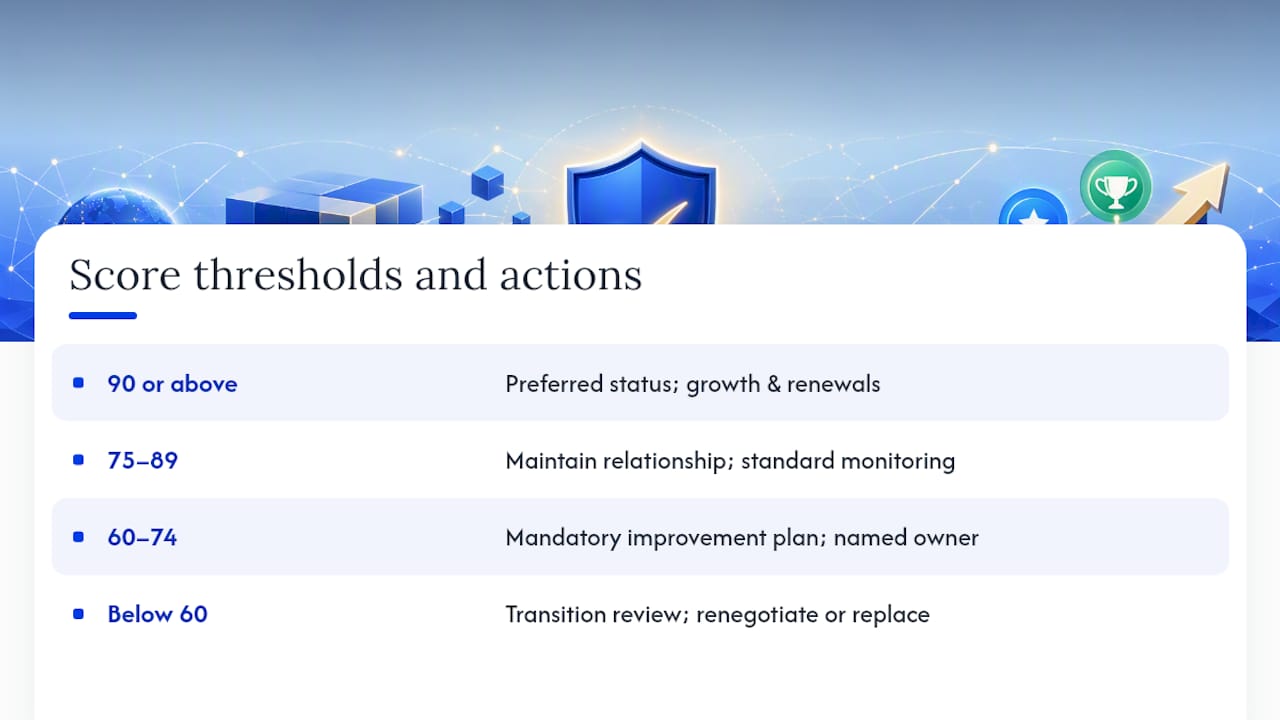
The threshold matters less than the automation behind it. Public sector vendor programs use rolling score averages that carry forward into future contracting decisions, meaning a poor score today has real consequences for a vendor’s next bid, not just an awkward conversation. That’s the governance model worth copying: thresholds that connect directly to what happens next, contract renewal, volume allocation, or exit, rather than sitting in a dashboard as a number with no teeth.
Set these thresholds in the contract itself where you can. An SLA that specifies “two consecutive quarters below 75 triggers a mandatory improvement plan” gives you contractual standing that a verbal understanding never will.
How Do You Build Continuous Improvement Into Vendor Relationships?
The vendors worth keeping long-term are the ones who improve without being told to. Getting there takes more than a scorecard, it takes a structure that rewards improvement instead of just penalizing decline.
Share scorecard data with vendors proactively, not just when something’s wrong. A vendor who sees their on-time delivery trend every quarter, even when it’s fine, starts treating the metric as shared ground rather than a surprise inspection. Build in a standing agenda item at every review for the vendor to propose one process change, a packaging adjustment, a scheduling tweak, anything that reduces cost or risk on either side. Vendors who feel like a collaborator rather than a suspect tend to surface these ideas voluntarily.
Recognize performance publicly within your own organization when a vendor earns it. A preferred-tier vendor who gets first call on new work, faster payment terms, or a multi-year renewal has a real incentive to keep performing, and other vendors notice the pattern. Analytics tools that use adaptive weighting and simulation can refine what “good” looks like over time as conditions change, but the underlying discipline is simpler than the technology: treat improvement as a two-way conversation, not a one-way report card.
What Common Mistakes Undermine Vendor Performance Management?
Most VPM programs fail for the same handful of reasons, and none of them involve a lack of data.
The first mistake is measuring everything and acting on nothing. Teams build elaborate scorecards with twenty metrics, review them quarterly, and never connect a low score to a contract consequence. The fix is fewer metrics tied to real thresholds, not more dashboards.
The second is inconsistent scoring across category managers. One buyer’s “meets expectations” is another’s “exceeds expectations,” which makes cross-vendor comparison meaningless. Standardized scoring definitions, written down and shared before the first review, solve this.
The third is treating every vendor the same regardless of criticality. A low-spend, low-risk vendor doesn’t need the same quarterly review cadence as a single-source critical supplier, and applying uniform rigor everywhere just burns capacity that critical vendors actually need.
The fourth, and probably the most common, is data trapped in silos, spend in the ERP, contract terms in a shared drive, performance notes in someone’s inbox. Nobody has the full picture, so decisions get made on partial information. Centralizing that data, even in a basic shared system before investing in dedicated software, fixes more of this than any scoring methodology change ever will.
How Does Vendor Performance Management Fit Into Broader Supplier Relationship Management?
Vendor performance management is the measurement engine inside a larger discipline called supplier relationship management (SRM). SRM covers the full strategic relationship, segmentation, joint business planning, innovation partnerships, while VPM supplies the data that makes those strategic decisions defensible instead of political.
Without VPM, SRM conversations tend to run on relationship strength and gut feel, who golfs with whom, who answers the phone fastest. With VPM feeding it, SRM segmentation decisions, which vendors get strategic partner status, which get transactional treatment, rest on documented performance history. That distinction shows up clearly at renewal time, when a strategic vendor with a strong scorecard has genuine standing to negotiate better terms, and a transactional vendor with a mediocre one does not.
The practical integration point is the vendor tier. Once a vendor is scored and tiered through VPM, that tier should directly inform how much strategic investment SRM puts into the relationship, quarterly joint planning for top-tier partners, standard contract management for the rest. Running these as two disconnected functions, one team scoring vendors and another managing relationships without looking at the scores, wastes the entire point of collecting the data.
How Does Vendor Performance Affect Organizational Risk and Compliance?
A vendor failure rarely stays contained to the vendor. A missed safety inspection becomes your liability exposure. An expired insurance certificate becomes your uncovered claim. A data security lapse at a subcontractor becomes your breach notification. Vendor performance management is, in large part, a risk management function wearing a procurement hat.
Compliance tracking inside a scorecard, certificate expirations, audit findings, safety incidents, catches problems while they’re still administrative rather than after they become legal. Contractor safety management practices that assess and monitor vendor safety performance on an ongoing basis, rather than at onboarding only, close a gap that traditional procurement reviews routinely miss.
Regulatory exposure compounds this. A vendor operating in a regulated space, environmental handling, financial services support, healthcare-adjacent work, carries compliance risk that transfers to you the moment you sign the contract, regardless of how well they perform on cost and delivery. That’s why risk exposure belongs as its own tiering dimension rather than getting folded into a generic quality score, a vendor can score 95 on delivery and still represent unacceptable compliance risk if their certifications are stale.
How Do You Get Stakeholder Buy-In for Vendor Performance Management?
A scorecard that only procurement sees rarely changes vendor behavior, and it rarely survives budget season either. Adoption depends on getting the people who actually interact with vendors, operations, finance, field staff, to trust and use the data.
Start with training that’s specific to each stakeholder group’s stake in the outcome. Finance needs to see how scorecard data ties to cost variance and TCO. Operations needs to see how it flags a vendor before a service failure hits their team. Field staff who submit the raw performance data, late deliveries, quality issues, need to understand that their input directly shapes contract decisions, or they’ll stop bothering to report it accurately.
Make the scorecard visible in existing workflows rather than a separate system people forget to check. If operations already reviews work orders weekly, surface the vendor score there instead of asking for a second login. Assign a single owner for the VPM program overall, someone whose job includes chasing stalled improvement plans and making sure scores actually translate into renewal or transition decisions. Programs that treat VPM as everyone’s part-time responsibility tend to produce accurate scorecards and zero consequences, which teaches vendors that the scoring doesn’t matter.
How 2ndstreetpropertymanagement Operationalizes Vendor Oversight for Investors
Building the scorecards, cadences, and improvement-plan discipline covered above takes real operational bandwidth, bandwidth most individual investors don’t have alongside a full-time job or a growing portfolio. A property management partner can carry that oversight load instead of leaving it to a part-time landlord juggling spreadsheets on the weekend.
That means centralized vendor oversight across maintenance, landscaping, and repair contractors, documented performance history instead of scattered text threads, and improvement plans that get tracked and closed instead of forgotten. If you’re managing one property, building this system yourself might make sense. If you’re managing several, or you’re tired of finding out about a vendor problem only after it’s cost you a tenant, an outsourced partner with the process already running gets you there faster. Visit 2ndstreetpropertymanagement to talk through what vendor oversight would look like for your specific portfolio.
A Candid Note on Measurement and Where to Start
Scoring vendors for the sake of having a scorecard wastes everyone’s time. The number only matters if it changes a decision. This week, do two things: centralize your key vendor documents, insurance, licenses, contracts, in one place, and launch a pilot scorecard on your one or two highest-risk vendors before rolling it out everywhere.
— Main
Sources
Comments