
18–20% Year One vs 10–12% Renewal: U.S. Property Management Cost


Expect to pay 8–12% of collected rent for monthly management, or a flat $80–$150 per unit. Once you factor in leasing and setup fees, most owners land closer to 18–20% of gross rent in year one, dropping to roughly 10–12% in renewal years. 2nd Street Property Management and industry benchmarks from iPropertyManagement both point to this range as the realistic all-in figure.
TL;DR:
Year one costs typically reach 18–20% of gross rent due to leasing, setup, and first-year fees, then drop to around 11% in renewal years.
Flat fees of $80–$150 per unit per month generally favor higher-rent markets, while percentage-based fees of 8–12% suit lower-rent, high-turnover properties better.
Additional charges like leasing fees, setup costs, renewal fees, maintenance markups, and eviction expenses can significantly increase total management costs.
Comparing quotes accurately requires full fee schedules, clarification on fee bases, and transparent vendor policies, as hidden charges are common.
Management is most cost-effective for owners with distant, high-turnover, or larger portfolios but may be unnecessary for owners handling nearby, long-term rentals themselves.
Table of Contents
How Much Does Property Management Cost: Percentage vs. Flat Fees
Two pricing models dominate the U.S. market, and picking the wrong one for your property type can quietly cost you thousands over a lease term.
The percentage model charges you a slice of whatever rent your manager actually collects. Nationally, the average lands at about 8.49% of collected rent, with most companies quoting somewhere between 3.75% and 14%. In practice, the workable range for single-family and small multifamily owners is 8–12%. This model ties your manager’s paycheck to your rent roll, so an empty unit hurts them almost as much as it hurts you.
The flat-fee model charges a set dollar amount, typically $80–$150 per unit per month, regardless of the rent collected. On a $1,200 unit, that same flat fee might run higher than the percentage would.
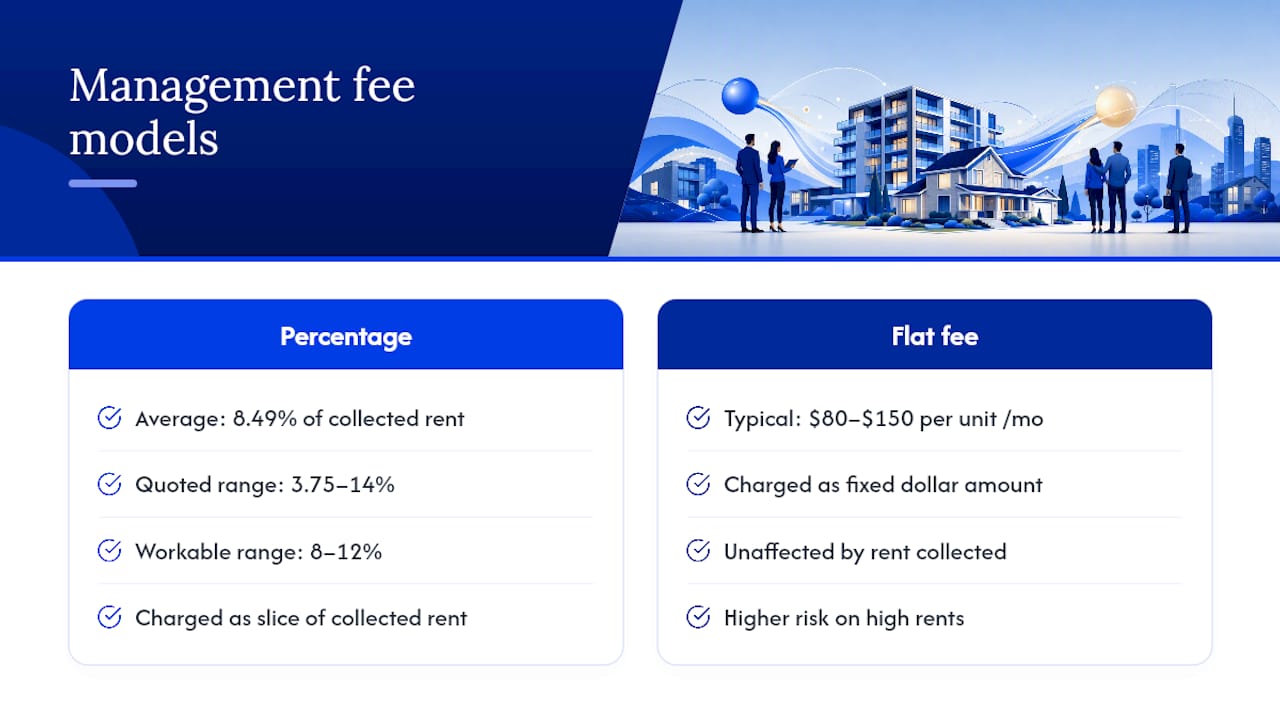
Here’s how the two models generally compare across common rent tiers:
Higher-rent markets tend to favor flat fees, while lower-rent or high-turnover units often do better under a percentage structure. Some owners also cross-reference HUD’s per-unit-per-month schedules by state, which offer a public, government-adjacent benchmark for what management work “should” cost regionally.
What Other Fees Should You Expect Beyond the Monthly Rate?
The headline management percentage is rarely the whole story. Owners who only compare that one number often get blindsided by a stack of add-on fees that show up on the first invoice.
Leasing or tenant placement fee: often 50–100% of one month’s rent when bundled with management, or a flat $500–$800 for placement-only arrangements.
Setup or onboarding fee: a one-time charge of $150–$500 to open your account, photograph the property, and load it into the management system.
Lease renewal fee: usually $150–$300, or sometimes 25–30% of one month’s rent, charged when an existing tenant signs a new lease term.
Maintenance coordination markup: commonly 5–15% on top of vendor invoices, or a flat per-work-order fee instead.
Eviction and legal fees: typically $300–$1,000 for management’s coordination work, plus court filing costs and attorney fees, which are almost always billed separately.
That eviction line item deserves a second look. The $300–$1,000 charge usually covers only your manager’s time and paperwork. Court costs, process server fees, and any attorney involvement get passed straight through to you as the owner, often adding another few hundred dollars depending on your state’s eviction timeline. Setup fees and renewal fees are generally negotiable, especially if you’re signing multiple properties under one agreement. Leasing fees tend to be the least flexible, since they compensate for real marketing spend and showing time.
What Drives Your Actual Property Management Expense?
Two owners with identical properties in different markets can receive quotes that differ by five percentage points, and the reason usually has nothing to do with quality of service.
Local rent levels reshape which pricing model wins. In high cost-of-living metros, flat fees often beat percentage fees outright, since 10% of a $2,800 rent is real money. In lower-rent markets, percentage fees can actually work in your favor because they scale down with the property.
Turnover rate is the biggest hidden lever. A tenant who stays three years generates one leasing fee. Vacancy length compounds this, since an unfilled unit produces zero collected rent and therefore zero percentage-based management fee, but the clock keeps running on your mortgage.
Other factors that move your quote:
Property condition and deferred maintenance drive up work-order volume and markup exposure.
Portfolio size gives you leverage. Owners with five or more units frequently negotiate blended or capped percentage rates.
State-level eviction and compliance rules affect legal costs and how long a nonpaying tenant occupies your unit before removal.
Pro Tip: Ask any prospective manager for their average days-on-market and average tenant tenure for properties similar to yours. Those two numbers predict your real annual cost better than the quoted percentage ever will.
How Do Year One and Renewal Year Costs Actually Compare?
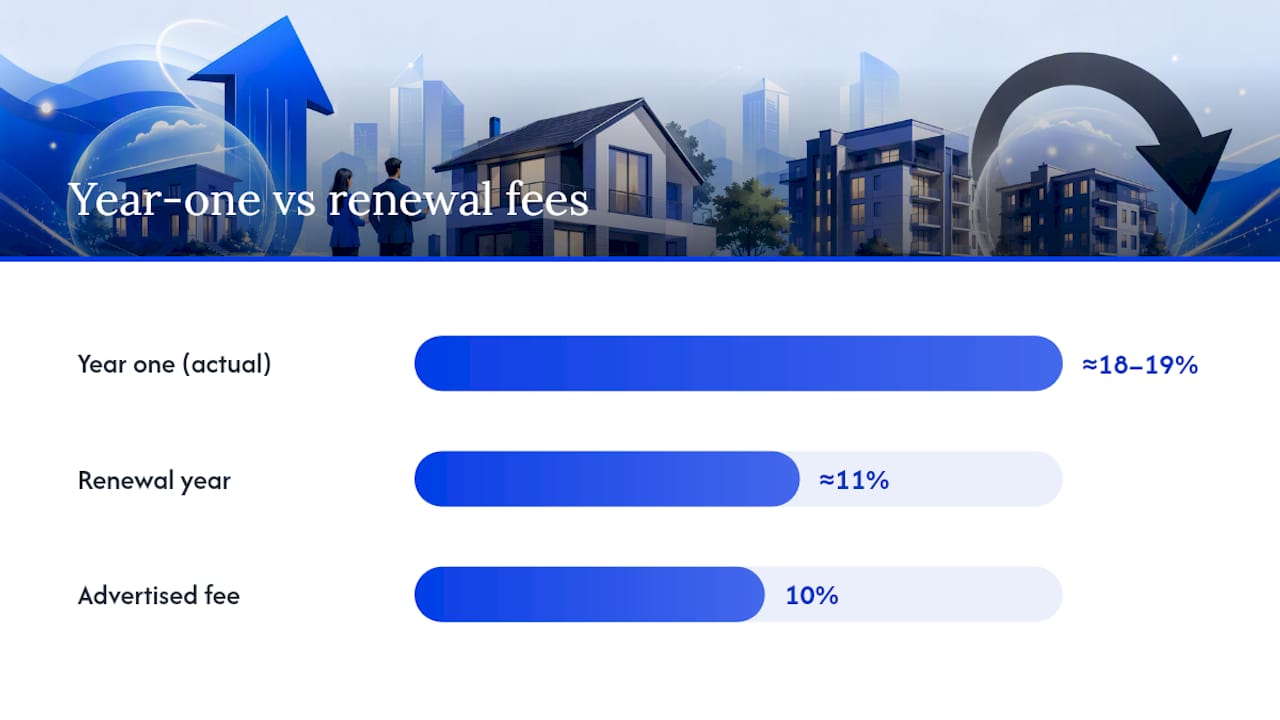
Numbers make this concrete faster than any explanation. Run two sample rentals through a realistic fee structure and the gap between the “advertised” rate and the “actual” rate becomes obvious.
The pattern holds across both examples:
Year one runs close to 18–19% of gross rent once leasing and setup costs land, matching the broader industry pattern of 18–20%.
Renewal years drop to roughly 11% once the one-time leasing and setup charges disappear from the invoice.
The headline “10% management fee” only tells you about a third of what you’ll actually spend in year one.
To model your own numbers, swap in your rent, your quoted leasing fee percentage, and your manager’s setup and renewal charges. Owners who skip this step and compare only the monthly percentage across quotes are comparing incomplete numbers.
How Do You Compare Property Management Quotes Accurately?
Comparing offers apples-to-apples requires a short, specific list of questions.
Request the complete fee schedule in writing, along with a sample owner statement showing exactly how charges appear on a monthly invoice.
Confirm whether the management fee is charged on collected rent or rent due, since that single distinction changes your effective cost during any vacancy.
Ask how late fees are split between you and the manager, and who absorbs the cost when a tenant simply doesn’t pay.
Get the maintenance vendor policy in writing, including any markup cap and the exact charge for after-hours or emergency calls.
Push for a negotiated cap on percentage fees at higher rent levels, or ask which services can be unbundled if you don’t need them.
Watch for these red flags while comparing:
A quote with no written fee schedule, only a verbal percentage.
Vague language around “administrative fees” with no dollar figure attached.
No willingness to show you a real, redacted owner statement from an existing client.
Owners who protect cash flow long-term almost always do this legwork upfront rather than after signing. Resources like this breakdown of hidden management fees walk through exactly which line items tend to hide in plain sight on a monthly statement.
What Makes 2nd Street Property Management’s Pricing Different
2nd Street Property Management was built by investors managing their own rental portfolios, not by a franchise trying to standardize fees across markets it doesn’t know. That background shapes how pricing gets presented to owners: as a full breakdown, not a single teaser percentage.
The company’s own resources walk through this in plain terms. Its guide to fee types categorizes what you’ll actually see on an invoice, while a three-minute fee explainer covers the same ground for owners who want the short version. A separate piece on protecting cash flow maps directly onto the quote checklist above: written fee schedules, clear vendor markup policy, and no surprise charges buried in month three.
When Does Paying for Management Actually Pay Off?
Professional management earns its cost fastest for owners who live far from their rental, who deal with frequent turnover, or who own in a state with complicated eviction procedures.
DIY management can work fine for a single nearby property with a stable, long-term tenant and an owner who has real time to spend on it. The math in the sample calculations above only tips toward outsourcing once turnover, distance, or portfolio size start eating into the hours you actually have. Run your own numbers against the checklist before deciding either way.
— Main
Get a Transparent Quote Built Around Your Actual Property
Property management companies can offer owners an alternative to vague, one-line percentage quotes common across the industry. Some companies structure pricing around a full itemized breakdown instead of a headline rate that hides leasing, setup, and maintenance charges until month two.

Core management packages typically cover tenant screening, rent collection, lease administration, and maintenance coordination, with services like eviction handling or Section 8 compliance available as needed rather than bundled into every contract; learn more about multi site snow management as an example of coordinated vendor services property managers often handle. To get an accurate quote, have your property address, current or expected rent, and recent maintenance history ready. Visit 2nd Street Property Management to request an itemized quote and a sample owner statement before you sign anything.
Sources
For a deeper look at the numbers behind this article, review iPropertyManagement’s fee research, ClearLeadDigital’s cost breakdown, and Forbes Advisor’s coverage of manager charges. State-level HUD PUPM schedules offer a useful regional comparison point, particularly if you’re weighing quotes across more than one market.
This article is general information, not a substitute for advice from a qualified financial advisor. Consult a qualified financial professional about your own circumstances before acting on anything here.
Recommended
Comments