
Pass NJ Inspections: Smoke Detector Checklist With N.J. Admin. Code

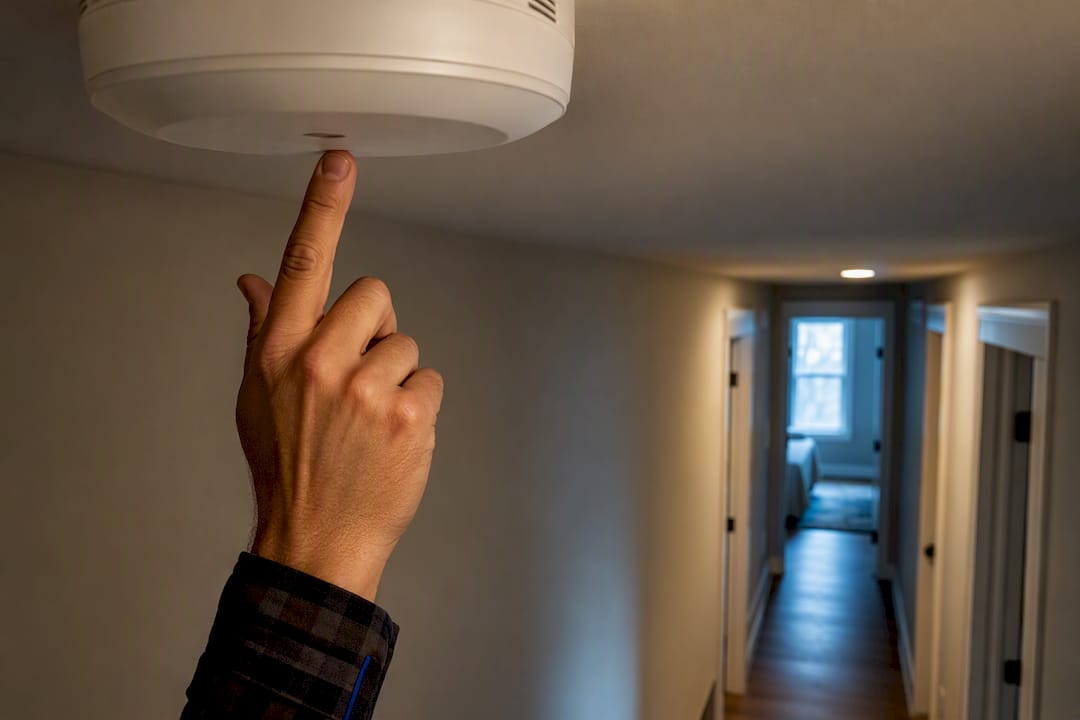
New Jersey requires at least one smoke alarm on every level of a home and outside each sleeping area, within 10 feet of bedroom doors. Replacement battery alarms must be 10-year sealed UL 217 units under N.J. Admin. Code § 5:70-4.19, and carbon monoxide alarms are mandatory wherever a fuel-burning appliance or attached garage exists. Selling or leasing a one- or two-family home also requires a municipal Certificate of Smoke Alarm, Carbon Monoxide Alarm, and Portable Fire Extinguisher Compliance.
TL;DR:
Homes built or renovated after 1991 must have smoke alarms inside each bedroom, in addition to hallway placement, increasing compliance complexity.
Replacement alarms in New Jersey must use sealed 10-year batteries since January 2019; standard 9-volt units are no longer compliant.
All levels of a home, including finished basements and convertibly finished attics, require smoke alarms, with the number depending on the home’s layout and age.
Carbon monoxide alarms are mandatory near fuel-burning appliances or attached garages, with placement within 10 feet of sleeping areas, using any power source listed to UL 2034.
Proper inspection preparation, recordkeeping, and timely replacement of alarms are crucial to passing municipal certificates and avoiding re-inspection delays.
Table of Contents
Smoke Detector Requirements NJ: Minimum Locations and Unit Counts
Power Sources, Replacements, and the 10-Year Sealed Battery Rule
Certificate of Compliance: When You Need It and How Inspections Work
Placement Geometry, Prohibited Spots, and Cutting Down False Alarms
Pre-Inspection Checklist for Landlords and Property Managers
Why Strict Smoke and CO Compliance Protects Everyone Involved
How 2ndstreetpropertymanagement Keeps Your Property Inspection-Ready
Smoke Detector Requirements NJ: Minimum Locations and Unit Counts
The rule that trips up most owners isn’t complicated once you break it down: New Jersey requires a working smoke alarm on every level of the dwelling, plus one outside each separate sleeping area. That second part matters more than people think. “Outside each sleeping area” means the hallway or common space serving the bedrooms, positioned within 10 feet of each bedroom door, according to municipal guidance from towns like Long Hill.
Basements count as a level. So does a finished attic used as living space. An unfinished attic or crawl space generally does not, unless it’s been converted into usable square footage. Code officials use a rough three-step rule to define a level change: if you climb roughly three steps or more between floors, you’re on a new level and it needs its own alarm.
Homes built or substantially renovated after 1991 typically carry an additional requirement: a smoke alarm inside each bedroom, not just outside it. Older housing stock built before that threshold often only needs the hallway placement, unless local amendments say otherwise.
Here’s how that plays out for common layouts:
Three-bedroom, two-story colonial: one alarm in the upstairs hallway near the bedrooms, one on the main floor, one in the basement. Minimum of three, more if bedrooms individually require units.
Split-level home: each distinct level, including the sunken family room level if it’s a true level change, needs its own alarm.
Finished basement with a bedroom: the basement needs its own alarm at the bottom of the stairs, plus one within 10 feet of that basement bedroom door.
A quick checklist for landlords walking a property: count the levels first, then count the sleeping areas, then check the construction year against the 1991 threshold. Miss any one of those three steps and you’ll likely fail a municipal inspection on your first attempt.
Power Sources, Replacements, and the 10-Year Sealed Battery Rule
New Jersey permits three power configurations for smoke alarms: hard-wired (A/C powered, usually with battery backup), battery-operated with a 10-year sealed non-replaceable battery, and plug-in units equipped with a restraining device that prevents accidental unplugging. Which one you’re allowed to install depends heavily on what was there before.
Since January 1, 2019, any replacement single-station battery alarm in a residential occupancy must be a 10-year sealed battery unit listed to UL 217. You can no longer swap in a standard 9-volt alarm and call it compliant. That single change eliminated the most common source of dead, chirping detectors in rental units, since the sealed lithium battery lasts as long as the alarm itself.
Pro Tip: If a tenant reports a “dead battery chirp” on a sealed 10-year unit, don’t hunt for a battery compartment. There isn’t one. The chirp means the whole alarm has reached end of life and needs full replacement.
The rule cuts both ways on hard-wired systems, too. If a house was built with A/C-powered, interconnected smoke alarms as part of original construction, that level of protection has to be maintained. You cannot downgrade a hard-wired interconnected system to standalone battery units during a repair or renovation, even though a battery unit alone satisfies code in a home that never had hard-wiring.
Interconnection requirements differ depending on whether you’re working under the Uniform Construction Code (new construction and major renovation) or the Uniform Fire Code path that governs resale and lease inspections. New construction under the UCC generally demands interconnected, hard-wired alarms throughout. Existing homes changing ownership are judged under the UFC, which focuses on whether the alarms present are operational and appropriately placed, not on retrofitting hard-wiring into a 1960s ranch.
Key replacement points to remember:
Replace every smoke alarm at 10 years from its manufacture date, printed on the unit label.
Never substitute a battery-only unit where hard-wired interconnection was part of the original certificate of occupancy.
Sealed 10-year batteries cannot be swapped individually; the chirp means replace the entire alarm.
Carbon Monoxide Alarm Rules for New Jersey Homes
CO alarms are required in any one- or two-family dwelling that contains a fuel-burning appliance, such as a gas furnace, gas water heater, or fireplace, or that has an attached garage. The alarm has to sit within 10 feet of the sleeping areas it protects, mirroring the placement logic used for smoke alarms under N.J. Admin. Code § 5:70-4.19.
You have the same flexibility on power source that smoke alarms allow. Battery-operated, hard-wired, and plug-in CO alarms are all acceptable, provided the unit carries a UL 2034 listing. Municipal handouts, including guidance referencing NFPA 720 installation practices, treat CO alarm placement as a companion requirement to smoke alarm placement rather than a separate system entirely.
A few placement and equipment notes worth flagging for multi-unit or larger properties:
A supervised, monitored CO detection system tied to a central panel can satisfy the requirement in buildings where that infrastructure already exists for fire alarm purposes.
Combination smoke/CO units are common and legal, as long as both sensing elements carry their respective UL listings.
An attached garage triggers the CO requirement even if the home has no gas appliances at all, since vehicle exhaust is the risk being addressed.
Certificate of Compliance: When You Need It and How Inspections Work
Selling, leasing, or changing the occupancy of a one- or two-family dwelling in New Jersey requires a Certificate of Smoke Alarm, Carbon Monoxide Alarm, and Portable Fire Extinguisher Compliance commonly abbreviated CSACMAPFEC. The certificate is issued by the fire prevention office or code enforcement division of the municipality where the property sits, and it’s typically valid for six months from the inspection date, per guidance from the NJ Division of Fire Safety.
That six-month window trips up landlords constantly. If you get the certificate inspected in January expecting a March closing, then the deal slips to August, you’re re-inspecting.
Inspectors working from municipal packets like the ones distributed in Long Hill typically check for:
Every required alarm present and functioning when tested on the spot.
Visible UL labels on each unit, confirming it’s a listed device, not a novelty or expired model.
No alarms painted over, covered, or obstructed by furniture or fixtures.
Sealed 10-year battery units where required, with no tampering or missing covers.
Original hard-wired systems maintained at their original level of interconnection.
A portable ABC-rated fire extinguisher, generally no larger than 10 pounds, mounted near the kitchen per Wyckoff, NJ’s compliance guidance.
Before you schedule the actual inspection, run through this sequence:
Test every alarm in the property manually, not just visually.
Replace any unit at or past its 10-year manufacture date.
Document the make, model, and installation type of every alarm and the fire extinguisher.
Confirm CO coverage matches every fuel-burning appliance and garage on the property.
Contact the local fire prevention office to confirm scheduling, fees, and any local amendments before the inspector arrives.
Pro Tip: Photograph the UL label on every alarm and the extinguisher’s inspection tag before the inspector shows up. If a unit fails or the inspector questions its listing, you have proof in hand instead of scrambling through a junk drawer.
Owners handling a sale often confuse the certificate requirement with the separate rules covered in a certificate of occupancy inspection. They’re related but not identical, and municipalities frequently require both before closing can proceed.
Placement Geometry, Prohibited Spots, and Cutting Down False Alarms
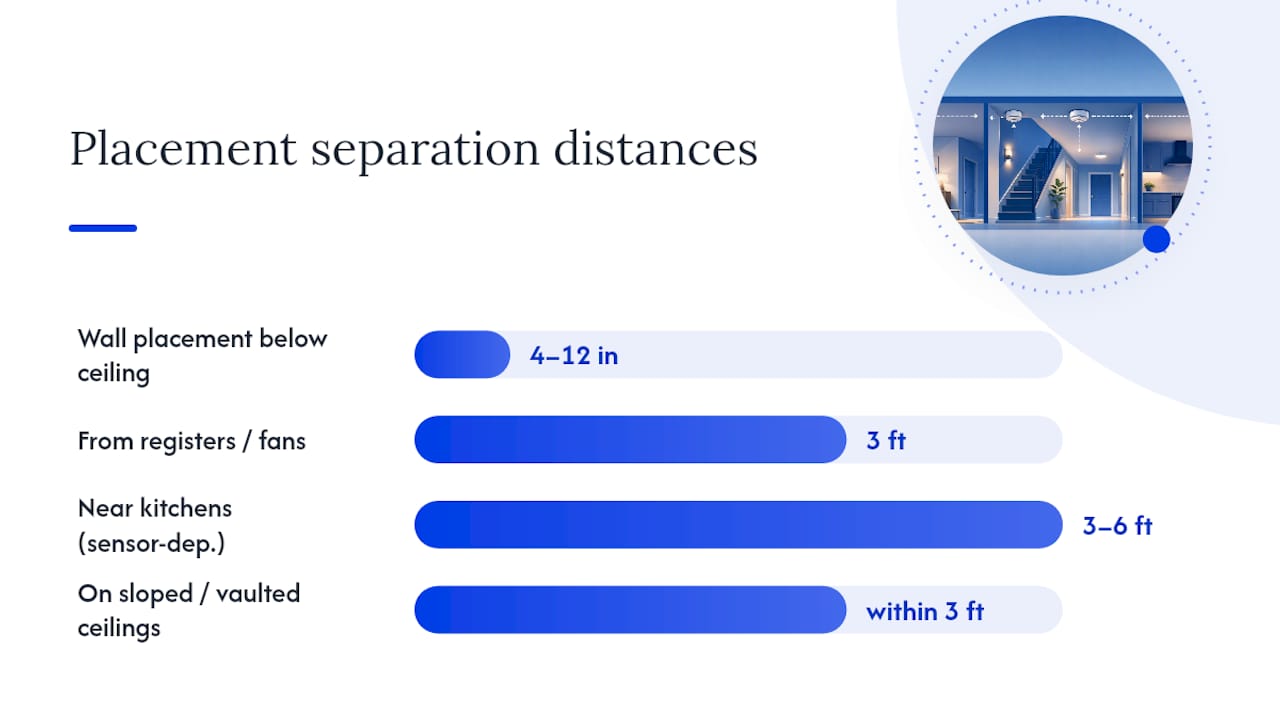
Ceiling-mounted, centered in the room, is the preferred position for any smoke alarm. When ceiling mounting isn’t practical, wall placement is acceptable between 4 and 12 inches below the ceiling line, following the geometry outlined in Edison, NJ’s smoke detector guidelines.
Distance from potential nuisance sources matters just as much as height. Keep alarms at least 3 feet from air supply registers or ceiling fans, since moving air can prevent smoke from reaching the sensor or trigger false readings. Near kitchens, most municipal guidance recommends 3 to 6 feet of separation depending on the sensor type, since cooking smoke and steam are the leading cause of nuisance alarms in rental units.
Certain locations are off-limits entirely:
Garages, where vehicle exhaust and temperature swings cause constant false triggers.
Uninsulated exterior walls, where condensation and temperature extremes affect sensor accuracy.
Unfinished attics and other spaces subject to extreme heat or cold beyond the unit’s rated operating range.
Directly inside bathrooms, due to steam interference.
Basement placement gets its own specific rule: mount the alarm at the bottom of the stairwell leading to the basement, not buried in the far corner of the space. On sloped or vaulted ceilings, position the alarm within 3 feet of the highest point of the ceiling, where smoke naturally collects first.
Pro Tip: If a kitchen-adjacent alarm keeps false-triggering on toast and stovetop steam, swap it for a photoelectric unit instead of disabling it. Photoelectric sensors respond less aggressively to cooking particulates than ionization sensors do, which cuts nuisance alarms without cutting protection.
Dual-sensor alarms, combining photoelectric and ionization technology, give broader detection across smoldering and flaming fire types. Municipal code sets the floor requirement, but nothing stops an owner from installing a higher-performing unit near problem areas.
Pre-Inspection Checklist for Landlords and Property Managers
Passing a compliance inspection on the first attempt comes down to preparation, not luck. Property managers who handle multiple units on a rotation tend to follow a version of this sequence before every scheduled inspection:
Test every smoke and CO alarm in the unit manually, using the test button, not just a visual check.
Photograph the UL label and manufacture date on each alarm for your file.
Replace any unit at or past its 10-year mark, including sealed battery models showing a persistent chirp.
Gather reset codes or contact information for any monitored or interconnected alarm system.
Confirm CO alarm coverage against every fuel-burning appliance and attached garage on the property.
Verify the portable ABC fire extinguisher is present, charged, and mounted near the kitchen.
Contact the local fire prevention office to confirm the inspection date falls within your certificate’s validity and to ask about any local amendments.
Keep a compliance file for each property containing alarm installation dates, model numbers, past certificates, and extinguisher inspection tags. Municipal inspectors respond well to organized documentation, and it speeds up the process considerably when your landlord maintenance records already show alarm testing as a recurring task rather than a one-time fix.
For properties with monitored or interconnected systems, involve a licensed fire protection contractor before the inspection rather than after a failed one. Schedule inspections 30 to 60 days ahead of a closing or move-in date, giving yourself room to correct any deficiency without risking a lapsed certificate.
Why Strict Smoke and CO Compliance Protects Everyone Involved
Compliance work like this rarely feels urgent until the moment it becomes very urgent. Treating alarm placement and certification as a recurring maintenance task, rather than a scramble before closing, is what separates owners who sail through inspections from those who reschedule twice.
The payoff isn’t just avoiding a failed inspection. Proactive compliance reduces actual emergency risk for tenants and cuts down the transactional friction that stalls sales and lease signings. A property with documented, tested, code-correct alarms closes faster and rents faster, because nobody’s waiting on a re-inspection.
— Main
How 2ndstreetpropertymanagement Keeps Your Property Inspection-Ready
Staying ahead of New Jersey’s smoke and CO alarm rules takes ongoing attention, not a one-time fix before a sale. Property management services exist for landlords who’d rather have someone else track certificate expiration dates, alarm replacement cycles, and municipal paperwork than chase it themselves every six months.
Some property management teams coordinate inspection scheduling with local fire prevention offices, manage maintenance calendars for alarm replacement and testing, and keep documentation organized for CSACMAPFEC renewals to help avoid expired certificates mid-lease. Vendor oversight for licensed contractor work on interconnected or hard-wired systems can also be part of property management services. If you manage a rental in Southern New Jersey and want a straightforward look at what compliance management could take off your plate, request a property management quote and we’ll walk through what your property needs before the next inspection window closes.
Sources
Recommended
Comments