
Rent Grace Period: What Landlords Can Set and Enforce


A rent grace period is a set number of days after the due date during which a tenant can still pay without a late fee. In most states the law does not require you to offer one, but a handful of states and many leases build one in, and the rules around late fees and eviction notices differ sharply from place to place. The landlords who avoid disputes are the ones who write the grace period, the fee and the counting method into the lease, then apply them the same way every month.
This guide is for rental owners and investors. It explains what a grace period does and does not change, how several states handle it, and how to draft a policy you can enforce.
TL;DR
A grace period delays the late fee. It does not move the due date, and it does not automatically delay a notice to pay or vacate.
There is no single U.S. rule. State statutes range from no required grace period to a few days, and some states set caps on the fee itself.
Your lease should state the due date, the number of days, how days are counted, the fee, and how it is paid.
Check state law and local ordinances before you set the fee. Excessive fees can be struck down as penalties.
Apply the policy consistently. A policy you waive at random is hard to enforce.
Table of Contents
What a rent grace period is, and what it is not
The due date is the date your lease says rent is owed. The grace period is an added window in which the tenant can pay without the late fee attached. California’s Department of Real Estate explains that rent is due on the date in the rental agreement, with a typical month-to-month lease making it the first of the month, and that late payment can lead to late fees or eviction.
So a tenant who pays on the fourth under a five-day grace period is technically a few days past the due date, but owes no fee. Two points trip up new landlords:
The grace period is usually about fees, not about the debt. Rent is still owed on the due date. Whether the grace period also pauses your ability to serve a nonpayment notice depends on state and local law and on how your lease is written.
Grace period and late fee are two separate terms. Your lease can have a grace period with no fee, a fee with no grace period, or both. Each needs to be stated on its own.
Is there a legal grace period for rent?
In most of the country, no federal rule requires one. State law decides, and the answer ranges from nothing at all to a defined number of days. A HUD-published survey of state late-fee laws, current through the end of 2021, found statutory grace periods running from three to 30 days in the states that set one. Where a state sets nothing, the lease controls, within whatever limits the state places on fees.
Here is how a few states approach it, using each state’s own published rules:
State | Grace period or waiting rule | Late fee limit |
Connecticut | Nine days for monthly rent, four for weekly rent, before the landlord can terminate through the statutory process | Written agreement required; lesser of $5 per day up to $50 or 5% of the delinquent rent, one charge per late payment |
Delaware | Lease-provided fee of no more than 5% of monthly rent | |
Washington | Fees may accrue from the first day after the due date once rent is more than five days late | |
Texas | Fee only if rent is unpaid more than two full days after the due date, and the written lease must give notice of the fee | Must be reasonable, under Property Code §92.019 |
Minnesota | Written agreement required; capped at 8% of unpaid rent | |
California | No required grace period; the lease controls | Fee must be a reasonable estimate of costs, not a penalty |
A few things stand out. Some states build the waiting period into the statute. Others leave it to the lease but cap or police the fee. And several require the fee to be disclosed in writing before it can be charged.
Rules also change. Connecticut, for example, added a provision effective January 1, 2026 that extends its statutory period by five days when the landlord’s online payment system prevents timely payment. If you accept rent through a portal, an outage can affect your timeline.
Local law adds another layer. The Maryland Attorney General warns that local ordinances may give tenants further protections, so state law is only the starting point. Nolo’s state-by-state guide, updated November 18, 2026, lists the statutes that govern due dates, grace periods and late fees in each state, and notes that notice and termination for nonpayment are governed by separate laws.
New Jersey owners
If your rentals are in New Jersey, the picture is a mix: no set cap on late fees, but a five-business-day protection for some tenants. We break it down in our guide to NJ late fee rules. Read it before you finalize any lease language, because the tenant type matters.
Grace period, late fee and eviction notice are three different clocks
The most expensive mistake is treating these as one timeline. They are not.
The grace period controls when a fee can start.
The late fee is a charge, usually capped or required to be reasonable.
The nonpayment notice is the legal step that begins an eviction, and its timing is set by statute.
Washington shows how they separate. The same statute that bars late fees for five days also allows a pay-or-vacate notice at any time after rent becomes due. The fee protection is not a bar on the notice.
Other states set notice periods that are unrelated to your grace period. In California, a landlord may serve a three-day notice to pay or quit, and a tenant who pays the demanded rent within the three court days keeps the tenancy. In Delaware, a landlord may give a seven-day nonpayment notice, but must get a court order before removing a tenant. In Minnesota, the landlord must give a written notice providing 14 days to pay before filing a nonpayment eviction.
No landlord can lock a tenant out or remove belongings on their own. The court process is the only lawful way to recover possession. If you want to see how missed rent, notices and a court case connect from start to finish, how Indiana evictions unfold shows the sequence in one state, and our own overview of lease enforcement steps covers the stages for landlords generally.
An eviction attorney licensed in your state is the right person to confirm notice timing before you serve anything. Notice defects can restart the process.
How to set a grace period policy in your lease
The goal is a policy that is clear, legal where the property sits, and easy to apply the same way every time. Work through it in this order.
1. Confirm the state and local rules first
Look up whether your state mandates a waiting period, caps the fee, or requires written disclosure. Then check the city or county. A statute that is silent at the state level can still be addressed by a local ordinance.
2. State the due date and the grace period in plain numbers
Write “Rent is due on the first day of each month. Rent received by 11:59 p.m. on the fifth day of the month carries no late fee.” Specify whether the count includes weekends and holidays. If you skip this, you invite an argument over whether the fifth falls on a Sunday.
A grace period of three to five days is common. California’s real estate guidance notes that most owners give a short grace period, though it is not required there. Where your state sets a minimum, treat it as the floor.
3. Define the fee and how it is calculated
Choose a flat amount or a percentage, and state when it begins and whether it grows daily. Keep it inside your state cap. The California guide says an excessive fee that works as a penalty is not legally valid, and a predetermined fee should track a reasonable estimate of your costs.
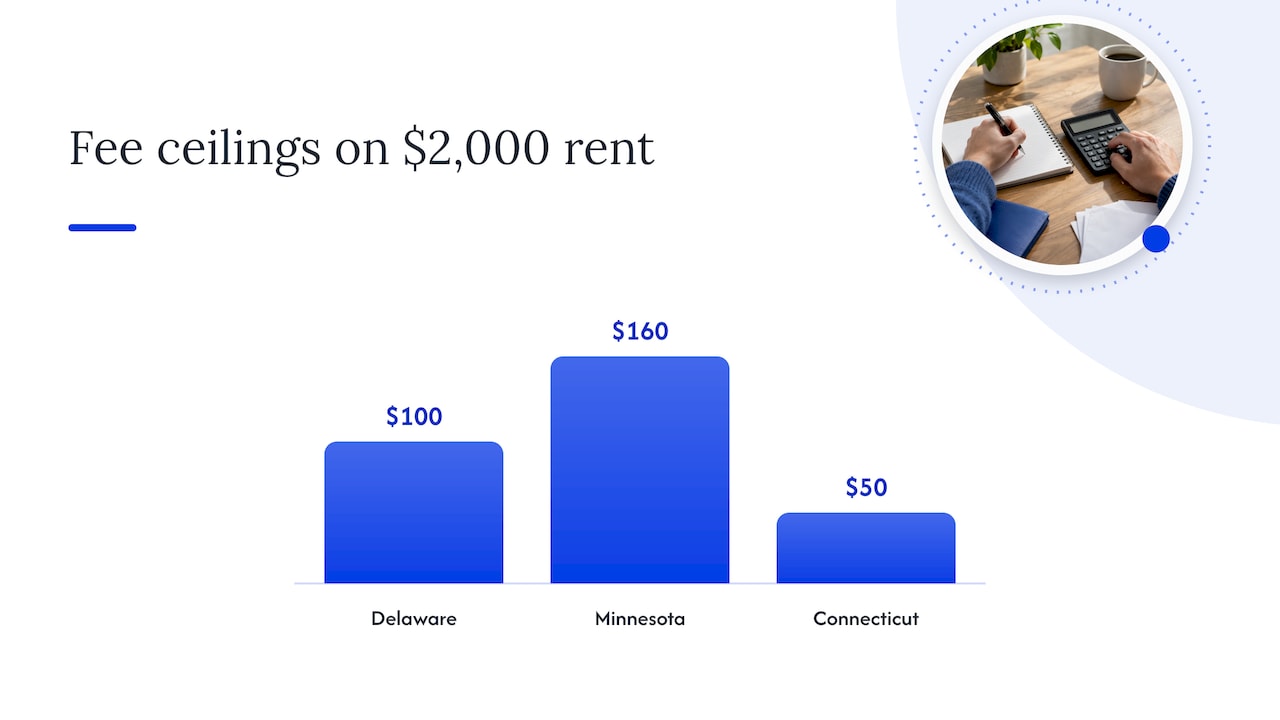
A worked example on $2,000 monthly rent shows how much the state matters:
In Delaware, a lease fee cannot exceed 5%, so the ceiling is $100, and it cannot be charged until five days after the due date.
In Minnesota, the 8% cap puts the ceiling at $160, if the lease states when it will be charged.
In Connecticut, 5% would be $100, but the statute takes the lesser of that or $5 per day up to $50, so the ceiling is $50, and only after the grace period.
The same lease language cannot be copied across those three states.
4. Disclose it in writing
Colorado’s renter handbook treats late-fee disclosure in the rental agreement as a core safeguard, and it separates collecting rent from evicting over an unpaid late-fee balance. Texas requires that the written lease give notice of the fee. Even where no statute requires it, a written term is the only version you can prove.
5. State the payment method
Spell out where and how rent is paid, and what counts as “received.” With online portals, define whether a payment is on time when the tenant initiates it or when funds clear. Connecticut’s online-outage extension shows why this matters.
6. Keep fee timing separate from eviction rights
Add a sentence that the grace period applies to late fees only and does not waive the landlord’s right to serve a statutory notice where the law allows. Have your attorney confirm that wording for your state.
7. Apply it the same way every time
A fee you waive for one tenant and charge another becomes hard to defend. Keep a written record of each payment date and each fee charged or waived. Our late rent policy guide walks through what belongs in the lease, and the 10-step late rent system shows how to follow through once a payment misses the window.
Why the grace period is also a screening and cash flow decision
A grace period is partly a business decision. A longer one can lower friction with reliable tenants, but it also lengthens the time before you know whether a payment is a one-off or the start of a pattern. A tight, clearly stated policy gives you an earlier signal.
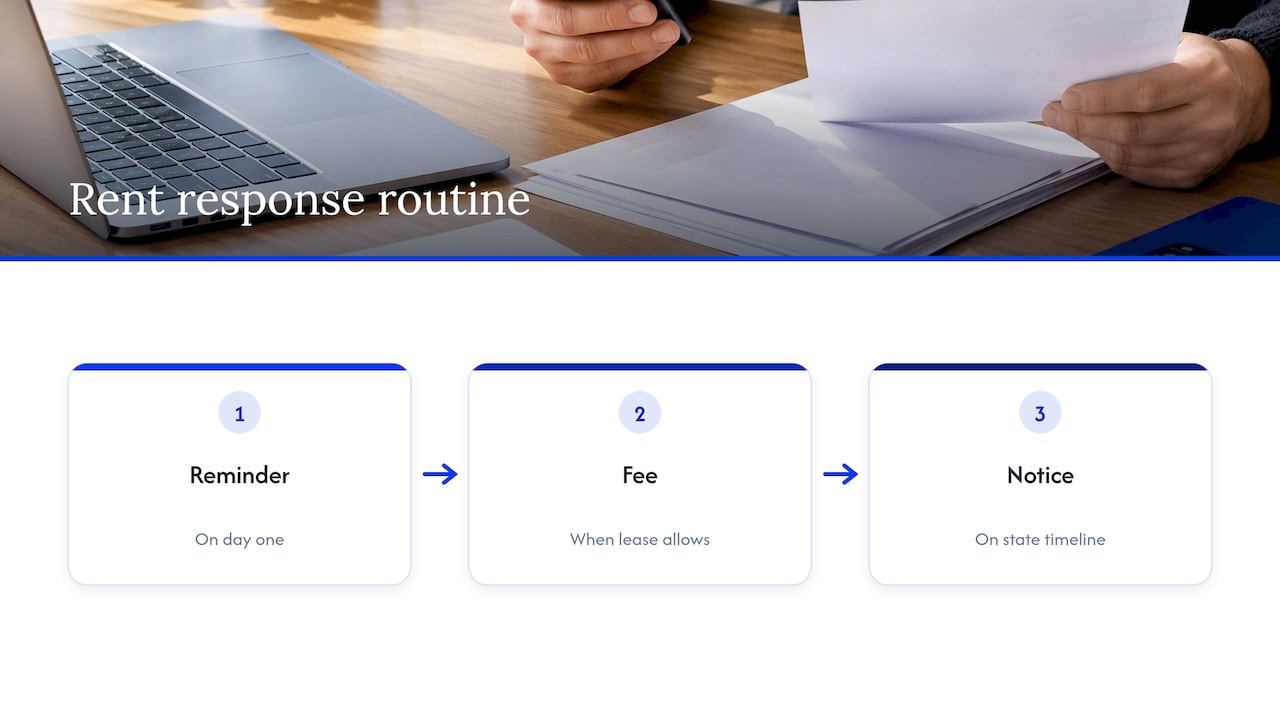
That signal is only as good as the tenant you placed. Solid tenant screening reduces how often the policy gets tested. For investors running several doors, a missed payment on one unit should trigger a routine, not a scramble: reminder on day one, fee on the day the lease allows, notice only on the timeline your state sets.
Our perspective
We manage rentals for investors, and we see the grace period as a compliance tool first and a courtesy second. The best policy is one the owner can defend line by line. Our approach starts with the property’s location. A lease that works in one state can expose an owner in the next, because fee caps, waiting periods and notice rules are not uniform. We build custom management processes around that reality, with an emphasis on compliance, risk mitigation and protecting your returns. An investor’s job is to protect cash flow, not to chase every dollar of fees. A clear grace period, a lawful fee and a documented routine do that better than improvisation. We are veteran-owned and led by investors, so we write policies the way we would want them written for our own doors. Main
Let us handle the routine
The policy only works if someone applies it on the first of the month, every month. 2nd Street Property Management provides residential property management for landlords and investors in Southern New Jersey and regional suburbs, including tenant screening, rent collection, leasing and maintenance coordination. We also offer association management for condos and HOAs.

If you want a lease and a collection process built around your state’s rules and your investment strategy, you can talk with us about residential property management.
FAQ
Is there a legal grace period for rent?
Not nationally. Some states set a statutory waiting period before a late fee or termination notice, such as five days in Delaware and Washington, while many leave it to the lease. Check your state statute and any local ordinance.
How long should a rent grace period be?
Where the state sets a minimum, use at least that. Otherwise, three to five days is common, and what matters most is that the number and the counting method are written in the lease. Pick one policy and apply it to every tenant.
Does a grace period stop me from starting an eviction?
Not automatically. The grace period usually governs late fees, while notices follow separate statutes. Washington, for instance, allows a pay-or-vacate notice any time after rent is due even though fees are barred for five days. Confirm timing with a licensed attorney in your state before serving a notice.
Can I charge any late fee I want?
No. States cap fees, require them to be reasonable, or require written disclosure. Connecticut, Delaware, Minnesota and Texas each set their own limits, and California treats an excessive fee as an invalid penalty. Set the amount only after checking your state and local rules.
Sources
Recommended
Comments