
Section 8 Pros and Cons for Landlords: What to Know First

Section 8 rewards landlords who treat it as a system: a subsidized rent that arrives on schedule, a deep applicant pool and long tenancies, in exchange for inspections, paperwork and a rent ceiling you do not set. The investors who do well with vouchers run the numbers before they list and build a repeatable process for inspections, screening and rent collection. That is how we manage Section 8 for owners at 2nd Street Property Management, and it is the lens for the pros and cons below.
TL;DR
The housing authority pays its share of the rent directly to you each month, and the tenant pays the rest. You are not paid the full rent by the government.
Your unit must pass a Housing Quality Standards inspection before payments start and keep passing, or payments can be suspended.
Rent is capped by the local payment standard and must be judged reasonable, so the numbers work best where market rents sit near that standard.
You still screen tenants, collect the tenant share and handle repairs. Voucher status does not replace any of that.
The decision comes down to your market, your property and whether you have a process for compliance.
Table of Contents
How Section 8 pays you
Section 8 here means the Housing Choice Voucher program, run by local public housing authorities (PHAs) with funding from HUD. The voucher holder pays a share of the rent, usually 30% of adjusted monthly income and in some cases up to 40%. The PHA pays the rest directly to you as the housing assistance payment (HAP).
The formula in federal regulation 24 CFR Part 982 sets the HAP at the lower of two numbers: the payment standard minus the family’s total tenant payment, or the gross rent minus that same payment. In plain terms, the subsidy never pays more than the rent you charge and never more than the local standard allows.
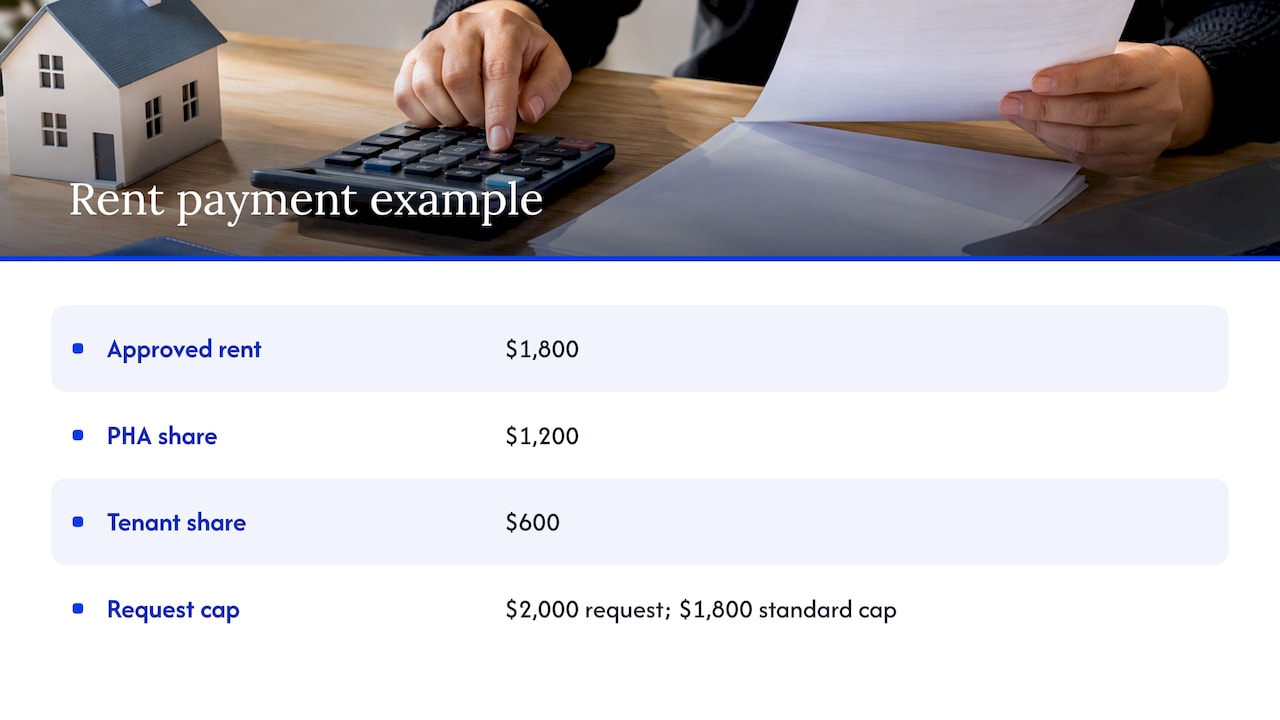
A simple illustration with made-up numbers: a family’s adjusted income is $2,000 a month, so its share is $600. The contract rent is $1,800 and the payment standard is $1,800. The PHA pays $1,200 and the tenant pays $600. If you wanted $2,000 and the standard stayed at $1,800, the approved rent would not reach it. Our guide to HAP math and the HUD worksheet walks through more cases.
The pros of accepting Section 8
Reliable payment for most of the rent
HUD describes the voucher as nearly guaranteeing a rent payment even if the tenant’s income goes down. The PHA’s portion is paid on a set cycle. A San Diego County handbook says the HAP goes out about the first working day of the month, by mail or direct deposit. For an investor modeling cash flow, a large share of rent that does not depend on the tenant’s paycheck is a real underwriting advantage.
There is a protective detail too. The Augusta Housing Authority states that if an eligible family vacates in violation of the lease, the owner still receives the HAP for that month, and that during a court eviction you are entitled to payments while the tenant remains in the unit.
A large applicant pool and steadier occupancy
Voucher holders have usually waited for assistance and have a limited time to use it, so they tend to be motivated to lease. That supports shorter vacancies and longer tenancies, which is where turnover costs, the quiet drain on most rental portfolios, get smaller. Fewer turns mean fewer make-readies, fewer leasing fees and fewer empty months.
A regular condition check
Annual or biennial inspections are a burden if you are unprepared, and a benefit if you are not. The San Diego handbook notes that units passing the initial inspection may qualify for inspections every two years. A third party looking at the roof, electrical, smoke detectors and plumbing on a schedule catches small problems before they become capital repairs.
Higher rents in some submarkets
In markets where the payment standard is at or above what unassisted tenants pay, voucher rents can match or beat the market. That depends entirely on your location and unit size, which is why the numbers come first.
The cons, and how to plan for them
Inspections and the repair clock
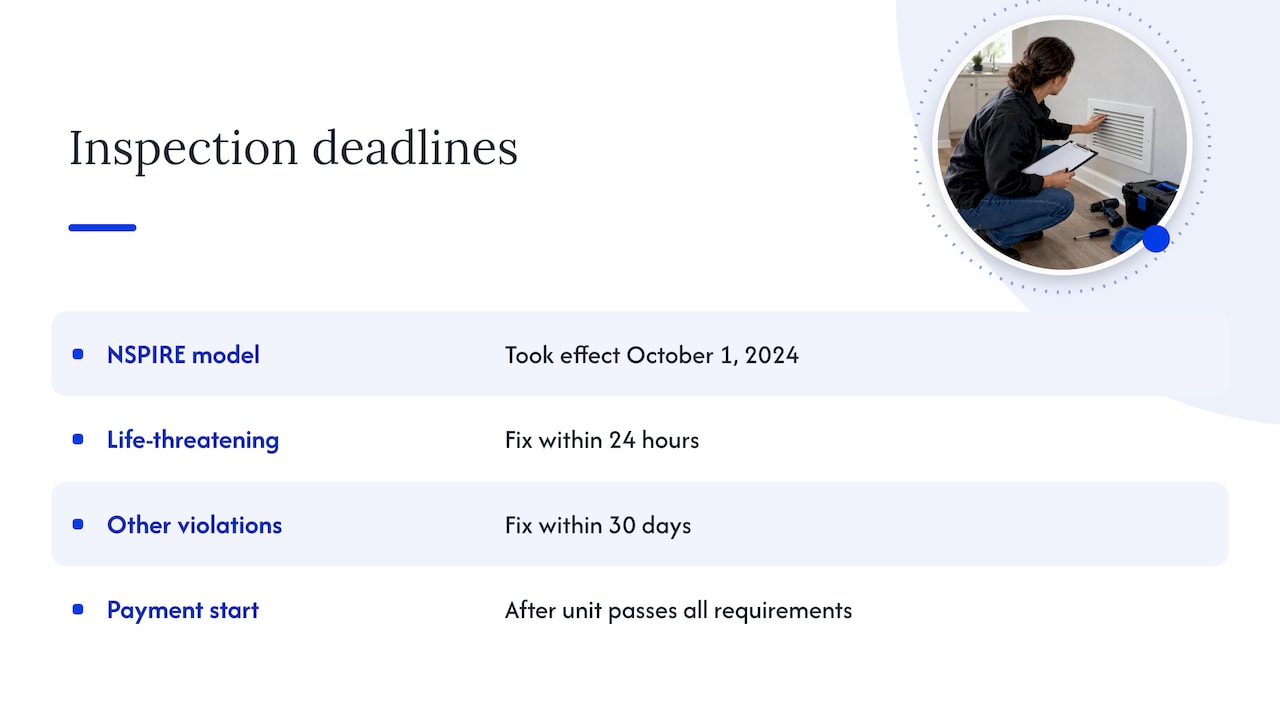
The unit must meet HUD’s Housing Quality Standards, which are moving to the NSPIRE inspection model. The Staunton housing authority’s guidebook notes the change to NSPIRE took effect October 1, 2024. Deadlines are short. NYCHA’s owner guide says life-threatening violations must be fixed within 24 hours and most others within 30 days, with subsidy payments suspended if they are not corrected.
Payments also do not start until the work is done. The Peoria Housing Authority states that assistance cannot begin until the unit passes all requirements, with utilities on and every document correctly returned. A failed first inspection means a longer vacancy, so make-ready should be done to inspection standard before you request it. Knowing who is responsible for plumbing repairs is a good place to start, since leaks and water heater problems are common inspection findings.
A rent ceiling you do not control
A PHA’s payment standard is normally set between 90% and 110% of HUD’s Fair Market Rent, and the rent must also be judged reasonable against comparable units. At initial occupancy the family’s share cannot exceed 40% of adjusted income, and the Augusta briefing notes you cannot raise the rent during the initial lease term. Increases later are not automatic either. The Foley Housing Authority explains that you must give 60 days’ written notice, and the increase must be approved as reasonable before you can charge it.
For high-value properties in affluent areas, a Forbes Real Estate Council piece notes that approved rents can sit below what unassisted tenants pay. If your rent is well above the local standard, voucher math will not work for that unit.
Paperwork and the housing authority’s calendar
Expect a Request for Tenancy Approval, a HAP contract, a lease addendum, lead paint certification and owner certification. The Peoria packet notes these must be returned before the voucher expires, and the HACLA owner booklet says no payment is made until the contract is executed and the unit passes. Lease-up runs on the agency’s timeline, so budget for a slower first month than a conventional lease.
The tenant share still needs collecting
The government’s portion is dependable. The family’s portion is the family’s. The Maryland People’s Law Library notes that a PHA’s failure to pay is not a lease violation by the tenant and does not let you end the tenancy, and that you may not collect anything above the tenant share the PHA sets. That makes a clear process for the tenant portion, from screening to rent reminders to documented notices, the part of your operation that protects your return.
Avoidable payment interruptions
Most missed HAP payments trace back to owner-side issues. The Indiana housing authority handbook explains that missed payments typically result from abatement after repeated inspection failures or from a late signed HAP contract or lease. Both are process problems you can control with calendars and checklists.
Local rules vary
Some states and cities restrict refusing voucher holders based on source of income, and procedures differ by housing authority. Check your own jurisdiction. If you own in South Jersey, start with our overview of Section 8 rules in New Jersey.
Pros and cons at a glance
Factor | What you gain | What to plan for |
Rent | Large share paid by the PHA each month | Rent capped by payment standard and reasonableness review |
Vacancy | Motivated applicant pool, longer tenancies | First lease-up can be slower than a standard lease |
Condition | Regular third-party inspection | Short repair deadlines; payments suspended if unresolved |
Paperwork | Clear, standardized contract | RFTA, HAP contract, recertification, rent-increase approvals |
Tenant share | Smaller portion to collect | Still requires screening and a collection routine |
Does Section 8 fit your property?
Run these checks before you decide:
Compare rent to the payment standard. Find your PHA’s standard for the bedroom count and compare it with your market rent. If they are close, the math tends to work.
Walk the unit to inspection standard. Smoke and carbon monoxide detectors, working utilities, no peeling paint in older homes, safe stairs and railings, no active leaks.
Price the compliance work. Include repair deadlines, re-inspections and the time spent on paperwork.
Set your screening criteria. Voucher holders go through the same process as any applicant, applied consistently. Our tenant screening checklist is a good template.
Model the first 60 days. Include the lease-up lag and a late first HAP.
If you want a broader benchmark for rental financial performance as you compare strategies, industry financial benchmarks for rental and leasing can help frame the numbers. Our posts on common Section 8 myths and mistakes that cost landlords money cover the rest.
Our view on Section 8
We are investors first. Our team is veteran-owned and led by an experienced investor, and we approach Section 8 the way we approach BRRRR deals: with a spreadsheet, a compliance plan and a clear view of risk. The mistake we see in the way owners talk about vouchers is treating them as either a guarantee or a hassle. They are neither. They are a rent structure with rules. When the rent fits the payment standard, the unit is ready for inspection and the tenant share has a collection process, the program supports the stable, long-tenancy cash flow most investors want. That is why our custom management processes cover tenant screening, rent collection, leasing, maintenance coordination and vendor oversight together. Inspection readiness and tenant-share collection should not be handled by separate people on separate calendars. Main
Getting Section 8 handled for you
If you own residential rentals, condos or Section 8 properties in Southern New Jersey and its regional suburbs, we manage them with tenant screening, rent collection, leasing, maintenance coordination and vendor and subcontractor oversight. We also handle condo and HOA association management. Learn more about our residential property management and association management services.
FAQ
Does Section 8 pay the full rent?
No. The PHA pays the housing assistance payment, which is the lower of the payment standard minus the family’s payment or the gross rent minus that payment. The family pays its share, generally 30% of adjusted monthly income, as described in federal regulation and on HUD’s voucher page.
Can I screen Section 8 applicants?
Yes. You select the tenant, not the housing authority. Apply the same written criteria to voucher holders as to every other applicant, and check your local source-of-income rules first.
What happens if my unit fails inspection?
You get a deadline to correct the problem. Life-threatening items typically must be fixed within 24 hours and most others within 30 days. If they are not corrected, the PHA can suspend or abate payments, according to the NYCHA owner guide and the Augusta briefing.
Is Section 8 a good fit for every rental?
No. It tends to fit best where market rent is near the local payment standard and the unit can be kept to inspection standard. Compare your rent to the standard before you decide.
Sources
Recommended
Comments