
Unauthorized Occupants in a Rental: Notices and Next Steps

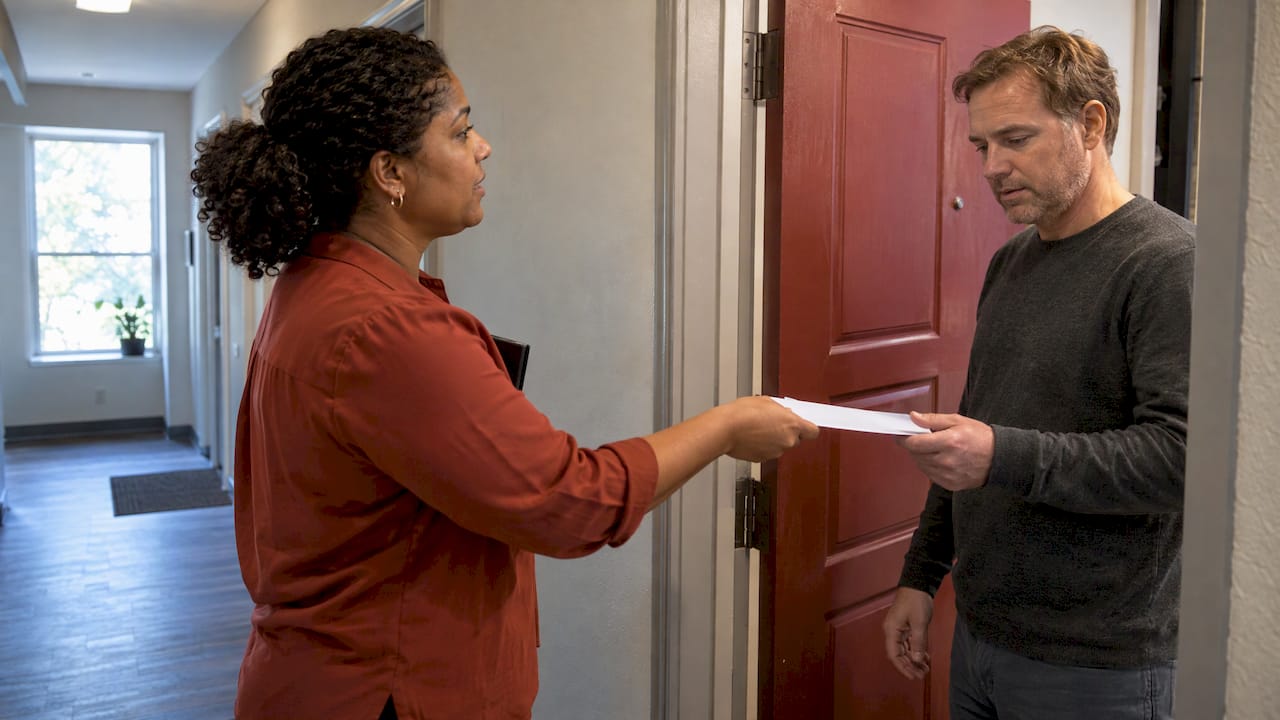
If someone is living in your rental who is not on the lease, do not change the locks, shut off utilities or tell them to leave in a text. Work out who the person is (guest, subtenant, co-tenant or stranger), check the lease term and local rule that applies, and then either approve them in writing or serve the notice your jurisdiction requires. The order matters because the wrong notice, or a self-help removal, can cost you the case and expose you to penalties.
We manage residential rentals for investors in Southern New Jersey, and this is the routine we would hand a fellow landlord. Rules differ by state and sometimes by city, so the examples below show the pattern. Confirm the exact notice period and service method for your own property before you act.
TL;DR
Classify the person first. Someone who pays rent, in cash or in work or goods, or who has a lease or oral agreement may be a tenant with full eviction protection. A true guest is treated differently.
Read the occupancy clause in your lease. It sets what counts as a violation and what approval process the tenant owed you.
Use the notice type, deadline and service method your jurisdiction requires, name the specific lease term and conduct, and keep proof of delivery.
If you will accept the person, add them in writing after screening them. If you will not, give a cure or move-out notice. Never use lockouts, utility shutoffs or removing belongings.
If the person stays, the lawful next step is usually a court filing. Fast-track removal exists only in narrow situations in a few states.
Table of Contents
Who is an unauthorized occupant?
An unauthorized occupant is anyone living in the unit who is not named on the lease and whom you have not approved. That label hides three very different legal situations.
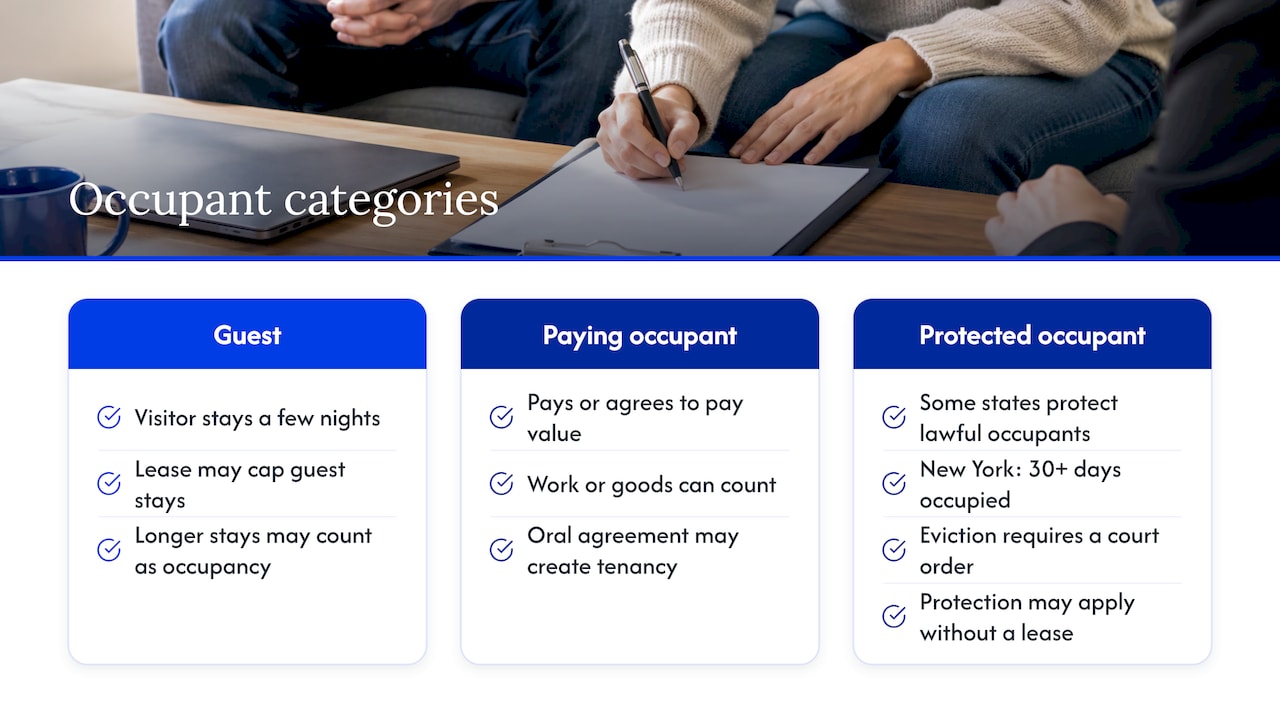
A guest. A visitor who stays a few nights. Most leases cap guest stays (often at a set number of consecutive days) and treat anything longer as occupancy.
A subtenant or roommate who pays. Under the Arizona Supreme Court’s guide to evicting guests and roommates, a person who pays or agrees to pay value for housing, including work or goods, or who has an oral agreement may be a tenant. A person who is not named on a written lease and stays without tenant or landlord permission is not a lawful tenant under that state’s rules.
A protected occupant. Some states protect people after a short period of lawful occupancy. The New York Attorney General’s guidance on unlawful evictions explains that people who have lawfully occupied a home for at least 30 days, such as roommates and family members, are protected from eviction without a court order, even without a current lease.
The label decides everything that follows. A stranger who entered without anyone’s consent is a different problem from a tenant’s boyfriend who has been there for four months and chips in for groceries. If you want to understand where an unwelcome occupant ends and a holdover or squatter begins, our guide on squatters vs. holdover tenants draws that line.
How to confirm what you are dealing with
Before sending anything, gather facts. A notice built on a guess is the most common reason a landlord loses at the first hearing.
Pull the lease and every addendum. Find the occupancy clause, the guest-stay limit, any subletting clause and the approval process for new household members.
Pull the application file. Confirm who was screened and who was listed as an intended occupant.
Document what you have seen. Dates, photos from permitted inspections, parcel or mail addressed to the person, vehicle registrations, and neighbor reports. Write down what you observed, not what you assume.
Ask the tenant in writing. A short, neutral message asking who is staying and for how long creates a record and often resolves the issue. Tenants frequently do not realize a long-term guest breaks the lease.
Check for payment. If the occupant is paying anyone for the space, you may be dealing with a subtenant, and the analysis changes.
Keep your entries factual. If you need to enter the unit to verify anything, follow your state’s entry-notice rules. Our article on notice to enter in NJ covers how that works and what tenants can do after an improper entry.
What the lease and local law decide
Two layers decide whether an unauthorized occupant is a violation you can act on: the lease and the law of your state and city.
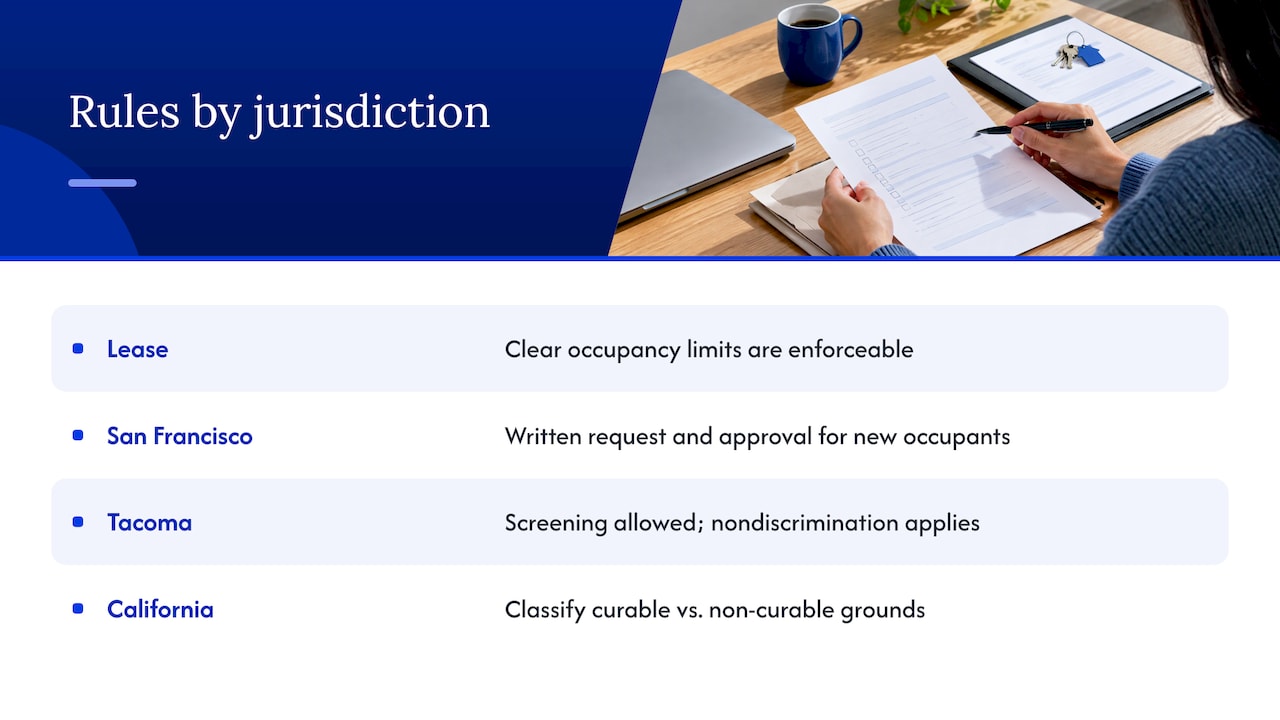
The lease. A clear occupancy limit is enforceable. In a 2021 opinion, Montgomery Street Housing v. Sheriff, the New Jersey Appellate Division upheld enforcement of a clear lease limiting occupants and requiring approval of adults added to an affordable-housing household, subject to the statutory good-cause requirements for eviction. The same opinion explained that a continuing substantial violation of a reasonable lease term after written notice to cease can be good cause for eviction under N.J.S.A. 2A:18-61.1(e)(1). In plain terms: write the rule clearly, give written notice, and give the tenant a chance to comply.
State and local law. Some places add their own steps. San Francisco’s Rent Board says tenants may generally replace departing roommates or add household members, but tenants under written leases must use the local written-request and approval procedure for new occupants. Tacoma’s Rental Housing Code, revised December 2025, permits screening of additional occupants subject to nondiscrimination requirements and limits how you may screen adults who are not financially responsible. Those are local rules. Do not assume your city has them, and do not assume it lacks them.
In California, the Department of Real Estate’s 2026 landlord-tenant guide distinguishes curable lease violations from non-curable grounds. That is why classification comes before the notice. Our overview of California rental laws walks through the landscape for owners there.
Occupancy limits and household changes also touch fair housing. Apply your occupancy and screening standards the same way to every household, and put them in writing.
Serving an unauthorized occupant notice
The notice type, deadline and service method come from your jurisdiction. The content of a good notice is consistent everywhere.
What the notice should contain
The property address and the tenant’s name as written on the lease.
The specific lease clause that is being violated, quoted exactly.
The specific conduct: who is living there and, if known, since when.
What the tenant must do (request approval and apply, or have the occupant leave) and by what date.
What happens if they do not comply.
Your name or your manager’s name and how to respond.
Keep the tone factual. Accusations and threats do not belong in a legal notice and can hurt you in front of a judge.
Deadlines vary a lot
Here is how different the periods are:
Situation | What the official source says |
Non-tenant guest, Arizona | A notice to vacate after at least five days, then an eviction action if the person remains (Arizona courts) |
Unapproved new occupant, San Francisco | Written notice allowing at least 10 days to cure by requesting approval or removing the occupant, before an unlawful-detainer case (SF Rent Board) |
Lodger, California | The same period as the rent-payment period and at least seven days (California Courts) |
Covered just-cause unit, California | An opportunity to cure a curable breach before a three-day notice to quit (California DRE) |
The San Francisco periods are local rules and should not be copied into another city’s process.
Serve it correctly and keep proof
Courts expect proof. The Tulare County Superior Court’s March 2026 eviction instructions say a landlord generally must deliver the appropriate written notice before filing and list personal delivery, leave-and-mail, and post-and-mail, with delivery details recorded. Whatever your state allows, record who served the notice, when, how and where, and keep a copy. A notice that was never properly served has to be started again, and the weeks you lost do not come back.
Approving the occupant and adding them to the lease
Many unauthorized occupants are people you would have accepted if the tenant had asked. Adding them is often the cleanest outcome: you get a second person legally responsible for the rent, and the violation ends.
A clean process looks like this:
Require a written request from the tenant naming the occupant and the intended move-in date.
Screen the person the way you screen every applicant, with the same criteria in writing. Our tenant screening checklist lays out the steps, and the guide to lawful rental denial reasons helps you document a decline properly.
Verify the application. Altered pay stubs and borrowed identities are common in additions made after the fact. See our guide on rental applicant fraud detection.
Sign a lease addendum or amended lease that names the new adult, makes them jointly responsible for the rent and states the new occupancy count and any rent change the lease allows.
Update your records: insurance information, emergency contacts, and any required disclosures. Our rental property disclosure requirements guide covers what to hand a new adult.
Watch the clock where a local rule has one. In San Francisco, an occupant request is treated as approved if the landlord does not answer in writing within 14 days with specific facts supporting a denial. Even where no such rule exists, answer in writing and promptly. Silence can read as consent and weakens a later enforcement action.
If an occupant is leaving and a roommate is replacing them, the unit’s move-out and turnover requirements follow the lease and local rules, such as the ones summarized in these move-out cleaning requirements in DC.
If the occupant will not leave
When the tenant does not cure and the occupant does not go, you are in the enforcement stage. Our four stages of lease enforcement article describes how to move from reminder to formal action in order.
Never use self-help
Changing locks, removing belongings, cutting utilities or using force is the fastest way to turn a winnable case into a liability. The New York Attorney General says RPAPL § 768 makes eviction without a court order a class A misdemeanor for covered lawful occupants. The statute also bars force, utility shutoffs, removing possessions, or changing locks without providing a key. Covered owners may face civil penalties of $1,000 to $10,000 per violation, and up to $100 per day for up to six months until the occupant is restored. Other states have their own penalties, and many treat a lockout as illegal even when the person is behind on everything.
The court route is the default
For most occupants who have any claim to be there, the path is a notice followed by a court filing. Some states also allow narrower processes:
Arizona allows law-enforcement removal of a guest who knowingly remains without permission, at the request of a tenant or landlord entitled to possession, under A.R.S. § 33-1378. That is an Arizona rule, not a national one.
California has a special process for lodgers, but only when the owner lives in the home, rents one room to one person and keeps access to every room. It does not apply to ordinary multi-occupant rentals. Where it does apply, an eligible lodger may be treated as trespassing after proper notice, though local police may decline and court eviction may then be needed (California Courts).
Colorado’s JDF 153 procedure, updated September 2025, is limited to vacant or uninhabited homes entered without any current or prior agreement or consent. It is not a substitute for an eviction action.
North Carolina has an expedited removal procedure, effective December 1, 2025, for narrowly defined unauthorized entrants: service within 24 hours, a magistrate hearing within 48 hours after service, and a court-set time to vacate no longer than four hours after service of the order (UNC School of Government). It still runs through a judge.
The common thread: even the fast-track routes are tied to narrow facts and, in most cases, a court. An occupant a tenant invited in, who has been there for weeks, rarely fits them.
Can you trespass a tenant’s guest?
Only where the law allows it and the facts fit. In Arizona, the statute above allows it for a guest who stays without permission. In many other states, a tenant’s guest is there with the tenant’s permission, and your remedy runs through the tenant and the lease, not through the police. Ask your attorney before you call law enforcement to remove anyone from an occupied unit.
Prevent the problem at the lease stage
Most occupancy disputes begin with an unclear lease. Build these into every agreement:
A named-occupant list and a maximum number of occupants.
A guest-stay limit with a clear number of days.
A written process for adding or replacing an occupant, with a response time you commit to.
A clause that makes every adult occupant sign an addendum and pass the same screening.
Periodic, properly noticed inspections and a unit that is turned over to a rent-ready standard, as described in our guide to a rent-ready unit.
If rent starts arriving late or from someone new, read our guide on rent withholding before you respond, because the way you handle payments from a non-lease occupant can create tenancy rights.
Our perspective
We are investors who manage for investors, and we treat an unauthorized occupant as a compliance and risk question first and an eviction question second. The expensive mistakes we see in this topic come from skipping classification. A landlord sends the wrong notice, serves it the wrong way, or accepts rent from a person nobody screened. Each one hands the occupant a procedural defense and costs you months of rent. Our approach is to build custom management processes around your lease, your property type and your local rules: screening every adult who will live in the unit, documenting every notice, and keeping vendors and inspections on a clean paper trail. For most owners, approving a qualified occupant in writing beats a contested removal, because you end with one more person responsible for the rent. That discipline protects your returns. A vacant unit and a legal bill erode cash flow far more than a well-run addendum ever will. Main
How we help owners handle occupancy issues
We provide residential property management for landlords and investors in Southern New Jersey and the surrounding suburbs, including tenant screening, leasing, rent collection and maintenance coordination, with Section 8 and association management also available. If you have a unit with an occupancy problem, or you want leases and screening that prevent one, learn more about our residential property management.

FAQ
Can I add an occupant to the lease mid-term?
Yes, with a written request, screening and a signed addendum or amended lease. Treat the new adult like any applicant, with the same written criteria. Check whether your city sets a response deadline, since some, like San Francisco, treat silence as approval.
What should an unauthorized occupant notice say?
It should quote the lease clause, describe the specific occupancy, state what the tenant must do and by when, and be served by a method your jurisdiction allows. Keep proof of service. The deadline and form depend on your state and city.
Can I remove an unauthorized occupant myself?
No. Lockouts, utility shutoffs and removing belongings are unlawful in many states and can bring penalties. In New York, for instance, such conduct against covered occupants is a class A misdemeanor with civil penalties. Use the notice and court process your state requires.
Is a long-term guest a tenant?
Possibly. Paying rent, including in work or goods, or having an oral agreement can make someone a tenant in some states. Some states also protect people after a set period of lawful occupancy, such as 30 days in New York. Classify the person before choosing a notice.
Sources
Arizona Supreme Court: Evicting Guests, Roommates, Family Members and Other Unwanted Occupants
New York Attorney General: Unlawful evictions (RPAPL section 768)
New Jersey Courts: Montgomery Street Housing v. Sheriff (A-2037-19)
San Francisco Rent Board: Breach of no-subletting clause and occupancy limits
California Department of Real Estate: 2026 Landlord-Tenant Guide
Tulare County Superior Court: Unlawful Detainer instructions
UNC School of Government: Tenants, Trespassers, and Travelers
Recommended
Comments