
HOA Architectural Review Process: A Landlord's Guide

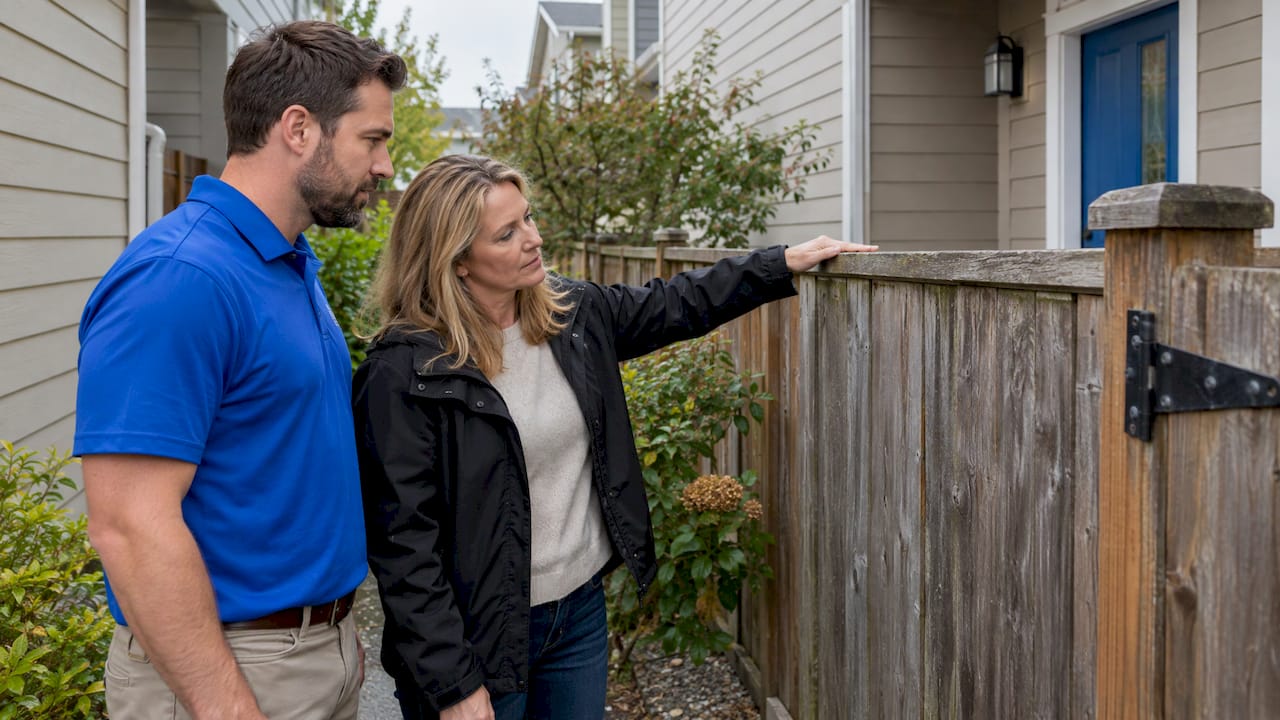
The HOA architectural review process is a written approval step that sits between your plan and your contractor. Before you change the exterior of a rental in an association, you submit a complete application, wait for a written decision, and start work only after you have it. For a landlord, the process has a second layer: the work often has to be coordinated with a tenant, a contractor and a township permit at the same time. Investors who run this as a routine, with the governing documents read first, tend to avoid the fines, forced removals and dead rent days that come from guessing.
TL;DR
Read the recorded declaration (the CC&Rs) first. It decides what needs approval, and when the declaration and the design guidelines conflict, the declaration usually controls.
Submit one complete application with plans, materials and contractor details. Many associations only start their review clock once the file is complete.
Expect roughly 30 days for a decision in many associations, but some allow 60, and some set no deadline at all. Your own documents set the number.
Association approval is not a township permit. You usually need both, and neither replaces the other.
Keep the approval letter, its conditions and its expiry date in the property file, and pass the conditions to your contractor in writing.
Table of Contents
What the architectural review committee actually reviews
An architectural review committee (ARC, sometimes called an ARB or ACC) is a group appointed by the association board to decide whether exterior changes fit the community’s standards. In one typical association, committee members are homeowners appointed by the Board, and they review projects such as pools, sheds, exterior additions and fences. The goal in most guidelines is consistency rather than control. One Florida association states that its guidelines exist to maintain the community’s appearance, character and property values and not to limit owners’ creativity.
The scope is wider than most investors expect. The same Florida guidelines treat essentially every permanent or temporary change to a building or lot exterior, including a paint color change, as something that needs review and approval before construction begins. Common rental-property triggers include:
Repainting in a new color, or replacing siding, roofing or shutters with different materials
Replacing a fence, gate or deck
Changing windows or the front door
Extending or repaving a driveway or parking area
Landscaping changes and signs, including temporary signs advertising a vacancy
That last item matters to landlords. In the Florida guidelines above, owners of rental apartment property face extra rules: signage needs ARC approval, no sign may sit within 10 feet of a lot line, and banners and illuminated signs are generally not permitted. A “For Rent” sign is not automatically exempt.
Which documents decide whether you need approval
Two layers of paper govern the question, and you need both.
The declaration (CC&Rs). The covenants, conditions and restrictions are recorded against the property. They cover general use restrictions and rental limits. Architectural guidelines, by contrast, cover the specific design and material approvals for exterior changes and fencing. The declaration is typically where the requirement for written permission lives. One association’s declaration, for example, requires written ARC permission before external work begins, and unapproved changes may have to be removed or modified at the owner’s expense.
The architectural guidelines. These are the detailed standards: approved colors, materials, fence heights, setbacks. If the two documents disagree, the Florida guidelines cited earlier say the CC&Rs prevail.
As a buyer you are bound by both. Owners are treated as having agreed to the guidelines and use restrictions when they purchased their unit. That is why the review of the governing documents belongs in your acquisition due diligence, not after closing. If your strategy involves a value-add renovation, such as a BRRRR (buy, rehab, rent, refinance, repeat) plan, an exterior scope that the association will not approve can break your numbers before you have bought.
Rental rules live in the same package. One association points owners who plan to rent to its rental restrictions and an occupancy summary form, and another bars short-term rentals of under 90 days. Read the rental section and the architectural section together.
How to submit an application that gets approved
The steps below follow what published association procedures ask for. The goal is a file the committee can approve in one pass.
1. Confirm you are the right applicant
Many associations only accept applications from the owner of record. One North Carolina community accepts applications only from current owners in good standing, and an Arizona association accepts only applications signed by the owner of record. If your tenant or contractor wants to apply on your behalf, check first. Also confirm that your assessments are current, since good standing is often a condition.
2. Find the calendar and the lead time
Some committees meet on a fixed schedule. One reviews applications on the first and third Thursday of each month with a minimum 10-day submission lead time. Another asks owners to apply at least 30 days in advance. Work backward from your planned start date and your lease calendar, not forward from the day you decide to act.
3. Build a complete package
A typical package includes:
The association’s application form, signed
A site plan or survey marked with the change
Dimensions, materials, colors and manufacturer samples or product sheets
The contractor’s name, license and insurance details
Photos of the existing condition
Any application fee the guidelines list
Completeness is not a formality. In the North Carolina community above, incomplete applications are automatically denied if the committee cannot get the missing information within 15 days. In other associations the decision clock does not start until the file is complete. Either way, a thin submission costs you weeks.
4. Keep proof of delivery
In one community the approval period begins when the complete submission is in the possession of a committee member. Your delivery date is the start of your timeline, so use the method the guidelines specify and save the confirmation.
5. Do not buy permits or start work early
The same document says permits must not be acquired and construction must not begin until written approval is received. Owners who build without written approval may be required to restore the property to its prior condition and fined until they do.
How long a decision takes
There is no national standard. The table shows how much published procedures differ.
Association procedure | Decision window | If the committee is silent |
30 days from a completed application | Not stated in the source | |
30 days from a complete request | Request is deemed approved | |
Written decision within 60 days | A conforming application is deemed approved | |
30 days after the committee receives a complete application | Application is deemed approved |
Two patterns matter to landlords. First, a deemed-approval clause only helps when your application is complete and conforming. Do not treat silence as permission without rereading the clause. Second, approval has a shelf life. Depending on the association, work must start within five months, three months or one year of approval, or the approval lapses. Some add completion deadlines, and one community can assess a monetary penalty for each month of delay. If your contractor is booked out, line up the schedule before you apply.
The committee’s decision usually comes in one of a few forms. One association lists approved, approved with conditions, resubmit, or disapproved, and in that community final approval is not given until the committee reviews the completed project. Plan for a closing inspection.

If the answer is no, or the clock runs out
A denial is rarely the end. Most procedures include a written reason and a way to appeal.
In one community, an owner may appeal a disapproval to the Board within 30 days.
Another lets the applicant request a full committee hearing or a Board hearing.
A third requires appeals to be submitted in writing to the Board through the management company within 30 days.
State law adds protections in some places, and it differs a lot. In Texas, associations of 40 or more lots must give written notice of a denial that explains why and what changes, if any, would lead to approval; the owner may request a board hearing within 30 days. In Florida, a denial must give written notice specifying the rule or covenant relied on and the aspect that does not conform. Neither rule is universal. New Jersey and other states have their own statutes and association documents, so confirm your state’s rules and the declaration before you rely on a deadline. For a legal dispute over a denial, speak with a real estate attorney licensed in your state.
When you receive a denial, the practical move is to ask which specific guideline was relied on, then resubmit with a modified design. A resubmission that cures the stated objection is faster than a fight. Missing the resubmission window can also end the application: in one community, a resubmission not made within 30 days is treated as withdrawn.
Association approval is not a permit
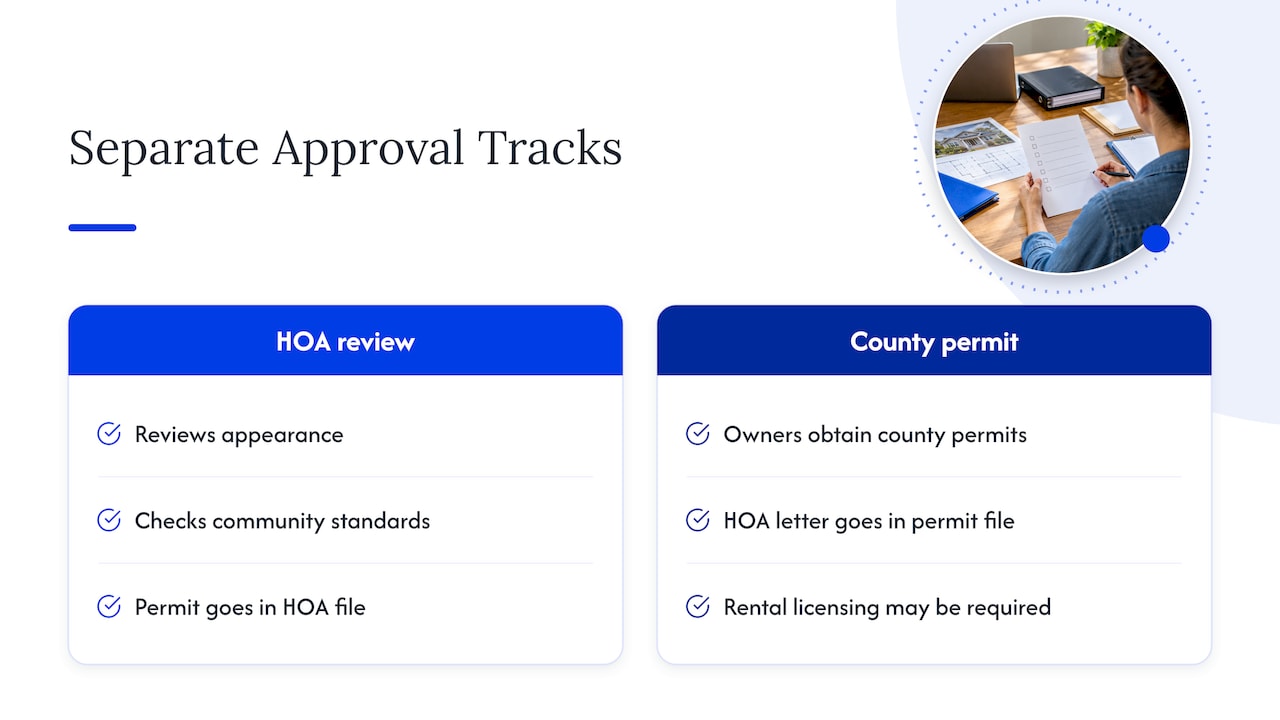
The ARC reviews appearance and compliance with the community’s standards. It does not replace the municipality. In the Wilde Lake, Maryland guidelines, for instance, owners remain responsible for all county permits, and that county also requires licensing of non-owner-occupied rentals. Treat them as two separate approvals running in parallel: the HOA letter goes into the permit file, and the permit goes into the HOA file. Check your township’s requirements for the specific work before you schedule a contractor.
After approval: what a landlord should document
Approval is the start of the paper trail, not the end of it.
Save the written decision with its conditions, expiry date and any required completion inspection.
Give the contractor the approved plans and conditions in writing. A fence installed one foot off the approved line can turn an approval into a violation.
Confirm the contractor’s insurance and license before work starts, and keep the certificates on file.
Tell the tenant the work dates, access needs, and any noise or parking effects, in writing, consistent with your lease.
Photograph the completed work and request the association’s final sign-off where the guidelines call for it.
Calendar the next obligation, such as landscaping installed within a set period or a maintenance duty tied to the change.
A structured maintenance routine keeps approved improvements compliant over time. This homeowner maintenance checklist gives a useful frame for tracking recurring upkeep once the work is done.
Vendor paperwork is where many owners are exposed. Our guide on vetting, contracting and monitoring vendors walks through the checks that apply whether you are an owner or on a board. And if a notice of violation arrives anyway, the HOA violations process explains the usual sequence of notice, hearing, fines and appeals.
Perspective
Most architectural problems we see in investor portfolios are not design disputes. They are timing and paperwork problems: a declaration nobody read before the purchase, an application submitted half-complete, a contractor starting before the letter arrived. Our team is led by an experienced investor, and we manage with compliance and risk mitigation in mind. For us, an architectural review is a line item in the investment plan, the same as a rehab budget or a lease-up date. When you are executing a strategy like BRRRR, an exterior scope that the association rejects can delay the refinance and the rent. So we read the governing documents early, coordinate maintenance and vendors against the approval conditions, and keep the file in order. We are veteran-owned, and we build custom management processes for New Jersey investors, including association management. Seeing the process from both the owner’s side and the association’s side is what lets us anticipate what a committee will ask for before it asks. Main
Let us handle the approval paperwork
If you own rentals in Southern New Jersey and would rather not run each architectural application yourself, our residential property management service covers leasing, tenant screening, rent collection and maintenance coordination, with vendor and subcontractor oversight and custom management processes built around your investment strategy. If you sit on the other side of the table, we also provide association management for HOAs and condo associations.
When you onboard with us, our 30 day onboarding playbook shows how a new property is set up from the start.
FAQ
How long do HOA architectural applications take?
Many associations commit to a decision within 30 days of a complete application, while others allow 60 days. Some declarations treat silence as approval, and some, such as Florida under its Chapter 720 as summarized by a legal reference, set no statutory deadline, so the declaration controls. Your governing documents give the real number.
What is the purpose of an architectural review committee?
Its purpose is to keep exterior changes consistent with the community’s published standards, protecting the appearance and property values the covenants were written to preserve. It reviews items such as fences, sheds, pools, additions, paint and signs, and issues written decisions.
Do I need approval if I only repaint or replace like for like?
Often yes. Some guidelines require review of nearly every exterior change, including paint color changes. Check your guidelines for any exemption for identical replacement, and get the answer in writing.
Can a tenant submit the application?
Usually not. Several associations accept applications only from the owner of record, so plan to sign it yourself or have your property manager prepare it for your signature.
What happens if I build without approval?
You may be required to restore the property to its prior condition and may face fines until you do, depending on the association’s documents. The violations process covers how notices, hearings and appeals typically work.
Sources
Recommended
Comments