
Reduce Rental Property Turnover Costs in 2026


Tenant turnover is defined as the process of one tenant vacating a unit and another moving in, and it is the single most controllable drain on rental income. Turnover costs range from $1,000 to $5,000 per unit, with vacancy loss alone accounting for 35–50% of that total. A 14-day vacancy on a $1,740 monthly rent unit already costs you over $900 in lost income before you spend a dollar on cleaning or repairs. The National Apartment Association tracks these costs as a primary benchmark for net operating income performance. Landlords who reduce rental property turnover costs consistently outperform those who treat turnover as an unavoidable cost of doing business.
What are the main components of tenant turnover costs?
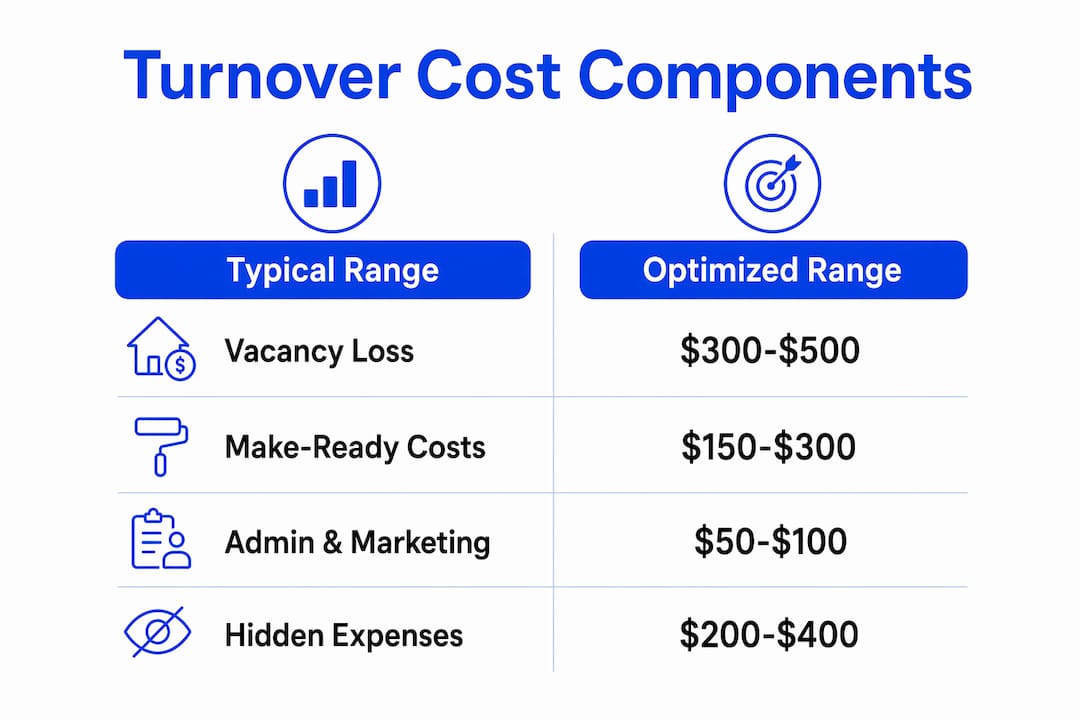
Turnover costs fall into four clear categories. Knowing where your money goes is the first step toward controlling it.

Lost rent from vacancy is the largest and most variable expense. Vacancy loss exceeds $900 for just a 14-day gap on a mid-range unit. Every additional day the unit sits empty is unrecoverable revenue.
Physical make-ready costs include painting, deep cleaning, carpet or flooring replacement, lock changes, and junk removal. These are the most visible costs and the easiest to track, but landlords often underestimate them by forgetting to log labor time.
Administrative and marketing expenses cover leasing commissions, application processing, background checks, and advertising on platforms like Zillow or Apartments.com. These fees add up quickly, especially when a unit sits vacant for multiple weeks.
Hidden costs are the ones that quietly erode your net operating income. Total turnover costs often exceed $4,000 when you factor in utility transfer fees, extended vacancy, and owner time. Most landlords never calculate these, which means they never fully understand their true cost per turn.
The table below shows typical versus optimized cost ranges for each component.
Cost Component | Typical Range | Optimized Range |
Vacancy loss (14 days) | $900–$1,500 | $300–$600 (7-day target) |
Cleaning and painting | $400–$800 | $250–$450 (flat-rate crews) |
Flooring repair or replacement | $300–$1,200 | $100–$300 (LVP installed) |
Lock changes | $75–$150 | $0–$30 (smart lock rekey) |
Marketing and leasing fees | $200–$600 | $100–$250 (pre-marketing) |
Administrative and hidden costs | $300–$750 | $150–$300 (digital tools) |
Tracking these numbers per unit per turn gives you a real cost baseline. Without that baseline, you are guessing.
How can proactive tenant retention strategies reduce turnover frequency?
The most cost-effective way to lower rental vacancy expenses is to prevent turnover from happening at all. Satisfied residents are 73% more likely to renew, yet most landlords misattribute departures to life changes rather than fixable service gaps.
Retention starts with maintenance responsiveness. Landlords who respond within 24 hours see an 86% tenant renewal rate. When response time exceeds 72 hours, that rate drops to 51%. That single operational change, faster maintenance response, is one of the highest-ROI moves available to any landlord.
Rent increases are the second biggest driver of tenant departures. Capping annual increases at 4% delivers roughly 17x ROI compared to absorbing the average $3,500 turnover cost. A small rent reduction of $50–$100 per month can also be more profitable than risking a vacancy, once you account for hidden vacancy costs like utilities, insurance, and your own time.
Here are the retention tactics that produce the highest renewal rates:
Start renewal conversations 60–90 days early. Tenants who feel informed and valued are far more likely to sign again.
Offer a small in-unit upgrade. A $200 upgrade requested 60 days before lease end increases renewal rates more effectively than an equivalent rent reduction. Tenants respond to visible, lasting improvements.
Use resident perks. Credit-building programs and rewards packages increase tenant satisfaction without significant cost to you.
Communicate personally, not just through automated notices. A direct call or personalized email at renewal time signals that you value the relationship.
Pro Tip: Ask your tenant one simple question 60 days before lease end: “Is there one small improvement that would make you want to stay?” A $150 fix can save you $3,500 in turnover costs.
What operational steps shorten turnover time and lower expenses?
Cutting costs on property leasing is not just about spending less. It is about spending faster and smarter. Every day you shave off the make-ready process is a day of rent you recover.
Conduct a pre-move-out inspection 30 days before lease end. Pre-move-out inspections let you order materials and schedule contractors before the unit is even vacant. This single step reduces make-ready time from 14 days to 7 days on average.
Start marketing 60 days before availability. Pre-marketing units 60 days out compresses vacancy windows by building a ready applicant pipeline. You can have a signed lease before the current tenant leaves.
Standardize your make-ready workflow. A written, 7-day checklist eliminates contractor scheduling bottlenecks and seasonal delays. Every task gets a day and an owner. Nothing waits.
Use curbside junk removal. Curbside junk removal at $79 undercuts full-service crews averaging $240. Your maintenance team moves items to the curb, and the service hauls them. Fast and cheap.
Negotiate flat rates with cleaning crews. Variable hourly rates create unpredictable costs. A flat-rate agreement with a dedicated turnover cleaning crew gives you budget certainty and faster scheduling.
Standardize paint colors, flooring, and fixtures. When every unit uses the same eggshell white and the same LVP flooring, touch-ups take hours instead of days. You also eliminate the cost of custom-matching materials.
The table below shows the impact of an optimized turnover process.
Metric | Typical Process | Optimized Process |
Make-ready time | 14 days | 7 days |
Vacancy loss | $900+ | $450 or less |
Contractor scheduling | Reactive | Pre-scheduled |
Unit marketing start | Day of vacancy | 60 days before |
Junk removal cost | $240 | $79 |
Pro Tip: Build your 7-day make-ready checklist once, then treat it as a non-negotiable standard. Contractors who cannot meet the timeline get replaced. Consistency is the only way to fix your vacancy process at scale.
What upgrades cut recurring turnover expenses long-term?
Some of the best investments you can make to minimize tenant turnover fees are one-time upgrades that pay for themselves across multiple turns. These are not cosmetic improvements. They are cost-elimination tools.
Luxury vinyl plank flooring. Switching to LVP eliminates carpet cleaning and replacement costs entirely. Carpet typically needs replacing every 3–5 years. LVP lasts 15–25 years and cleans in minutes.
Smart locks. Smart locks reduce lock-change costs by allowing digital rekeying between tenants. No locksmith, no hardware cost, no scheduling delay. The upfront cost pays back within two or three turns.
LED lighting. LED fixtures last significantly longer than incandescent bulbs and reduce utility costs during vacancy periods. Lower utility bills during vacancy directly protect your cash flow.
Smart thermostats. These devices let you control temperature remotely during vacancy, cutting heating and cooling waste between tenants.
Digital lease and screening tools. Automated lease signing and background check platforms reduce administrative time and speed up tenant placement. Faster placement means fewer vacancy days.
The key principle here is cost-per-turn thinking. An upgrade that costs $300 but saves $200 per turn pays for itself after two tenants. Over a 10-year hold, the savings compound significantly. This is the same logic that drives maximizing rental income across a portfolio.
Pro Tip: Prioritize LVP flooring and smart locks first. They deliver the fastest payback and the most visible impact on your cost per turn.
Key Takeaways
Reducing tenant turnover costs requires combining proactive retention, faster make-ready processes, and targeted one-time upgrades that eliminate recurring expenses across every turn.
Point | Details |
Vacancy loss is the biggest cost | A 14-day vacancy costs over $900 in lost rent before any make-ready spending begins. |
Maintenance speed drives renewals | Responding within 24 hours produces an 86% renewal rate versus 51% at 72+ hours. |
Pre-marketing cuts vacancy days | Starting marketing 60 days before availability allows lease signing before the unit empties. |
Small upgrades outperform discounts | A $200 in-unit upgrade at renewal time increases retention more than an equivalent rent reduction. |
LVP and smart locks pay for themselves | These two upgrades eliminate recurring flooring and lock-change costs across multiple tenant turns. |
Why most landlords are solving the wrong problem
Most landlords I talk to focus almost entirely on finding the next tenant after one leaves. They treat turnover as a leasing problem. It is not. It is a retention problem that occasionally becomes a leasing problem.
The data makes this clear. Tenants who feel satisfied are 73% more likely to renew. That means the majority of turnover events are preventable. Landlords who chase better listing photos or lower vacancy days are confusing movement with progress. The real work happens 60–90 days before lease end, not after the tenant is already gone.
What I have seen work consistently is a simple shift in mindset: treat your tenant like a long-term asset, not a short-term occupant. That means proactive communication, fast maintenance, and small investments in their comfort. A $200 upgrade or a 4% rent cap feels like a cost. Compared to a $3,500 turnover event, it is a return.
Institutional operators already know this. They use predictive analytics and automated renewal workflows to flag at-risk tenants before they give notice. Individual landlords can replicate this at a smaller scale with a simple tracking spreadsheet and a 90-day renewal calendar.
The landlords who protect their cash flow long-term are not the ones who fill units fastest. They are the ones who rarely need to.
— Main
How 2ndstreetpropertymanagement helps you control turnover costs
Turnover costs are predictable and controllable when you have the right systems in place. 2ndstreetpropertymanagement was built by investors who understand exactly what an empty unit costs and how to prevent it.
From pre-move-out inspections and standardized make-ready workflows to proactive tenant communication and cost-effective property management, 2ndstreetpropertymanagement handles the operational details that protect your net operating income. If you are ready to stop losing money between tenants and start running your rental like a business, 2ndstreetpropertymanagement has the process and the track record to back it up.
FAQ
What is the average cost of tenant turnover per unit?
Tenant turnover costs range from $1,000 to $5,000 per unit, with vacancy loss accounting for 35–50% of the total. Hidden costs like utility transfers and owner time often push the real figure above $4,000.
How do I calculate turnover expenses for my rental property?
Add up vacancy loss, cleaning, repairs, flooring, lock changes, marketing fees, and administrative time. Track each cost per unit per turn to build a baseline, then measure improvement over time.
What is the fastest way to reduce vacancy days between tenants?
Pre-marketing your unit 60 days before availability and conducting a pre-move-out inspection 30 days before lease end are the two fastest ways to compress vacancy windows.
Does raising rent increase tenant turnover?
Yes. Rent increases above 4% annually are a leading driver of tenant departures. Capping increases at 4% delivers roughly 17x ROI compared to absorbing the cost of a full turnover event.
What upgrades best reduce long-term turnover costs?
Luxury vinyl plank flooring and smart locks deliver the fastest payback. LVP eliminates carpet replacement cycles, and smart locks remove lock-change labor and materials costs between every tenant turn.
Recommended
Comments