
Long Term vs Short Term Rental Explained for Investors


Short-term rentals are defined as properties rented by the night or week, operating like hospitality businesses, while long-term rentals involve leases spanning months or years with stable, predictable tenancy. Understanding the long term vs short term rental explained distinction is the foundation of every smart rental investment decision. The two strategies differ fundamentally in income dynamics, management intensity, and risk profile. Short-term rentals offer higher gross revenue potential but demand active, daily involvement. Long-term rentals prioritize passive cash flow and tenant stability over peak income. Choosing the wrong model for your property type and market can cost you significantly in both time and returns.
What are the financial differences between long-term and short-term rentals?
The income gap between short-term and long-term rentals is real, but it is smaller than most investors expect once you account for operating costs. Net income for STRs exceeds long-term rental income by only 9–13% in urban markets. In leisure markets, that premium climbs above 130%. The market type matters far more than the rental format itself.
The reason the urban gap is so narrow comes down to cost structure. Short-term rentals carry an operating cost burden of around 38% of gross revenue, compared to roughly 15% for long-term rentals. Those costs include platform fees, professional cleaning between every stay, dynamic pricing tools, and guest supplies. A property grossing $60,000 per year as a short-term rental may net less than a long-term rental generating $42,000 with minimal overhead.

Vacancy is the other variable that erodes short-term rental income. Effective vacancy rates for STRs exceed 40% in urban markets. That means your property sits empty nearly half the time, even when it is listed and priced competitively. Long-term rentals rarely face vacancy above 5–8% in stable residential markets.
Mid-term rentals, defined as stays of 30–90 days, occupy a profitable middle ground. Vacancy for mid-term rentals runs as low as 3–5%, while per-stay costs drop sharply compared to nightly rentals. In urban markets, mid-term rentals often outperform both short-term and long-term strategies on a net income basis.
Pro Tip: Before projecting returns on any rental strategy, build a full operating cost model. Gross revenue is a vanity metric. Net cash flow after vacancy, maintenance, management fees, and platform costs is the number that actually builds wealth.
Market type | STR net income premium over LTR | Key driver |
Urban primary markets | 9–13% | High vacancy and operating costs compress margins |
Leisure and vacation markets | Over 130% | Strong demand and pricing power offset costs |
Mid-term urban rentals | Positive vs both | Low vacancy and reduced per-stay expenses |
How do operational demands differ between the two rental types?
Short-term rentals function as active businesses, not passive investments. Every guest checkout triggers a cleaning, a restocking run, and a review response. STRs require fully furnished properties with guest amenities and technology like smart locks, while long-term rentals prioritize durability and minimal furnishing. The operational gap between the two models is wide and often underestimated by first-time investors.
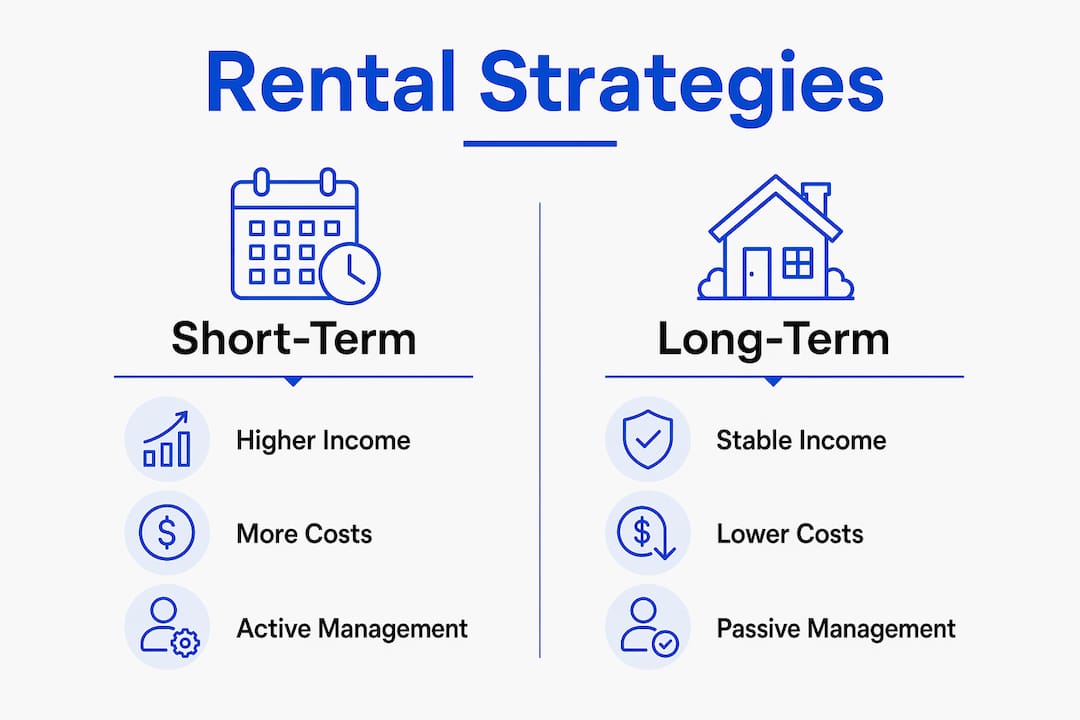
Long-term rentals offer a fundamentally different rhythm. Tenant turnover happens once every one to three years on average. Day-to-day management is minimal when tenants are stable. The risk, however, is maintenance drift. Long-term rentals can accumulate unreported issues over time, leading to concentrated repair costs at turnover that catch owners off guard.
The operational demands of each model break down clearly:
Short-term rentals: Frequent cleaning and turnover coordination, guest communication before and during every stay, dynamic pricing management, platform listing optimization, restocking consumables, and handling reviews.
Long-term rentals: Tenant screening and lease execution, periodic property inspections, responsive maintenance, annual rent reviews, and lease renewal negotiations.
Technology and outsourcing change the equation for short-term rentals. Automated messaging tools, keyless entry systems, and remote property management platforms reduce the hands-on burden significantly. A professional property manager can handle the full operational load, but that cost must factor into your net income projections.
Pro Tip: If you cannot commit to active daily management or afford a quality property manager, a long-term rental will almost always produce better risk-adjusted returns than a poorly managed short-term rental.
Why does location determine which rental strategy wins?
Location is the dominant factor in determining rental strategy success. Market type explains more variability in returns than the rental format alone. A short-term rental in a coastal vacation market like Gatlinburg, Tennessee, can generate returns that dwarf a comparable property in a midsize urban market. The inverse is also true: a short-term rental in a supply-saturated urban neighborhood may underperform a simple long-term lease.
Tourism-heavy and leisure markets reward short-term rentals because demand is seasonal, concentrated, and price-inelastic. Guests pay premium nightly rates for proximity to attractions, and occupancy spikes during peak seasons. Long-term rentals perform best in employment-stable neighborhoods near major employers, universities, or transit corridors, where tenant demand is steady year-round and vacancy risk is low.
Regulations add another layer of complexity. Many cities have introduced short-term rental permit requirements, owner-occupancy rules, and annual rental day caps. Before committing to a short-term strategy, verify local ordinances. A property that qualifies today may face restrictions next year. Investors who identify high-growth neighborhoods early and understand local regulatory trends hold a significant advantage.
Factor | Ideal for STR | Ideal for LTR |
Market type | Tourism, leisure, vacation destinations | Stable residential, employment hubs |
Demand pattern | Seasonal, event-driven | Year-round, consistent |
Regulatory environment | Permissive STR ordinances | Standard landlord-tenant law |
Property type | Furnished, amenity-rich units | Unfurnished, durable finishes |
Investor involvement | Active or outsourced management | Passive, low-touch oversight |
What are the financing, risk, and tax considerations?
Financing is easier for long-term rentals because lenders treat stable lease income as predictable cash flow. Conventional mortgage underwriting uses long-term rental income directly in debt-service calculations. Short-term rentals are a different story. Lenders classify them as hospitality businesses with volatile income, which affects loan underwriting standards and often requires specialized products at higher rates.
Risk profiles also diverge sharply between the two models:
Short-term rental risks: Seasonal demand swings, platform policy changes, local regulation shifts, higher insurance premiums, and income volatility tied to reviews and rankings.
Long-term rental risks: Tenant default, maintenance drift, below-market rents locked into multi-year leases, and slower response to rising market rents.
Tax treatment differs as well. Short-term rentals with average guest stays under seven days qualify as active businesses under IRS rules, which opens access to depreciation strategies and the ability to offset losses against other income if you meet material participation thresholds. Long-term rentals typically fall under passive activity rules, limiting loss deductions. Both strategies benefit from cost segregation studies and accelerated depreciation, but the mechanics differ.
Understanding lender perceptions of STR versus LTR properties is critical before you commit capital. Your financing structure affects your cash-on-cash return from day one.
Pro Tip: Consult a CPA who specializes in real estate before choosing your rental strategy. The tax treatment of short-term rentals can be a significant advantage or a compliance liability depending on your participation level and income structure.
How can you choose the right rental strategy for your property?
The right rental strategy comes from matching your property, market, and personal capacity to the demands of each model. No single approach wins universally. Work through this decision framework before committing:
Assess your market type. Research whether your property’s location has strong short-term rental demand or stable long-term tenant demand. Tourism markets and vacation destinations favor STRs. Employment-driven residential markets favor LTRs.
Evaluate your management capacity. Short-term rentals require active involvement or a paid manager. If you want passive income, a long-term lease or mid-term rental is the better fit.
Model realistic net income. Build a full cost projection including vacancy, cleaning, platform fees, management, insurance, and maintenance. Compare net figures, not gross revenue.
Check local regulations. Confirm that short-term rentals are legally permitted in your target market and that permit requirements are manageable.
Consider your financing situation. If you need conventional mortgage financing, long-term rental income is easier to qualify with. Factor in rate differences for STR-specific loan products.
Explore mid-term rentals as a hybrid. In urban markets where STR vacancy is high and LTR income feels limiting, mid-term rentals often deliver the best net income with manageable operations.
Real estate investment returns depend on matching strategy to market, not chasing the highest gross revenue number. Investors who align their rental model with their property’s actual competitive position consistently outperform those who chase trends.
Key Takeaways
The most effective rental strategy is determined by market location, operating cost structure, and management capacity, not by gross revenue potential alone.
Point | Details |
Net income gap is market-dependent | STRs outperform LTRs by 9–13% in urban markets but over 130% in leisure markets. |
Operating costs compress STR margins | STRs carry roughly 38% cost burden versus 15% for LTRs, narrowing the net advantage. |
Location drives strategy success | Tourism markets favor STRs; employment-stable neighborhoods favor LTRs. |
Mid-term rentals offer a strong alternative | Vacancy as low as 3–5% and lower per-stay costs make mid-term rentals competitive in urban markets. |
Financing and tax treatment differ | LTRs qualify for conventional mortgages more easily; STRs offer active business tax treatment under IRS rules. |
What I’ve learned from watching investors pick the wrong model
The most common mistake I see is investors choosing a rental strategy based on gross revenue projections from peak-season data. They see a Gatlinburg cabin generating $8,000 in a single October week and assume that rate holds year-round. It does not. The investors who build real wealth from rental properties are the ones who model the full year, including the slow months, the cleaning bills, and the platform fee increases.
My honest recommendation for new investors is to start with a long-term lease. The operational simplicity gives you time to learn the market, build cash reserves, and understand your property’s true cost structure. Once you have that foundation, scaling into short-term or mid-term rentals becomes a calculated move rather than a gamble.
The mid-term rental model deserves far more attention than it gets. Traveling nurses, corporate relocations, and remote workers create consistent demand in most mid-size cities. The vacancy rate is dramatically lower than short-term rentals, the per-stay costs are a fraction of nightly turnovers, and the income premium over long-term leases is real. For urban investors frustrated by tight STR margins, mid-term rentals are worth serious analysis.
Regulations are the wildcard that can invalidate an entire strategy overnight. I have watched investors build short-term rental portfolios in markets that subsequently banned or severely restricted STR permits. Always treat regulatory risk as a first-order concern, not an afterthought.
— Main
How 2ndstreetpropertymanagement helps you maximize rental income
Choosing between rental strategies is only the first decision. Executing that strategy well is where most investors leave money on the table.
2ndstreetpropertymanagement is built by investors for investors, which means the team understands both the financial targets you are working toward and the operational realities of managing rental properties. Whether you own a short-term vacation rental, a long-term residential unit, or a mid-term rental targeting corporate tenants, 2ndstreetpropertymanagement provides property management solutions tailored to your market and goals. From dynamic pricing and guest management to tenant screening and lease administration, the team handles the operational load so you can focus on growing your portfolio. Connect with 2ndstreetpropertymanagement for a personalized rental strategy assessment at 2ndstreetpropertymanagement.com.
FAQ
What is the main difference between short-term and long-term rentals?
Short-term rentals are rented by the night or week and operate as active hospitality businesses, while long-term rentals involve leases of months or years with stable, predictable income and minimal daily management.
Do short-term rentals always earn more than long-term rentals?
Not always. In urban markets, the net income premium for short-term rentals over long-term rentals is only 9–13% after accounting for higher operating costs and vacancy rates above 40%.
What is a mid-term rental and when does it make sense?
A mid-term rental covers stays of 30–90 days, targeting tenants like traveling nurses or corporate relocators. It offers vacancy rates as low as 3–5% and lower per-stay costs than nightly rentals, making it a strong option in urban markets.
How does location affect which rental strategy is better?
Tourism and leisure markets strongly favor short-term rentals, where income premiums can exceed 130% over long-term leases. Employment-stable residential neighborhoods favor long-term rentals due to consistent tenant demand and lower vacancy risk.
Is it harder to finance a short-term rental property?
Yes. Lenders classify short-term rentals as hospitality businesses with volatile income, which complicates conventional mortgage underwriting and often requires specialized loan products at higher rates compared to long-term rental financing.
Recommended
Comments