
The Role of Tenant Background Check in Reducing Risk


A tenant background check is a structured screening process landlords use to evaluate a rental applicant’s financial reliability, rental history, and identity before signing a lease. The role of tenant background check goes far beyond a simple credit pull. It compiles credit history, criminal records, eviction data, and identity verification into one decision-ready report. Improper tenant selection costs landlords $3,500 to $10,000 in eviction legal fees alone, with total losses exceeding $15,000 per bad tenancy. That number makes one thing clear: screening is not administrative overhead. It is risk management.
What information is included in a comprehensive tenant background check?
A standard tenant background check includes four core components: credit history, criminal background, eviction history, and identity verification. Each one answers a different question about the applicant’s reliability and suitability as a renter.
Credit history reveals how an applicant manages financial obligations. A credit score gives you a starting point, but 18 months of payment history tells you far more. Patterns of late payments, collections, or high debt loads signal a tenant who may struggle to pay rent consistently.
Criminal background check assesses whether an applicant poses a safety risk to other residents or the property. Legal nuances matter here. Blanket bans on any criminal record expose you to fair housing liability. The better approach is an individualized review of offense type, severity, and how long ago it occurred.
Eviction history is one of the strongest predictors of future rental behavior. A prior eviction tells you the applicant has already failed to meet lease obligations to another landlord. Two or more evictions in recent years is a serious red flag.
Identity verification confirms the applicant is who they claim to be. Fraud in rental applications is more common than most landlords expect. Verifying a government-issued ID against the submitted information prevents costly move-in fraud before it starts.
Together, these four data points give you an objective picture of the applicant. Relying on gut instinct without this data is a documented risk. Subjective judgments consistently fail to identify high-risk tenants the way documented criteria do.
How does modern technology improve tenant screening accuracy?

Automation has fundamentally changed how fast and how accurately landlords can screen applicants. Automated screening cut processing time from 5–7 days to 24–48 hours in 2026. In a competitive rental market, that speed gives you a real advantage without sacrificing data quality.
The most significant advance is the verification waterfall approach. Here is how it works in practice:
Direct payroll data connection. The system pulls income and employment data straight from the applicant’s payroll provider. This is the most accurate source and requires no document uploads from the applicant.
Bank account data connection. If payroll data is unavailable, the system connects to the applicant’s bank account to verify income deposits and spending patterns.
Document OCR review. If neither payroll nor bank connections are available, the system uses optical character recognition to read and verify uploaded documents like pay stubs or tax returns.
This multi-step verification waterfall layers methods to maximize fraud detection and minimize manual review. Each step catches what the previous one might miss. The result is fewer fraudulent applications reaching your desk and higher applicant completion rates because the process is faster and less burdensome.
Pro Tip: Integrate your screening platform directly with your property management software. When screening reports flow automatically into your applicant files, you eliminate manual data entry errors and keep your records audit-ready.
Automated, multi-layer verification also reduces your team’s manual workload significantly. That matters whether you manage two units or two hundred.
Why do consistent screening criteria protect landlords legally?
Consistent, documented tenant screening criteria are your primary legal defense against Fair Housing Act complaints. Applying the same standards to every applicant removes the appearance of selective enforcement and reduces discrimination liability. The moment you deviate from your written criteria for one applicant, you create legal exposure.
The Fair Credit Reporting Act (FCRA) adds another layer of compliance requirements. You must obtain written consent before running any background check. If you deny an application based on screening results, you must send an adverse action notice. That notice must state the specific, objective reason for denial.
Written criteria first. Define your minimum income threshold, credit score floor, and rental history requirements before you advertise the unit. Document these in writing.
Consistent application. Run the same checks on every applicant for the same unit type. No exceptions based on personal impressions.
Adverse action notices. When you deny an applicant, the notice must specify the exact reason, such as income below the stated minimum. Vague reasons like “did not meet our standards” invite legal challenge.
Individualized criminal record review. Avoid blanket bans. Assess the offense type, how recent it was, and whether evidence of rehabilitation exists. This approach aligns with fair housing best practices and reduces complaint risk.
Pro Tip: Keep a written log of every screening decision, including the specific criteria each applicant met or failed. If a Fair Housing complaint is ever filed, that log is your strongest defense.
The financial case for compliance is just as strong as the legal one. Documented, consistent screening reduces costly evictions and the legal disputes that follow them.
What practical steps build an effective screening process?
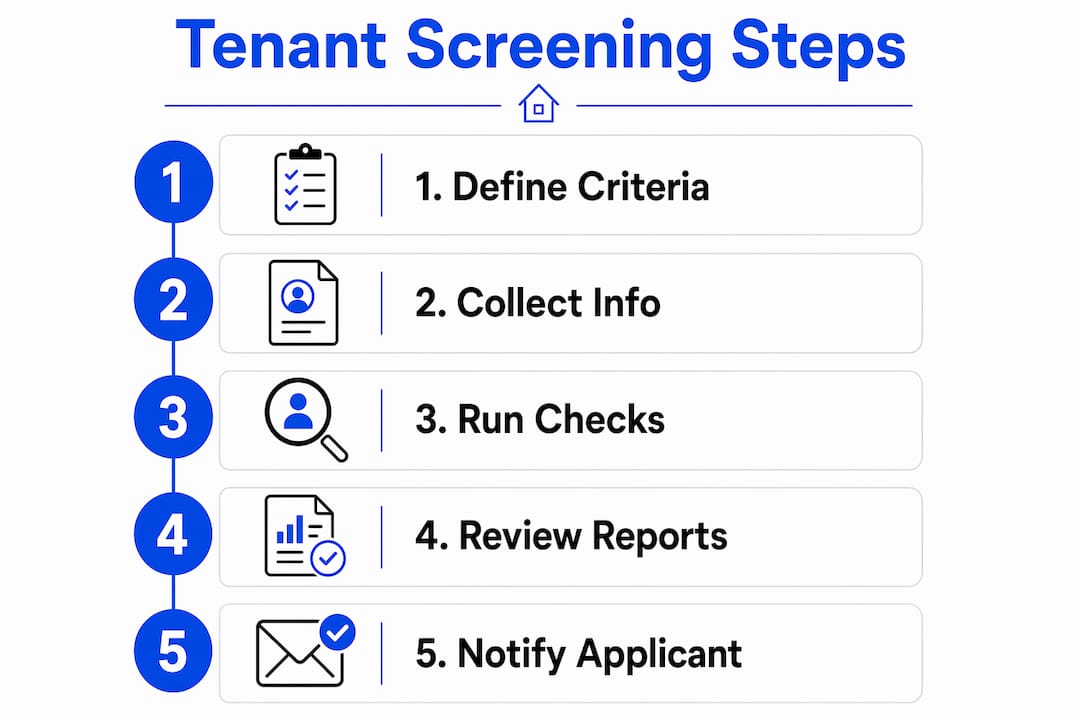
Building a reliable tenant verification process requires more than picking a screening service. It requires a repeatable system that produces consistent results every time.
Define your criteria before you list the unit. Set minimum income requirements, acceptable credit score ranges, and rental history standards in writing. Many landlords use an income-to-rent ratio of 3:1 as a baseline. Whatever threshold you choose, write it down and apply it uniformly.
Use a professional screening service integrated with your property management software. These services pull FCRA-compliant reports that include payment history, criminal records, eviction data, and identity verification in one place. Integration means reports attach automatically to applicant files, keeping your records clean and organized.
Collect complete applicant information upfront. A thorough rental application collects full legal name, Social Security number, current and prior addresses, employment history, and landlord references. Incomplete applications slow screening and create gaps in your data.
Review reports against your written criteria, not your impressions. Score each applicant against the same checklist. This is where objective criteria outperform gut instinct every time. If an applicant meets all criteria, approve them. If they fall short on a documented standard, decline them with a proper adverse action notice.
Respond promptly and correctly. Approval letters and adverse action notices both require timely delivery. Delays create legal risk and damage your reputation with applicants who may reapply in the future or refer others to your properties.
The tenant screening mistakes that cost landlords the most money almost always trace back to skipping one of these steps. A complete system, applied consistently, is what separates a profitable rental portfolio from a costly one.
Key Takeaways
A thorough tenant background check, applied consistently using documented criteria and modern verification technology, is the single most effective tool landlords have to protect rental income and reduce legal risk.
Point | Details |
Four core components | Every check must cover credit history, criminal records, eviction history, and identity verification. |
Automation speeds decisions | Automated screening cuts processing from 5–7 days to 24–48 hours, giving landlords a competitive edge. |
Consistent criteria prevent liability | Applying the same written standards to every applicant is your primary defense against Fair Housing complaints. |
FCRA compliance is non-negotiable | Written consent and specific adverse action notices are required by law and protect you from legal challenge. |
Objective data beats instinct | Documented financial and rental history criteria identify high-risk tenants far more reliably than subjective judgment. |
Screening is a business system, not a checklist item
I have worked with enough landlords to know where the real mistakes happen. It is almost never in the screening report itself. The report usually tells you exactly what you need to know. The mistake is in how landlords use that information, or more often, how they fail to use it consistently.
The most common pattern I see: a landlord sets solid criteria, runs a thorough background check, finds a red flag, and then talks themselves out of it. The applicant seems nice. The unit has been vacant for three weeks. The landlord decides the eviction was probably a one-time thing. Six months later, they are filing for eviction themselves and wondering what went wrong.
Screening works when you treat it as a business system with fixed rules, not a case-by-case judgment call. The benefits of professional property management come largely from removing that emotional variable. A professional manager applies the same criteria to every applicant, every time, without the pressure of a vacant unit clouding the decision.
The other thing I would push back on is the idea that thorough screening slows you down. With modern verification tools, a complete report comes back in under 48 hours. That is not a delay. That is due diligence that protects years of cash flow.
— Main
How 2ndstreetpropertymanagement approaches tenant screening

2ndstreetpropertymanagement was built by investors who understand exactly what a bad tenant placement costs. A single poor selection can wipe out months of positive cash flow and trigger legal fees that take years to recover. That is why tenant screening sits at the center of every placement process, not as a formality, but as a core investment protection step.
The team at 2ndstreetpropertymanagement uses integrated screening platforms that deliver FCRA-compliant reports covering credit, criminal, eviction, and identity data, all reviewed against documented criteria before any approval goes out. If you want a proven screening system working for your rental portfolio, 2ndstreetpropertymanagement is built to deliver exactly that.
FAQ
What does a tenant background check include?
A standard tenant background check covers credit history, criminal records, eviction history, and identity verification. These four components give landlords an objective picture of an applicant’s reliability and risk level.
How long does a tenant background check take in 2026?
Automated screening services complete most checks in 24–48 hours. Manual processes without automation can take 5–7 days, which puts landlords at a disadvantage in competitive rental markets.
What is the FCRA and why does it matter for landlords?
The Fair Credit Reporting Act (FCRA) requires landlords to obtain written consent before running a background check and to send a specific adverse action notice if they deny an application based on the report. Non-compliance exposes landlords to legal liability.
Can landlords reject applicants based on criminal history?
Landlords can consider criminal history, but blanket bans on any criminal record create fair housing liability. Best practice requires an individualized assessment of the offense type, how recent it was, and any evidence of rehabilitation.
How much can a bad tenant placement cost a landlord?
Eviction legal fees alone run $3,500 to $10,000. When you add lost rent over 3–6 months, total losses from a single bad tenancy can exceed $15,000, making thorough upfront screening one of the highest-return practices a landlord can adopt.
Recommended
Comments