
How to Find the Landlord of a Property You Want to Buy
- Rey Rey Rodriguez

- 2 days ago
- 10 min read

The fastest route to identifying a property’s legal owner is your county assessor’s office, followed immediately by the county recorder or recorder of deeds. The assessor gives you a name and mailing address in minutes; the recorder gives you the actual deed, which is the document that proves ownership. Together, they answer the question in most cases without spending a dime.
If you need to move now, work through this order:
County Assessor / Property Tax Database: owner name, mailing address, parcel ID
County Recorder / Recorder of Deeds: the recorded deed and chain of title
GIS or Parcel Map: confirms you have the right property
Secretary of State Business Search: reveals the registered agent if an LLC holds title
Title Company or Probate/Clerk of Court: for conflicts, liens, or estate ownership
At 2ndstreetpropertymanagement, we run this exact sequence before onboarding any managed property, because guessing at ownership is how investors end up negotiating with the wrong person.
Key Takeaways
Verifying legal ownership starts with the county assessor and recorder, and escalates to a title company only when records conflict or an entity structure hides the real decision-maker.
Point | Details |
Start with public records | Check the county assessor for owner name and mailing address, then confirm with the recorder’s deed. |
Use parcel ID over address | A parcel ID or APN avoids the mismatches that plague address-only searches. |
Title search catches hidden risk | Liens, judgments, and easements won’t show up in a basic assessor lookup. |
Trace entities methodically | LLCs route through the Secretary of State; trusts route through the named trustee; estates route through probate court. |
Escalate on conflict | Hire a title company or attorney the moment records disagree or an owner won’t confirm authority. |
Table of Contents
What You Need Before You Start Searching
Walking into a county records search without the right identifiers wastes time. Gather these three things first:
The property’s full street address
The parcel ID, APN, or PIN (often on a tax bill or property record card)
Any prior owner name you already know, if the property recently changed hands
A parcel ID beats an address every time. Addresses get misspelled, reassigned, or duplicated across municipalities; a parcel number is unique to that lot and pulls the exact assessor and recorder record with no ambiguity. County property-search tools typically let you search by address, owner name, account number, or parcel number, and the parcel number search is almost always the cleanest.
Pro Tip: No tax bill handy? Pull up your county’s GIS parcel map online, click the property, and the parcel ID usually populates instantly. It also works as a curb check if a physical marker or plat number is visible near the lot line.
Step-by-Step: Free Public-Record Searches to Run Now
Run these in order. Each source answers a slightly different question, and skipping steps is how investors miss liens or misidentify the current owner.
County assessor or property tax database. Search by parcel ID or address to pull the owner name, mailing address, and assessed value. Systems like Cook County’s Assessor Property Details Search let you search by address or PIN. The City of St. Louis assessor displays owner data under the property’s Basic Info tab, alongside zoning, sale history, and permits.
County recorder or recorder of deeds. This confirms the name on the assessor record matches the grantee on the most recently recorded deed, which is the legal proof of ownership.
GIS or parcel map. Cross-check boundaries so you’re not researching the neighbor’s lot by mistake.
Tax collector database. Check for unpaid taxes or active tax liens. The DC OTR real property tax database is a strong example, covering a large number of parcels online.
Secretary of State business search. If the owner listed is an LLC or corporation, this reveals the registered agent and often the managing member.
County clerk, probate court, or UCC filings. Necessary if the property may be tied up in an estate or used as loan collateral.
For tool references, county assessor portals and recorder sites are your primary stops, but municipal systems like the City of Boston properties portal combine ownership, assessed value, and tax data in one search, which speeds up verification considerably. Google Maps or Street View is worth a quick pass too, mainly to confirm the physical property matches what the records describe.
Pro Tip: Always search by parcel ID when the option exists. Address-based searches are the top cause of pulling the wrong owner record on multi-unit or recently subdivided parcels.
What a Title Search Reveals That Public Records Alone Don’t
A basic assessor lookup tells you who the county currently bills for taxes. It does not tell you whether that ownership is clean. A professional title search reviews the full chain of title and surfaces:
Recorded liens, including contractor or mechanic’s liens
Outstanding mortgages or deeds of trust
Unpaid property tax obligations
Judgments against the current or prior owner
Easements that restrict how the property can be used
Covenants or deed restrictions
Gaps or breaks in the chain of title
Why this matters for investors: an assessor record can be outdated, misspelled, or slow to reflect a recent transfer. The recorded deed at the county recorder is the actual proof of who holds legal title. A title search does more than confirm an owner; it surfaces encumbrances that could kill a deal or trigger costly surprises after closing. If you’re buying, financing, or negotiating with an owner you found through public records, treat that owner name as a strong lead, not a guarantee, until a deed copy confirms it.
When to Hire a Title Company, Abstractor, or Attorney
DIY searches work well for identifying an owner. They work poorly for confirming that ownership is free of complications. Hire a professional when you hit any of these triggers:
Assessor and recorder records show conflicting owner names
There’s a visible gap in the chain of title
The owner is a trust or LLC with no clear management contact
Litigation, probate, or a pending lien shows up in county records
You’re moving toward a purchase, refinance, or formal offer
A title company issues a preliminary report and, eventually, title insurance. An abstractor manually rebuilds the chain of title when records are incomplete or inconsistent. A real estate attorney steps in for legal disputes or complex closings involving multiple parties. Costs vary by county and complexity, so get a written fee quote before committing. Property titles are public and often free to search, but some counties charge for certified copies or require in-person visits, which is often the deciding factor in going professional. If you want a deeper walkthrough of what a title search actually covers, this property title search guide breaks down the process in plain terms.
Tracing Ownership Behind an LLC, Trust, or Estate
Deeds don’t always list a person. Here’s how to work backward from each entity type:
LLC or corporation: Search the Secretary of State’s business registry for the entity name. This surfaces the registered agent, filing status, and often the manager or officer names.
Trust: The deed will name the trustee, not the beneficiaries, who generally stay private. The trustee is your legitimate contact. Confirm their authority by requesting a copy of the recorded deed.
Estate or deceased owner: Check the county probate clerk or court records for an open estate filing, which names the personal representative or executor.
Ownership structures like these are common with investment property, and understanding how LLC and trust ownership actually works will save you from chasing dead ends. The sequence is always the same: identify the entity type first, then find the human authorized to speak for it.
Registered agent contact through SOS lookup
UCC filing search if financing may be involved
County clerk or probate search for estate-held property
Contacting the Owner Without Overstepping
Use the mailing address listed on the assessor record as your first contact point. If you need a formal paper trail, send certified mail to have proof of delivery.
Before treating anyone as the decision-maker, verify they actually have authority to act for the property:
Ask for a copy of the recorded deed, referencing the volume/page or document number
Request a management agreement or power of attorney if you’re dealing with an agent
Confirm a registered agent through the Secretary of State if the owner is an LLC
Never request or share sensitive tenant or occupant information during outreach
A simple opening line works better than a long pitch: “I’m reaching out regarding the property at [address]; can you confirm you’re the owner of record or point me to who is?” If a management company responds instead of the owner, that’s normal. It’s worth understanding what a property manager’s role actually covers so you know what they can and can’t authorize on the owner’s behalf.
Pro Tip: If the assessor’s mailing address differs from the property address, that’s often a sign of an out-of-area investor or an LLC, not a red flag by itself. Cross-reference before assuming anything’s wrong.

Data Privacy and Legal Limits on Using Ownership Information
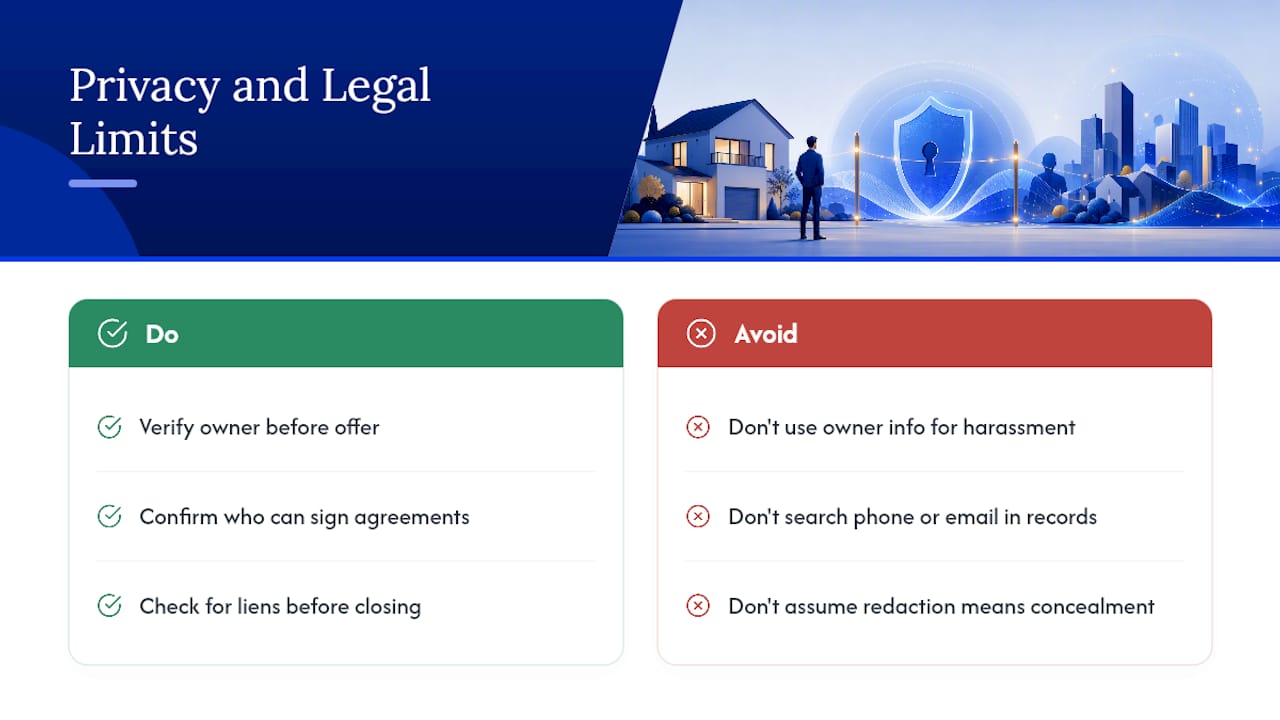
Property ownership records are public, but that doesn’t mean every use of them is fair game. Deed records, assessor data, and tax rolls exist to support transparent property transactions, tax administration, and title verification, not to enable harassment or unrelated surveillance of a private individual.
Stick to legitimate purposes: verifying an owner before a purchase offer, confirming who can legally sign a management agreement, or checking for liens before closing. Avoid using owner mailing addresses or names for anything outside standard investment or transactional due diligence.
Some information stays gated even in “public” systems. Trust beneficiaries typically aren’t disclosed even when the trustee is. Personal phone numbers and emails almost never appear in county records, which is a deliberate privacy boundary, not a search failure on your part. If you need contact details beyond a mailing address, that’s a signal to go through a title company or attorney rather than trying to track someone down through unofficial channels.
Keep in mind that county offices vary widely in what they publish online versus what requires an in-person or written request. Some counties redact certain identifying details for owner-occupied residential parcels for safety reasons. If a record you expect to find is missing, that’s often policy, not evidence something’s being hidden.
When the Owner Won’t Respond or Won’t Confirm Ownership
Silence doesn’t mean the search failed. It usually means you need a different channel or more patience.
Start by trying a second contact method. If certified mail to the assessor’s address goes unanswered after a reasonable window, check whether the mailing address routes to a property management company, an attorney, or an LLC’s registered agent. Any of those can relay a message even if the owner personally stays quiet.
If an owner or their representative actively refuses to confirm ownership, that’s a legitimate reason to lean on the recorded deed itself rather than their word. The deed at the county recorder is the legal proof; you don’t need the owner’s cooperation to establish who holds title, only their cooperation to negotiate or transact. For anything involving an offer, financing, or a dispute where confirmation truly matters, a title company or attorney can request records and confirmations through channels an individual investor can’t always access.
Persistent unresponsiveness paired with red flags, unrecorded transfers, conflicting deeds, or an unreachable LLC agent, is exactly when to stop DIY searching and pay for a professional title report. It resolves the ownership question definitively and protects you if the deal moves forward.
Red Flags That Signal Deeper Problems
Certain patterns in public records should slow you down before you commit time or money to a deal.
Active mortgages or deeds of trust that seem inconsistent with the seller’s asking price or claimed equity position.
Tax liens or years of delinquent property tax records, which can attach to the property regardless of who buys it.
Conflicting owner names between the assessor record and the most recent recorded deed, often a sign of an incomplete or delayed transfer.
A missing or unrecorded deed, meaning the last transaction was never properly filed, which creates a genuine gap in the chain of title.
Multiple recorded liens from different creditors, suggesting broader financial distress tied to the owner rather than the property itself.
None of these automatically kill a deal, but each one raises the cost of skipping a professional title search. A property with a clean assessor record and a messy recorder history is far riskier than one where both agree. For real-world examples of how these issues play out, this breakdown of common title problems is worth a read before you assume a quick public-records check is enough.
Why Verification Is Non-Negotiable in Our Onboarding Process
We build ownership verification into every property we onboard, not because we distrust our clients, but because the deed, not a conversation, is what protects everyone if a dispute ever surfaces. A management agreement signed with the wrong party is unenforceable, full stop.
Pro Tip: Keep a verification file for every property you manage or acquire: deed copy, parcel ID, assessor printout, and a screenshot of the Secretary of State search if an LLC is involved. It takes ten minutes and saves you from a much longer problem later.
Frequently Asked Questions
How do I find out who owns a rental property? Start with the county assessor’s website using the address or parcel ID, then confirm ownership with the deed on file at the county recorder or recorder of deeds.
What’s the difference between the assessor’s record and the recorded deed? The assessor tracks who’s billed for property taxes and can lag behind a recent sale. The recorded deed at the recorder’s office is the actual legal proof of ownership.
Can I find a landlord’s contact information for free? Yes, in most cases. The assessor record typically lists a mailing address you can use for formal contact, including certified mail.
What if the property is owned by an LLC? Search your state’s Secretary of State business registry using the LLC name from the deed. That search reveals the registered agent, who is a legitimate point of contact.
When should I stop searching myself and hire a title company? Hire a professional the moment you find conflicting owner names, a gap in the chain of title, or an owner who won’t confirm their authority to act.
Sources
Run the assessor search first, pull the recorded deed second, and check the Secretary of State if a business owns the property. If anything conflicts, call a title company before you go further. For help managing what comes after you confirm ownership, 2ndstreetpropertymanagement works with investors across the acquisition and management process.
Recommended
Comments