
Late Rent Policy for Landlords: What Belongs in Your Lease


A lawful late rent policy must do three things: appear in writing in the lease, follow your state’s caps and grace-period rules, and clearly separate the late fee from base rent owed. Skip any one of these and you’re exposed either to a tenant dispute or, worse, an unenforceable clause you cannot collect on.
The non-negotiable elements are:
A written clause disclosing the exact fee or formula before a tenant signs
Compliance with your state’s maximum fee (percentage or flat dollar cap)
A minimum grace period before any fee applies
Clear language stating whether the charge is a one-time fee, not interest
If your late-fee clause isn’t in writing, isn’t capped correctly for your state, and doesn’t separate the fee from rent owed, you don’t have a policy. You have a liability.
Key Takeaways
A compliant late rent policy requires written lease disclosure, state-specific fee caps and grace periods, and clear separation between rent owed and fees charged.
Point | Details |
Check state law first | Confirm your state’s fee cap, grace period, and eviction rules before drafting any clause. |
Separate fees from rent | Never let late fees become grounds for eviction; only unpaid rent typically qualifies. |
Use written repayment plans | Structured plans with allocation and default terms often cost less than eviction filings. |
Document every accommodation | Verbal payment extensions risk being treated as unintended lease modifications. |
Get compliance support | 2ndstreetpropertymanagement audits lease clauses and builds rent-collection workflows for owners. |
Table of Contents
How Late Rent Laws Vary by State
Every state treats late fees differently, and the gap among jurisdictions is wider than most landlords expect. Some cap fees as a percentage of rent, others use flat-dollar limits, and a handful leave the ceiling largely to the lease itself, provided the fee is “reasonable.” The variables you need to check before writing a single sentence:
Whether your state caps fees by percentage, flat dollar amount, or neither
The minimum grace period required before a fee can be charged
Whether unpaid late fees alone can support an eviction filing
Whether interest on late fees is allowed
Rules on deducting unpaid fees from a security deposit or future rent
Washington, D.C. offers a useful illustration of how tight these rules can get: D.C. Law 21-172 caps late fees at 5% of rent owed, requires a five-day grace period, bans interest on the fee entirely, and prohibits eviction for nonpayment of the fee alone. Minnesota takes a different approach, with Sec. 504B.177 setting its own limits and notice structure. California’s guidance on partial rent payments reflects a common industry practice of waiving fees if rent arrives within a short window, often by the fifth of the month.
A percentage cap in one state can be more restrictive than a flat-dollar cap in another once you run the math on a typical rent roll.
Verify current law directly on your state’s official code portal rather than a secondhand landlord forum. Laws change, and forum threads don’t get updated when they do.
What Should a Late Fee Clause Include?
A compliant clause needs six components working together: the exact fee formula, the grace period, the charge date, the invoicing process, how partial payments get applied, and non-waiver language protecting your right to enforce the clause later.
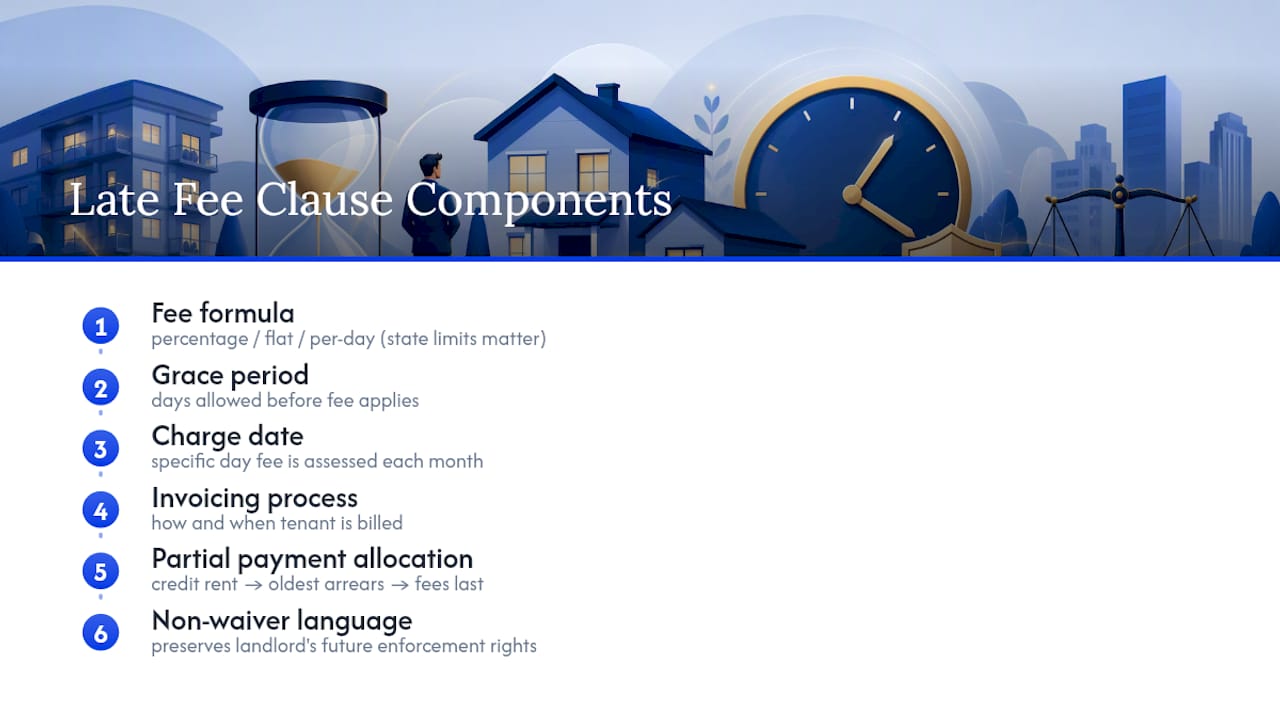
Fee formulas generally fall into three patterns. A percentage-based fee, often 5% of monthly rent, works well in states with percentage caps. A flat fee in the $25 to $50 range is common in states that set dollar limits rather than percentages, based on industry-practice figures compiled by LegalClarity. A per-day fee capped at a maximum dollar amount suits states that allow escalating charges but still want a ceiling. None of these are universal, and the wrong formula in the wrong state voids the entire clause.

Pro Tip: Write your payment-allocation language so that any partial payment credits current rent first, then oldest arrears, then fees last. Landlords who reverse this order, crediting fees before rent, generate far more disputes and slower-moving eviction cases.
Your management fee structure and your late-fee structure often get drafted at the same time. If you’re auditing both, our breakdown of property management fee types is worth reading alongside this section, since fee stacking confuses tenants more than either fee alone.
Can You Evict a Tenant Over an Unpaid Late Fee?
Not usually, and this is where landlords get their remedies backward. Nonpayment of rent is grounds for eviction virtually everywhere. Nonpayment of a late fee, standing alone, generally is not, a distinction D.C.'s late fee law states explicitly and one that shows up in some form across many jurisdictions.
What you can typically do with an unpaid, lawful late fee:
Invoice it separately from rent so the tenant sees a clear, itemized charge
Deduct it from the security deposit at move-out if state law permits, a process the Office of the Tenant Advocate’s FAQ walks through in detail
Pursue it in small claims court in some states, separate from an eviction filing
A typical enforcement sequence looks like this:
Rent goes unpaid past the grace period; the late fee is invoiced
A pay-or-quit notice goes out for the rent arrears, following your state’s required timeline
If rent remains unpaid after the cure period, you file for eviction on the rent, not the fee
Any lawful unpaid fees get deducted from the deposit at move-out
Landlords who conflate these two tracks, rent arrears and fee collection, tend to lose time in court over technicalities. Our rent withholding playbook covers a related scenario where the sequence matters just as much.
Should You Offer a Rent Repayment Plan Instead?
When a tenant wants to pay but needs more time, a written repayment plan often costs you less than an eviction filing. CFPB guidance recommends structured plans that adjust due dates, split payments, or spread arrears across 6 to 12 months, and the math tends to favor negotiation once you count filing fees, vacancy time, and turnover costs against a few months of installments.
An enforceable plan needs, at minimum:
The total arrears amount, stated precisely
Installment amounts and due dates
Allocation order (current rent first, then oldest arrears)
A non-waiver clause preserving your eviction rights if the plan is broken
Default and acceleration terms
Signatures from both parties
LegalClarity’s guidance on drafting these agreements is a solid template to start from.
Pro Tip: Never let a repayment arrangement live as a verbal promise. Document ability to pay in writing before you agree to anything, because an undocumented handshake deal can later look like an unintended lease modification rather than a temporary accommodation.
Sample Late Fee Clause for Your Lease
Below is a starting point, marked clearly as a sample for legal review, not a finished legal document:
Clause Line | What to Check in Your State |
Fee amount or formula | Percentage cap vs. flat-dollar cap |
Grace period end date | Minimum number of days required by statute |
“Does not accrue interest” | Whether your state permits or bans interest on fees |
Payment allocation order | Whether state law dictates how partial payments apply |
Non-waiver language | Whether informal acceptance of late rent risks a modification |
Adapt the fee line first.
Quick Compliance Audit for Your Existing Lease
Run this eight-item check before you enforce any fee or file for eviction:
Clause in writing? If not, fix it before the next lease renewal.
Fee formula lawful for your state? Confirm against current statute, not memory.
Grace period included? Add one if missing.
Payment allocation rules stated? Add allocation language now.
Notice templates ready? Prepare pay-or-quit notices in advance.
Invoice process defined? Set a standard timeline for billing fees.
Security-deposit deduction rules confirmed? Check your state’s deposit statute.
Tenant communications documented? Keep every accommodation in writing, per Nolo’s guidance.
Why Clear Terms Beat Loose Enforcement
Landlords who write precise fee terms and offer structured repayment plans see fewer evictions and lower legal costs than those who negotiate case-by-case. This pattern shows up consistently across the operational guides 2ndstreetpropertymanagement has built for owners managing their own rent-collection workflows.
How 2ndstreetpropertymanagement Handles Late Rent for You
Auditing every lease clause against your state’s statute takes time most owners don’t have, and 2ndstreetpropertymanagement builds that audit into standard property management, not as an upsell. We draft compliant late-fee language, run rent-collection workflows that flag arrears before they snowball, and structure repayment plans that protect your cash flow instead of forcing an eviction filing every time a tenant falls behind.

If your current lease has never been checked against your state’s fee caps and grace-period rules, that’s the first gap worth closing. Request a property management consultation and we’ll walk through your existing lease language, flag what needs updating, and show you how a documented collection process fits into full-service management.
Frequently Asked Questions
Can a landlord charge a late fee if it’s not in the lease? No. A late fee clause must be disclosed in writing before the lease is signed. Charging an undisclosed fee after the fact is unenforceable in most states and can expose you to a tenant complaint.
Is there a standard grace period for late rent? There’s no universal number. Some states require a minimum grace period by statute, such as five days under D.C. law, while others leave it to the lease. Check your specific state code rather than assuming a common practice applies.
Can unpaid late fees be deducted from a security deposit? In many states, yes, provided the fee itself was lawful and properly invoiced. The OTA FAQ outlines how this works in practice for the District of Columbia.
What happens if rent is late but the tenant is willing to pay? A written repayment plan is usually the stronger move over immediate eviction proceedings, according to CFPB guidance. Document the arrears amount, schedule, and default terms before accepting any partial payment.
This article is general information, not a substitute for advice from a qualified lawyer. Consult a qualified legal professional about your own circumstances before acting on anything here.
Sources
Recommended
Comments