
Creative Financing for Real Estate Investors: 2026 Guide
- Rey Rey Rodriguez

- 6 hours ago
- 8 min read

Creative financing is defined as any real estate acquisition strategy that structures funding outside of conventional bank loans, using methods like seller financing, subject-to deals, lease options, wraparound mortgages, and syndications. These approaches let you control more properties with less personal capital by restructuring ownership terms, payment schedules, or existing debt instead of starting from scratch with a lender. The Garn–St Germain Depository Institutions Act and Regulation D Rule 506(b) are two federal frameworks that directly shape how these deals are structured and who can participate. At 2ndstreetpropertymanagement, we work with investors every day who use these methods to grow portfolios that conventional lenders would never fund.
What are the main types of creative financing?
Creative financing involves restructuring existing financing or ownership terms rather than relying on traditional bank underwriting. Each method serves a different deal situation, and knowing which tool fits which scenario is what separates disciplined investors from those who confuse movement with progress.
Seller financing. The seller acts as the lender, holding a promissory note and receiving monthly payments directly from you. This works best when the seller owns the property free and clear or prefers steady income over a lump sum. The note structure functions like a purchase servicing agreement, so payment timing, servicing responsibilities, and security interests all need to be spelled out clearly.
Subject-to deals. You take title to the property while the seller’s existing mortgage stays in their name. The deed transfers to you, but the loan does not. This creates immediate due-on-sale clause exposure, which is the central legal risk every investor must evaluate before closing.
Lease options. You lease the property with the contractual right to purchase it at a set price within a defined period. Rent credits often apply toward the purchase price. This method works well when you need time to arrange permanent financing or want to control a property before committing capital.
Wraparound mortgages. You create a new mortgage that “wraps around” the seller’s existing loan. You make one payment to the seller, who continues paying the original lender. The spread between the two interest rates generates profit for the seller and gives you flexible terms.
Private money and hard money loans. Hard money loans are asset-based, approved on the property’s value rather than your credit score. They close fast, which makes them the go-to tool for fix-and-flip deals or situations where conventional financing falls through.
Syndications under Regulation D. You pool capital from multiple investors to acquire larger assets. Regulation D Rule 506(b) allows unlimited capital raises from accredited investors plus a limited number of non-accredited investors, but restricts general solicitation. Securities compliance dictates your marketing strategy and investor eligibility from day one.
How does creative financing compare to traditional bank loans?
Traditional bank loans require strong personal credit, documented income, and down payments that typically range from 20% to 25% for investment properties. Creative methods shift the approval criteria from your personal financial profile to the deal structure itself, the property’s value, or the seller’s motivation.

Pro Tip: When a seller is motivated by monthly income rather than a lump sum, seller financing almost always produces better terms than any bank will offer you.
The table below compares the key factors across financing types.
Factor | Traditional bank loan | Seller financing | Subject-to | Hard money |
Credit requirement | High | Negotiable | Low | Low |
Down payment | 20%–25% | Negotiable | Minimal | Varies |
Closing speed | 30–60 days | 1–2 weeks | Fast | Days |
Approval basis | Borrower profile | Seller agreement | Existing mortgage | Asset value |
Legal complexity | Low | Moderate | High | Low |
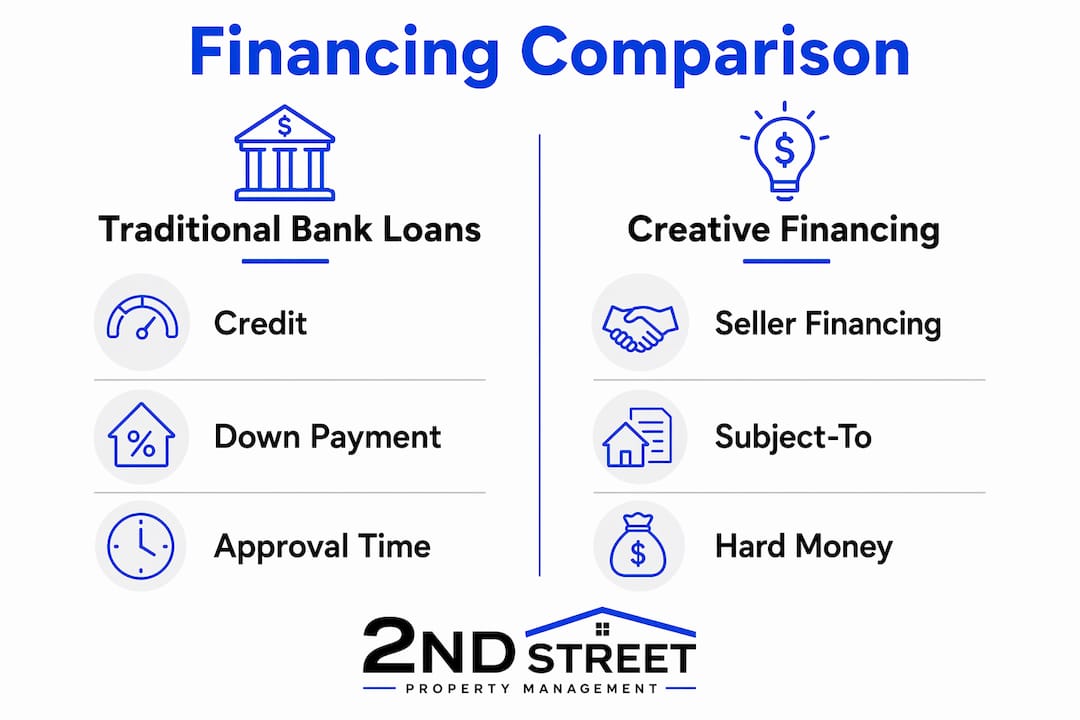
The most important contrast is closing speed. Bridge loans close in days and carry rates from 7% to 14% over a 6–24 month term. That speed costs more, but it wins deals that a 45-day bank approval would lose. Knowing when speed matters more than rate is a core skill for any serious investor.
What are the legal and risk considerations for creative financing?
Legal risk in alternative financing options is real and concentrated in a few specific areas. Ignoring these risks does not make them disappear. It just means you find out about them at the worst possible time.
Due-on-sale clause. Most conventional mortgages include a clause that lets the lender demand full repayment if the property is transferred without their consent. Subject-to deals and wraparound mortgages both trigger this risk. Lenders can enforce this clause immediately upon discovering the transfer.
Garn–St Germain exemptions. The Garn–St Germain Depository Institutions Act provides specific exemptions for certain transfers, including transfers to relatives upon death and transfers into living trusts. These exemptions are narrow. Do not assume your deal qualifies without legal review.
Lender enforcement reality. Lenders often choose not to enforce the due-on-sale clause when the loan remains current and the interest rate is at or above market. The legal risk remains, but practical enforcement is not automatic. Underwriting a subject-to deal requires evaluating lender response timelines and mortgage documents carefully, not just running cash flow numbers.
Seller financing contract risk. A seller financing note is a legal instrument. If payment terms, default provisions, or security interests are vague, disputes become expensive. Use a real estate attorney to draft or review every note.
Lease option complexity. Lease options create equitable interest in the property. If the contract language is unclear, courts in some states have treated them as disguised land contracts, which carry different legal obligations for both parties.
Syndication securities compliance. Securities law compliance for syndications requires coordinated marketing, investor verification, and documentation from the start. Choosing the wrong Regulation D exemption can delay or kill your capital raise entirely.
Pro Tip: Hire a real estate attorney who specializes in creative deal structures before you close any subject-to or wraparound transaction. The cost is a fraction of what a lender acceleration event would cost you.
How can investors apply creative financing strategically?
Creative financing structures work best when you match the method to the deal situation rather than forcing one approach onto every acquisition. The goal is always to preserve cash, reduce personal liability, and generate returns that justify the added complexity.
Match the method to seller motivation. A seller who needs monthly income is a natural fit for seller financing. A seller facing foreclosure with equity in the property may accept a subject-to deal to protect their credit. Read the seller’s situation before proposing a structure.
Use seller financing to preserve cash flow. When you negotiate a below-market interest rate on a seller-financed note, the spread between your financing cost and market rents directly improves your monthly cash flow. This is one of the clearest paths to passive income in real estate without a large capital outlay.
Apply subject-to deals selectively. Subject-to works best when the existing mortgage carries a favorable interest rate and the seller has limited equity. You inherit a loan that would be impossible to replicate at current market rates. That rate advantage compounds over time.
Layer syndications for larger deals. When a single acquisition exceeds your capital capacity, a Regulation D syndication lets you bring in accredited investors while maintaining operational control. The compliance burden is real, but the capital access it provides is unmatched for scaling a portfolio.
Use hard money and bridge loans as a bridge, not a foundation. These tools close fast and fund deals that banks won’t touch. But their rates and short terms mean you need a clear exit strategy before you close. Refinancing into permanent financing or selling within the loan term is the plan, not the backup.
Negotiate terms, not just price. In creative deals, the interest rate, amortization schedule, balloon payment date, and prepayment terms are all negotiable. A seller who won’t move on price may accept a longer amortization or a lower interest rate. Flexible funding solutions come from creative negotiation, not just creative structures.
Key takeaways
Creative financing gives real estate investors the tools to acquire properties when conventional loans are unavailable, too slow, or too expensive, but each method carries distinct legal and structural risks that require disciplined evaluation.
Point | Details |
Definition is precise | Creative financing restructures ownership or payment terms rather than replacing bank loans with another institutional product. |
Legal risk is concentrated | Due-on-sale clauses in subject-to and wraparound deals are the single largest legal exposure investors face. |
Match method to situation | Seller motivation, existing mortgage terms, and your exit strategy determine which financing structure fits each deal. |
Compliance is non-negotiable | Regulation D syndications require securities law compliance from the first investor conversation, not after the raise closes. |
Speed has a price | Hard money and bridge loans close fast but carry rates of 7%–14% and require a clear exit plan before closing. |
What I’ve learned from years of creative deal structures
The biggest mistake I see investors make is treating creative financing as a workaround rather than a discipline. They hear “no money down” and assume the risk disappears. It doesn’t. The risk just shifts from capital exposure to legal and structural exposure, and that kind of risk is harder to quantify on a spreadsheet.
The deals I’ve seen go wrong almost always share one trait: the investor skipped the attorney review because the seller seemed trustworthy or the deal seemed simple. Due-on-sale clause enforcement is contractual. A lender does not need a reason beyond the transfer itself to accelerate the loan. Trusting a handshake over a legal review is how investors lose properties they spent months acquiring.
What actually works is building a repeatable process. You evaluate the seller’s motivation first, then the existing mortgage terms, then the legal structure, and finally the cash flow math. Most investors do it in reverse. They run the numbers, fall in love with the return, and then try to fit the legal structure around a decision they’ve already made emotionally.
Creative financing expands your deal flow significantly. Properties that look dead on arrival under conventional financing often have real potential when you can restructure the terms. But that potential only materializes when you approach each deal with the same rigor you’d apply to any underwriting process.
— Main
How 2ndstreetpropertymanagement supports investors using flexible financing
Investors using alternative financing options face a specific challenge: the deal structure is complex, but the property still needs to perform day to day. That’s where 2ndstreetpropertymanagement comes in.

2ndstreetpropertymanagement is built by investors for investors, which means we understand that a creatively financed property carries different cash flow requirements and timelines than a conventionally funded one. Our property management services are designed to protect your returns from the moment you close, whether you used seller financing, a subject-to deal, or a hard money bridge loan to get there. If you’re managing a growing portfolio of creatively financed properties and need operational support that understands your deal structures, reach out to 2ndstreetpropertymanagement directly.
FAQ
What is creative financing in real estate?
Creative financing is any acquisition strategy that funds a property purchase outside of conventional bank loans, including seller financing, subject-to deals, lease options, wraparound mortgages, and syndications. The core idea is restructuring ownership or payment terms to close deals that traditional lenders would not approve.
What is the biggest legal risk in creative financing?
The due-on-sale clause is the primary legal risk. It allows lenders to demand full loan repayment when a property is transferred without their consent, which is directly triggered by subject-to and wraparound mortgage structures.
How does Regulation D apply to real estate syndications?
Regulation D Rule 506(b) allows sponsors to raise unlimited capital from accredited investors plus a limited number of non-accredited investors, but prohibits general solicitation. Compliance must be in place from the first investor conversation.
When should investors use hard money loans?
Hard money loans work best when speed is the priority or conventional financing is unavailable. They are asset-based, close in days, and carry rates from 7% to 14% over terms of 6–24 months, making them suited for fix-and-flip or transitional deals with a clear exit plan.
Can seller financing work if the seller still has a mortgage?
Yes, but it creates due-on-sale clause exposure. The seller’s lender can demand full repayment upon discovering the transfer. A real estate attorney should review the existing mortgage terms before structuring any seller-financed deal on encumbered property.
Recommended
Comments