
Wealth Building Strategies for Long-Term Financial Freedom
- Rey Rey Rodriguez

- 3 hours ago
- 8 min read

Wealth building is the deliberate process of growing your assets and income streams to achieve financial independence on your own terms. The industry term for this practice is personal wealth accumulation, and it combines disciplined saving, strategic investing, and consistent money management over time. Frameworks like the 50/30/20 budgeting rule and emergency fund guidelines from Fidelity form the practical backbone of any serious wealth plan. Financial freedom, as defined by leading financial authorities, is not just a number. It is the psychological state of having enough income-generating assets to make life decisions without fear of debt or unpaid bills.
What are the key stages and strategies of wealth building?
Wealth building moves through two distinct phases: accumulation and preservation. Understanding which phase you are in determines every major financial decision you make.
Wealth accumulation focuses on growing assets with a higher risk tolerance during your working years. Preservation, by contrast, focuses on protecting those assets with income stability and lower risk as you approach or enter retirement. Confusing the two phases confuses movement with progress. An investor who shifts to preservation strategies at age 35 may protect what they have but sacrifice the compounding growth that builds real wealth over decades.

Accumulation vs. preservation: knowing when to shift
Phase | Primary Goal | Risk Tolerance | Typical Timeline |
Accumulation | Grow assets aggressively | Higher | Working years (20s–50s) |
Preservation | Protect and generate income | Lower | Pre and post retirement |
The transition between phases is not a hard date. It depends on your asset base, income needs, and personal goals. A financial advisor aligned with fiduciary standards helps you map that transition without leaving growth on the table prematurely.
Pro Tip: If you are under 45 and already defaulting to preservation strategies out of fear, you are likely sacrificing years of compound growth. Revisit your risk tolerance with a fee-only advisor.
Applying preservation logic too early is one of the most common and costly mistakes investors make. The goal during accumulation is not to avoid losses entirely. The goal is to accept calculated risk in exchange for long-term asset growth.
How does budgeting and disciplined saving empower wealth building?
A budget is not a restriction. It is the mechanism that creates the surplus you need to invest. Without surplus, there is no wealth creation.
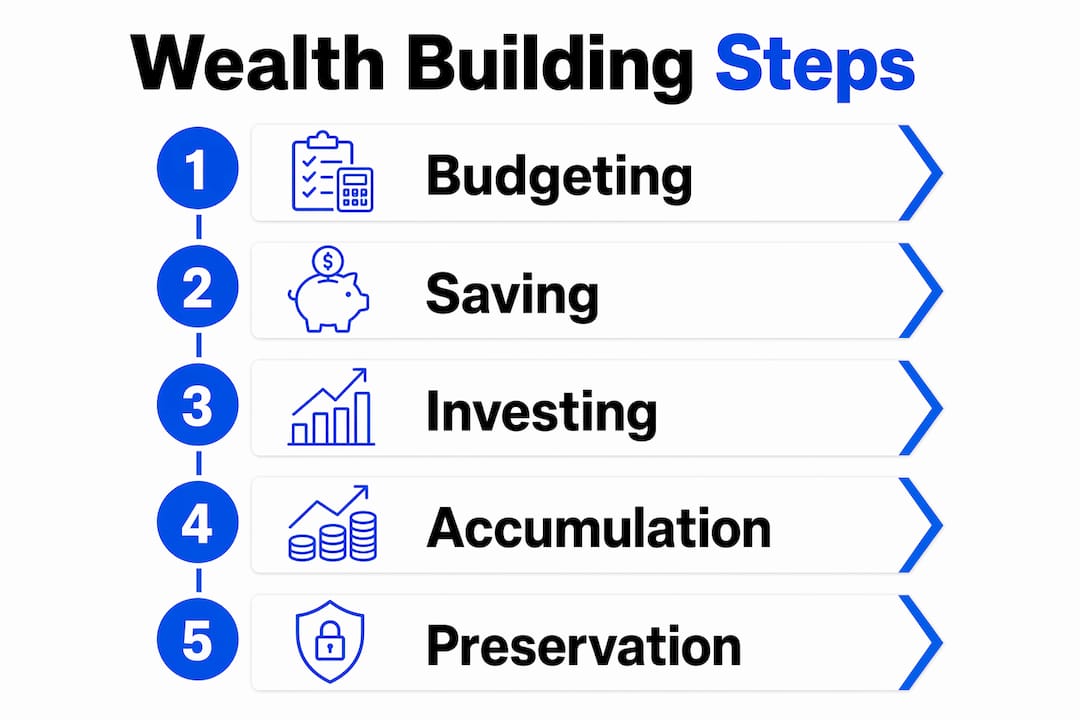
The 50/30/20 rule allocates 50% to needs, 30% to wants, and 20% to savings and debt reduction. That 20% is your wealth engine. Every dollar that stays in the “wants” category instead of the savings category is a dollar that never compounds. The rule works because it is simple enough to follow and flexible enough to adapt to different income levels.
Building your emergency fund first
Before you invest a single dollar, you need a financial floor. Emergency funds should start at $1,000 and scale up to cover 3–6 months of essential living expenses. Fidelity recommends extending that buffer to 12 months for investors facing prolonged income risk or market downturns.
Without an emergency fund, one unexpected expense forces you into high-interest debt. That debt then drains the same income you planned to invest. The emergency fund is not a savings goal. It is a prerequisite for every other wealth strategy.
Four steps to build saving discipline
Automate your savings transfer on payday so the money never sits in your checking account.
Set a specific savings target tied to a real goal, such as a down payment or retirement account milestone.
Review your budget monthly and redirect any surplus from the “wants” category into savings.
Avoid lifestyle inflation when your income increases. Raise your savings rate before you raise your spending.
Pro Tip: Treat your savings contribution like a fixed bill. Automate it the day your paycheck arrives, and you will never miss what you never see.
Lifestyle inflation is the silent killer of personal finance growth. Most investors who fail to build wealth do not lack income. They lack the discipline to keep their expenses below their income as that income grows.
What investment strategies facilitate long-term wealth growth?
The mathematics of wealth building is straightforward: (Income minus Expenses) × Investment Returns × Time. This formula shows that time is not just a factor. It is a multiplier. Starting early compounds every dollar you invest across more cycles, which is why a 25-year-old investing $300 per month outperforms a 35-year-old investing $600 per month over the same end date.
Start early. Compound growth rewards time above all other variables. Even small, consistent contributions made early outperform larger contributions made late.
Invest approximately 15% of your gross income toward retirement and long-term accounts. Financial experts recommend this threshold as the baseline for building meaningful retirement wealth.
Prioritize employer-matched accounts first. Employer matching contributions effectively double your savings on matched dollars. That is an immediate 100% return before any market growth occurs.
Diversify across asset classes. Stocks, bonds, real estate, and index funds each carry different risk and return profiles. Spreading capital across them reduces the damage any single downturn can cause.
Automate your contributions. Automating savings and investing removes emotional decision-making from the process. Investors who automate contribute more consistently and avoid the timing mistakes that erode returns.
Real estate deserves special attention as an asset class. It generates cash flow, appreciates over time, builds equity through debt paydown, and offers depreciation benefits that reduce taxable income. For investors focused on long-term wealth through real estate, these four return streams working simultaneously create compounding effects that stocks alone rarely match.
How can increasing income and managing debt accelerate wealth building?
Income growth is the most powerful lever in personal finance. Increasing income outperforms expense reduction as a wealth strategy because income has no ceiling. Cutting expenses has a floor. You cannot spend less than zero, but you can always earn more.
That said, income growth without debt control produces no lasting wealth. High-interest debt, particularly credit card balances above 15% APR, destroys compounding returns faster than most investments can generate them.
Use the debt snowball method. Pay minimum balances on all debts, then direct every extra dollar toward the smallest balance. Each paid-off account frees up cash flow for the next one.
Avoid new high-interest debt. Every dollar borrowed at 20% interest requires a 20% return just to break even. No standard investment consistently delivers that.
Grow income through side income streams, career advancement, or rental income. Each new income source expands the gap between earnings and expenses, which is the only gap that builds wealth.
Redirect income increases directly to investing. When you get a raise, increase your investment contribution before you increase your lifestyle spending.
The connection between debt management and investing capacity is direct. Every dollar freed from debt service becomes a dollar available for asset accumulation. Investors who clear high-interest debt first and then redirect that payment toward investments often see their net worth accelerate sharply within two to three years.
What practical habits support sustainable wealth building over time?
Sustainable asset accumulation is built on habits, not windfalls. The investors who build lasting wealth are rarely the ones who made one great trade. They are the ones who showed up consistently for decades.
Pay yourself first. Direct a fixed percentage of every paycheck to savings and investments before spending on anything else. This single habit, done consistently, builds more wealth than any market timing strategy.
Set SMART financial goals. Specific, measurable, achievable, relevant, and time-bound goals give your wealth plan direction. “I want to be rich” is not a goal. “I want $500,000 in retirement accounts by age 55” is.
Avoid get-rich-quick schemes. Financial freedom is personal and requires defining specific goals for motivation and progress tracking. Shortcuts that promise outsized returns almost always carry outsized risk or outright fraud.
Review your strategy annually. Life changes. Your income, expenses, family situation, and risk tolerance all shift over time. Your wealth strategy should shift with them.
Protect your wealth as it grows. Insurance, estate planning, and tax-advantaged accounts are not optional extras. They are the infrastructure that keeps your accumulated assets intact.
The psychological dimension of financial freedom matters as much as the numbers. Financial freedom is defined as the state of having sufficient income-generating assets to support your lifestyle and make decisions without fear. That state is as much about mindset as it is about account balances.
Key Takeaways
Wealth building succeeds when you combine disciplined saving, consistent investing, income growth, and a strategy that evolves with your life phase.
Point | Details |
Know your phase | Distinguish accumulation from preservation to avoid mismatched strategies that limit growth. |
Budget for surplus | The 50/30/20 rule creates the investing capacity that drives long-term asset growth. |
Invest early and consistently | Starting early and automating contributions compounds returns across more time cycles. |
Prioritize employer matches | Matched retirement contributions deliver an immediate 100% return before market growth. |
Grow income, control debt | Increasing income expands your investing capacity; eliminating high-interest debt protects it. |
The discipline gap: what most wealth advice gets wrong
Most wealth building content focuses on tactics. Pick the right account. Choose the right allocation. Follow the right rule. What it underestimates is the discipline gap between knowing what to do and actually doing it for 20 years straight.
I have seen investors with detailed financial plans abandon them after one bad quarter. I have also seen investors with modest incomes and simple index fund strategies build substantial net worth over time. The difference was never the plan. It was the consistency.
Financial freedom is more psychological than numerical. The number that represents “enough” is different for every investor. Someone who defines freedom as covering basic expenses with passive income needs far less than someone who defines it as funding a specific lifestyle. Neither definition is wrong. But you cannot build toward a goal you have not defined.
The other thing most advice gets wrong is the timeline. Wealth building is not a five-year project. It is a multi-decade practice. The investors who treat it as a sprint burn out or take on too much risk chasing faster results. The investors who treat it as a discipline, like physical fitness, make steady progress that compounds into something significant.
My honest recommendation: define what financial freedom means to you specifically, automate the mechanics, and then get out of your own way. Adjust your real estate wealth strategies as your life evolves, but never stop the contributions.
— Main
How 2ndstreetpropertymanagement supports your wealth strategy
Real estate is one of the most reliable vehicles for long-term asset accumulation, combining cash flow, appreciation, debt paydown, and tax advantages in a single investment.
2ndstreetpropertymanagement is built by investors, for investors. The team understands that managing rental properties is not just about maintenance calls. It is about protecting your returns and growing your portfolio with discipline. Whether you are acquiring your first rental or scaling an existing portfolio, professional property management keeps your investment performing while you focus on the next acquisition. Connect with 2ndstreetpropertymanagement to put your real estate assets to work as a core part of your long-term wealth plan.
FAQ
What is the definition of wealth building?
Wealth building is the deliberate process of growing assets and income streams over time to achieve financial independence. It combines budgeting, saving, investing, and income growth into a long-term strategy.
How much of my income should I invest for wealth building?
Financial experts recommend directing approximately 15% of your gross income toward retirement and long-term investments. Always capture employer matching contributions first, as they represent an immediate 100% return on matched dollars.
What is the difference between wealth accumulation and wealth preservation?
Accumulation focuses on growing assets with higher risk tolerance during working years. Preservation focuses on protecting assets and generating stable income with lower risk, typically closer to or during retirement.
How does the 50/30/20 rule support personal finance growth?
The 50/30/20 rule allocates 50% of income to needs, 30% to wants, and 20% to savings and debt reduction. That 20% creates the surplus that funds investing and accelerates long-term wealth growth.
Why is an emergency fund critical before investing?
An emergency fund prevents you from taking on high-interest debt when unexpected expenses arise. Start with $1,000, then build to 3–6 months of essential expenses before directing significant capital toward investments.
Recommended
Comments