
What Is a Single Family Rental? A Clear Investor's Guide
- Rey Rey Rodriguez

- 2 days ago
- 6 min read

What is a single family rental property?
A single-family rental (SFR) is a standalone residential home leased to one household under a single lease agreement. It has one utility connection, sits on its own lot, and operates as a completely separate unit from any multifamily building. Common examples include detached houses, townhouses, and standalone units in residential neighborhoods.
The SFR category is the most straightforward form of residential rental property you can own. One home, one tenant household, one lease. That simplicity is exactly what makes it the dominant entry point for real estate investors across the country.
Key characteristics that define an SFR include it being a single dwelling unit on its own lot, not attached to a shared building structure; covered by one lease agreement; having separate utility connections rather than shared building systems; being a standalone structure legally and physically separated from multifamily properties; and managed as one asset with one tenant relationship.

How big is the single-family rental market in the U.S.?
The SFR market is larger than most people realize. 14 million U.S. households rent single-family units, accounting for one-third of all renter households nationwide. That is a massive segment of the residential rental sector, and it is predominantly owned by individual investors rather than large institutions.
Market snapshot: 33% of U.S. renter households live in single-family rentals, yet individual investors own the vast majority of these properties, not institutional portfolios.
Several forces are driving continued demand:
Homeownership affordability pressures push households that want single-family living into the rental market
Larger household sizes in SFRs (averaging 2.9 people per household vs. 1.9 in apartments) reflect family-oriented demand
Limited new SFR supply relative to apartment construction keeps vacancy low in most markets
Growing build-to-rent communities, where institutional investors develop purpose-built SFR neighborhoods with shared amenities
Why do investors favor single-family rental properties?
SFRs appeal to investors for reasons that go well beyond simplicity. Financing is one of the clearest advantages: you can acquire an SFR using a conventional 30-year fixed mortgage, the same product available to owner-occupants. That access to standard residential financing keeps entry costs manageable and the underwriting process familiar.
Beyond financing, the operational profile of SFRs tends to be cleaner than multifamily. Occupancy rates above 95% are achievable in stable markets, driven by tenants who stay longer and treat the property more carefully. SFRs also carry a recession-resistant quality because they fulfill a fundamental housing need rather than a lifestyle preference, which keeps demand steady even when the broader economy softens.
Financing flexibility: conventional mortgages with standard down payment requirements
Lower turnover: longer average tenancies reduce vacancy and re-leasing costs
Broad resale market: single-family homes attract both investors and owner-occupants when you sell
Multiple return streams: monthly cash flow, principal paydown, and long-term appreciation
Recession resilience: housing demand persists regardless of economic cycles
Pro Tip: Tenant selection is where most SFR investors either win or lose on operational costs. A well-screened, long-term tenant in an SFR can reduce your annual maintenance spend more than any other single decision you make.
Who rents single-family homes, and why do they stay?
The typical SFR tenant is a family, often with children, looking for space, stability, and a neighborhood they can put down roots in. Families seeking larger spaces, private yards, and longer-term rentals make up the core of SFR demand, and that profile drives one of the asset class’s most valuable traits: low turnover.
Renters in SFRs tend to think of the property as home, not just a temporary address. That psychological shift changes how they treat the space. They mow the lawn, handle minor upkeep, and avoid the kind of wear that comes from treating a place as purely transactional. For landlords, this translates directly into lower operating costs and fewer maintenance calls.
Common SFR tenant characteristics:
Larger households, typically families with children
Longer lease terms, often renewing year over year
Higher income stability compared to the average apartment renter
Strong preference for suburban neighborhoods with good schools and outdoor space
What are the financial fundamentals of owning an SFR?
The income model for an SFR is straightforward: one tenant pays monthly rent, and you cover the mortgage, taxes, insurance, maintenance, and any property management fees from that income. Whatever remains is your cash flow. Returns come from a combination of monthly cash flow, principal paydown, and long-term appreciation.
Typical SFR expenses to budget for:
Mortgage payment (principal and interest)
Property taxes and homeowner’s insurance
Routine maintenance and periodic capital repairs
Property management fees if you use a professional manager
Vacancy costs during tenant transitions
The one financial risk that catches new SFR investors off guard is vacancy concentration. When a single-family rental sits empty, income drops to zero. That is a sharper hit than in a multifamily building where other units keep generating rent. Disciplined tenant screening and competitive pricing reduce this risk, but it never disappears entirely. Tax advantages, including depreciation deductions and expense write-offs, help offset carrying costs during vacancies.
Expert perspective on SFR investing and management
The SFR asset class rewards investors who understand both the financial mechanics and the human dynamics at play. As real estate investor Eric Hughes notes, "for investors with a five- to 10-year horizon, single-family homes typically build equity faster thanks to more liquid resale markets and stronger emotional-buying premiums from homeowners."
Single-family rentals sit at a distinctive crossroads between owning a home and living in multifamily housing. Their position, upheld by lasting economic and demographic forces, helps clarify why this asset class consistently draws investment across evolving market conditions. At 2ndstreetpropertymanagement, built by investors for investors, we see this play out in every market we operate in: the fundamentals of SFR investing reward patience, disciplined tenant selection, and professional management.
The emergence of build-to-rent communities adds a layer of nuance worth understanding. These purpose-built SFR neighborhoods operate more like apartment communities, with centralized management and shared amenities. They carry different operational demands than a traditional standalone SFR, and investors entering that segment should plan accordingly.
How do single-family rentals compare to other rental property types?
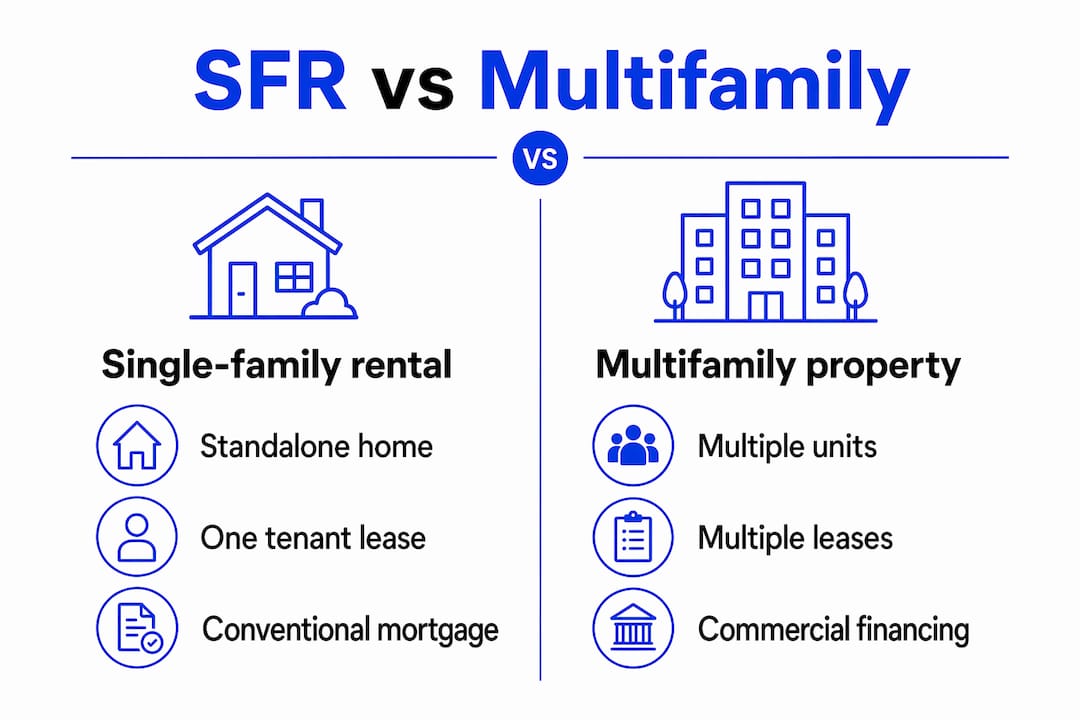
The clearest contrast is between SFRs and multifamily properties. You can explore the full multifamily comparison in depth, but the core tradeoffs come down to income density versus simplicity.
Factor | Single-family rental | Multifamily property |
Financing | Conventional residential mortgage | Commercial or portfolio loan |
Vacancy risk | High per unit (entire income lost) | Distributed across units |
Tenant turnover | Lower, longer average tenancy | Higher, shorter average tenancy |
Resale market | Broad (investors + owner-occupants) | Narrower (primarily investors) |
Management complexity | Lower | Higher |
Appreciation driver | Market sentiment + emotional premium | Rental income and NOI |
Condos occupy a middle ground. You own the interior unit but share building systems and pay HOA fees, which adds a cost layer and reduces your control over the asset. For most investors starting out, a standalone SFR offers cleaner ownership and fewer variables.
What risks should you know before investing in SFRs?
Every SFR investment carries risks that deserve honest evaluation before you commit capital.
Vacancy concentration: one empty unit means zero income, with no other units to offset the loss
Maintenance unpredictability: a single roof, HVAC system, or foundation issue can erase months of cash flow
Tenant risk: a non-paying or destructive tenant in an SFR affects the entire asset, not just one unit
Market sensitivity: SFR values track general housing sentiment, so local price corrections hit your equity directly
Liquidity timing: while the buyer pool is broad, selling still takes time, and a forced sale in a down market is costly
What legal and regulatory requirements apply to SFR landlords?
SFR landlords operate under a layered set of obligations that vary by state and municipality. At the federal level, the Fair Housing Act prohibits discrimination based on race, color, national origin, religion, sex, familial status, and disability. State landlord-tenant laws govern lease requirements, security deposit limits, notice periods for entry, and eviction procedures. Local ordinances may add rent control provisions, rental registration requirements, or habitability standards specific to your city or county.
Before placing a tenant, confirm your lease complies with state-specific requirements, carry adequate landlord insurance, and understand the eviction process in your jurisdiction. Cutting corners on compliance creates liability that can far exceed any short-term savings.
How should you approach SFR maintenance and management?
Managing an SFR well comes down to two disciplines: preventive maintenance and responsive communication. Properties that receive regular attention, annual HVAC servicing, gutter cleaning, and roof inspections, rarely produce the expensive emergency repairs that destroy cash flow projections.
Tenants in SFRs often handle minor upkeep like lawn care and basic yard maintenance, which reduces your direct workload. Build that expectation into the lease clearly. For investors managing multiple properties or operating at a distance, professional property management pays for itself by reducing vacancy days, handling maintenance coordination, and keeping legal compliance on track. The benefits of professional management compound over time, particularly as your portfolio grows beyond one or two properties.
Key Takeaways
Single-family rentals offer investors a straightforward, recession-resistant asset class with broad financing access, lower tenant turnover, and multiple return streams, provided vacancy risk and maintenance costs are actively managed.
Point | Details |
SFR definition | A detached home leased to one household under one lease, separate from multifamily buildings. |
Market scale | 14 million U.S. households rent SFRs, representing 33% of all renter households. |
Investor advantage | Conventional 30-year mortgages are available, and resale markets include both investors and owner-occupants. |
Vacancy risk | A vacant SFR produces zero income, making tenant screening and competitive pricing critical. |
Tenant profile | SFR tenants are typically families seeking space and stability, resulting in longer average tenancies. |
Recommended
Comments