
What Is a Real Estate Fund? A Beginner's Guide
- Rey Rey Rodriguez

- 51 minutes ago
- 6 min read

What is a real estate fund, and how does it work?
A real estate fund is a pooled investment vehicle where a professional sponsor raises capital from multiple investors and deploys it across a portfolio of properties, loans, or real estate securities. You don’t own a building. You own an economic interest in a fund entity that owns the buildings, and distributions flow to you from rental income, property sales, or loan interest.
Think of it this way: instead of buying one apartment complex yourself, you contribute capital alongside dozens of other investors, and a professional manager handles acquisitions, operations, and exits on your behalf. Minimums typically are set at levels that may be substantial for individual investors for private funds, though some platforms accept lower amounts. The tradeoff is direct: you gain institutional-level diversification and professional management, but you give up direct control and accept illiquidity that can last years.
Key characteristics of a real estate investment fund:
Pooled capital: Multiple investors contribute; a sponsor deploys the combined capital
Professional management: The fund manager handles deal sourcing, due diligence, and asset operations
Economic interest, not direct ownership: Investors hold LLC membership or limited partnership interests
Diversification: Capital spreads across multiple assets, geographies, and sometimes property types
Illiquidity: Most private funds lock up capital for 3–10 years
Fee structures: Typically a 1–2% annual management fee plus 20% carried interest above a preferred return threshold
How do the types and structures of real estate funds differ?
Understanding fund structures helps you match the right vehicle to your goals before you commit capital.

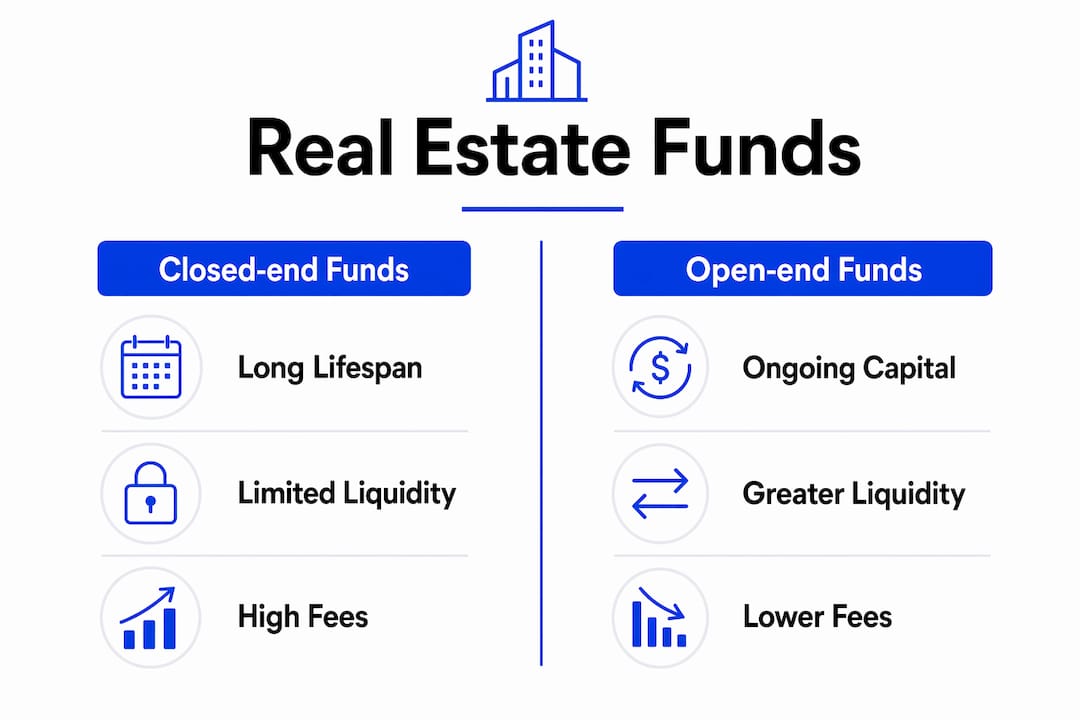
Open-end vs. closed-end funds is the most fundamental distinction. Open-end funds operate on a perpetual basis, accepting new subscriptions and processing redemptions on an ongoing schedule. Closed-end funds raise a fixed amount of capital over a defined period, then close to new investors. Their lifespan generally lasts several years, ending with asset sales and final distributions.
Investment strategies vary by risk and return profile:
Core: Stable, income-producing assets in established markets. Lower risk, lower upside.
Value-add: Properties needing improvements or repositioning. Moderate risk with appreciation potential.
Opportunistic: Distressed assets, development projects, or emerging markets. Highest risk, highest potential reward.
Fund models by asset type:
Equity funds: Own properties directly; returns come from appreciation and rental income
Debt funds: Lend capital as mortgages or bridge loans; investors receive interest distributions
Hybrid funds: Combine equity ownership and debt instruments
Investor eligibility matters too. Most private real estate funds restrict access to accredited investors, defined by the SEC as individuals with a net worth exceeding $1 million (excluding primary residence) or annual income above $200,000. Some crowdfunding platforms offer access to non-accredited investors, though typically with lower minimums and different structures.
How do real estate funds compare to REITs?
The distinction between a real estate fund and a REIT shapes your liquidity, income expectations, and tax position in very different ways.

A REIT is a company that owns, operates, or finances income-producing real estate. By law, REITs must distribute at least 90% of their taxable income as dividends to shareholders. That requirement makes them attractive for investors who want current cash flow. Exchange-listed REITs trade like stocks, so you can buy or sell shares any day the market is open. Some non-traded REITs carry upfront fees as high as 10%, so structure matters even within the REIT category.
Private real estate funds prioritize capital appreciation over current income. Capital is locked up, distributions are less frequent, and the goal is typically to sell assets at a profit after a multi-year hold. If you need income now, a REIT fits better. If you’re building long-term wealth and can tolerate illiquidity, a private fund strategy may align more closely with your goals.
Key differences at a glance:
Liquidity: REITs trade on exchanges daily; private funds lock capital for years
Income focus: REITs pay high dividend yields; funds target appreciation
Investor access: REITs are open to any investor; most private funds require accredited status
Tax treatment: Funds pass through depreciation to investors via K-1s; REITs generally do not
What are the pros and cons of investing in real estate funds?
Real estate funds offer genuine advantages, but they come with real costs and constraints you need to understand before committing.
Advantages:
Diversification: A single fund investment can spread your capital across dozens of properties and multiple markets, something nearly impossible to replicate through direct ownership
Professional management: You gain access to operators with sourcing networks, legal teams, and asset management expertise
Tax efficiency: Depreciation passes through to investors via K-1 forms, often generating paper losses that offset taxable distributions
Institutional access: Funds acquire assets at a scale and quality level unavailable to individual buyers
Disadvantages:
Illiquidity: Your capital is committed for the fund’s duration, with limited or no early exit options
Fee drag: Management fees and carried interest compound over the hold period and reduce net returns
Sponsor dependence: The fund’s performance depends heavily on the manager’s judgment, integrity, and execution
Market risk: Real estate values fluctuate with interest rates, local economies, and property sector conditions
Pro Tip: Evaluate a fund’s fee structure in full before investing. A 2% management fee plus 20% carried interest on a 7-year hold can meaningfully reduce your net return even when gross performance looks strong.
What should you know before investing in a real estate fund?
Disciplined due diligence separates informed investors from those who confuse movement with progress.
Start with sponsor alignment. Principals who invest their own capital alongside yours have a direct financial incentive to perform. Ask what percentage of the fund the sponsor has committed personally. A manager with no skin in the game is a red flag.
Next, evaluate the track record honestly. Past performance doesn’t guarantee future results, but a sponsor with multiple completed fund cycles, audited returns, and verifiable exits tells a very different story than one pitching a first fund. Request references from prior investors.
Additional factors to assess:
Fee structure: Understand management fees, acquisition fees, disposition fees, and the carried interest waterfall
Investment horizon: Match the fund’s expected hold period to your own liquidity timeline
Diversification within the fund: How many assets? Which geographies? What property types?
Redemption terms: For open-end funds, understand notice periods and any gates on redemptions
Reviewing your broader real estate investment planning before committing to a fund helps you size the position appropriately within your portfolio.
A deeper look at fund structures, fees, and return patterns
Most private real estate funds are structured as LLCs or limited partnerships. This matters because both are pass-through entities: income, gains, and depreciation flow directly to investors and appear on their individual tax returns via Schedule K-1. Depreciation is particularly valuable. A fund can distribute cash to you while simultaneously generating a paper loss that offsets that income on your K-1, reducing your current tax burden.
The J-curve is a pattern every fund investor should understand. In the early years of a closed-end fund, returns are often negative or flat. Acquisition costs, management fees, and capital improvements consume cash before properties generate meaningful income or appreciate. Returns typically accelerate in the middle and back half of the fund’s life as assets stabilize and are eventually sold.
Fund type | Typical lifespan | Liquidity | Primary return source | Typical fees |
Closed-end equity | 5–10 years | Illiquid | Appreciation + income | 1–2% mgmt + 20% carry |
Open-end (evergreen) | Perpetual | Periodic redemptions | Income + appreciation | 1–2% mgmt + 20% carry |
Debt fund | 3–7 years | Illiquid | Interest income | 1–2% mgmt + carry varies |
Hybrid fund | 5–10 years | Illiquid | Both income and appreciation | 1–2% mgmt + 20% carry |
Risk mitigation in fund investing comes down to three levers: diversification across assets and geographies, sponsor quality, and position sizing. No single fund should represent your entire real estate allocation. Pairing a fund investment with direct ownership or other vehicles gives you exposure across multiple risk profiles.
Key Takeaways
Real estate funds give investors access to professionally managed, diversified property portfolios, but illiquidity, fees, and sponsor quality determine whether that access creates or destroys value.
Point | Details |
Pooled structure | You own a fund interest, not a property; the sponsor manages all acquisitions and operations. |
Capital lock-up | Private funds typically restrict capital for 3–10 years, so match the hold period to your timeline. |
Tax advantage | Depreciation passes through to investors via K-1, often offsetting taxable distributions. |
Sponsor alignment | Principals investing their own capital alongside yours signals accountability and performance incentive. |
Fees compound | A 1–2% management fee plus 20% carried interest reduces net returns over a multi-year hold. |
Recommended
Comments