
Rental Property Tax Basis Explained for Landlords


Tax basis is defined as the total cost you have invested in a rental property, adjusted over time by improvements, depreciation, and other IRS-recognized events. Getting this number right is not optional. Your tax basis determines your annual depreciation deduction, your taxable gain when you sell, and whether the IRS accepts your return without question. Rental property tax basis explained correctly from the start saves you thousands of dollars and prevents costly surprises at closing. The rules governing basis calculation have been shaped by IRS regulations and updated by 2026 legislative guidance, making accuracy more critical than ever for landlords managing real estate investments.
What is rental property tax basis and why does it matter?
Tax basis is the IRS’s measure of your investment in a property. The adjusted basis equals your original cost plus capitalizable closing costs and improvements, minus accumulated depreciation and other decreases. That single number drives two of the most important calculations in rental property ownership: your annual depreciation deduction and your taxable gain at sale.
Most landlords think of basis as a one-time calculation done at closing. That is a costly misconception. Basis changes every single year you own the property. Depreciation reduces it. Capital improvements increase it. Casualty losses and insurance reimbursements can reduce it further. Ignoring these annual adjustments means your gain calculation at sale will be wrong, and the IRS will not accept “I didn’t know” as a defense.
The practical stakes are high. A landlord who bought a $400,000 rental property and held it for 15 years without tracking basis adjustments could face a taxable gain tens of thousands of dollars larger than expected. Tracking your basis from day one is the single most protective financial habit you can build as a rental property owner.
How to calculate initial cost basis for rental property
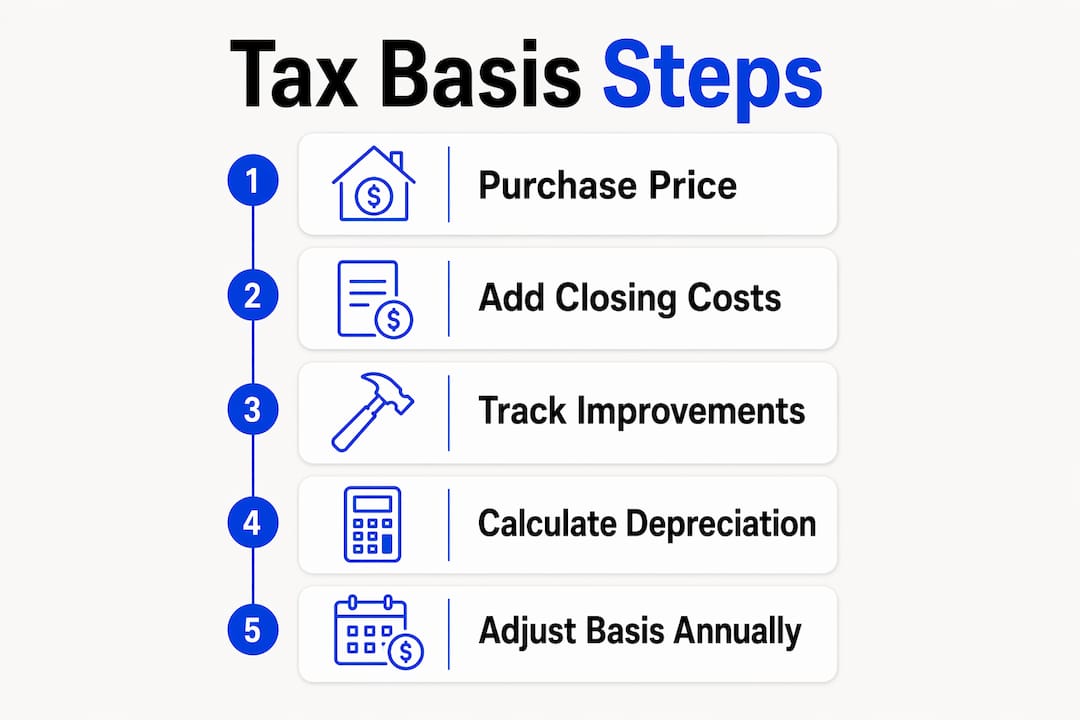
Your starting basis is the purchase price of the property. That is the number on your settlement statement, before any adjustments. From there, you add specific closing costs that the IRS requires you to capitalize rather than deduct immediately.
Capitalizable closing costs include title insurance, attorney fees, recording fees, transfer taxes, and survey fees. These costs increase your depreciable basis and spread their tax benefit over 27.5 years through depreciation. They are not deductible in the year you pay them.
The costs you cannot add to basis are equally important to know:
Prepaid interest and mortgage points are amortized over the loan term, not added to basis or immediately deducted.
Loan origination fees follow the same amortization rule rather than adding to basis.
Routine repairs made before placing the property in service are deducted immediately, not capitalized.
Hazard insurance premiums paid at closing are a current expense, not a basis addition.
Property taxes paid at closing are deductible, not added to basis.
Pro Tip: Print your HUD-1 or Closing Disclosure and go line by line. Highlight every fee and categorize it as “add to basis,” “amortize,” or “deduct now.” This 30-minute exercise at closing prevents years of compounding errors.
A common mistake landlords make is adding every closing cost to basis without checking the IRS rules. The reverse error is equally damaging: deducting capitalizable costs immediately and understating basis. Both errors distort your depreciation deductions and your eventual gain calculation. Start with a clean, accurate number and your entire tax history for that property will be more defensible.
How does tax basis change over time with improvements and depreciation?
Your basis is not static. Two forces move it in opposite directions every year: capital improvements push it up, and depreciation pulls it down.

Capital improvements add to basis and must be depreciated separately over their own recovery periods. Examples include a new roof, HVAC replacement, kitchen remodel, room addition, or new flooring. These are not deductible in the year you pay for them. They extend the useful life or add value to the property, so the IRS requires you to recover their cost over time.
Repairs are different. Fixing a broken window, patching drywall, or replacing a single faucet are immediate deductions. They maintain the property without adding value or extending its life. The line between a repair and an improvement is one of the most litigated distinctions in rental property taxation, and misclassification leads to lost tax benefits and audits.
Decreases to basis include:
Accumulated depreciation claimed each year reduces basis dollar for dollar.
Casualty losses you deduct after a fire, flood, or other disaster reduce basis by the amount deducted.
Insurance reimbursements for casualty losses reduce basis by the amount received.
Energy credits claimed on improvements may reduce the basis of the improvement itself.
Pro Tip: Keep a running spreadsheet with three columns: date, description, and amount. Log every improvement the month you complete it. At tax time, hand this to your CPA instead of a shoebox of receipts. The time savings alone justify the habit.
Tracking basis annually is not just good practice. It is the only way to know your true financial position in a property. Landlords who skip this step often discover at sale that their taxable gain is far larger than their cash profit, because years of unclaimed or misrecorded adjustments have distorted their adjusted basis.
How is depreciation calculated and how does it affect your basis?
Residential rental property depreciates using straight-line MACRS over 27.5 years. Only the building depreciates. Land does not wear out, so the IRS does not allow a deduction for it. This means your first task is splitting the purchase price between land and building.
The most defensible method for this split uses your local property tax assessor’s ratio. If the assessor values the land at 20% of total assessed value and the building at 80%, you apply that same ratio to your purchase price. Failing to allocate correctly between land and building causes compounding tax errors that affect every year of ownership.
Here is how the depreciation calculation works step by step:
Determine total purchase price. Start with the price on your settlement statement.
Add capitalizable closing costs. Title insurance, attorney fees, recording fees, and transfer taxes all increase your basis.
Allocate land vs. building. Use the tax assessor’s ratio to split the total basis.
Identify the depreciable basis. This is the building portion only.
Apply the 27.5-year straight-line rate. Annual depreciation equals approximately 3.6% of the depreciable building basis.
Apply the mid-month convention. The IRS uses the placed-in-service date, not the purchase date, to start depreciation. In the first year, you prorate based on the month the property was placed in service.
Step | Example ($350,000 purchase) |
Purchase price + closing costs | $360,000 total basis |
Land allocation (20%) | $72,000 (not depreciable) |
Building basis (80%) | $288,000 (depreciable) |
Annual depreciation (3.6%) | $10,368 per year |
First-year (placed in service in october) | $2,592 (3 months prorated) |
Pro Tip: Never skip a year of depreciation. The IRS requires you to recapture depreciation at sale whether you claimed it or not. Skipping deductions costs you money twice: once when you miss the deduction, and again when you pay recapture tax on depreciation you never benefited from.
Each year’s depreciation deduction reduces your adjusted basis by the same amount. After 10 years of full ownership, the landlord in the example above would have reduced their adjusted basis by roughly $103,680. That reduction directly increases the taxable gain when the property sells.
What are the tax implications when you sell a rental property?
Selling a rental property triggers two separate tax calculations, and most landlords are only prepared for one of them. The first is capital gains tax on your profit. The second is depreciation recapture, and it catches many sellers off guard.
Your taxable gain equals the sale price minus your adjusted basis. Adjusted basis is your original cost plus improvements minus all accumulated depreciation. Depreciation deductions reduce adjusted basis annually, which increases your taxable gain at sale. The longer you hold the property, the more depreciation has reduced your basis, and the larger your gain becomes.
Depreciation recapture is taxed separately from capital gains. The IRS taxes the portion of your gain attributable to depreciation at a maximum federal rate of 25%. This rate applies even if you never actually claimed the depreciation deductions. That rule is not a technicality. It is a firm IRS position that has ended many landlords’ plans to “catch up” on missed depreciation at sale.
Depreciation provides a real tax benefit every year you own a rental property, lowering your taxable income without any cash outlay. But that benefit is not free. The IRS collects its share at sale through recapture tax, and the bill arrives whether or not you planned for it. The landlords who come out ahead are the ones who claimed every deduction, tracked every dollar of basis, and prepared for recapture before they listed the property.
Strategies to manage the tax impact at sale include:
1031 exchange: Defer both capital gains and recapture tax by reinvesting proceeds into a like-kind property within IRS deadlines.
Installment sale: Spread the gain over multiple years to manage your tax bracket exposure.
Cost segregation study: Accelerate depreciation on shorter-lived components before sale to maximize deductions taken.
Qualified Opportunity Zone investment: Defer and potentially reduce gain by reinvesting in a designated zone.
The most common surprise at sale is not the capital gains tax. It is the recapture bill on depreciation the landlord forgot they claimed, or worse, forgot to claim at all. Knowing your adjusted basis before you list the property gives you time to plan, not react.
Key Takeaways
Accurate tax basis tracking is the foundation of every profitable rental property exit, because your adjusted basis determines both your annual depreciation deduction and your full taxable gain at sale.
Point | Details |
Start with total cost | Add capitalizable closing costs to purchase price to form your initial basis. |
Adjust basis every year | Add capital improvements and subtract annual depreciation to keep basis current. |
Land is never depreciable | Allocate purchase price between land and building using the tax assessor’s ratio. |
Depreciation recapture is unavoidable | The IRS taxes recaptured depreciation at up to 25%, claimed or not. |
Track records from day one | Detailed logs of improvements and depreciation schedules protect you at sale and during audits. |
The mistake most landlords don’t realize they’re making
After working with rental property investors for years, the pattern I see most often is not ignorance of the rules. It is overconfidence in a one-time calculation. Landlords nail their initial basis at closing, then never touch the number again. Five years later, they have replaced the HVAC, added a deck, and repainted every unit. None of it made it into the basis calculation. When they sell, their gain is inflated by tens of thousands of dollars in improvements they paid for but never recorded.
The land-building split is the second most common failure. Landlords either skip it entirely and depreciate the full purchase price, or they guess at the ratio without using the tax assessor’s data. Both approaches invite IRS scrutiny and produce inaccurate deductions. The tax assessor’s ratio method is IRS-accepted and takes 10 minutes to apply. There is no reason to guess.
The third error is treating depreciation as optional. Some landlords skip it because they think it complicates their taxes or they don’t need the deduction that year. The IRS does not care. Recapture tax applies to the depreciation you were allowed to take, not just what you claimed. Skipping deductions is a guaranteed way to pay tax twice on the same income. For a deeper look at how rental property depreciation works and how to avoid recapture surprises, the 2ndstreetpropertymanagement resource library covers the mechanics in plain language.
My advice is simple: treat your basis like a bank account. Every improvement is a deposit. Every year of depreciation is a withdrawal. Know your balance at all times, and you will never be surprised at the closing table.
— Main
How 2ndstreetpropertymanagement supports rental property investors
Managing tax basis accurately requires the same discipline as managing cash flow. It is ongoing, detail-oriented work that compounds in value over time.
2ndstreetpropertymanagement was built by investors for investors, which means the team understands that expense tracking, improvement documentation, and tax-efficient property management are not back-office details. They are core to your return. Whether you own one rental or a growing portfolio, having a management partner who tracks expenses with the precision your CPA needs makes tax season less painful and your basis records more defensible. Visit 2ndstreetpropertymanagement.com to learn how professional management supports your investment goals from acquisition through disposition.
FAQ
What is tax basis for rental property?
Tax basis is the total amount you have invested in a rental property, starting with the purchase price plus capitalizable closing costs. It adjusts over time as you add improvements and subtract accumulated depreciation.
How do I determine the depreciable basis of my rental property?
Subtract the land value from your total adjusted basis to find the depreciable building basis. Use your local tax assessor’s ratio to allocate the purchase price between land and building accurately.
What closing costs can I add to my rental property basis?
Title insurance, attorney fees, recording fees, transfer taxes, and survey fees are all capitalizable and add to your basis. Loan origination fees and points are amortized over the loan term rather than added to basis.
Does depreciation reduce my tax basis even if I don’t claim it?
Yes. The IRS calculates depreciation recapture based on the depreciation you were allowed to take, not just what you actually claimed. Skipping depreciation deductions does not reduce your recapture tax liability at sale.
What happens to my tax basis when I sell a rental property?
Your taxable gain equals the sale price minus your adjusted basis at the time of sale. The portion of that gain attributable to depreciation is taxed at a maximum recapture rate of 25% federally, separate from capital gains tax.
Recommended
Comments