
What Is a Property Management Agreement for Landlords


Most landlords sign a property management contract without reading past the fee section. That’s a costly habit. Understanding what is a property management agreement means knowing exactly what authority you’re handing over, what services you’re paying for, and how you can exit if things go wrong. This article breaks down every critical element of these agreements so you can sign with confidence, not just convenience.
Table of Contents
Key takeaways
Point | Details |
It’s a legal agency contract | The agreement legally authorizes a manager to act on your behalf, binding you to tenants and vendors. |
Authority limits protect you | Spending thresholds and scope clauses define what the manager can do without your approval. |
Fees vary widely | Management fees typically run 6%–12% of collected rent, with leasing fees up to one month’s rent. |
Termination has rules | Most agreements require 30–90 days’ notice, with specific obligations on both sides at exit. |
Review before you sign | Aligning scope, fees, and authority limits to your needs prevents disputes and financial surprises. |
What is a property management agreement, exactly
A property management agreement is a legally binding agency contract that appoints a property manager to act on your behalf within a defined scope of authority. The legal structure here matters. You are the principal. The manager is your agent. That relationship means the manager’s authorized actions can legally bind you to tenants, vendors, and contractors, even if you were never directly involved in a specific decision.
This is fundamentally different from hiring a contractor for a one-time job. A property management contract creates an ongoing agency relationship with real legal weight. The manager can sign leases, collect rent, authorize repairs, and enter into vendor agreements, all in your name.
Key legal implications every landlord should understand:
The manager’s authority is only as broad or narrow as the written agreement defines it
Actions taken outside that authority can still bind you if a third party reasonably believed the manager had permission
Most states require property managers to hold a real estate broker’s license or a dedicated property management license
The agreement governs your relationship with the manager separately from any tenant lease
For HUD multifamily housing, agreements require additional compliance provisions, which illustrates just how much these contracts vary by property type and context. A one-size-fits-all template is rarely the right starting point.
Key components every agreement should include
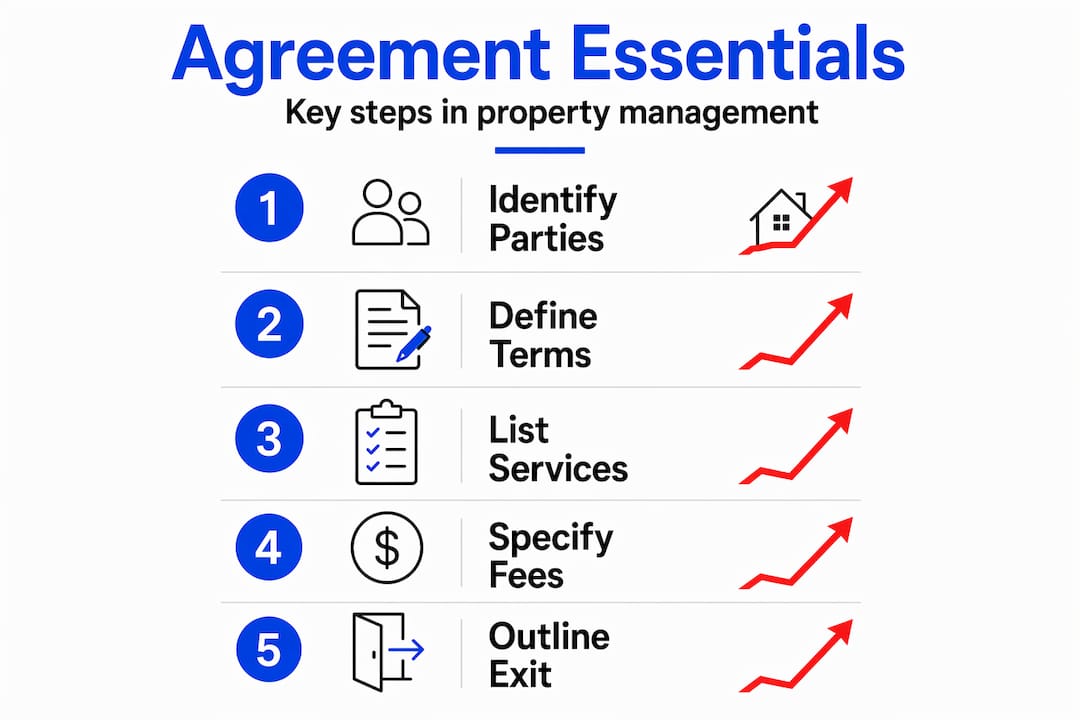
A well-structured property management agreement leaves nothing to interpretation. Clear scope prevents misunderstandings and disputes down the road. Here is what you should expect to see, and verify, in any agreement before signing.
Identification of parties and property
The agreement must name the owner, the management company, and every property covered. Vague descriptions create gaps in accountability.
Term and duration
Most agreements run one year with automatic renewal clauses. Know the renewal terms before you sign, not after the contract auto-renews.

Scope of services
This is where management duties get spelled out: rent collection, maintenance coordination, tenant screening and placement, lease enforcement, and legal compliance. Do not assume a service is included because it seems obvious. If it is not written in, it is not guaranteed.
Fee and compensation structures
Compensation structures vary widely. Common models include:
Fee Type | Typical Range | What It Covers |
Monthly management fee | 6%–12% of collected rent | Ongoing oversight and operations |
Leasing fee | 50%–100% of one month’s rent | Tenant placement and lease execution |
Maintenance markup | 10%–20% above vendor cost | Coordinating and overseeing repairs |
Lease renewal fee | $100–$300 flat | Renewing existing tenant leases |
Reporting and accounting
The agreement should specify how often you receive financial reports, what software or portal is used, and how security deposits are held and reconciled.
Liability and indemnification
These clauses determine who is responsible when something goes wrong. Read them carefully. Broad indemnification language can shift significant legal exposure onto you.
Termination rights
Both parties need clear exit conditions. This section deserves its own deep look, covered below.
Pro Tip: Before signing, request a property management agreement sample from the company and compare it against a checklist of these components. Any company that resists sharing their standard contract before you commit is a red flag.
Scope of authority and spending limits
This is the section most landlords underestimate, and it is where disputes most often originate. Reading authority and spending limits is just as important as reviewing fees. Unclear clauses create real risk that a manager’s actions will bind you to costs or commitments you never approved.
Here is how to approach this section methodically:
Identify the spending threshold. Most agreements set a dollar limit, typically between $300 and $1,500 per repair, below which the manager can authorize work without your approval. Know your number. If the contract says $1,000 and your property has aging HVAC, you may want that threshold lower.
Distinguish general from limited authority. General authority gives the manager broad discretion to act on your behalf across most operational decisions. Limited authority restricts them to specific, named tasks. Most residential agreements fall somewhere in between. Know where yours lands.
Check vendor contract authority. Can the manager sign multi-year vendor contracts in your name? Landscaping, pest control, and HVAC maintenance agreements can carry real financial weight. If the agreement allows this without your sign-off, negotiate a cap or an approval requirement.
Look for emergency exception clauses. Most agreements allow the manager to exceed spending limits in genuine emergencies, like a burst pipe or structural failure. That is reasonable. What you want to avoid is a vague definition of “emergency” that gives the manager too much unilateral discretion.
Review how disputes over authority are resolved. In any conflict, actions are reviewed against explicitly stated authority in the contract as the first evidence step. Clear clauses protect you. Vague ones work against you.
Pro Tip: Negotiate your spending threshold before signing. Most property managers will agree to a lower limit if you ask. Starting at $500 instead of $1,000 gives you more control without creating operational friction for routine maintenance.
Termination provisions: what landlords need to know
Knowing how to exit a property management agreement is just as important as knowing how to enter one. Termination clauses typically require 30 to 90 days’ notice, with immediate termination reserved for serious breaches like fraud, gross negligence, or willful misconduct.
What you need to know before you ever need to use this section:
Notice requirements. Most agreements require written notice. Verbal notice rarely satisfies the contract, even if the manager acknowledges it. Know the exact notice period and the required delivery method.
Grounds for immediate termination. Look for specific language that allows you to terminate without notice if the manager breaches fiduciary duty, mishandles funds, or violates licensing requirements. Vague language here gives managers room to argue.
Post-termination obligations. On exit, the manager must transfer all files, complete a final accounting, reconcile security deposits, and notify active vendors. Get this list in writing before you sign.
Early termination fees. Some agreements charge a fee if you exit before the term ends without cause. Know the amount and the conditions. A $500 fee is reasonable. A fee equal to three months of management charges is not.
Transition of tenant relationships. The agreement should specify how tenant communications are handed off and who notifies tenants of the management change.
The most common pitfall is assuming a verbal agreement to part ways is sufficient. It is not. Always follow the written process, even if the relationship ends amicably.
How to evaluate a property management agreement before signing
Understanding property management services explained in a contract is one thing. Knowing whether those services match your actual needs is another. Here is a practical framework for evaluating any agreement before you commit.
You can also review essential property management tips to build a stronger baseline before entering negotiations.
Questions to ask and verify before signing:
Does the scope of services match what you actually need? If you self-manage maintenance, does the contract allow that, or does it require all work to go through the manager?
Are all fees listed explicitly? Hidden fees in management agreements can quietly erode your cash flow. Ask for a complete fee schedule, not just the headline management percentage.
What does the manager’s reporting look like? Request a sample monthly report. If it does not give you the financial detail you need to track ROI, ask for a different format or frequency.
How are maintenance vendors selected? Do you have approval rights, or does the manager use a preferred vendor list with markups?
What happens if the property sits vacant? Some agreements charge a reduced fee during vacancy; others charge the full rate. Know which applies.
Is legal review warranted? For multi-unit properties or agreements with complex indemnification language, having a real estate attorney review the contract before signing is money well spent.
Property management compliance is another layer worth understanding. Managers operating outside their licensed authority or in violation of state law can expose you to liability even when you did nothing wrong.
My take on what landlords consistently get wrong
I’ve reviewed a lot of property management agreements over the years, and the pattern is consistent. Landlords spend the most time on the management fee percentage and almost no time on authority limits and termination terms. That is exactly backwards.
The fee matters, obviously. But a manager charging 8% who has vague authority clauses will cost you far more than a manager charging 10% with tight, well-defined limits. I’ve seen landlords get bound to vendor contracts they never approved, pay for repairs that exceeded agreed thresholds, and then discover they had no clean legal ground to stand on because the contract language was too loose.
The termination section is the other place I always tell landlords to slow down. You will likely need to exit a management agreement at some point. Property management relationships do not always work out, and your investment strategy will evolve. The time to negotiate a clean exit process is before you sign, not when the relationship is already strained.
My recommendation: treat the authority and termination sections as non-negotiable starting points for conversation. A good property manager will welcome that discussion. It signals you are a serious, informed owner. And if a manager pushes back on basic transparency around these terms, that tells you something important before you ever hand over the keys.
— Main
Work with a management team built for investors

At 2ndstreetpropertymanagement, we built our agreements the way investors actually need them: clear authority limits, transparent fee structures, and termination terms that respect your ownership rights. We believe a well-structured property management relationship starts with a contract that protects both sides. If you are evaluating property management options or want to understand exactly what our agreements include before committing, we are ready to walk you through every clause. Visit 2ndstreetpropertymanagement.com to learn more about our services and request a consultation.
FAQ
What is a property management agreement?
A property management agreement is a legally binding contract that appoints a manager to act as your agent, authorizing them to handle leasing, rent collection, maintenance, and other property operations on your behalf within a defined scope.
What should be included in a property management agreement?
A complete agreement covers the parties and properties involved, the term and duration, the full scope of services, all fee structures, reporting obligations, liability clauses, and termination rights with specific notice requirements.
How much do property managers typically charge?
Management fees typically range from 6% to 12% of collected monthly rent, with leasing fees running 50% to 100% of one month’s rent for placing a new tenant.
Can I terminate a property management agreement early?
Yes, but most agreements require 30 to 90 days’ written notice and may include early termination fees. Immediate termination without penalty is generally only allowed when the manager has committed a serious breach of the contract.
Why are authority and spending limits important in these agreements?
Clear authority clauses determine what the manager can approve without your consent. Without defined limits, a manager can bind you to repair costs, vendor contracts, or other financial commitments you never authorized.
Recommended
Comments