
Rental Property Flood Insurance Explained for Landlords


Rental property flood insurance is a standalone policy that protects your building from flood-related damage. It is entirely separate from your standard landlord or DP-3 policy, and standard landlord policies exclude rising water damage by definition. If you carry a federally backed mortgage on a property located in a Special Flood Hazard Area (SFHA), the federal government requires you to hold flood insurance. Even outside those designated zones, the financial exposure from a single flood event can wipe out years of cash flow. Here is what every rental property owner needs to know:
Flood insurance covers the building structure, not tenant belongings
The National Flood Insurance Program (NFIP), administered by FEMA, is the primary source of coverage
A 30-day waiting period applies in most cases before coverage activates
Private flood insurers can supplement or replace NFIP coverage with higher limits
Loss of rental income is not covered under NFIP policies
Table of Contents
What does rental property flood insurance actually cover?
Flood insurance for rentals is written in two distinct parts: building coverage and contents coverage, each with its own premium and deductible. As a landlord, your primary concern is the building policy.
Building coverage typically includes:
The structure itself, including foundation, walls, and roof
Electrical and plumbing systems
HVAC equipment, water heaters, and built-in appliances
Permanently installed flooring, paneling, and cabinets
Detached garages (up to 10% of building coverage)
What flood insurance does not cover:
Tenant personal belongings. Your policy does not protect your tenants’ furniture, electronics, or clothing. Tenant belongings require a separate contents-only NFIP policy purchased by the tenant.
Loss of rental income. NFIP policies exclude this entirely, though some private insurers offer endorsements that fill this gap.
Vehicles, currency, or precious metals
Damage from moisture or mold that could have been avoided
NFIP residential claims are settled on an Actual Cash Value (ACV) basis, meaning depreciation reduces your payout relative to what a replacement cost policy would pay. That gap matters when you are budgeting post-flood repairs on a rental property.
Pro Tip: State clearly in your lease agreement that the landlord’s flood policy does not cover tenant belongings, and direct tenants to purchase their own NFIP contents-only policy. This one clause prevents disputes and protects you from liability after a flood event.
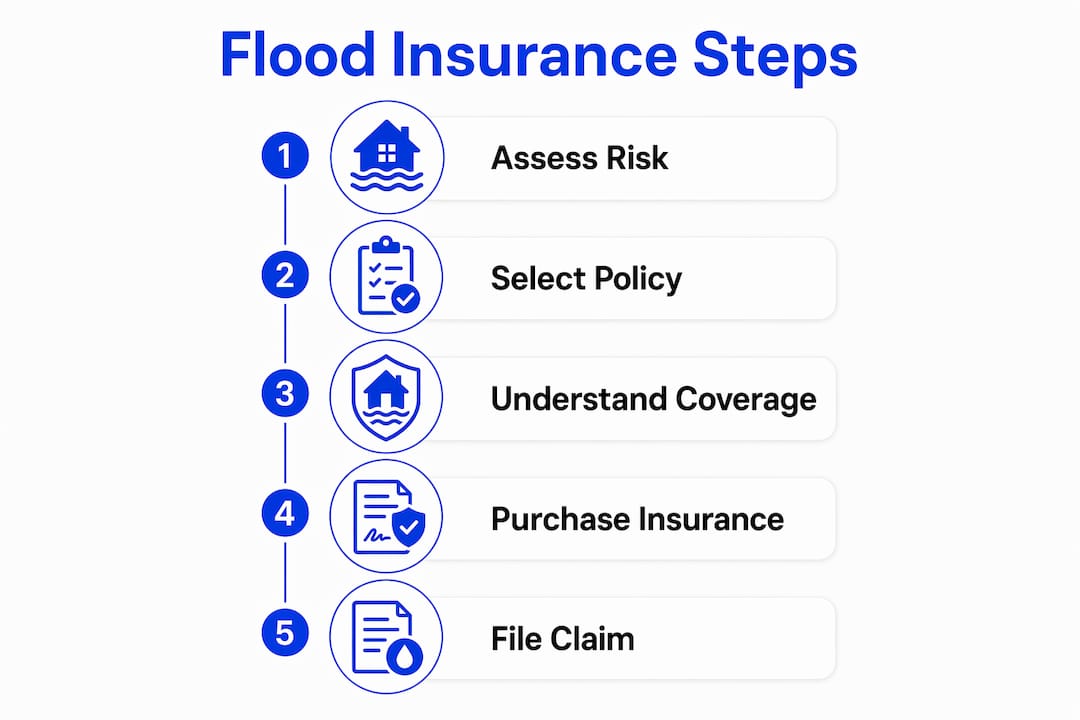
How to purchase flood insurance for a rental property
Getting covered is straightforward, but timing is everything. The NFIP’s 30-day waiting period means a policy purchased today does not protect you until next month. Do not wait until a storm is forming offshore.
Steps to get covered:
Check your flood zone. Visit FEMA’s Flood Map Service Center at msc.fema.gov to confirm your property’s flood zone designation before requesting quotes.
Get a quote. Use the NFIP Quote Tool at floodsmart.gov or contact your existing home or auto insurance agent. Most agents who sell property insurance can write NFIP policies.
Compare private market options. Private flood insurers can offer higher limits, faster claims processing, and loss-of-rent endorsements that NFIP excludes.
Purchase well before flood season. The standard 30-day waiting period has limited exceptions. Coverage activates immediately only when the policy is tied to a loan closing or a government-mandated purchase.
Confirm coverage amounts. NFIP caps building coverage for residential properties at $250,000. If your rental’s replacement cost exceeds that, a private excess flood policy fills the gap.
For high-value or short-term rentals, layering NFIP as a base with private excess coverage is a common approach among experienced investors. You get the federal program’s stability plus the private market’s flexibility on limits and endorsements.
What does flood insurance cost for a rental property?

Premiums vary widely based on risk. A property in a low-to-moderate risk zone might cost a few hundred dollars annually, while a coastal property in a V or VE zone can run several thousand dollars per year. Several factors drive that spread.
Key premium factors include:
Flood zone designation. Properties in high-risk A, AE, V, and VE zones pay significantly more than those in B, C, or X zones.
Building elevation. How your lowest floor sits relative to the Base Flood Elevation (BFE) is one of the strongest premium determinants. Every foot above BFE typically lowers your premium.
Building age and construction type. Older structures built before local flood maps were adopted often carry higher rates.
Deductible selection. Choosing a higher deductible reduces your annual premium but increases your out-of-pocket cost at claim time. Balance this against your cash reserves.
Coverage limits selected. Building and contents coverage are priced separately. Only buy contents coverage if you own furnished units or have equipment worth insuring.
The NFIP’s maximum building coverage for a residential rental is $250,000. Private insurers can go well beyond that, which matters for multi-unit or high-value properties. Rising insurance costs are already reshaping deal economics across real estate markets, so underwriting flood risk accurately before acquisition protects your ROI from day one.
Common misconceptions landlords have about flood insurance
Most landlords who get burned by flood damage had the same assumption: their existing policy covered it. It did not.
“My landlord policy covers floods.” Standard DP-3 and landlord policies exclude flood damage explicitly. Only a separate flood policy covers rising water.
“I only need flood insurance if I’m in a flood zone.” About one-third of NFIP claims come from properties outside designated high-risk zones. Flash flooding, urban runoff, and storm surge do not respect map boundaries.
“My flood policy covers my tenants’ stuff.” It does not. Tenant belongings require a separate contents-only policy in the tenant’s name.
“Flood insurance covers my lost rent.” NFIP policies do not include loss of rental income. If your property is uninhabitable for three months after a flood, that income gap is yours to absorb unless you have a private endorsement.
“I can buy coverage right before a storm.” The 30-day waiting period blocks last-minute purchases. Once a flood has begun, you cannot increase or initiate coverage.
“Federal disaster assistance will cover my losses.” FEMA disaster assistance is limited, requires a presidential disaster declaration, and often comes as a loan that must be repaid with interest.
Understanding these gaps is what separates a prepared investor from one who is surprised at the worst possible moment. For a broader look at protecting your rental assets, the coverage strategy goes well beyond flood insurance alone.
How FEMA flood zones affect your rental property coverage

FEMA designates flood zones based on risk level, and your zone determines whether flood insurance is mandatory and how much you will pay for it.
Zone classifications that matter most for landlords:
Zone X (B and C). Low-to-moderate risk. Flood insurance is not federally required but is still advisable given that a third of NFIP claims originate here.
Zone A. High-risk SFHA. Flood insurance is mandatory for federally backed mortgages. Flood data in Zone A is approximate, meaning BFE may not be established for every parcel.
Zone AE. High-risk SFHA with detailed hydraulic analysis and a defined Base Flood Elevation. BFE is the benchmark used to calculate your elevation certificate and, by extension, your premium.
Zone V and VE. Coastal high-risk zones subject to wave action in addition to flooding. These carry the highest premiums and the strictest building requirements.
Properties in Zone A or AE with federally backed mortgages are legally required to carry flood insurance. Lenders must notify borrowers of this requirement before closing.
Your flood zone can change when FEMA updates its maps. A rezoning from Zone X to Zone AE can trigger a mandatory purchase requirement and a significant premium increase overnight. Check the FEMA Flood Map Service Center at msc.fema.gov annually, especially if your property is near a waterway or coastal area.
Flood insurance requirements for rental properties
Whether flood insurance is required depends on two things: your flood zone and your mortgage type. Properties in SFHAs with loans backed by federally regulated lenders must carry flood insurance as a condition of the loan. This applies to single-family rentals, multi-unit residential buildings, and mobile or manufactured homes used as rentals.
If your rental is free and clear or financed through a private lender, no federal mandate applies. But that does not mean you should skip coverage. A flood that renders your property uninhabitable for months creates a cash flow crisis that no investor wants to manage without insurance backing it. Lenders also increasingly require flood insurance in moderate-risk zones as underwriting standards tighten. Review your loan documents and confirm your flood zone status before assuming you are exempt.
How to file a flood insurance claim for a rental property
Act fast after a flood. Delays in documentation can reduce your settlement.
Contact your insurer immediately. Report the loss as soon as it is safe to access the property. Your insurer will assign an adjuster.
Document everything before cleanup. Photograph and video all damage to the structure, systems, and any landlord-owned contents before moving or discarding anything.
Separate damaged from undamaged property. Create a written inventory of damaged items with estimated values and purchase dates.
Meet with the adjuster. Walk the property with the assigned adjuster and provide your documentation. Ask specifically how ACV depreciation will be applied to your claim.
Review the Proof of Loss. You will need to sign and submit a Proof of Loss statement, typically within 60 days of the flood. Missing this deadline can void your claim.
Understand your payout timeline. NFIP claims are paid based on ACV, so your settlement may be lower than your repair estimate. If you believe the settlement is inadequate, you can request a re-inspection or file an appeal.
Keeping a current inventory of your property’s systems, appliances, and finishes makes this process faster and protects you from disputes over depreciation calculations.
How to reduce flood insurance costs for your rental property
Lowering your premium does not require accepting more risk. Several legitimate strategies can reduce what you pay without cutting coverage where it counts.
Elevate the building or mechanical systems. Raising your lowest floor or moving HVAC equipment above the BFE can meaningfully reduce your premium. An elevation certificate documents the improvement.
Get an elevation certificate. If your property does not have one, a licensed surveyor can produce it. The certificate often reveals that your building sits higher than the flood map assumes, which can lower your rate.
Increase your deductible. If you have strong cash reserves, a higher deductible reduces annual premiums. Just confirm the deductible is manageable against your rental income.
Shop the private market. Private flood insurers sometimes offer lower premiums than NFIP for properties with favorable elevation and construction characteristics.
Participate in the Community Rating System (CRS). If your municipality participates in FEMA’s CRS program, you may qualify for NFIP premium discounts of up to 45% based on the community’s flood management activities.
Avoid coverage you do not need. If your units are unfurnished and tenants supply their own appliances, you likely do not need contents coverage under your landlord policy.
Protecting rental income and cash flow means treating flood insurance as a line item in your investment analysis, not an afterthought. The landlords who get this right price it into their acquisition model from day one.
Key Takeaways
Rental property flood insurance is a separate, mandatory policy for properties in high-risk FEMA flood zones with federally backed mortgages, covering building structure but not tenant belongings or lost rental income.
Point | Details |
Separate policy required | Standard landlord and DP-3 policies exclude flood damage; a standalone flood policy is the only protection. |
30-day waiting period | NFIP coverage takes effect 30 days after purchase, except when tied to a loan closing. |
Tenant belongings excluded | Tenants must buy their own NFIP contents-only policy; state this clearly in the lease. |
ACV settlement basis | NFIP pays claims on Actual Cash Value, factoring in depreciation, not full replacement cost. |
One-third of claims outside high-risk zones | About one-third of NFIP claims come from properties outside designated high-risk flood areas, making coverage wise even in lower-risk zones. |
Recommended
Comments