
How to Finance Your First Rental Property in 2026


What you need to know before financing your first rental property
Getting your first rental property financed comes down to three non-negotiables: enough capital for a down payment, a credit score that opens the right doors, and a loan structure that fits your income story. Skip any one of these, and the deal stalls before it starts.
Here is what lenders actually require in 2026:
Down payment: Investment property loans generally require 15–25% down, compared to 3–5% for a primary residence. FHA house hacking drops that to 3.5% if you occupy one unit.
Credit score: Conventional investment loans require 680 minimum, with 720+ for best rates. FHA loans accept 580+.
Reserves: Lenders require several months of PITI (principal, interest, taxes, and insurance) in liquid reserves, separate from your down payment.
Interest rates: Investment property mortgage rates run 0.5%–0.75% higher than primary residence rates in 2026.
Loan types: Several loan paths exist, including conventional loans, FHA house hacking, DSCR loans, home equity loans, HELOCs, seller financing, hard money loans, and cash-out refinances, each suited to different investor profiles.
Cash flow analysis: Budget a significant portion of gross rental income for operating expenses before applying for any loan.
Pre-approval: Get pre-approved with multiple lenders who specialize in investment property loans to compare rates and strengthen your offer.
Your first rental property is rarely a get-rich-quick move. It is a disciplined financial decision that rewards preparation.
How to prepare your finances and define your investment goals
Preparation is where most first-time investors either build a real foundation or waste six months chasing deals they cannot fund. Before you look at a single listing, your finances need to pass a readiness test.
Start with your “Magic Number.” Multiply your annual living expenses by 25. That figure represents the wealth threshold at which your investments could theoretically replace your paycheck. It is not your starting goal; it is your north star. Knowing it keeps you from confusing a $200/month cash-flowing rental with financial independence.
Build two separate funds, never one. An emergency fund covering 3–6 months of essential living expenses protects your life. An investment reserve, funded at 15–20% of your income, covers down payments and closing costs. Mixing them is one of the most common and costly mistakes new investors make.
Your credit score is your most controllable variable. Aim for 720+ before applying. At 740 and above, you access the best rate tiers on conventional loans. The difference between a 680 and a 740 score on a 30-year investment mortgage can translate to tens of thousands of dollars in interest over the life of the loan.
Pull your credit reports from all three bureaus (Equifax, Experian, TransUnion) and dispute any errors.
Pay down revolving balances below 30% utilization.
Avoid opening new credit accounts in the 6 months before applying.
Keep existing accounts open to preserve your average account age.
Get pre-approved with 3+ lenders who specifically handle investment property loans, not just primary residence mortgages. Pre-approval documents your borrowing power, speeds up your offer timeline, and lets you compare rates side by side. Lenders vary more than most first-time investors expect.
Set clear investment goals before you shop. Define your target monthly cash flow, preferred property type (single-family, duplex, small multifamily), and intended holding period. A 5-year flip strategy calls for different financing than a 20-year buy-and-hold. Knowing your exit shapes every loan decision you make.

Loan options for first-time rental property investors
No single loan fits every investor. Your income type, available capital, credit score, and risk tolerance determine which path actually works for you.
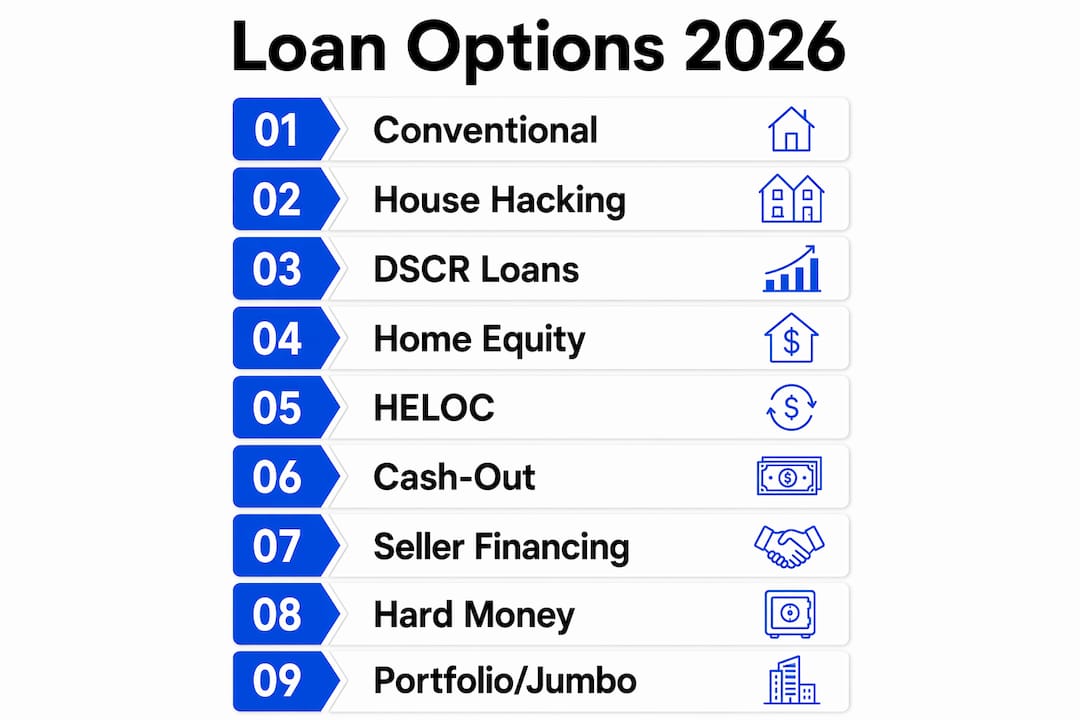
1. Conventional investment property loans
The default choice for most first-time investors with W2 income and solid credit. Conventional loans follow Fannie Mae and Freddie Mac guidelines, which means predictable underwriting and competitive rates. You need 15–25% down, a 680+ credit score, and 6–12 months of PITI in reserves. Rates run 0.5%–0.75% above primary residence rates. For a $250,000 property, budget $50,000–$62,500 for the down payment alone, plus closing costs and reserves on top.
2. House hacking with FHA or VA loans
House hacking means buying a 2–4 unit property, living in one unit, and renting the others. Because you occupy the property, it qualifies as a primary residence for financing purposes. FHA loans require just 3.5% down with a 580+ credit score. VA loans require 0% down for eligible active-duty military and veterans. The catch: you must owner-occupy for at least 12 months. For investors with limited capital, this is the lowest-cost entry path available. A $250,000 duplex requires roughly $8,750 down via FHA versus $50,000–$62,500 conventional.
3. DSCR loans
A Debt Service Coverage Ratio loan qualifies you based on the property’s rental income rather than your personal W2 or tax returns. DSCR loans are the fastest-growing rental loan product in the U.S. and are especially useful for self-employed investors or anyone whose tax returns understate their actual income. You need 20–25% down and a credit score of 660+, with best rates at 740+. The lender calculates your DSCR (net operating income divided by annual debt service) and wants to see 1.25 or higher.
4. Home equity loans
Home equity loans allow borrowing against your primary residence equity with a fixed interest rate. They enable access to capital for down payments on rentals while keeping your existing mortgage. Adequate equity, good credit, and manageable debt-to-income ratios are generally required. The fixed terms facilitate long-term planning.
5. HELOC (Home Equity Line of Credit)
A HELOC works like a revolving credit line secured by your home equity, with a variable interest rate. You draw funds as needed up to a set limit during the draw period, which makes it flexible for staging a down payment or funding repairs. HELOCs and home equity loans both require 15–25% existing equity and a 680+ credit score. The variable rate is the key risk: if rates rise after you draw, your carrying cost rises with them. Use a HELOC for short-term bridge financing, not as the permanent funding source for a buy-and-hold rental.
6. Cash-out refinance
This replaces your existing mortgage with a larger loan and lets you borrow cash against your equity. The interest rate is often lower than other home equity products. Lenders require you to retain significant equity after cashing out, have good credit, and maintain a reasonable debt-to-income ratio. Recently purchased properties may require seasoning. This option suits investors looking to deploy built-up equity into rentals without multiple loans.
7. Seller financing
In seller financing, the property seller acts as the lender. You make installment payments directly to them under terms you negotiate, which can include flexible down payments, interest rates, and repayment schedules. This path works best on off-market deals where the seller has no mortgage and wants a steady income stream. The trade-off is that seller financing often carries higher interest rates than conventional loans and requires careful legal documentation to protect both parties. Treat it as a situational tool, not a default starting point.
8. Hard money loans
Hard money loans are short-term, asset-based loans from private lenders or companies, secured primarily by the property’s value rather than your creditworthiness. They close fast, sometimes in 5–10 days, but carry high interest costs and are designed for flips or bridge financing, not long-term holds. Down payments range from 10–30% depending on the lender and deal. If you plan to buy, renovate, and refinance (the BRRRR strategy), hard money can bridge the gap between purchase and permanent financing. For a straight buy-and-hold first rental, the cost structure rarely pencils out.
9. Portfolio loans and jumbo loans
Portfolio loans are held by the originating lender rather than sold to Fannie Mae or Freddie Mac, which gives lenders more flexibility on underwriting criteria. They suit investors with multiple properties, non-traditional income, or properties that do not meet conventional guidelines. Jumbo loans cover properties that exceed conforming loan limits and typically require higher credit scores, larger down payments, and lower DTI ratios. Both are more relevant once you are scaling beyond your first or second property, but knowing they exist helps you plan your financing roadmap from the start.
How to budget for operating expenses and manage cash flow
Cash flow indicates whether your rental property is profitable. It is essential to budget accurately before purchase.
Budget a significant portion of gross rental income for operating expenses, including taxes, insurance, maintenance, vacancy, and property management fees. Skipping this step often leads to overestimating cash flow.
Key metric: Lenders prefer a DSCR of 1.25 or higher, meaning your net operating income covers your debt service by 25%. A DSCR below 1.0 means the property loses money every month before any unexpected repairs.
The 1% rule needs updating for 2026 rates. The old benchmark said monthly rent should equal at least 1% of the purchase price. At current investment property rates of 6.75%–7.25%, you actually need 1.1%–1.2% for positive cash flow. A $250,000 property needs roughly $2,750–$3,000/month in rent, not $2,500. Run that number before you make any offer.
Your reserve budget extends well beyond the down payment. Plan for closing costs at 2–5% of the purchase price, a repair contingency fund, and 6–12 months of PITI in liquid reserves after closing. For a conventional purchase, total capital requirements typically run $40,000–$90,000. FHA house hacking can reduce that to $15,000+, but reserves and closing costs still apply.

Track income and expenses from day one. Use a dedicated account for rental income and expenses, separate from your personal finances. This simplifies tax preparation, clarifies your actual cash-on-cash return, and gives you the data you need to make informed decisions about rent increases, repairs, and future acquisitions. Explore cash flow management strategies to build a system that scales with your portfolio.
How to navigate the purchase and loan application process
Once your finances are ready and your target property pencils out, the path from offer to closing follows a predictable sequence. Knowing each step in advance prevents costly delays and protects your earnest money.
Get pre-approved before you offer. Pre-approval from multiple lenders documents your borrowing power and signals to sellers that you are a serious buyer. It also gives you a rate baseline to negotiate against. Pre-approval typically takes 3–7 business days.
Submit earnest money of 1–3% of the purchase price. This deposit, held in escrow, shows the seller you are committed. You get it back if a contingency fails; you lose it if you walk away without cause.
Use three contingencies to protect your position. An inspection contingency (7–14 days) lets you hire a professional inspector and negotiate repairs or exit the deal. A financing contingency protects you if your loan falls through. An appraisal contingency ensures the lender’s valuation supports the purchase price.
Always hire a professional inspector. A thorough inspection costs $300–$800 and surfaces issues you cannot see during a walkthrough. Roof problems, foundation concerns, and HVAC failures are the most expensive surprises in rental properties.
Budget for closing costs of 2–5% of the purchase price. The national average across markets runs approximately $6,900. Closing timelines typically run 30–45 days from an accepted offer for conventional and FHA loans. Hard money can close in 5–10 days for the right deal.
Prepare your tenant screening and property management plan before closing. Decide whether you will self-manage or hire a property manager. Self-management costs nothing in fees but requires your time and attention. Professional management typically costs 8–12% of monthly rent plus leasing fees. For a first property you can visit easily, self-management is a reasonable starting point.
Pro Tip: Before closing, verify that projected rents are supported by current comparable leases in the area, not just listing prices. Overestimating rent by even $150/month can turn a cash-flowing deal into a break-even one after expenses.
For a deeper look at financing strategies with limited cash, the path from pre-approval to closing is covered step by step.
Expert advice on common pitfalls when financing your first rental property
First-time investors tend to make the same mistakes. Knowing them in advance does not make you immune, but it does make you harder to surprise.
Underestimating reserves is the most common and most damaging error. The down payment and closing costs are just the entry fee. Lenders require 6–12 months of PITI in liquid reserves after closing, and that figure does not include repair contingencies or vacancy buffers. Running out of reserves in month three because a water heater failed is not bad luck; it is a planning gap.
House hacking is powerful, but it requires a genuine commitment. Living next to your tenants for 12 months is not for everyone. If you are not willing to owner-occupy, FHA financing is off the table. Be honest with yourself before you structure a deal around it.
Your first rental property is a learning asset, not a lottery ticket. First properties usually serve as learning tools rather than instant wealth generators. Focus on stable operations, consistent cash flow, and building the systems that let you scale. The investors who build large portfolios almost universally credit their first property with teaching them what they needed to know, not with making them rich.
Be conservative in your cash flow projections. Use the 35–50% expense ratio even if the property looks pristine. Deferred maintenance, unexpected vacancies, and capital expenditures (roof, HVAC, plumbing) arrive on their own schedule, not yours.
Variable-rate products carry real risk on long holds. HELOCs and adjustable-rate mortgages work well as short-term bridge tools. On a property you plan to hold for 10+ years, a variable rate introduces payment uncertainty that can erode your cash flow when rates rise. Fix your rate whenever the math supports it.
Vet your contractors before you pay them anything. Get at least three bids, check references, and never pay more than the completed work warrants. Paying 50% upfront to an unvetted contractor is one of the most reliable ways to lose money in real estate.
Push your credit score above 740 before you apply. A credit score above 740 is the single most effective way to reduce your loan rate and improve your financing options across every loan type. The rate improvement compounds over a 30-year mortgage into a material difference in total cost.
Pro Tip: Run your numbers at both 6.75% and 7.25% interest rates before making an offer. If the deal only works at the lower rate, it is too thin. A deal that cash flows at 7.25% gives you a real margin of safety.
At 2ndstreetpropertymanagement, we work with investors at every stage of this process, from pre-purchase analysis to ongoing property management. If you are ready to take the next step, explore our investor resources or connect with our team directly.
Key Takeaways
Financing your first rental property requires a minimum 15–25% down payment, a 680+ credit score, 6–12 months of PITI in reserves, and a clear-eyed cash flow analysis before you make any offer.
Point | Details |
Down payment range | Conventional loans require 15–25% down; FHA house hacking drops that to 3.5% with owner-occupancy. |
Reserve requirement | Lenders require 6–12 months of PITI in liquid reserves, separate from your down payment and closing costs. |
Operating expense budget | Allocate 35–50% of gross rental income to taxes, insurance, maintenance, vacancy, and management fees. |
Credit score threshold | A score of 740+ unlocks the best loan rates and is the single highest-leverage rate improvement available. |
DSCR target | Lenders prefer a Debt Service Coverage Ratio of 1.25 or higher; below 1.0 means the property loses money monthly. |
Recommended
Comments