
What Is a Multi-Family Property? Investor's Guide


A multi-family property is a residential building with two or more independent housing units, each with its own kitchen, bathroom, and entrance. The industry term is “multifamily real estate,” and it covers everything from a duplex on a quiet street to a 200-unit apartment complex. Properties with 2 to 4 units fall under residential classification and qualify for conventional financing. Properties with 5 or more units shift into commercial territory, which changes how you buy, finance, and manage them. If you are researching real estate investment options, understanding this distinction is the single most important thing you can learn before making any purchase decision.
What is a multi-family property and how is it classified?
The classification system for multifamily real estate is more structured than most first-time investors realize, and it directly affects your financing options, legal obligations, and management strategy.
The most common property types break down as follows:
Duplex: Two units in one building, sharing a wall or stacked vertically. The most accessible entry point for individual investors.
Triplex: Three units under one roof. Still financed as residential property with a conventional loan.
Fourplex: Four units. The last tier before commercial classification kicks in.
Garden apartments: Low-rise complexes, typically 2 to 3 stories, with 5 to 50 units. These require commercial financing.
Large multifamily complexes: Mid-rise and high-rise buildings with 50 or more units, typically owned by institutional investors or real estate investment trusts.
The 2-to-4 unit versus 5-plus unit line is not arbitrary. It determines whether you apply for a residential mortgage through lenders like Wells Fargo or Chase, or whether you need a commercial loan with different underwriting standards, higher down payments, and shorter amortization periods.
Ownership patterns reflect this divide clearly. Individual investors own 64% of 2-to-4 unit multifamily properties, which means the small-scale segment is genuinely accessible to everyday investors rather than dominated by large firms. That accessibility disappears fast once you cross into the 5-plus unit range, where institutional capital competes more aggressively.
Beyond unit count, multifamily properties are also graded by asset class. Class A, B, C, and D are defined by age, condition, and location. Class A targets luxury tenants with premium amenities. Class B and C properties are older, often in transitional neighborhoods, and offer value-add opportunities where you improve the asset and raise rents over time. Most individual investors target Class B or C because the entry price is lower and the upside is real.
Property type | Unit count | Financing type | Typical owner |
Duplex | 2 | Conventional residential | Individual investor |
Triplex | 3 | Conventional residential | Individual investor |
Fourplex | 4 | Conventional residential | Individual investor |
Garden apartment | 5 to 50 | Commercial loan | Small to mid-size investor |
Large complex | 50+ | Commercial or institutional | Institution or REIT |
What are the advantages of owning multi-family real estate?
The core financial case for multifamily investment rests on four pillars: income diversification, tax efficiency, economies of scale, and demand resilience.
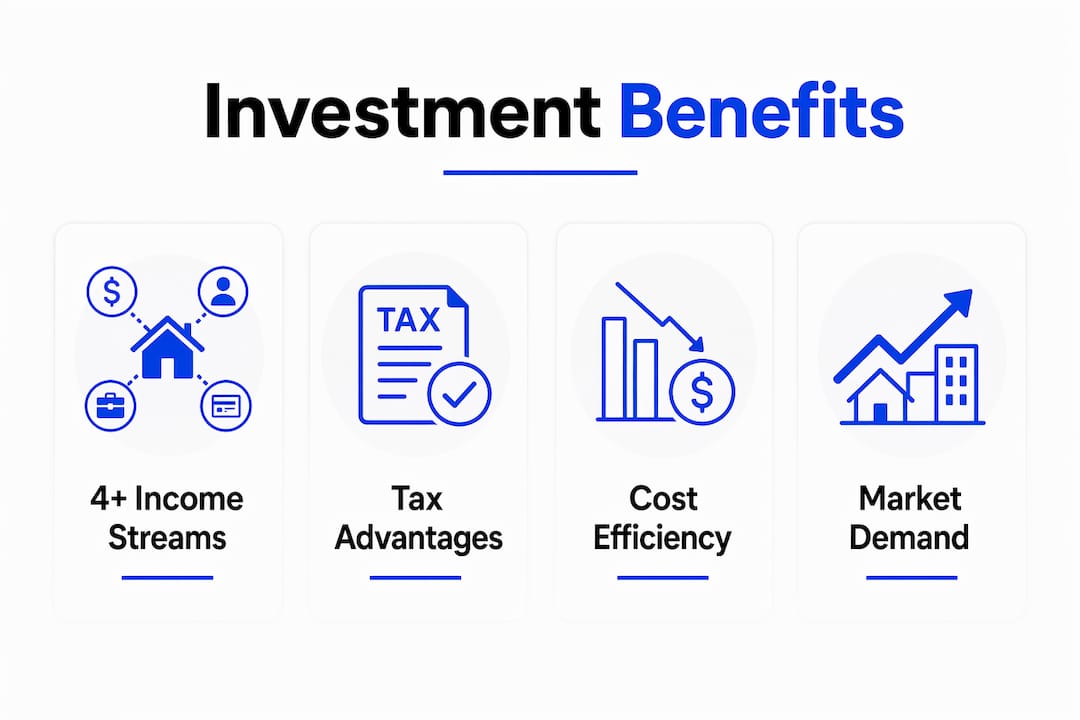
Multiple income streams reduce vacancy risk. A single-family rental that sits vacant earns zero dollars. A fourplex with one vacant unit still generates 75% of its gross rent. That math matters enormously when you are covering a mortgage and operating expenses every month.

Tax advantages are substantial. Multifamily owners can reduce taxable income through depreciation, deductible maintenance costs, and management fee write-offs. Depreciation alone allows you to show a paper loss on a cash-flowing property, which offsets income from other sources. For a deeper breakdown of how these deductions work in practice, the tax benefits of real estate are worth studying before your first purchase.
Economies of scale cut your cost per unit. One roof inspection covers four units instead of one. One property manager handles an entire building instead of four separate addresses. One insurance policy covers the whole structure. As your portfolio grows, these efficiencies compound.
Demand is structurally durable. Two-thirds of renters occupy multifamily units out of necessity rather than preference. They are not choosing between renting and buying based on lifestyle. They are renting because ownership is out of reach. That structural demand stabilizes your income stream even when the broader economy softens.
Pro Tip: If you are buying your first multifamily property, consider a house-hack strategy. Purchase a 2-to-4 unit property, live in one unit, and let the rental income from the other units cover most or all of your mortgage. You get owner-occupant financing rates, which are lower than investment property rates, and you build equity while your tenants pay down your debt.
How to evaluate and finance a multi-family property purchase
Buying multifamily real estate is not the same as buying a single-family home. The evaluation process is more rigorous, and the financing structure depends heavily on unit count.
Here is a practical sequence for evaluating any multifamily purchase:
Assess the physical condition of every unit. Inspect roofing, plumbing, electrical panels, HVAC systems, and foundation. Older properties often lack sufficient electrical capacity for modern demands, and retrofitting infrastructure after purchase costs far more than accounting for it in your offer price.
Verify rental compliance and zoning. Check for pending municipal regulations or zoning changes that could restrict how you use the property. A building currently operating as a fourplex in a zone being reconsidered for single-family use is a serious risk that due diligence catches before closing.
Analyze the rent roll and lease terms. Review every active lease, current rent versus market rent, and any deferred rent agreements. The gap between in-place rents and market rents tells you your upside potential.
Calculate your key metrics. Net operating income (NOI), cap rate, and cash-on-cash return are the three numbers that matter most. Do not buy on gross rent alone. Factor in vacancy, maintenance reserves, insurance, taxes, and management fees.
Understand your financing options. For 2-to-4 unit properties, conventional residential loans through Fannie Mae or Freddie Mac guidelines apply. Down payments typically range from 15% to 25% for investment properties. For 5-plus unit properties, you need a commercial loan, which carries different debt service coverage ratio (DSCR) requirements and often a 25% to 30% down payment minimum.
Pro Tip: If you plan to owner-occupy one unit in a 2-to-4 unit property, you may qualify for FHA financing with as little as 3.5% down. That is one of the most capital-efficient entry points in all of real estate investing.
What are the management challenges for multi-family properties?
Owning a multifamily property is an active business, not a passive investment. The investors who lose money in this asset class almost always share one trait: they underestimated the management workload.
The core challenges break down into three categories:
Tenant screening and turnover. Every vacancy costs you money in lost rent, cleaning, repairs, and leasing fees. Rigorous tenant screening, including credit checks, income verification, and rental history, is your first line of defense against delinquency and damage.
Maintenance and deferred repairs. Deferred maintenance leads directly to higher turnover and rent delinquencies. Tenants leave poorly maintained properties. Proactive maintenance scheduling, not reactive repairs, is what separates profitable operators from struggling ones. A solid maintenance cost budgeting approach prevents small issues from becoming expensive emergencies.
Rent collection and delinquency. Consistent enforcement of lease terms and a clear late-fee policy reduces the frequency of payment problems. Soft enforcement creates patterns that are hard to reverse.
Property management software platforms like AppFolio, Buildium, and Rentec Direct automate rent collection, maintenance requests, and lease tracking. For investors managing more than four units, these tools pay for themselves in time savings and reduced errors.
The alternative to self-management is hiring a professional property management company. This makes sense when your time is limited, when you own properties in multiple markets, or when the management complexity exceeds your bandwidth. For practical guidance on managing rental properties effectively, the operational details matter as much as the purchase decision itself.
Key takeaways
Multifamily real estate rewards investors who understand the classification system, run disciplined numbers, and treat property management as a core business function rather than an afterthought.
Point | Details |
Classification drives financing | Properties with 2 to 4 units use residential loans; 5-plus units require commercial financing with stricter terms. |
Individual investors dominate small multifamily | 64% of 2-to-4 unit properties are owned by individuals, making this segment genuinely accessible. |
Demand is structurally stable | Two-thirds of renters occupy multifamily units out of necessity, which buffers income during economic downturns. |
Tax advantages are real | Depreciation and deductible expenses reduce taxable income, creating advantages over single-family ownership. |
Management quality determines returns | Deferred maintenance and poor tenant screening are the leading causes of underperformance in multifamily portfolios. |
Why multifamily is still the best market for disciplined individual investors
I have watched investors chase single-family portfolios, commercial office buildings, and short-term rentals. Most of them eventually circle back to multifamily. The reason is simple: this asset class rewards local knowledge and hands-on management in a way that institutional capital cannot easily replicate.
The top 50 multifamily firms own less than 11% of U.S. apartment stock, and no single company controls more than 0.5%. That fragmentation is not a weakness. It is an opportunity. You are not competing against BlackRock for a duplex in your city. You are competing against other local operators, and the investor with better market knowledge, tighter operations, and faster maintenance response wins.
What I tell every investor starting out: do not buy a fourplex in a market you have never visited because the cap rate looks good on a spreadsheet. Multifamily is a hyperlocal business. Vacancy rates, rent growth, and tenant quality vary block by block in some cities. The investor who knows their submarket cold will outperform the one who relies on aggregated data every single time.
Start small. A duplex or triplex gives you real management experience without overwhelming complexity. Learn the business at that scale before you move into garden apartments or larger complexes. The skills transfer directly, and the mistakes are far less costly.
— Main
How 2ndstreetpropertymanagement helps multifamily investors protect their returns
Managing a multifamily property well is a full-time job, and most investors did not get into real estate to spend their evenings chasing maintenance requests. 2ndstreetpropertymanagement was built by investors for investors, which means the team understands what your cash flow depends on and what threatens it.
From tenant screening and lease enforcement to maintenance coordination and financial reporting, 2ndstreetpropertymanagement handles the operational side so you can focus on growing your portfolio. Whether you own a duplex or a 20-unit building, the right management partner protects your asset and your income. Visit 2ndstreetpropertymanagement.com to learn how their property management services can support your multifamily investment goals.
FAQ
What qualifies as a multi-family property?
Any residential building with two or more independent units, each with its own kitchen, bathroom, and entrance, qualifies as a multifamily property. Common examples include duplexes, triplexes, fourplexes, and apartment buildings.
What is the difference between single-family and multi-family?
A single-family property contains one housing unit for one household, while a multifamily property contains two or more independent units. The key investment difference is that multifamily properties generate multiple income streams from a single purchase and a single mortgage.
How is financing different for multi-family properties?
Properties with 2 to 4 units qualify for conventional residential loans through standard lenders, while properties with 5 or more units require commercial financing with different underwriting standards, higher down payments, and shorter loan terms.
Do I need a property manager for a multi-family investment?
Self-management works for investors with time, local presence, and operational experience. For investors managing multiple properties or properties in different markets, a professional property management company reduces workload and typically improves tenant retention and maintenance response times.
What are the best types of multi-family properties for new investors?
Duplexes and triplexes are the most accessible entry points because they qualify for residential financing and allow owner-occupancy strategies. Class B and C properties in stable rental markets offer value-add potential without the complexity of large commercial assets.
Recommended
Comments