
HAP Math in Minutes: HUD Rules and Worksheet for Section 8 Landlords

The Housing Assistance Payment equals whichever is smaller: the PHA’s payment standard minus the tenant’s total tenant payment (TTP), or the gross rent minus TTP. Gross rent is contract rent plus the PHA-approved utility allowance. If your gross rent runs higher than the payment standard, the tenant absorbs that gap dollar for dollar, on top of their TTP.
TL;DR:
Most rejected HAP requests stem from using outdated utility allowances, citing assisted units as comparables, or failing to disclose the payment standard difference upfront.
PHAs set payment standards within 90% to 110% of fair market rent, with some areas applying ZIP-code level Small Area Fair Market Rents, causing regional variations.
Setting contract rent above the payment standard shifts the payment difference to the tenant, requiring clear communication during lease shows to prevent trust issues and turnover.
Documenting rent reasonableness with at least three unassisted comparables is crucial and must be updated regularly to avoid delays or rejections.
A property management company can handle calculations, documentation, and PHA filings, saving landlords time and reducing errors in Section 8 compliance.
Table of Contents
Section 8 Rent Calculation Checklist: What to Gather First
You cannot compute an accurate HAP without four numbers in hand before you touch a worksheet. Skipping any one of them is how landlords end up with rejected rent increases or a tenant blindsided by a bill they did not expect.
Pull these together before you open your local PHA’s HAP calculation form:
The current payment standard for the voucher’s bedroom size, plus any Small Area Fair Market Rent (SAFMR) or exception adjustment tied to the property’s ZIP code
The PHA-approved utility allowance for the unit, noting which utilities the tenant pays directly versus what you cover as the owner
Your proposed contract rent and the tenant’s TTP, which you can confirm with your PHA caseworker if it is not already on file
Comparable unassisted unit rents, ideally with photos, dates, and addresses or general location details
The correct local intake form, commonly a HUD-52517 Request for Tenancy Approval or an equivalent PHA-specific HAP worksheet
Have those five items on your desk and the actual arithmetic takes minutes.
Step-by-Step: Calculating HAP and Tenant Rent to Owner
Every Section 8 rent calculation runs through five defined terms. Contract rent is what you charge for the unit alone. Utility allowance (UA) is the PHA’s estimate of tenant-paid utility costs, added to contract rent to produce gross rent. The payment standard is the PHA’s local subsidy cap for that voucher size, set following the HCV Guidebook’s payment standards rules. TTP is the tenant’s total tenant payment, calculated by the PHA from household income.
The formula itself never changes: HAP = the lower of (payment standard − TTP) or (gross rent − TTP). Tacoma Housing Authority’s public rent calculation resources walk through this exact mechanic using worked HAP worksheets, and the logic transfers to any PHA nationwide.
Example A: Gross rent at or below the payment standard.
Contract rent: $1,200. Owner-paid utilities, so UA = $0. Gross rent = $1,200.
Payment standard for a two-bedroom voucher: $1,350.
Tenant TTP: $400.
Payment standard minus TTP: $1,350 − $400 = $950.
Gross rent minus TTP: $1,200 − $400 = $800.
HAP = the lower figure = $800. Tenant rent to owner = $400 (their TTP in full).
Example B: Gross rent above the payment standard.
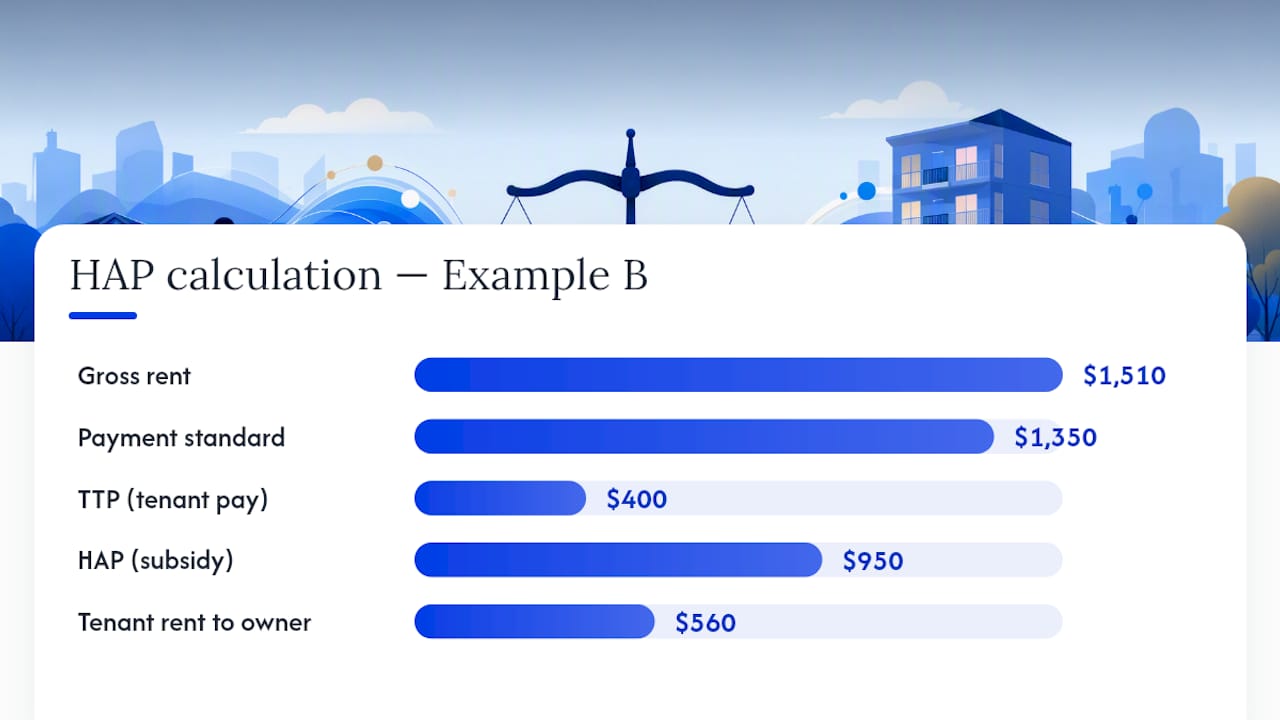
Contract rent: $1,450. Tenant pays gas heat separately, UA = $60. Gross rent = $1,510.
Payment standard: $1,350. TTP: $400.
Payment standard minus TTP: $1,350 − $400 = $950.
Gross rent minus TTP: $1,510 − $400 = $1,110.
HAP = the lower figure = $950.
Payment standard difference: gross rent minus payment standard = $1,510 − $1,350 = $160. Tenant rent to owner = TTP + payment standard difference = $400 + $160 = $560.
Pro Tip: Confirm which figure your PHA’s worksheet field actually asks for. On a HUD-52517-style form, gross rent, payment standard, TTP, and HAP each get a dedicated line. Enter contract rent and UA separately even though gross rent is their sum since auditors check that the addition matches.
How Payment Standards and Utility Allowances Actually Work
Your PHA does not set the payment standard arbitrarily. HUD requires it to fall within a basic range of 90% to 110% of the applicable Fair Market Rent, and PHAs covering metro areas increasingly apply Small Area Fair Market Rents at the ZIP-code level rather than one flat number citywide. That means two units a few miles apart, inside the same PHA jurisdiction, can carry meaningfully different caps.
A few operational points worth tracking:
Some PHAs request HUD-approved exception payment standards above the normal 110% ceiling for specific submarkets, so check your PHA’s current administrative plan rather than assuming last year’s figures still apply.
Utility allowances are PHA-set estimates, not your actual utility bills, and you must use the PHA’s published UA schedule in your gross rent math regardless of what a tenant’s real usage looks like.
Setting contract rent close to the payment standard keeps your total gross rent competitive with the local voucher market. Push contract rent well above it, and you shift real cost onto the tenant, which can affect how quickly a unit leases.
Utility allowance changes deserve their own attention if you cover any utilities yourself. Review how utility management choices affect gross rent before locking in a rent request.
Rent Reasonableness: Comparables, Evidence, and Timing
PHAs cannot approve your rent request on the payment standard alone. Federal regulation requires a documented comparability analysis using at least three comparable unassisted units, on-site comparables where the property has enough unassisted units to draw from, per PIH Notice 2020-19. Comparability turns on location, unit size, age, quality, and amenities, not just square footage.
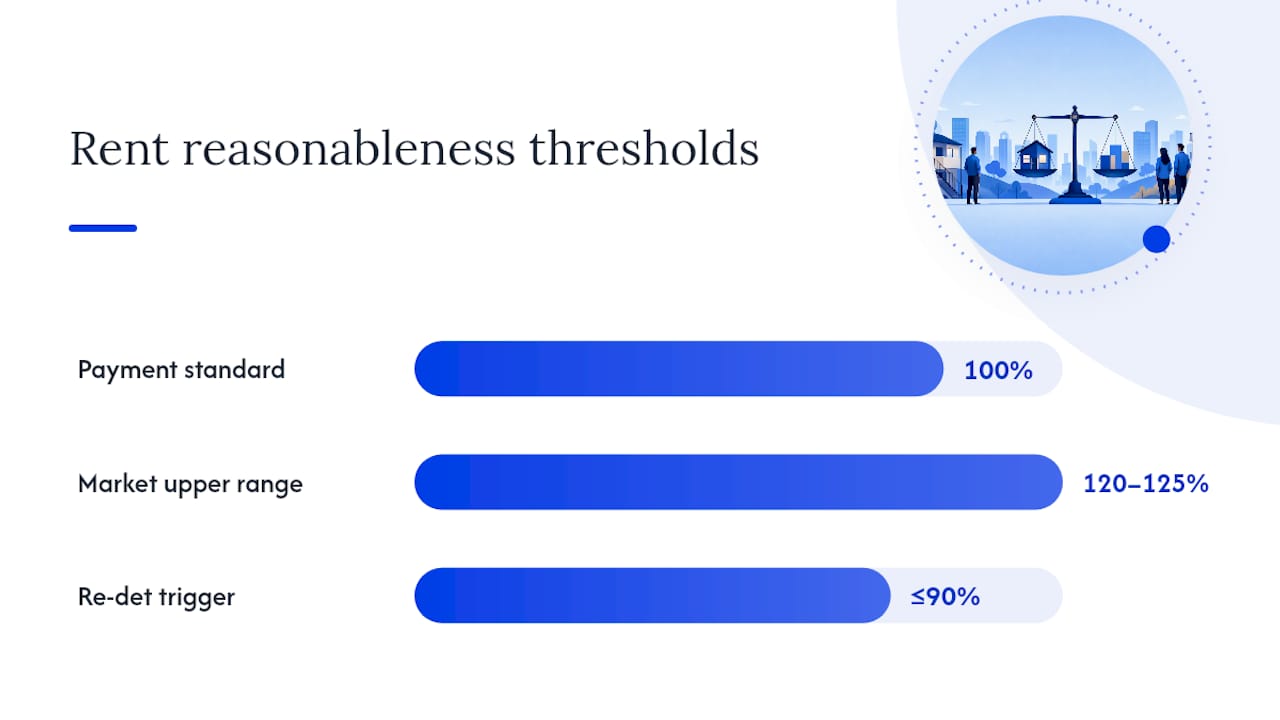
HUD’s rent reasonableness guidebook goes further, recommending PHAs gather market data spanning a range that includes units priced 20 to 25% above the payment standard when that data is available, so the comparison isn’t artificially compressed near the subsidy cap. Under 24 CFR § 983.303, accepting a HAP contract is itself an owner certification that you are not charging more than comparable unassisted units on the same premises.
Build a documentation packet that includes:
Owner certification of on-site unassisted rents, if the property has other unassisted units
Dated market listings with addresses or general location, screenshots, or printouts
Photos showing unit condition, finishes, and amenities
A lease abstract or rent roll excerpt for each comparable cited
A dated comparability worksheet tying each comparable to the subject unit’s specs
Re-determination isn’t a one-time event. PHAs must run it before the initial HAP contract, before approving any rent increase, and when HUD directs it or FMRs drop by 10% or more in the area.
Pro Tip: Keep a standing “rent reasonableness packet” template per unit, updated with fresh comparables every time you request an increase, rather than building one from scratch each cycle. It cuts approval turnaround significantly. For increase timing specifics, see filing a Section 8 rent increase.
Mistakes That Get Section 8 Rent Requests Rejected
Most rejected HAP calculations trace back to a small set of repeat offenders, and every one of them is preventable with a checklist.
Using the wrong utility allowance. Landlords sometimes apply an outdated UA schedule or guess at tenant-paid utilities instead of pulling the current PHA figure, which throws off gross rent from the start.
Citing assisted units as comparables. PHAs require unassisted comparables. A rent-reasonableness packet built on other voucher units in the same building gets kicked back every time.
Failing to disclose the payment standard difference at lease-up. If gross rent exceeds the payment standard, tell the prospective tenant the exact dollar amount before signing, not after the first invoice.
Fix each with a habit: verify the PHA’s payment standard and UA schedule before finalizing contract rent, keep a dated comparables packet on file for every unit, and add payment standard difference language directly into the lease addendum. Timestamp every email or portal submission to the PHA, and file the worksheet and owner certification in the tenant’s folder the same day you calculate it. Review common Section 8 landlord mistakes for a longer list of what trips up first-time voucher landlords.
How 2ndstreetpropertymanagement Handles the Numbers for You
A professional property management company can build rent-reasonableness packets and run HAP worksheets as part of managing Section 8 units, drawing on HUD citations and PHA-tested processes. Such a team may act as the PHA liaison, handle rent-increase filings within local deadlines, and keep the documentation trail intact from lease-up through re-determination. For a deeper walk-through of the workflow, see our Section 8 landlord field manual.
Why Landlords Underestimate the Payment Standard Difference
Most guidance on Section 8 treats the payment standard as if it were a rent ceiling. It isn’t. It’s a subsidy cap, and the distinction changes how you should price a unit.
Set contract rent above the payment standard and HUD’s rules let you do it. Nothing in the regulation stops you. What changes is who pays the difference: the tenant, not the PHA, and not you. That’s where landlords get into trouble. They calculate the HAP correctly, get the number they expected, and then act surprised when a prospective tenant walks away from a lease because the payment standard difference pushed their out-of-pocket rent higher than they can sustain.
The fix isn’t a different formula. It’s a different conversation, one that happens before the lease is signed, not after the first rent statement lands. Tell the tenant the exact payment standard difference in dollars at the showing, not as a footnote in the lease packet. Landlords who skip that step aren’t miscalculating rent. They’re miscalculating trust, and that costs more in turnover than any rent-reasonableness rejection ever will.
The other blind spot is documentation timing. Landlords treat the comparables packet as something you build when a PHA asks for it. By then you’re reconstructing photos and listings from memory, scrambling before a deadline. Treat it instead as a living file you update every time you touch the unit. It’s the difference between a rent increase that clears in a week and one that stalls for a month while you dig up evidence you should have had on hand already.
— Main
Get Your Section 8 Rent Calculations Handled Correctly
Running the HAP math yourself is doable with the checklist above, but keeping every unit’s payment standards, utility allowances, and comparables packet current across a growing portfolio is where most self-managing landlords lose time. 2ndstreetpropertymanagement handles managed Section 8 compliance end to end, from HAP worksheets to rent-reasonableness documentation to PHA correspondence, so your numbers stay defensible without you tracking every notice yourself.
If you own or manage Section 8 units in Southern New Jersey and want a packet review before your next rent increase filing, reach out to 2ndstreetpropertymanagement to get started.
FAQ
What Is the Formula for Calculating Section 8 HAP?
HAP equals the lower of (payment standard minus TTP) or (gross rent minus TTP), where gross rent is contract rent plus the PHA-approved utility allowance.
Who Pays the Difference When Gross Rent Exceeds the Payment Standard?
The tenant pays it. This payment standard difference gets added directly to their TTP to form the tenant’s total rent to owner.
How Often Do PHAs Check Rent Reasonableness?
PHAs must confirm rent reasonableness before the initial HAP contract, before any rent increase, and whenever FMRs drop by 10% or more or HUD directs a review.
How Many Comparable Units Does a PHA Need for Rent Reasonableness?
At least three comparable unassisted units, matched on location, size, age, quality, and amenities, with on-site comparables used where available.
Can 2ndstreetpropertymanagement Handle My HAP Calculations and PHA Filings?
Some property management companies prepare rent-reasonableness packets, run HAP worksheets, and manage PHA communication and rent-increase filings for Section 8 landlords in their service areas.
Recommended
Comments