
U.S. Landlords: 10 Steps to Fraud Resistant Tenant Income Verification


Verify income for every applicant using corroboration: a core document set plus at least one independent confirmation, whether that’s an employer’s verification of employment or direct-source payroll data. This baseline cuts eviction risk and shuts down the kind of paystub fabrication that’s become common in rental applications. Where a fast, low-friction check is available, pull tax transcripts through the IRS Income Verification Express Service or run applicants through a structured screening system like the one 2ndstreetpropertymanagement uses across its own portfolio.
TL;DR:
Verifying tenant income requires multiple checks, including document review, employer verification, and direct-source payroll confirmation, to prevent fraud.
Cross-referencing pay stubs, bank statements, and employer information increases detection of fabricated documents beyond relying on a single piece of evidence.
Automated, direct-source verification tools are faster, more reliable, and essential for high-volume screening, reducing fraud risk and saving time.
Applying consistent rent-to-income thresholds, adjusted for vouchers or partial subsidies, is crucial for fair and effective tenant qualification.
Most landlords underinvest by trusting documents at face value without thorough cross-checks, which allows fraudulent applications to slip through.
Table of Contents
What Income Verification for Tenants Actually Checks
Income verification is the process of confirming that a rental applicant’s stated earnings are real, sufficient, and likely to continue. It’s not one check. It’s three, stacked together.
The first goal is affordability: does the applicant earn enough to cover rent without stretching every month? The second is consistency: does the income show up reliably, not as a one-time deposit dressed up to look like a salary? The third is legitimacy: is the documentation genuine, or altered?
Income verification sits alongside, not instead of, credit checks, criminal background screening, and rental history review. A tenant can pass a credit check and still hand you a doctored paystub. Rigorous income verification protects three groups:
Landlords, who avoid the direct cost of a bad placement.
Neighboring tenants, who benefit from a financially stable building.
Honest applicants, who aren’t undercut by someone gaming a weaker process.
The Real Cost of Skipping Verification
A single bad tenant placement rarely shows up as one clean loss. It shows up as unpaid rent, legal fees for eviction, unit turnover costs, and months of lost occupancy while you re-lease. Add those up across a portfolio and weak screening becomes one of the more expensive habits a landlord can have.
Rental application fraud is rising, and it’s hitting operating budgets directly. Industry reporting from the National Multifamily Housing Council documents growing fraud in rental applications, with landlords absorbing higher costs as fabricated income documents and identity fraud become more sophisticated.
Fraud isn’t limited to fake pay stubs anymore. Applicants increasingly submit doctored bank statements and misrepresent 1099 income because these documents are easy to generate and hard to check by eye. Every layer of independent confirmation you add—tax transcripts, direct-source payroll, employer callbacks—closes off another path fraud can take, and it protects the net operating income of the property, not just the individual lease.
Methods for Verifying Tenant Income
Landlords generally rely on three approaches, and the strongest applications combine at least two of them.
Manual document review. Request pay stubs covering the most recent 30 to 60 days, a W-2 from the prior tax year, and two to three months of bank statements. Cross-check the net pay on the stub against the actual deposit amount in the bank statement. A mismatch of more than a few dollars, once taxes and standard deductions are accounted for, deserves a follow-up question.
Employer verification of employment (VOE). Don’t call the number the applicant wrote down. Look up the employer independently through its official website or a public directory, then call HR or a manager to confirm employment dates, title, and salary. If you’re using a third-party service to run this check, understand your obligations under the Fair Credit Reporting Act, including providing required disclosures and obtaining written consent before pulling data.
Direct-source payroll or consumer-permissioned verification. These tools connect directly to payroll systems or gig platforms with the applicant’s permission, pulling verified earnings data without relying on anything the applicant submitted by hand. Consumer-permissioned platforms retrieve payroll or platform earnings straight from the source, and results can return in under 30 seconds, which makes this the fastest and most fraud-resistant option when the applicant’s employer or platform supports it.
Escalate to the more rigorous end of this list whenever something doesn’t add up: numbers that don’t match across documents, an employer that can’t be verified through a public search, or an applicant who resists providing bank statements. High-value units and applicants with thin credit files also warrant the extra step.
Pro Tip: Run direct-source verification first when it’s available. It’s faster than chasing down an employer’s HR department, and it removes the paper trail that fraud usually hides in. Save manual document review for cases where direct-source coverage doesn’t exist, like small employers or cash-based self-employment.
Document Checklist and How to Spot a Fake
What you request should shift based on how the applicant earns money. W-2 employees need recent pay stubs and a W-2. 1099 contractors need 1099s from the past year plus bank statements showing the deposits. Self-employed applicants need two years of tax returns. Retirees and benefit recipients need an award letter.
Once documents arrive, inspect them the way an underwriter would, not the way a busy landlord skims a stack of mail.
Check fonts and alignment on pay stubs. Templates pulled from generator sites often have inconsistent spacing or fonts that don’t match across sections of the same document.
Confirm the year-to-date figure math. Multiply the gross pay by the number of pay periods elapsed and see if it lands near the YTD total on the stub.
Watch for suspiciously round numbers. Real paychecks carry decimals; a stub showing exactly $2,500.00 every single period is worth a second look.
Call the employer’s number from an independent search, not the number printed on the document.
Compare the bank statement’s deposit pattern against the paystub’s pay schedule. A biweekly paystub should show a matching biweekly deposit rhythm in the bank account.
Cross-referencing one document against another. Paystub against bank deposit, bank deposit against employer confirmation. Catches fabricated income far more reliably than reviewing any single document in isolation, and it cuts down on false positives against honest applicants whose paperwork just looks a little unusual.
The RealPage guidance on income verification backs this multi-document approach directly: no single document is ever treated as sufficient on its own.
Setting a Rent-to-Income Threshold That Holds Up
Most landlords apply one of two related standards: gross monthly income at about two and a half to three times the monthly rent, or the classic 30% rule, where rent shouldn’t exceed 30% of gross monthly income. Neither is a law. Both are defensible policy choices as long as you apply them consistently to every applicant.
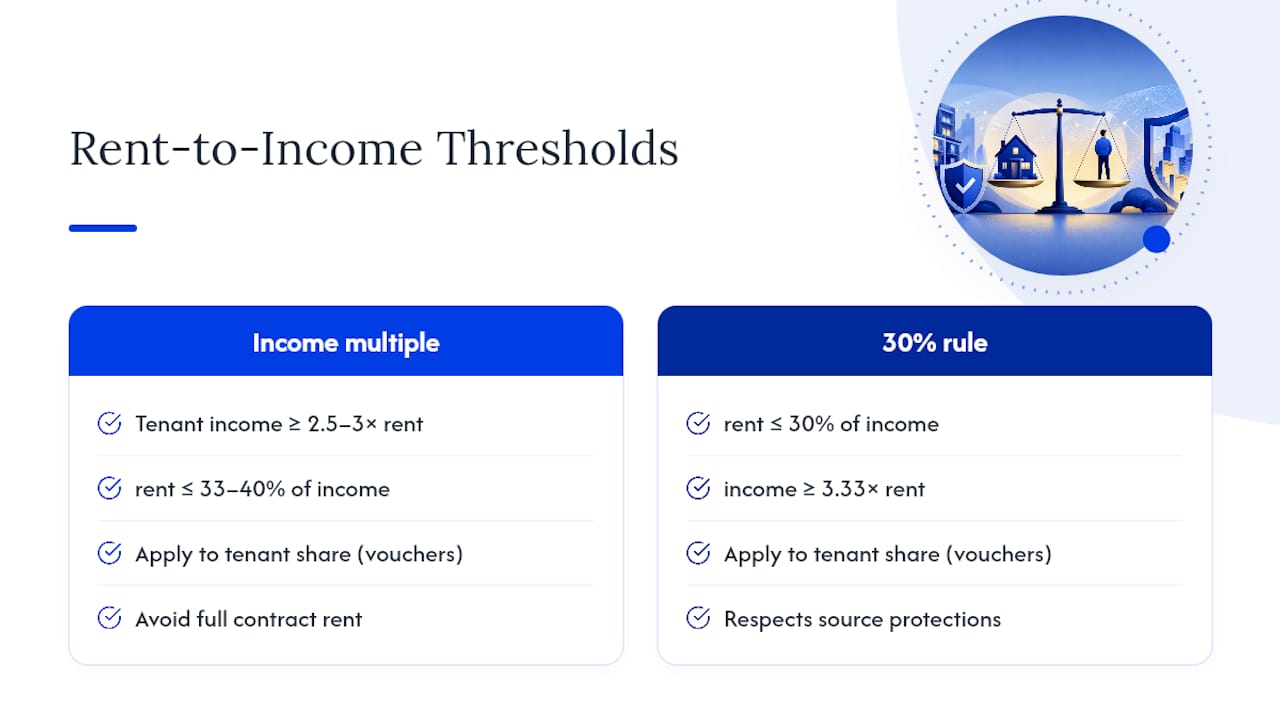
The math is simple.
Vouchers and partial subsidies change the math, not the principle. Apply your income multiple only to the tenant’s actual out-of-pocket portion of rent, not the full contract rent the housing authority pays. Applying the multiple to the full rent when a voucher covers part of it can violate source-of-income protections in jurisdictions that have them. Write your threshold down as a formal policy and apply it the same way to every applicant, every time.
Nontraditional Income: Self-Employed, Gig Workers, and Retirees
Traditional pay stubs don’t exist for a growing share of applicants, and that doesn’t make their income any less real. It just means the documentation looks different.
Self-employed applicants: request two years of tax returns, a year-to-date profit and loss statement, three months of business bank statements, and, where available, a letter from a CPA confirming income stability.
Gig and platform workers: ask for a platform earnings export or 1099s, and use direct-source platform verification when the platform supports it, since gig income tends to fluctuate month to month.
New hires: an offer letter establishes future income, but confirm it with a direct call to the new employer and check the start date against the lease start date to avoid a gap in verified income.
Retirees and benefit recipients: award letters from Social Security, a pension administrator, or a disability program establish recurring income; count only the portion that’s guaranteed and recurring, not one-time distributions.
When paperwork alone can’t tell the full story, Treasury’s HAF guidance offers a useful model: accept a reasonable, fact-specific proxy for income alongside attestation, rather than turning away applicants whose income is real but doesn’t fit a W-2 template.
Technology, Automation, and Protecting Applicant Data
Direct-source payroll and platform verification tools have made income checks faster and considerably harder to fool, since the data comes straight from the payroll provider or gig platform rather than from a document the applicant could edit.
Automation earns its cost once you’re screening a meaningful volume of applicants, managing a multi-unit portfolio, or dealing with income situations complicated enough that manual review keeps stalling. A single-unit landlord with one or two applicants a year may not need it. A portfolio manager processing dozens of applications a month almost always does.
Limit access to income documents and verification results to the staff who actually need them.
Log every review with a timestamp and reviewer name so you can reconstruct the decision later.
Store documents in a secure, access-controlled system rather than a shared inbox.
Keep the applicant-facing process simple. A verification step that takes 20 minutes and five uploads will cost you qualified applicants who give up partway through.
Pro Tip: If you’re evaluating a direct-source verification tool, ask how it handles applicants whose employer or platform isn’t yet integrated. A tool with no fallback to manual review just pushes the hardest cases back onto you with no plan.
A Workflow You Can Copy This Week
Publish your income criteria and required documents before an applicant even submits a form. That single step eliminates most disputes later, because everyone knows the bar going in.
Intake: collect the full document set (pay stubs, W-2 or 1099, bank statements, or the self-employed equivalent) along with written consent to verify.
Document check: review for internal consistency and authenticity red flags.
Cross-check: compare paystub net pay against bank deposits.
Independent confirmation: run employer VOE or direct-source payroll verification.
Decision: approve, request a cosigner or higher deposit if income is borderline, or decline with a documented reason.
Step | What to retain |
Document intake | Copies of all submitted income documents |
Verification results | VOE call notes or direct-source verification report |
Decision rationale | Written note on why the applicant was approved, conditioned, or denied |
Consent record | Signed authorization to verify income |
A checklist like the one in 2ndstreetpropertymanagement’s tenant screening system turns this from a mental process into something every property manager on a team can execute the same way.
How 2ndstreetpropertymanagement Puts This Into Practice
This screening approach is built from the investor’s side of the table, not just the compliance side, which is why the process leans on corroboration rather than a single document. A 10-step screening system maps directly onto the workflow above: published criteria, full document intake, independent verification, and a documented decision on every file.
For landlords who want the deeper mechanics behind each stage, the tenant screening checklist and the guide to reducing risk through background checks cover the pieces that sit alongside income verification in a complete applicant review.
Why Most Landlords Underinvest in This Step
The conventional advice on tenant income checks stops at “ask for pay stubs and a W-2.” That’s not wrong, it’s just incomplete, and incomplete verification is exactly what fabricated documents are designed to slip through. The applicants worth worrying about aren’t the ones with no income. They’re the ones who can produce a document that looks right at a glance.
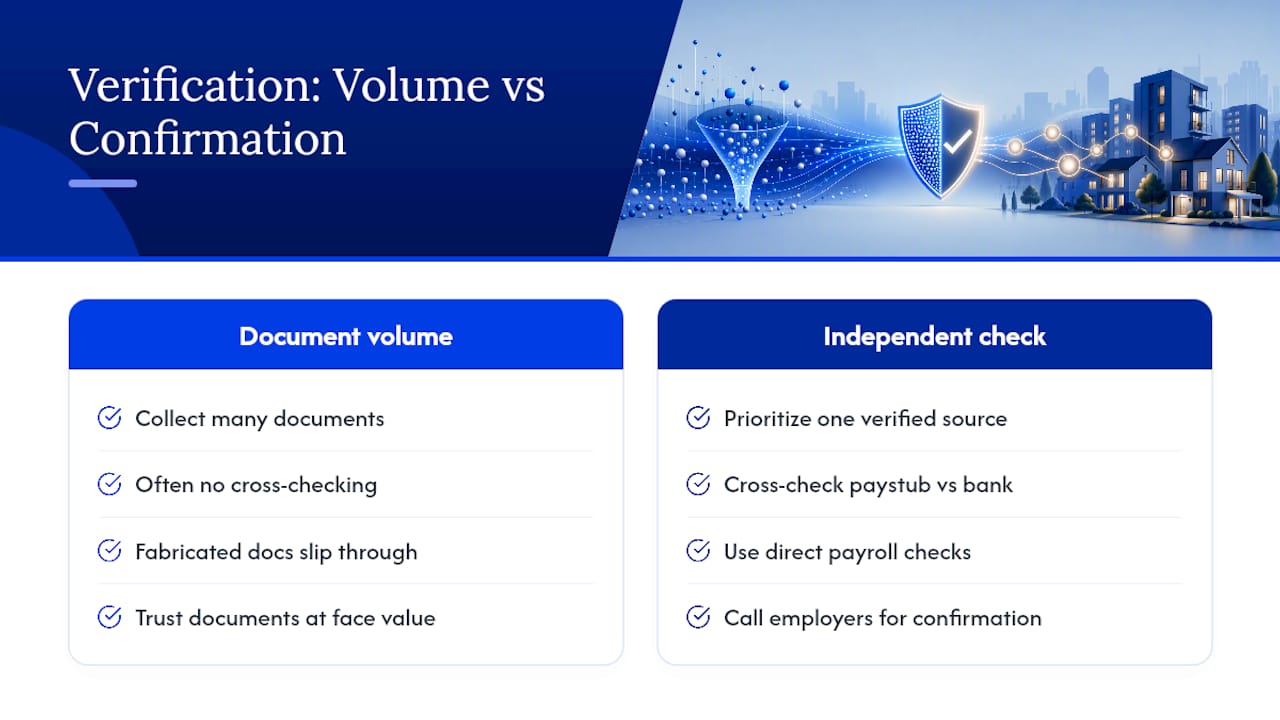
What gets underrated is the cross-check step. Landlords will happily collect three types of documents and then never compare them against each other, which defeats most of the point of collecting three in the first place. A paystub and a bank statement that don’t agree tell you more than either document alone.
If you take one thing from this guide, prioritize independent confirmation over document volume. One verified data point from a source the applicant can’t edit is worth more than five documents you’re trusting at face value. Direct-source payroll checks and honest employer callbacks close the gap that paper alone leaves open, and that gap is exactly where fraud lives.
— Main
Let 2ndstreetpropertymanagement Handle Verification For You
Running document review, employer callbacks, and cross-checks on every applicant takes real hours, and those hours multiply fast once you’re managing more than a handful of units. Professional property management firms that have addressed these bottlenecks handle tenant screening, income verification, and recordkeeping as one connected process rather than three separate chores that need to be coordinated independently.

That means every applicant gets a documented workflow: full document intake, independent confirmation, and a retained audit trail that can be referenced if a decision is ever questioned. These workflows also cover Section 8 and voucher cases correctly, applying income thresholds to the tenant’s actual rent portion rather than the full contract rent. If you’re ready to stop chasing paystubs and bank statements yourself, reach out to 2ndstreetpropertymanagement to see how managed screening fits your portfolio.
Sources
FAQ
How Do You Show Proof of Income When Renting?
Applicants typically provide recent pay stubs, a W-2 or 1099, and bank statements showing consistent deposits; self-employed applicants add tax returns and a profit and loss statement.
Do Landlords Call to Verify Income?
Many do, either by calling the employer directly using an independently sourced phone number or by using a direct-source payroll verification tool that confirms earnings without a phone call.
What Do Landlords Look for With Income Verification?
Landlords check that income meets a set rent-to-income threshold, that the documentation is authentic, and that the income is consistent enough to reliably cover rent each month. Property managers typically apply this through documented, repeatable screening processes rather than case-by-case judgment calls.
What Are Red Flags for Tenant Applications?
Common red flags include mismatched year-to-date figures on pay stubs, round-number deposits that don’t match a real pay schedule, an employer that can’t be verified through an independent search, and bank statements with inconsistent formatting or deposit timing.
Recommended
Comments