
U.S. Landlords: Start Rent Reporting and Post a Tradeline in 30 Days

Updated: Sep 28

Yes, you should report rent, and the reason is simple: it turns your monthly rent roll into leverage for both sides of the lease. Tenants who pay on time build credit history they otherwise couldn’t access, and you get a stronger incentive structure that rewards reliable payers. Most landlords who enroll see the first tradeline appear on a tenant’s credit file within a month.
TL;DR:
Reporting rent payments can help tenants build credit and improve their scores, especially for credit-invisible renters.
Most property managers are aware of rent reporting despite only 40% actively using it, with tradelines appearing within a month of enrollment.
Choosing positive-only reporting protects tenants from negative marks due to missed payments, while full-file reporting provides a more complete rental history.
Implementation typically involves a small fee, verification documents, a lease disclosure clause, and ongoing monthly reporting cycles.
Streamlining the process within existing rent collection systems increases reliability, and positive-only reporting usually offers better tenant buy-in and legal peace of mind.
Table of Contents
What Rent Reporting for Landlords Actually Means
Rent reporting is the practice of sending a tenant’s monthly payment record to a consumer credit bureau, where it becomes a tradeline on their credit file. The three major bureaus involved are Equifax, TransUnion, and Experian, the last of which runs a dedicated pipeline called Experian RentBureau built specifically to collect rental payment data from property managers and reporting platforms. On-time payments logged there can show up directly on a renter’s Experian credit report.
The adoption numbers tell an interesting story. TransUnion’s survey found nearly 75% of property managers know they can report rent, but only about 40% actually do.
Reported data typically includes payment amount, due date, and payment date, not lease terms or unit details.
FICO and VantageScore have both expanded scoring models to weigh rental data more heavily than they did a decade ago.
A randomized study from the Urban Institute found positive-only rent reporting substantially raised participants’ odds of reaching a near-prime VantageScore of 601 or higher.
That last finding matters because it shows rent reporting isn’t a marketing gimmick tenants tolerate. It’s a measurable credit-building mechanism with a paper trail behind it.
How to Start Reporting Rent Payments
You don’t need a data science team to begin reporting rental payments to credit bureaus. You need a clear policy and a vendor that matches it.
Pick your model first. If your priority is helping tenants without punishing missed payments, go positive-only. If you want the full financial picture reported, including late or missed rent, choose full-file.
Choose an enrollment path. You can enroll through a landlord-driven reporting service, let tenants opt in through a standalone app, or use a property management platform with built-in bureau reporting.
Gather verification documents. Vendors typically require a signed lease, a rent ledger showing payment history, and identity-matching details for each tenant.
Add a lease clause or addendum. A short paragraph disclosing that rent payments may be reported to credit bureaus, and naming which bureau, keeps you transparent and protects you if a tenant disputes later.
Notify tenants directly, not just through boilerplate lease language. A quick email or move-in conversation avoids surprise and builds goodwill.
Most services push the first reported tradeline live within 30 days of enrollment, then report monthly on a fixed cycle after that.
Pro Tip: Enroll your longest-tenured, most reliable tenants first. Their clean payment history creates immediate positive tradelines and gives you a template for onboarding everyone else.
Once the mechanics are running, TransUnion found 62% of property managers who report call the process simple and manageable, not the compliance headache many expect going in.
Positive-Only vs. Full-File Reporting: Which Should You Choose?
Positive-only reporting sends only on-time payments to the bureau. Missed or late rent simply doesn’t get transmitted, so a bad month never becomes a permanent mark. Full-file reporting sends everything, meaning consistent payers build strong credit and inconsistent payers see their scores take a hit.
The Federal Reserve Bank of Kansas City’s analysis lays out the trade-off clearly: full-file reporting can lower scores for tenants with a history of delinquencies, while positive-only tends to protect those same tenants from that downside. The Urban Institute’s randomized trial backs this up on the benefit side, showing positive-only programs meaningfully increased the odds credit-invisible renters gained a score at all.
That split has real consequences for tenant screening down the line. A property that reports full-file builds a more complete rental history that future landlords can screen against, which can widen a tenant’s access to better housing over time if their record is clean. A property that reports positive-only mainly helps thin-file or credit-invisible renters get a foothold, without adding screening risk for anyone.
Use this quick framework when deciding:
If your resident base includes many first-time renters or credit-invisible tenants, positive-only builds trust and access with limited downside.
If you manage a larger portfolio and want reporting to double as a delinquency deterrent, full-file aligns incentives more directly.
Regulatory momentum, including HUD guidance and state-level activity, currently leans toward encouraging positive-only models, so check your state’s rules before committing to full-file.
Costs, Compliance, and What to Expect Operationally
Reporting services generally fall into three categories: tenant opt-in apps, landlord-facing reporting platforms bundled into property management software, and bureau-facing programs like Experian RentBureau that plug directly into existing systems.
Pricing patterns vary by vendor, but NerdWallet’s rundown of rent-reporting services shows most charge either a one-time enrollment fee, a small monthly per-tenant fee, or both, and either the landlord or the tenant can end up covering the cost depending on the arrangement you set.
Before a vendor activates reporting, expect them to request:
A signed, current lease naming every adult tenant on the account
A rent ledger showing at least a few months of payment history
Identity-matching information to confirm each tenant against bureau records
If you furnish data to a credit bureau, you take on furnisher responsibilities under the Fair Credit Reporting Act, which means investigating tenant disputes within a defined window and correcting inaccurate entries once verified. Most reporting platforms handle the bureau-facing dispute mechanics for you, but you remain accountable for the accuracy of what you submit.
Rolling Out Rent Reporting Without Disrupting Operations
A clean rollout follows a predictable rhythm, and skipping steps is where most landlords run into trouble.
Pre-launch: Finalize your reporting model, draft the lease addendum, train any on-site staff on the new workflow, and plan how you’ll explain the change to current tenants.
Launch: Collect verification documents, enroll your first batch of tenants, and confirm a test tradeline actually posts before rolling out portfolio-wide.
Monthly operations: Reconcile rent payments against your ledger, submit the report on your vendor’s schedule, and monitor for disputes or data mismatches each cycle.
Watch for red flags: A sudden spike in disputes, repeated tenant complaints about incorrect balances, or mismatched names and Social Security details usually point to a documentation problem, not a bureau error.
The Urban Institute’s implementation data found administrative issues, not eligibility, caused the biggest gap between tenants enrolled and tenants actually reported. Clean records fix that before it starts.
Pro Tip: Run your rent ledger through the same reconciliation process you already use for rent collection each month. Bolting reporting onto an existing workflow is far more reliable than building a separate one from scratch.
Why We Think Every Landlord Should At Least Test This
Rent reporting is one of the few landlord practices that benefits both sides of the lease without requiring you to spend much, change your rent, or renegotiate anything with tenants. We’ve watched property owners hesitate over this for the wrong reason: they assume it’s a compliance burden. The data says otherwise. Once a property manager sets it up, the majority describe it as straightforward, and the tenant goodwill it generates tends to show up later as lower turnover and fewer late payments.
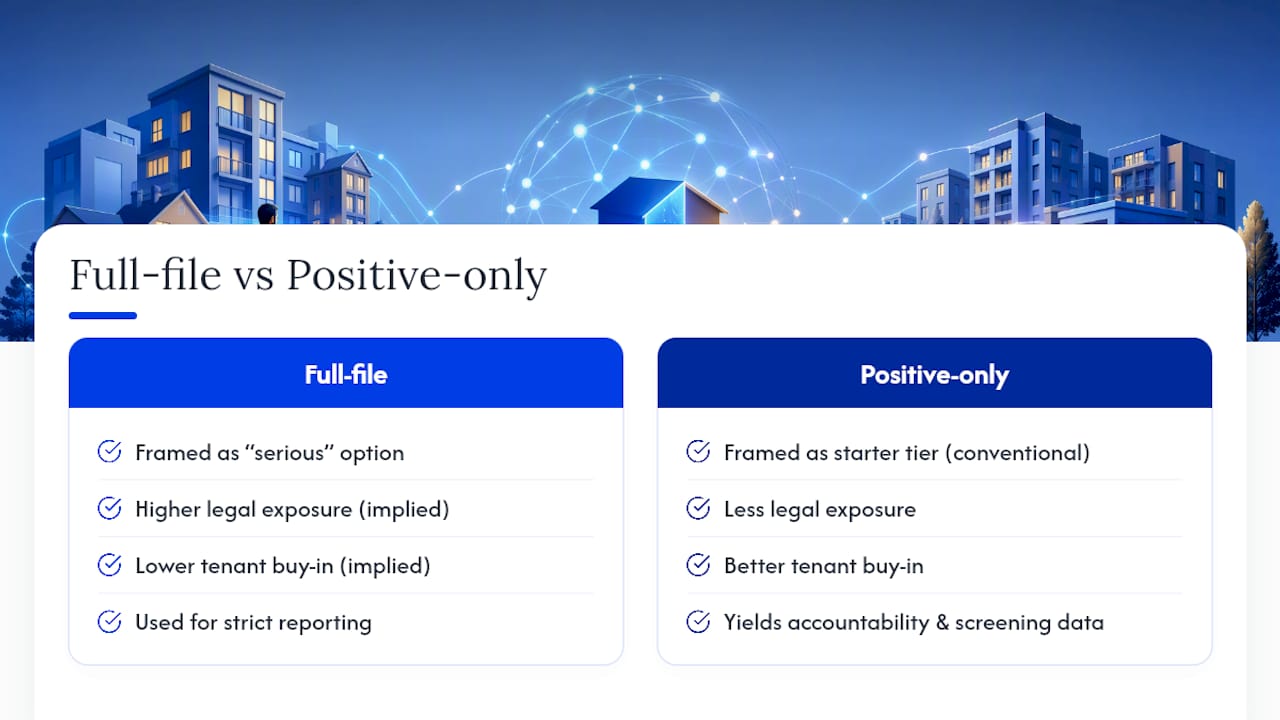
Where we push back on conventional advice is the full-file default. A lot of guides treat full-file as the “serious” option and positive-only as a starter tier. That framing gets it backwards for most residential portfolios. If your goal is tenant accountability and better screening data down the line, positive-only usually gets you there with less legal exposure and better tenant buy-in.
2nd Street Property Management builds rent reporting into the same operational systems we already use for tenant screening and rent collection, because bolting it onto a disorganized process is where landlords lose the benefit.
— Main
Where to Learn More
For deeper detail beyond this guide, the Urban Institute’s randomized study covers the credit-building evidence in full. TransUnion’s landlord survey breaks down adoption barriers and benefits. The Kansas City Fed’s analysis explains model trade-offs, and Experian RentBureau’s overview walks through how to start reporting directly.
Sources
Recommended
Comments