
Rental Property Utility Management Options for Landlords


Utility billing is one of the most friction-filled parts of running a rental portfolio. Tenants dispute charges, manual processes eat hours, and a single billing error can turn a good landlord-tenant relationship into a formal complaint. Choosing the right rental property utility management options changes all of that. Done well, it cuts your administrative workload, reduces expense leakage, and gives tenants the billing clarity they expect. This article breaks down the top options, what each one costs you in time and money, and how to match the right solution to your portfolio.
Table of Contents
1. What to look for in rental property utility management options
3. Smart utility management technology and demand response programs
4. Automated vacancy power management and utility onboarding/offboarding
6. AI-driven billing software and automated invoice processing
My honest take on utility management after years in this business
Let 2ndstreetpropertymanagement handle your utility management
Key takeaways
Point | Details |
RUBS fits submeter-free properties | Ratio Utility Billing Systems fairly allocate costs without requiring individual meters. |
Smart tech generates real ROI | Sensor-based HVAC investments can return more than double their upfront cost in savings. |
Automation cuts vacancy costs | Automated onboarding and offboarding removes expensive manual labor during tenant turnover. |
Transparency reduces disputes | Clear billing formulas and documentation lower tenant complaints and legal exposure. |
Software integration saves time | Platforms combining banking, accounting, and billing reduce errors and administrative burden. |
1. What to look for in rental property utility management options
Before committing to any system, you need a clear picture of what your portfolio actually demands. Not every option fits every property type, and the wrong choice creates more problems than it solves.
Here are the core criteria to evaluate before you decide:
Legal compliance. State and local laws govern how landlords can bill for utilities. Some jurisdictions require specific disclosures, metering standards, or caps on administrative fees. Know your market before selecting any billing method.
Portfolio size and property type. A 4-unit building and a 200-unit multifamily community have different administrative tolerances. Single-family rentals often call for direct tenant billing, while larger multifamily assets benefit from centralized billing platforms.
Automation potential. Integrated platforms that combine banking, accounting, and utility billing reduce tax-time errors and prevent fund commingling, especially for portfolios between 5 and 25 units.
Tenant experience. Billing methods that lack transparency generate disputes. Tenants need to understand what they are paying for and why. Clear formulas and itemized statements protect you legally and build trust.
Integration with property management software. Utility billing that lives in a separate system from your leasing and maintenance data creates duplicated work. Look for tools that connect natively.
Scalability. A solution that works at 10 units should still work at 50. Factor in how the system handles growth before you sign any contracts.
Pro Tip: Always collect a utility deposit alongside the security deposit. A deposit covering 0.5 to 1 month of expected utility costs protects you from service payment defaults, particularly for tenants new to paying utilities directly.
Understanding rental property management basics before selecting a billing system ensures you are not patching a process problem with a technology solution.
2. Ratio utility billing systems (RUBS)
RUBS is the go-to solution for landlords who own properties without individual submeters. Instead of measuring each unit’s exact consumption, RUBS uses a formula to allocate the master utility bill across all tenants.
The most common allocation formulas are:
Occupancy-based. Cost is divided by the number of residents in each unit. A two-person unit pays more than a one-person unit.
Square footage-based. Larger units are assigned a proportionally higher share of the total bill.
Bedroom-based. Cost allocation ties to the number of bedrooms, which serves as a proxy for likely occupancy.
RUBS systems are indispensable for properties without submeters because they automate cost allocation and reduce manual accounting errors. Modern billing software handles the math automatically and generates itemized statements for each tenant, which is critical for transparency.
The main risk with RUBS is perceived unfairness. Tenants may feel they are subsidizing neighbors who use more water or electricity. You mitigate this by explaining the formula clearly in the lease and sending itemized statements each billing cycle. Research from British Columbia found that tenants overpaying utilities by as much as five times expected levels in unregulated private submetering scenarios, which underlines why documentation and oversight matter regardless of which method you choose.
RUBS typically costs landlords between $3 and $10 per unit monthly when using third-party billing software. For most mid-size portfolios, the administrative savings and cost recovery more than justify that fee.
3. Smart utility management technology and demand response programs
Smart technology has moved past novelty. For landlords managing more than 20 units, sensor-based utility management is now one of the highest-ROI property utility solutions available.
The core components include:
Smart HVAC controls. Sensors and connected thermostats monitor real-time conditions and adjust heating and cooling automatically. This eliminates the waste from HVAC systems running at full capacity in vacant units.
IoT water and energy sensors. These flag abnormal usage spikes before they become costly problems, such as a pipe leak running undetected for weeks.
Demand response program participation. Utility companies pay property owners to reduce consumption during peak grid demand periods.
The numbers here are hard to ignore. One real estate operator earned roughly $30,000 in a single year through demand response program participation by curtailing consumption at peak times. That is income you did not have to raise rent to generate.
On the capital investment side, a sensor-based HVAC investment of $280,000 produced savings exceeding $540,000, primarily from gas consumption reductions and emissions compliance costs avoided. That is a return that outperforms many value-add renovation projects.
“Treating mechanical assets as digital energy resources offers risk mitigation and transforms utility management into a revenue opportunity.” — Armada Power
Compliance is a growing factor as well. Cities like New York and Denver have enacted building emissions laws that carry real financial penalties. Smart HVAC systems help you stay ahead of those requirements rather than scrambling to retrofit later.
4. Automated vacancy power management and utility onboarding/offboarding
Tenant turnover is where utility costs quietly drain your cash flow. Between a move-out and the next move-in, utilities need to transfer back to the landlord account, then reconnect in the new tenant’s name. When this is done manually, it creates delays, double billing, and missed disconnections that leave you paying for a vacant unit’s consumption.
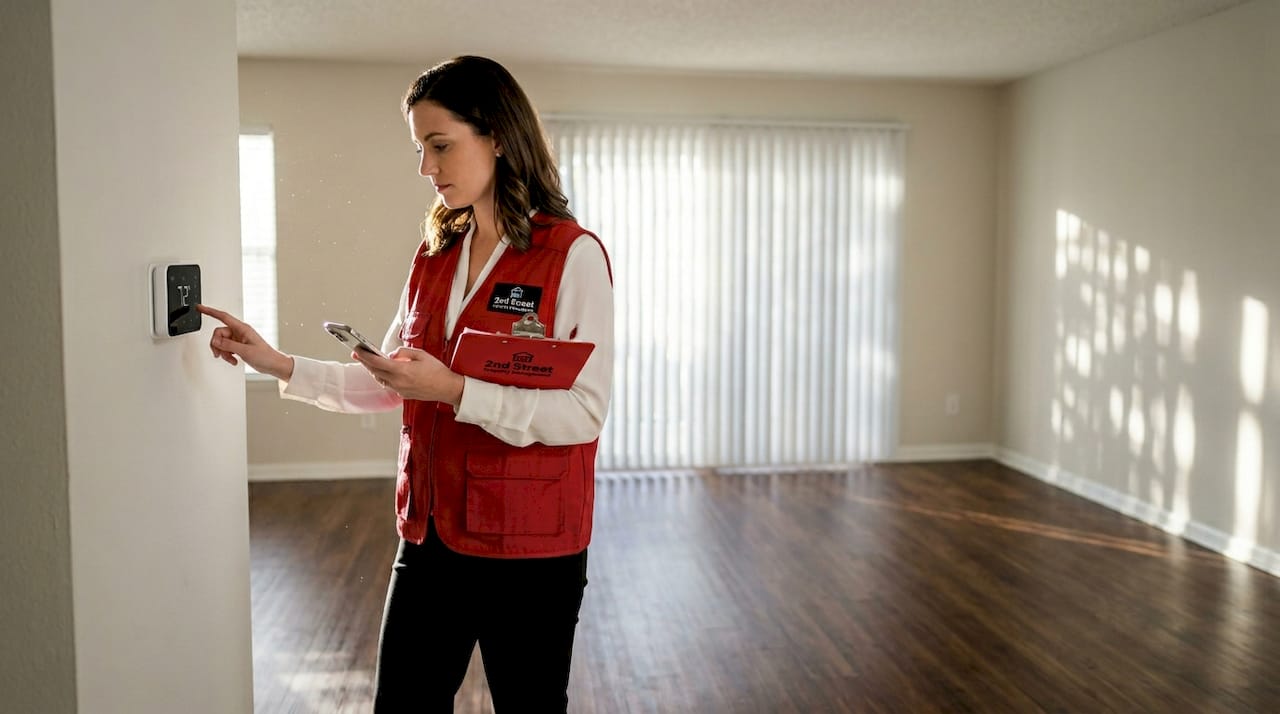
Vacancy power automation solves this by triggering electricity connection and disconnection automatically based on lease start and end dates. The system reads lease data and sends commands to the utility provider without requiring a staff member to make a phone call or submit a form.
The benefits compound quickly across a larger portfolio:
Reduced labor. No more staff time spent coordinating with utility companies for each turnover.
Eliminated expense leakage. Utilities do not run in a vacant unit longer than necessary.
Faster move-in readiness. New tenants have utilities active on their lease start date without waiting on manual processing.
Audit trail. Automated systems log every connection and disconnection event, which matters if a billing dispute arises.
Pro Tip: When evaluating property management software, make utility onboarding and offboarding automation a non-negotiable feature. The time savings alone typically pay for the platform cost within the first two to three turnovers.
Platforms that offer this feature usually bundle it with broader lease management tools. The operational payoff is significant for any landlord managing five or more units, and it becomes genuinely transformative at 20 or more. For landlords weighing self-managing versus hiring out, this type of automation can tip the decision toward staying in-house while maintaining the efficiency of professional management.
5. Centralized billing and bulk internet management
For larger portfolios, the most efficient utility management strategy is centralization. This means consolidating all utility accounts, billing, and reporting into a single platform rather than managing each property or utility type separately.
Summit Property Management achieved $8.8 million in annual savings by centralizing utility and internet management across more than 10,000 units. That figure comes from bulk purchasing power, reduced administrative overhead, and capturing internet as a billable service alongside traditional utilities.
Bulk internet is an often-overlooked piece of this. Many landlords treat internet service as the tenant’s problem. But bundling internet into a centralized utility package creates a new monthly revenue line and removes the friction tenants feel when setting up service. It also gives you negotiating leverage with providers that individual tenants simply do not have.
Centralization also produces cleaner data. When every utility account feeds into one reporting system, you can spot usage anomalies across your portfolio, benchmark costs between similar properties, and make capital allocation decisions with actual numbers rather than estimates.
6. AI-driven billing software and automated invoice processing
Manual utility invoice processing is where billing errors are born. A staff member re-entering data from a PDF utility bill into a spreadsheet introduces mistakes. Those mistakes lead to tenant disputes, underbilling, or overbilling, each of which carries its own cost.
AI-driven billing software reads utility invoices automatically, extracts the relevant data, and flags usage spikes for landlord review. The system handles what used to require dedicated administrative time, and it does so with a level of consistency a human cannot replicate at scale.
For landlords managing between 5 and 25 units, integrated platforms that combine banking, accounting, and utility billing simplify operations and reduce costly errors significantly. The integration prevents fund commingling, which is a real legal risk when security deposits and operating funds share accounts.
The practical upshot: you stop spending evenings reconciling utility invoices, and you stop catching billing mistakes after tenants have already complained about them.
7. Comparison of utility management options
Choosing between these options comes down to your property type, portfolio size, and how much administrative capacity you have in-house. The table below maps the key variables.
Option | Best for | Typical monthly cost | Administrative effort | Tenant transparency |
RUBS | Properties without submeters | $3–$10 per unit | Low with software | Medium (formula-based) |
Smart HVAC and sensors | 20+ unit multifamily | High upfront, positive ROI | Low after setup | High |
Vacancy power automation | Any portfolio with turnover | Bundled with software | Very low | N/A |
Centralized billing | 50+ unit portfolios | Varies by provider | Low | High |
AI invoice processing | 5–25 unit portfolios | Low to medium | Very low | High |
No single option is universally correct. RUBS works well for smaller multifamily assets without the capital for submeters. Smart technology pays off over time for larger portfolios with emission compliance exposure. Automation tools deliver returns at almost any scale by eliminating labor. The goal is matching the right combination to your specific portfolio rather than defaulting to whatever your property management software includes by default.
My honest take on utility management after years in this business
I’ve watched landlords spend enormous energy on rent collection systems and lease agreements while treating utility billing as an afterthought. It is never an afterthought for your tenants. Utility disputes are one of the top reasons good tenants leave, and they are almost always preventable.
What I’ve found is that transparency solves more problems than any technology does. Before I switched to billing software with itemized statements, I spent hours every quarter explaining charges to tenants who felt they were being billed arbitrarily. Once tenants could see exactly how their share was calculated, the disputes stopped. Not because the numbers changed, but because the process was visible.
I’ve also seen landlords resist smart HVAC investment because the upfront cost looks intimidating on a spreadsheet. But when you factor in demand response income, reduced consumption costs, and avoided compliance penalties, the math almost always works in your favor within three to five years. The landlords who adopted this early are now generating income from their HVAC systems that their competitors are paying penalties to avoid.
The piece most people overlook is vacancy management. Every day a vacant unit runs utilities unnecessarily is a direct expense with zero return. Automation removes that leak permanently.
My advice: start with software that handles billing and vacancy automation, then layer in smart technology as your cash flow supports it. Build the foundation before you pursue the advanced tools. Check out some rental management tips to make sure your operational foundation supports whatever utility system you choose.
— Main
Let 2ndstreetpropertymanagement handle your utility management
Utility management complexity grows with every unit you add. At some point, the hours you spend managing billing, reconciling invoices, and handling tenant disputes cost more than professional management would.
2ndstreetpropertymanagement was built by investors who understand that every dollar of expense leakage and every hour of unnecessary administrative work directly reduces your return. Our property management services include integrated utility billing, automated tenant onboarding and offboarding, and the reporting infrastructure you need to make informed capital decisions across your portfolio. If you are ready to stop managing utilities manually and start treating your rental income as the investment it should be, explore our services and take the first step toward a more efficient portfolio.
FAQ
What is the easiest utility management option for small landlords?
For landlords managing fewer than 25 units, AI-driven billing software that integrates with accounting tools is the most practical starting point, as it eliminates manual invoice entry and flags usage anomalies automatically.
How does RUBS billing work for rentals?
RUBS allocates the master utility bill across tenants using a formula based on occupancy, square footage, or bedroom count, making it a workable option for properties without individual submeters.
Can rental property owners actually earn money from utility management?
Yes. Participation in demand response programs allows property owners to earn revenue by reducing energy consumption during peak grid periods, with some operators earning $30,000 or more annually.
What is the biggest risk with third-party utility billing?
Lack of oversight and transparency is the core risk. Reports show tenants paying far above expected utility costs in unregulated billing arrangements, which creates disputes, legal exposure, and tenant turnover.
When does smart HVAC technology make financial sense?
For portfolios of 20 or more units, particularly in cities with building emissions regulations, smart HVAC investment typically delivers positive ROI within three to five years through energy savings and avoided compliance penalties.
Recommended
Comments