
Rental Property Disclosure Requirements: Landlord Guide
- Rey Rey Rodriguez

- May 31
- 9 min read

Most landlords know they need to hand over a lead paint pamphlet before signing a lease. What they don’t know is that this single federal rule is just the beginning. Rental property disclosure requirements now span dozens of federal, state, and local mandates covering everything from mold and radon to security deposit banking information and utility billing methods. Miss the wrong one at the wrong time, and you’re looking at lease termination rights, fraud claims, or worse. This guide breaks down what you actually need to know, organized by jurisdiction level, with practical compliance steps you can use immediately.
Table of Contents
Key takeaways
Point | Details |
Federal disclosures are non-negotiable | Lead-based paint rules apply to all pre-1978 housing regardless of whether hazards are known. |
State and local rules vary widely | Mold, radon, bed bugs, and death-in-unit disclosures depend on your specific jurisdiction. |
Financial terms must be disclosed clearly | Security deposit details, nonrefundable fees, and utility billing arrangements require written disclosure in most states. |
Timing matters as much as content | Many disclosure failures come from delivering documents in the wrong sequence or after the lease is signed. |
Build a process, not just a checklist | Treating disclosure as a workflow with documented tenant acknowledgments protects you legally. |
Rental property disclosure requirements at the federal level
Federal law creates a baseline floor that applies to landlords across every state. The most well-known rule comes from the Residential Lead-Based Paint Hazard Reduction Act. If you own or manage housing built before 1978, you must comply before every new lease is signed, regardless of whether you know of any actual lead hazard.
Here is what federal lead disclosure requires:
Provide an EPA-approved lead hazard pamphlet to the prospective tenant before they sign the lease. The EPA released an updated version of this pamphlet in 2026, so confirm you are distributing the current edition.
Complete a written property disclosure form stating what the landlord knows, or does not know, about lead-based paint and lead hazards on the premises.
Obtain a signed tenant acknowledgment confirming receipt of both documents.
Give tenants a minimum 10-day window to conduct their own lead paint inspection before they are obligated to sign, unless they waive this right in writing.
The sequence matters here. Handing over the pamphlet after the lease is signed is a compliance failure even if you had zero knowledge of any lead hazard. Disclosure is a process, not a paperwork afterthought.
Federal asbestos rules also apply in certain situations, particularly when landlords know of asbestos-containing materials on the property. This is most relevant in properties built before the late 1970s where disturbances or renovations are occurring.
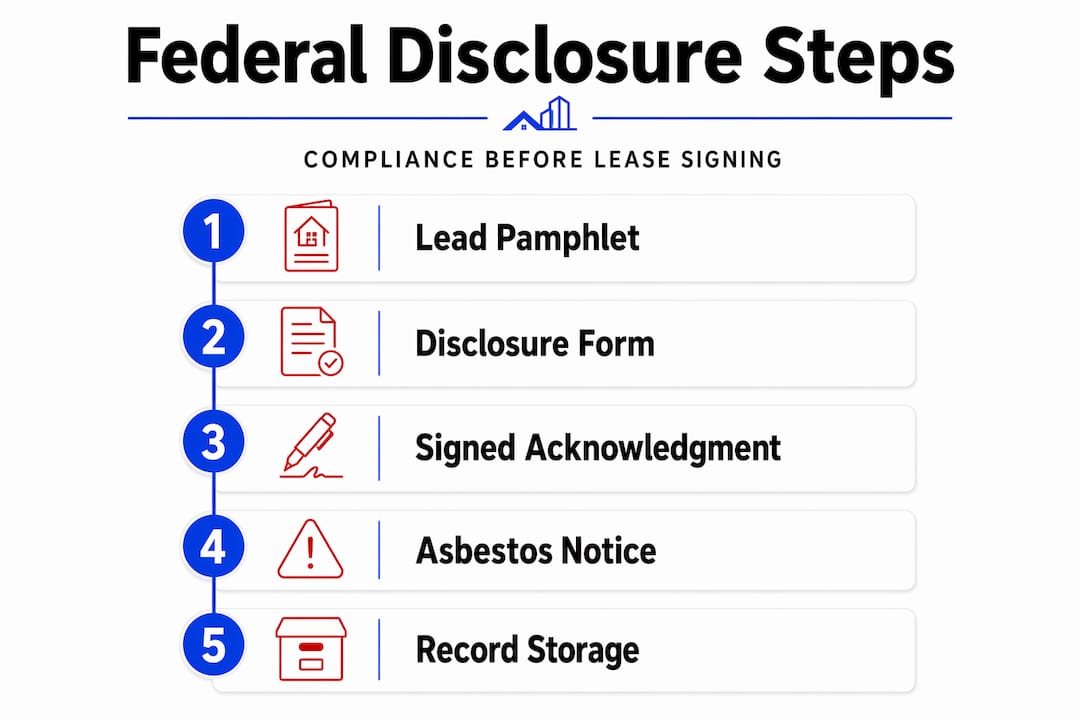
Pro Tip: Create a dedicated lead disclosure folder for each property containing the current EPA pamphlet, your signed disclosure form, and tenant acknowledgment. This file is your legal protection if a tenant later claims they were never informed.
State and local disclosure rules vary more than you think
Beyond the federal baseline, the landscape shifts dramatically depending on where your property sits. There is no single universal list of state disclosures. What California requires is different from what Texas requires, and both differ from what a city like Minneapolis now mandates.

Here is a comparison of common disclosure categories and how state or local requirements typically diverge:
Disclosure type | Trigger | Jurisdiction examples |
Mold | Landlord knowledge of mold presence | California, Washington, Virginia |
Radon | Test results or local mandate | Illinois, Pennsylvania, some local codes |
Flooding history | Prior flood damage or flood zone location | Many states with coastal or flood-prone zones |
Bed bugs | Prior infestation history | New York, Chicago |
Death in unit | Recent death on premises | California (within 3 years) |
Meth contamination | Prior drug lab on premises | Several western states |
Landlord contact info | Identity of owner and local agent | Minneapolis, California, many others |
No federal mold disclosure law exists, but states like California, Washington, and Virginia require it when you have actual knowledge of mold presence. Radon disclosure depends on whether testing has occurred and what jurisdiction you are in.
Minneapolis stands out as an example of how local rules can go further than most landlords expect. Starting March 1, 2025, Minneapolis requires pre-lease disclosures that include the landlord’s contact information, the property’s rental license status, and any open violations. These must be provided before lease signing, and tenants have termination rights if the landlord fails to deliver on time.
One operational mistake that trips up experienced landlords is conflating disclosure triggers. Tracking landlord knowledge separately from test results matters because some jurisdictions only require disclosure if you have actual knowledge, while others require it the moment testing has occurred regardless of results. Mixing these up leads to both over-disclosing and under-disclosing, and neither is safe.
Pro Tip: Build a jurisdiction-specific checklist for every market where you own property. This is not a one-time task. Review it annually, because local housing ordinances update more frequently than state statutes.
Rental agreement and financial disclosure obligations
Tenant disclosure laws extend well beyond physical hazards. Many states require landlords to disclose specific financial terms and operational details as part of the rental agreement requirements. These rules exist because disputes over money are among the most common sources of landlord-tenant conflict.
Here are the key financial and operational disclosures you need to address in your lease or a written addendum:
Landlord identity and contact information. Many states require you to disclose the name and address of the property owner and, if different, a local agent authorized to accept legal notices. California and numerous other states mandate this. Without it, a tenant may have grounds to withhold rent in some jurisdictions.
Security deposit bank details. Security deposit disclosure requirements in most states include the name and address of the bank where deposits are held, whether the deposit earns interest, the applicable interest rate, and the conditions under which the deposit can be withheld.
Nonrefundable fees. If you charge a pet fee, move-in fee, or any other nonrefundable amount, it must be explicitly identified as nonrefundable in writing. Calling it a “deposit” when it is actually a fee you intend to keep is a disclosure violation in most states.
Shared utility billing. If multiple tenants share utilities billed through one meter, or if utilities are billed through a ratio utility billing system, you generally need to explain exactly how charges are calculated and allocated. This is a frequently overlooked disclosure that generates significant tenant disputes.
Lease terms and lease addendums. Any unusual conditions, entry policies, or rules that affect tenants materially should be in writing and signed. Verbal agreements do not satisfy housing disclosure rules.
Documenting all of this inside the lease or a separate addendum is not just good practice. It is legally protective evidence if a tenant later claims they were never told.
Pitfalls and legal consequences of non-compliance
The consequences of failing to meet your disclosure obligations are not theoretical. They are concrete, tenant-enforceable, and in some jurisdictions, automatic. Many landlords assume a missed disclosure is a minor technical error. It is not.
Lease termination rights. Under Minneapolis tenant disclosure laws effective 2025, tenants can terminate the lease if required pre-lease disclosures are not provided on time. The notice period equals the tenant’s rent payment schedule, up to three months. That is a vacancy you did not plan for.
Misrepresentation and fraud claims. When you fail to disclose a known hazard, you expose yourself to claims that go beyond administrative penalties. Courts have treated undisclosed lead hazards and mold issues as constructive fraud in civil cases.
Lease invalidation. Noncompliance can invalidate leases or expose you to fraud claims even when no actual hazard exists. The failure is in the process, not just the substance.
Fines and regulatory penalties. Federal lead paint violations carry civil penalties up to tens of thousands of dollars per violation. Some state and local agencies impose their own fines on top of federal exposure.
The most common operational failure isn’t refusing to disclose. It’s timing. Landlords hand over the right documents in the wrong order, deliver them after signing instead of before, or send them electronically without obtaining a verified acknowledgment.
Treating disclosure as a process with checkpoints, not a packet you hand over at lease signing, is the difference between legal protection and legal exposure.
If a dispute goes to court, your signed acknowledgment records are your defense. Without them, it becomes a he-said-she-said problem. Review tenant screening compliance practices alongside disclosure workflows, since both feed into the same landlord-tenant rights framework.
Practical compliance strategies for landlords
Getting disclosure right is not complicated once you build the right system. Here is a step-by-step framework you can implement for every property, every lease cycle:
Build a jurisdiction-specific disclosure checklist. List every required disclosure for your federal, state, and local jurisdiction. A property in Minneapolis has a longer checklist than a property in a rural county with minimal local ordinances. Creating a location-specific compliance checklist is the foundation of every other step.
Assemble your lease packet in the correct order. Every lease signing should include a master packet: federal lead hazard pamphlet (current edition), lead disclosure form, state-required property condition disclosure, financial disclosures, and any applicable local disclosure forms. The order of delivery matters for compliance.
Separate pre-signature and post-signature deadlines. Some disclosures must happen before the lease is signed. Others, like Minneapolis’s additional disclosures, are due within 90 days after the lease starts. Calendarizing these separate checkpoints prevents the timing failures that create liability.
Obtain and retain signed tenant acknowledgments. Every disclosure must have a paper trail. Whether you use physical signatures or verified electronic signatures, retain these records for the duration of the tenancy and for the statutory period after it ends. Many states require retention for three to five years.
Track disclosure triggers as two separate categories. Log what you know as a landlord separately from what formal testing or inspection reports have confirmed. Tracking triggers separately gives you precision. You disclose exactly what the law requires, nothing more and nothing less.
Review your checklists annually. Local ordinances change faster than most landlords realize. Set a calendar reminder each year to verify that your disclosure packets reflect current requirements in every jurisdiction where you operate.
Pro Tip: Partner with a property management service that maintains updated compliance workflows for each market. When disclosure laws change mid-year, you want a system that catches it before your next lease signing does.
My perspective on where landlords actually go wrong
I’ve seen hundreds of landlords navigate disclosure requirements, and the pattern is almost always the same. They know about lead paint. They’ve done it before. So they treat every new lease like a routine box-check. That’s where things break down.
What I’ve learned is that the real risk is not ignorance of the law. It’s overconfidence. Landlords who have rented properties for ten years in one city suddenly acquire a unit in a different municipality and assume the same packet works. It doesn’t. Local disclosure rules, like the detailed renter protections in Minneapolis, are evolving in ways that catch experienced operators off guard.
The other mistake I see constantly is treating disclosure as a single event instead of a workflow with checkpoints. Handing over a packet at lease signing and calling it done confuses movement with progress. If you don’t have a signed acknowledgment, if the timing was off by even one day, or if the pamphlet you gave was an outdated version, your compliance is incomplete.
My take is this: the landlords who avoid disclosure-related disputes are not the ones with the best lawyers. They’re the ones who built repeatable systems and stay current on jurisdiction-specific changes. Proactive disclosure is not just a legal obligation. It is one of the clearest signals you can send a tenant that you operate professionally. That signal pays dividends in tenant retention, fewer disputes, and lower legal costs over the life of the investment.
— Main
How 2ndstreetpropertymanagement keeps you protected
Staying current on disclosure requirements across multiple jurisdictions is genuinely difficult work. Laws change, local ordinances add new mandates, and the cost of missing a deadline can wipe out months of rental income.
2ndstreetpropertymanagement was built by investors who understand that compliance is not a distraction from returns. It is what protects them. Their team maintains updated, jurisdiction-specific disclosure checklists, manages lease packet assembly, and documents tenant acknowledgments so nothing falls through the cracks. Whether you own one unit or a growing portfolio, having a management partner who treats disclosure as a process protects both your assets and your relationships with tenants. Explore property management solutions designed for real estate investors who want compliance handled right the first time.
FAQ
What disclosures are required for all rental properties federally?
Federal law requires landlords of pre-1978 housing to provide an EPA-approved lead hazard pamphlet, a written lead disclosure form, and a signed tenant acknowledgment before lease signing. No other federal hazard disclosure applies universally to all rental properties.
Can a tenant break a lease if a landlord misses a disclosure?
Yes. In jurisdictions like Minneapolis, tenants have the legal right to terminate a lease if required pre-lease disclosures were not provided on time. The termination notice period can extend up to three months depending on the rent payment schedule.
Do I have to disclose mold even if I haven’t tested for it?
It depends on your state. States like California, Washington, and Virginia require mold disclosure when the landlord has actual knowledge of mold. Without confirmed knowledge, most states do not require proactive testing, but this varies by jurisdiction.
What financial details must I disclose to tenants?
Most states require written disclosure of the bank holding the security deposit, whether it earns interest, conditions for withholding it, and explicit identification of any nonrefundable fees. Shared utility billing arrangements also typically require written explanation.
How long should I keep disclosure records after a tenancy ends?
Best practice is to retain all disclosure forms and signed tenant acknowledgments for the full tenancy period plus three to five years after move-out, depending on your state’s statute of limitations for landlord-tenant claims. When in doubt, keep them longer.
Recommended

Comments