
What Makes a Rent Increase Notice Legally Valid?


A rent increase takes effect only when it names the current rent, the new rent, and an exact effective date, and the landlord serves it with the notice period the law requires. Most states require written notice for month-to-month tenancies, though several jurisdictions require longer periods, and the landlord needs proof it was delivered. Inside a fixed-term lease, none of this matters unless the lease itself allows a mid-term change.
TL;DR:
Most states require written rent increase notices to include the tenant’s name, property address, current and new rent amounts, effective date, and landlord signature to be enforceable.
Notice periods vary widely across jurisdictions, with most states defaulting to 30 days for month-to-month tenancies, but some states and cities enforce longer periods or specific rent caps.
A rent increase is only valid for fixed-term leases if the lease contains an escalation clause; otherwise, it can only be done at renewal or with proper notice for month-to-month agreements.
Proper delivery methods include certified mail with proof, hand delivery with acknowledgment, or electronic notice if authorized; informal methods like email without consent are often invalid.
Common landlord mistakes involve vague effective dates, mid-lease increases without escalation clauses, or improper service, which can render a rent hike unenforceable despite correct wording.
Table of Contents
Rent Increase Notice Requirements: What the Document Must Include
Landlord Checklist: Avoiding the Most Common Notice Mistakes
What Should Tenants Do After Receiving a Rent Increase Notice?
Does a Rent Increase Affect Your Security Deposit or Other Lease Terms?
How 2ndstreetpropertymanagement Handles Rent Increases for You
Rent Increase Notice Requirements: What the Document Must Include
A notice that skips a required field is not a formality problem. It is a legal defect that can void the increase outright. Every enforceable rent increase notice template built for real use contains the same core skeleton, and the fields that seem optional usually turn into disputes later.
The mandatory fields are:
Tenant name(s) exactly as they appear on the lease
Property address, including unit number if applicable
Current rent amount stated in dollars
New rent amount stated in dollars
Effective date as a specific calendar date, not “next month” or “30 days from receipt”
Landlord or property manager signature, printed name, and the date signed
Beyond those six, a few optional fields save landlords real headaches. A brief statement of reason (tax increase, market adjustment, capital improvement) is not legally required in most states, but it defuses a lot of tenant pushback before it starts. If the rent payment portal or mailing address is changing alongside the increase, say so in the same notice. Many property managers also attach a short acknowledgment line for the tenant to sign and return, which becomes useful proof of delivery on its own.
Ambiguous wording sinks otherwise solid notices constantly. “Your rent will increase by approximately” gives no enforceable dollar figure. “Effective next billing cycle” is not a date. “Rent will go up soon” is not a notice at all, it is a warning. Courts and housing boards read these documents literally, and vague language gets interpreted against whoever wrote it. State the number. State the date. Nothing else survives a challenge as reliably.
How Long Does a Landlord Have to Give Notice?
Notice periods vary more than most landlords expect, and the variation is exactly where costly mistakes happen. Federal law sets no rent cap and no universal notice period. Everything comes from the state or the city, and the rules on where rent is capped shift enough between neighboring states that copying a friend’s process is a bad idea.
The baseline most landlords rely on is 30 days’ written notice for a month-to-month tenancy. That holds true across a majority of states. But several jurisdictions extend it well beyond that baseline:
Maine requires longer notice periods
Delaware and Vermont require longer notice periods
New York uses a sliding scale for notice depending on tenant duration and increase size
California, Oregon, and Washington require extended notice periods for increases above certain thresholds, along with statewide rent caps
Only three states currently impose a statewide cap on annual rent increases: California, Oregon, and Washington. Every other state leaves the increase amount uncapped by state law, though a city inside that state might still cap it.
California’s AB 1482, Oregon’s SB 608, and Washington’s HB 1217 tie their caps to a published inflation index, and the exact percentage resets every year. A landlord in Sacramento cannot simply apply last year’s allowable percentage this year, the number moves with the index. Washington’s cap under HB 1217 is a newer addition to this group, and it came with its own state-issued notice form requirement, meaning a generic template will not satisfy the statute even if the dollar amounts and dates are correct.
Here is the part that trips up landlords who did their homework at the state level and stopped: a city can layer a stricter rule on top of the state rule. Rent-stabilized units in places like New York City follow entirely separate percentage limits set by a local board, not the general statewide baseline, and the NYC rent increase guide walks through how those local determinations work. Seattle, Los Angeles, and a growing list of mid-size cities do the same thing. The practical rule is simple: local ordinance wins when it is stricter than state law, and you cannot assume your city has no rent control just because your state does not. Always check the city housing department page for the specific address in question, not just the state statute.
When Can You Actually Raise the Rent?
Timing depends entirely on what kind of tenancy you are dealing with, and landlords who miss this distinction end up serving notices that have no legal effect.
Fixed-term leases lock the rent for the full term. If a tenant signed a 12-month lease at $1,800 a month, that number holds for all 12 months unless the lease itself contains an escalation clause spelling out a future increase and the date it kicks in. A rent increase notice sent in month six of a fixed lease with no escalation clause is not enforceable, no matter how properly it is worded.
Month-to-month tenancies can be adjusted with proper notice at any point. Because there is no fixed term to protect, the only barrier is the statutory notice period for that state or city.
Renewal is the cleanest moment to raise rent, even on a lease that technically allows mid-term increases. Bundling the new rate with a renewal offer avoids the appearance of a surprise mid-tenancy change and tends to produce fewer disputes.
Counting days correctly matters more than landlords assume. Notice periods typically run from the date of delivery, not the date the letter was written, and the effective date should land on the first of a rental period whenever possible to avoid a partial-month proration headache. A prorated rent situation created by a mid-month effective date adds an extra calculation neither party enjoys untangling.
How Do You Legally Deliver a Rent Increase Notice?
A perfectly worded notice that cannot be proven delivered is functionally worthless in a dispute. The most common way landlords lose an otherwise valid rent increase has nothing to do with the wording, it comes down to proof of service.
The delivery methods that consistently hold up:
Certified mail with return receipt requested. The receipt becomes your dated proof, and it is hard for a tenant to credibly dispute.
Hand delivery with a signed acknowledgment. Have the tenant sign and date a copy confirming receipt.
State-mandated forms, where the jurisdiction requires one. Washington’s updated rules under HB 1217 are a recent example of a state now requiring a specific form rather than accepting a generic notice.
Email, but only when the lease or a prior written agreement explicitly authorizes electronic notice as valid service. Without that agreement in place, an emailed notice is easy to challenge.
Keep copies of everything: the signed notice itself, mail receipts, delivery confirmations, and a dated ledger tracking rent payments before and after the effective date. If a tenant later claims they never received notice, that paper trail is what settles the question, not your memory of mailing it.
Pro Tip: Build a simple delivery log the moment you send any notice: date sent, method used, tracking or receipt number, and the name of anyone who signed for it. This single habit resolves more disputes before they start than any clause you could add to the notice itself.

If delivery is challenged in a housing court or through a tenant complaint, the side with documentation almost always wins the factual question of whether notice occurred, regardless of how the underlying increase is justified.
Rent Increase Letter Templates You Can Use Today
Two template styles cover nearly every situation a landlord runs into, and picking the wrong one for the relationship you have with a tenant creates unnecessary friction.
The formal notice stays short and states only what the law requires: tenant name, address, current rent, new rent, effective date, notice-period confirmation, and a signature line. This version fits best for tenants you have limited communication with, larger portfolios where consistency matters more than personalization, or any situation where you expect pushback and want the paper trail to speak entirely for itself.
The friendly, retention-focused notice opens with a brief line acknowledging the tenant’s tenancy, states the same required fields, and attaches a renewal offer with its own signature line. This style is built for tenants you want to keep long-term, and pairing a formal increase with a renewal offer tends to produce fewer vacancies than a bare notice does.
Both templates need customization before you send them. Add any state-specific language your jurisdiction requires (some states mandate a sentence disclosing the tenant’s right to vacate instead of accepting the increase). If your city requires a specific form, a printable fillable notice template built for that state gets you the right fields without drafting from scratch, though you should still verify it matches any recently updated statutory form, particularly in states like Washington that changed their form requirements.
A few adaptation notes worth keeping in mind:
Swap in your state’s exact statutory notice period, not a generic 30-day assumption.
Add a line referencing the applicable rent cap statute if one applies (AB 1482, SB 608, HB 1217, or a local ordinance).
Include a reply-by date for the friendly version so tenants know when to respond before the renewal window closes.
Landlord Checklist: Avoiding the Most Common Notice Mistakes
Work backward from the date you want the new rent to start. Confirm the lease type and pull the local notice-period rule, pick the effective date, serve the notice through a method you can document, log the proof, and follow up with a renewal packet if you want the tenant to stay.
Step | Action | Common failure point |
1 | Check lease type and local law | Assuming state rule without checking city ordinance |
2 | Set effective date | Vague date like “next month” instead of a calendar date |
3 | Serve notice | Using email with no prior written consent |
— | Log proof of delivery | No receipt, signature, or timestamp kept |
— | Send renewal or follow-up | Sending increase soon after a tenant maintenance complaint |
The last row deserves its own warning. Raising rent shortly after a tenant files a repair request or code complaint invites a retaliation claim, even if the increase is entirely justified on the merits. Document your maintenance response separately and space out the timing where possible.
What Should Tenants Do After Receiving a Rent Increase Notice?
Start by checking the math and the calendar, not your emotional reaction to the number. Confirm the notice states the exact new rent and an exact effective date, then count backward to see whether you received the full statutory notice period for your state and city. If your unit falls under a local rent-stabilization program, the increase may be capped regardless of what the notice claims.
From there, you generally have four paths:
Sign and accept, often bundled into a lease renewal.
Negotiate, particularly if you have been a reliable long-term tenant. Landlords often prefer a modest compromise over a vacancy.
Give written notice to vacate before the increase takes effect, if you plan to move rather than pay the new rate.
File a complaint with your local housing authority or a tenant assistance office if the notice violates your state or city’s notice period or exceeds an applicable cap.
Keep a copy of the notice itself, every payment receipt from before and after the effective date, and any written communication with your landlord about the increase. That file is exactly what a housing board or attorney will ask for first if the increase gets disputed.
What Do Professional Property Managers Do Differently?
Professional managers treat a rent increase as a compliance task first, a revenue decision second. The standard workflow: confirm the lease type and local law, notify the tenant early, serve the notice through a documented method, and log every step. 2ndstreetpropertymanagement, built by investors for investors, applies that same discipline across cash-flow-focused property management work daily. Complex or localized situations still warrant a call to your state housing authority or an attorney before you send anything.
Does a Rent Increase Affect Your Security Deposit or Other Lease Terms?
A rent increase notice changes exactly one thing: the monthly rent amount from the effective date forward. It does not automatically change your security deposit, and most states calculate the deposit cap (commonly one to two months’ rent) based on the rent in effect when the deposit was originally collected, not the new increased amount.
That said, landlords sometimes use a lease renewal that includes a rent increase as an opportunity to request an additional deposit to match the new rent, particularly in states that allow deposits up to two months’ rent and where the original deposit was collected at a lower rate. That request has to be handled as its own separate, properly disclosed lease amendment, not folded silently into the rent increase notice. Tenants should read a renewal package line by line rather than assuming only the rent number changed.
Other lease terms, pet policies, parking assignments, utility responsibilities, generally stay untouched by a rent increase notice unless the notice or an attached renewal explicitly modifies them. If a landlord tries to change multiple lease terms through what is labeled as a simple rent increase notice, that is a sign the document needs closer scrutiny, and possibly a rejection of the renewal as written until the terms get separated out clearly. Confirming what changed against what stayed the same before signing anything protects both sides from a dispute over an assumption nobody wrote down.
Can You Dispute a Rent Increase Notice, and How?
Grounds for a dispute usually fall into one of three buckets: the notice period was too short, the increase exceeds an applicable cap, or the increase appears retaliatory against a tenant who recently complained about repairs, code violations, or exercised another legal right.
The procedure starts with documentation, not a phone call. Pull your lease, the notice itself, and the delivery date. Compare the notice period you actually received against your state and city’s statutory minimum. If your city has a rent-stabilization board, like the boards referenced in the NYC rent increase guidance, check whether your unit is registered under that program and whether the increase percentage matches the board’s current allowable limit.
From there, most disputes follow one of these paths:
Written objection to the landlord, stating specifically which requirement was not met (notice period, cap, form). This alone resolves a surprising number of good-faith clerical errors.
Complaint to a local housing authority or rent board, particularly effective in cities with active rent-stabilization enforcement.
Retaliation claim, if the timing suggests the increase followed a repair complaint or exercise of a tenant right. Understanding tenant protections against retaliatory action helps clarify what qualifies and what the burden of proof looks like.
Small claims or housing court, generally the last step, reserved for increases already in effect and being actively contested.
None of these paths require withholding rent outright, which carries its own separate legal risk and should be approached only with a clear understanding of your state’s specific rules on rent withholding.
State-Specific Rules Beyond Notice Periods and Caps
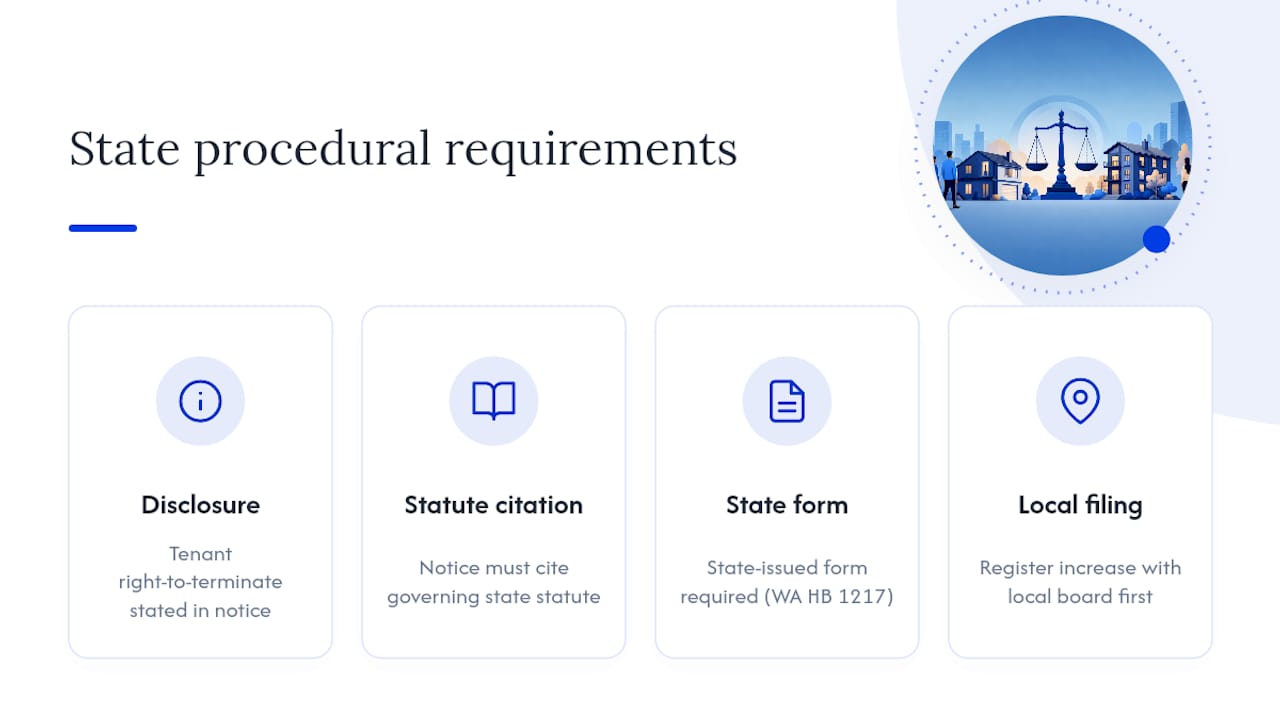
Notice periods and caps get the most attention, but several states attach extra procedural requirements that trip up landlords who assume a generic template covers everything.
Some states require a specific disclosure statement inside the notice itself, telling the tenant they have the right to terminate the tenancy instead of accepting the new rent, rather than assuming silence means acceptance. Others require the notice to reference the specific statute under which the increase is issued, which the state statutes referenced in rent-increase guidance outline for the states carrying that requirement.
Washington’s requirement under HB 1217 is worth calling out again here specifically because it broke from the generic-template norm: the state now expects a particular state-issued form rather than any notice containing the right fields in any layout. A landlord who reused an old California-style template in Washington after the law changed risks an unenforceable notice even though every dollar amount and date was accurate.
A handful of jurisdictions also require landlords to file or register rent increases with a local board before the notice period even begins, particularly in cities with active rent-stabilization programs. Skipping that filing step can delay when the increase legally takes effect, regardless of what date is written on the tenant-facing notice. The pattern across all of these variations is the same: never assume a notice format that worked in one state or city transfers cleanly to another, and check the specific municipal or state housing page before reusing a template across properties in different jurisdictions.
Where Do Landlords Most Often Get This Wrong?
Three mistakes account for most of the rent increase notices that end up unenforceable, and tenants who know what to look for can spot them almost immediately.
Vague or missing effective dates top the list. A notice that says “your rent will increase starting next billing cycle” gives no fixed date a tenant, or a court, can verify against the required notice period. Tenants should treat any notice without a specific calendar date as defective on its face.
Mid-lease increases with no escalation clause come next. A landlord cannot raise rent inside a fixed-term lease unless the lease itself contains language permitting it. If you are still six months into a 12-month lease and there is no escalation clause in your signed agreement, the notice has no legal footing, regardless of how it is worded.
Improper delivery methods round out the pattern. An emailed notice with no prior written agreement authorizing electronic service, or a notice simply left in a mailbox with no proof of delivery at all, fails the service requirement even when the content is perfect. Tenants can reasonably ask for proof of delivery, and landlords who cannot produce it are on shakier ground than the dollar figure on the page suggests.
A fourth, subtler error shows up in timing rather than wording: increases that land right after a tenant files a maintenance complaint or exercises a legal right invite a retaliation claim. The notice itself might be flawless, but the sequence of events undermines it.
Why Templates Alone Won’t Protect You
Templates solve the wording problem. They do nothing for the timing problem, and timing is where most disputes actually originate. A landlord can copy a flawless field-by-field notice off any template site, serve it a week too early under their state’s rule, and lose the increase entirely on a technicality that had nothing to do with the letter’s language.
The conventional advice treats a rent increase notice as a document to get right. It is really a small legal process with a document attached, and the process is what breaks most often: wrong notice period for the jurisdiction, wrong delivery method, or an increase served too close to a tenant complaint to look anything but retaliatory. Fix the process first. The wording matters far less than landlords assume once the process is solid.
If there is one habit worth adopting over any other, it is treating proof of delivery as equally important as the dollar figure itself. Landlords lose enforceable increases on missing receipts and unsigned acknowledgments far more often than on a bad number. Tenants, meanwhile, should stop reading a notice for tone and start reading it for the six required fields. A notice missing even one of them is worth questioning before you assume it is final.
— Main
How 2ndstreetpropertymanagement Handles Rent Increases for You
Drafting a compliant notice is one problem. Keeping track of which city’s rules apply, proving delivery, and following up with a renewal packet without losing a tenant in the process is a different problem entirely, and it’s the one that actually causes disputes. 2ndstreetpropertymanagement, built by investors who manage their own properties the same way, runs a documented process on every increase: a lease and local-law check, tenant outreach timed to preserve the relationship, delivery through a method that holds up if challenged, and a dated recordkeeping trail landlords can produce on demand.

That means no guessing whether your city’s ordinance overrides your state’s baseline, and no scrambling for proof if a tenant disputes service six months later. If you own rental property in Southern New Jersey or a nearby suburb and want your next increase handled without the DIY legal research, reach out to 2ndstreetpropertymanagement to get your properties reviewed and your next notice sent correctly the first time.
Where to Verify Your State’s Exact Rules
Templates and general guidance get you most of the way there, but the final check should always be the primary source for your specific city and state.
Your state’s landlord-tenant statute, searchable through your state legislature’s website, for the exact notice period and any cap.
City housing department pages, such as the NYC rent increase guide or Seattle’s rental housing pages, for local rent-stabilization rules and required forms.
Template providers like LawDepot for a fillable starting point you still need to check against current statutory form requirements.
If your city has any history of rent control, confirm the local ordinance before assuming your state’s baseline rule applies.
This article is general information, not a substitute for advice from a qualified lawyer. Consult a qualified legal professional about your own circumstances before acting on anything here.
Sources
Recommended
Comments