
Private Money for Real Estate Investors: 2026 Guide


Private money is individual capital lent directly to real estate investors, secured by the property itself, offering faster and more flexible terms than any bank can match. Unlike a mortgage from a credit union or a conventional loan from a national bank, this type of financing comes from a person, not an institution. That distinction changes everything: the underwriting is relationship-driven, the timeline compresses from months to days, and the terms are negotiable. For investors who need to move fast on a deal, understanding how to access and use private capital for projects is one of the most valuable skills you can build.
What is private money, and how does it differ from hard money loans?
Private money is defined as individual capital deployed by a person or small group, secured by real estate, and structured around a personal relationship rather than a standardized credit program. The lender is typically a high-net-worth individual, a family member, or a fellow investor who trusts you and your track record. That trust replaces the thick file of tax returns and W-2s that a bank requires.
Hard money lending is often confused with private money, but the two have meaningful differences. Hard money typically comes from a fund or a company with fixed program guidelines, stricter underwriting criteria, and less room for exceptions. Private lenders are individuals deploying their own capital, which means they can make judgment calls that an institutional fund simply cannot.

The industry is actively working to resolve this confusion. The National Private Lenders Association (NPLA) and the American Association of Private Lenders (AAPL) both push “private lending” as the professional umbrella term, replacing the older “hard money” label. The goal is to standardize terminology and elevate the industry’s credibility. For you as a borrower, the practical takeaway is this: when you hear “hard money,” ask whether you are dealing with a fund or an individual. That answer tells you how much flexibility you actually have.
Feature | Private money lender | Institutional hard money fund |
Capital source | Individual’s personal funds | Pooled investor capital |
Underwriting | Relationship and judgment based | Standardized program guidelines |
Flexibility on terms | High, case by case | Low, program rules apply |
Closing speed | 3–7 days possible | 1–3 weeks typical |
FICO requirements | Often flexible or no-FICO | Usually minimum score required |
Pro Tip: When approaching a potential private lender for the first time, bring a one-page deal summary with the purchase price, ARV (after-repair value), your exit strategy, and your track record. Lenders fund people before they fund deals.
What are typical terms, rates, and qualification criteria?
Interest rates for private money loans on real estate typically range from 8% to 12%, with friends and family sometimes offering rates as low as 6% to 8%. The rate you receive depends heavily on your relationship with the lender, the perceived risk of the deal, and whether the lender is an individual or operates more like a fund. A strong track record and a clean deal can push your rate toward the lower end of that range.
Loan terms vary by strategy. Fix-and-flip investors typically borrow for 6 to 12 months. Rental property acquisitions may use private money as a bridge loan for 12 to 24 months before refinancing into a conventional product. Longer holds are less common with private capital, since most individual lenders prefer shorter durations that return their capital faster.
Qualification criteria are far more flexible than conventional lending. Many private lenders accept FICO scores as low as 600 or skip credit scoring entirely, focusing instead on the property’s cash flow and the investor’s exit plan. That flexibility makes private money a real option for investors who are self-employed, recently started investing, or carry debt that disqualifies them from bank financing.
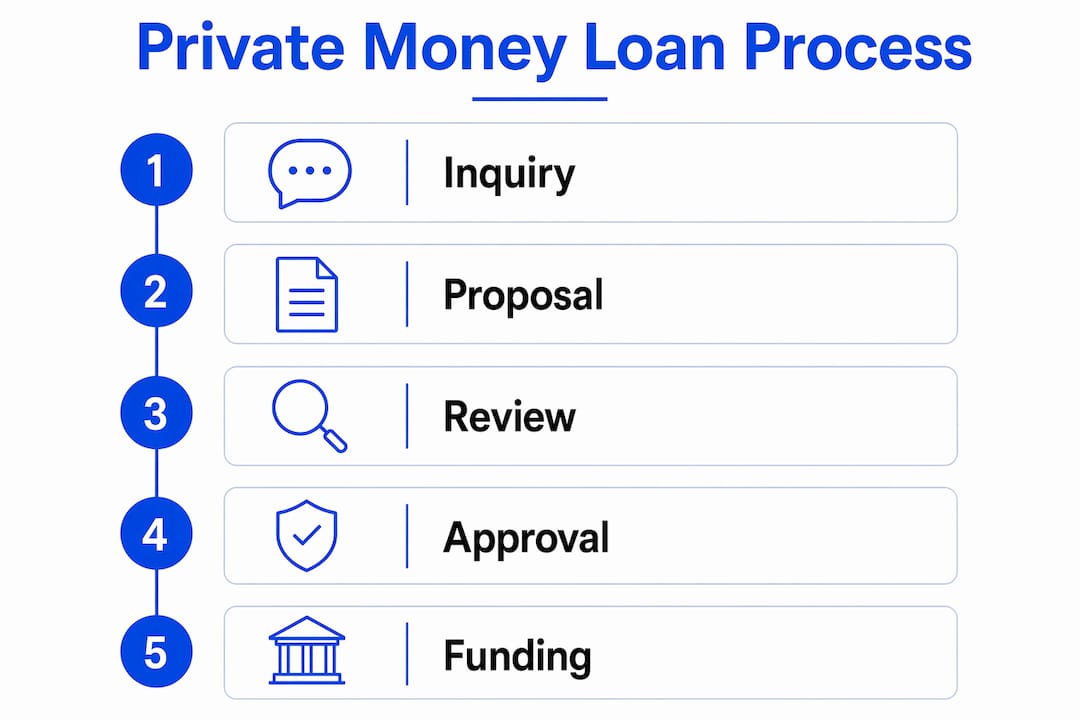
Loan-to-value ratios are where lenders draw a firm line. Most private money lenders cap LTV at 65% to 75% to maintain an equity cushion that protects them if the deal goes sideways. Some lenders who know you well may stretch to 80%, but that is the exception. You need to bring real equity to the table.
Key loan criteria private lenders evaluate:
Property value and ARV: The deal must pencil out even in a downside scenario.
Borrower exit strategy: Lenders want to know exactly how and when they get repaid.
Track record: Prior successful deals carry more weight than a credit score.
Equity cushion: LTV below 75% is the standard expectation.
Cash reserves: Lenders want to see you can cover payments if the project runs long.
Pro Tip: Even if a lender is a close friend, document every term in writing before any money moves. Verbal agreements create ambiguity, and ambiguity destroys relationships faster than a bad deal does.
How can real estate investors find private money lenders?
Finding private lenders requires consistent, deliberate networking rather than a one-time search. The investors who always have capital available built those relationships over years, not weeks. Here is a proven sequence for building that pipeline.
Join your local Real Estate Investors Association (REIA). REIAs attract both active investors and passive capital holders looking for yield. Attend every meeting, present your deals, and ask questions publicly. Lenders in the room are watching how you carry yourself.
Talk to wealth managers and family offices. High-net-worth individuals often hold cash in low-yield accounts and are open to real estate-secured notes paying 8% to 10%. A warm introduction through a CPA or financial advisor is the fastest path to this capital.
Build a track record before you need the money. Lenders fund people with proof of execution. Document your closed deals with photos, timelines, and return data. Share that record proactively, not just when you need a loan.
Use online platforms as a supplement, not a substitute. Platforms that connect borrowers with private lenders can fill gaps, but the best terms almost always come from direct relationships. Use platforms to close deals while you build your personal network in parallel.
Stay in front of your existing lenders. Send a brief monthly update on active projects. When a lender sees consistent communication and on-time payments, they think of you first when they have capital to deploy. Repeat deal flow is the foundation of a sustainable private lending network.
The investors who struggle to find private capital usually make one mistake: they only reach out when they need money. Relationship building works in the opposite direction. You invest in the relationship first, and the capital follows.
What best practices protect both parties in a private money deal?
Every private money deal, regardless of how well you know the lender, requires proper legal documentation. A handshake agreement is a lawsuit waiting to happen. The minimum documentation for any private loan includes three instruments:
Promissory Note: The written promise to repay, including the interest rate, payment schedule, and maturity date.
Mortgage or Deed of Trust: The security instrument that gives the lender a lien on the property.
Personal Guarantee: A commitment from you personally to repay the debt, even if the entity holding the property cannot.
Beyond documentation, your behavior as a borrower defines your reputation. Pay on time, every time. If a project runs into a problem, call your lender before they call you. Lenders who feel respected and informed will work with you through difficulties. Lenders who feel surprised or ignored will not fund your next deal.
Setting clear terms upfront prevents disputes later. Agree on the interest rate, the payment structure (interest-only or amortizing), the maturity date, extension options, and default remedies before the loan closes. Ambiguity on any of these points creates friction when the deal does not go exactly as planned.
Private lenders who trust you may offer exceptions on standard terms, but that flexibility is earned through a history of clean execution. Treat every deal as an audition for the next one. Successful investors who use alternative financing consistently report that their best lender relationships started with a single, well-executed deal and grew from there.
Pro Tip: Have a real estate attorney draft or review your loan documents, even for loans from family members. The cost is minimal compared to the cost of a dispute over an undocumented term.
Key Takeaways
Private money is the fastest and most flexible real estate financing tool available, but it only works when borrowers treat lenders as long-term partners and execute every deal with documented agreements and consistent communication.
Point | Details |
Private money vs. hard money | Private money comes from individuals; hard money often comes from funds with fixed program rules. |
Interest rate range | Rates typically run 8%–12%, with friends and family sometimes offering 6%–8%. |
LTV requirements | Most private lenders cap loan-to-value at 65%–75% to protect their equity position. |
Legal documentation | Every deal needs a Promissory Note, Mortgage or Deed of Trust, and Personal Guarantee. |
Finding lenders | REIAs, wealth managers, and consistent deal performance build the strongest private lending networks. |
Why private money rewards the prepared investor
Private money is the highest-leverage financing tool I have seen in real estate, and I have also watched it destroy relationships when investors treated it carelessly. The speed is real. Closing in 3–7 days versus 30 to 90 days with a conventional lender is not a minor convenience. It is the difference between winning a competitive deal and losing it to someone who had their capital lined up.
What most articles miss is the integrity requirement. Private lenders are not banks. They are people who chose to trust you with their savings or their investment capital. When you miss a payment without warning, you are not just triggering a default clause. You are damaging a person’s financial plan and their confidence in you. That damage is very hard to repair.
The investors I respect most treat their private lenders like silent partners. They communicate proactively, share deal updates without being asked, and always pay before the due date. That behavior compounds over time. One lender who trusts you completely is worth more than ten lenders who are skeptical. Building that trust is not a soft skill. It is a core business practice.
My honest advice: start with one private lender, execute one deal flawlessly, and let the results speak. Do not try to build a network of ten lenders before you have proven yourself to one. Depth of relationship beats breadth of contacts every time in this business.
— Main
How 2ndstreetpropertymanagement supports your financing strategy
Real estate investors who understand private money still need a reliable partner to manage the properties those deals produce. 2ndstreetpropertymanagement is built by investors for investors, which means the team understands how financing decisions connect directly to cash flow, ROI, and long-term portfolio performance.

Whether you are using private capital to fund your first flip or your fifteenth rental acquisition, having a property management partner who thinks like an investor changes your outcomes. 2ndstreetpropertymanagement offers tailored investment solutions that align with the way active investors actually operate. If you are ready to put your private money deals to work and need a team that protects your returns, visit 2ndstreetpropertymanagement.com to learn more.
FAQ
What is private money in real estate?
Private money is capital lent by an individual, secured by real estate, and structured around a personal relationship rather than institutional underwriting. It offers faster closings and more flexible terms than conventional bank loans.
How fast can a private money loan close?
Private money lenders can close deals in as little as 3–7 days, compared to 30–90 days for traditional lenders. That speed gives investors a significant advantage on time-sensitive acquisitions.
What interest rates do private money lenders charge?
Rates typically range from 8% to 12% for most private lenders, with friends and family sometimes offering 6% to 8%. The rate depends on the lender relationship, deal risk, and the borrower’s track record.
Do private money lenders check credit scores?
Many private lenders accept FICO scores as low as 600 or use no-FICO programs that focus on the property’s cash flow and the investor’s exit strategy instead of credit history.
What documents are required for a private money loan?
Every private money loan should include a Promissory Note, a Mortgage or Deed of Trust, and a Personal Guarantee. Skipping any of these creates legal risk for both the borrower and the lender.
Recommended
Comments