
Passive Income: Best Strategies for Real Investors


Passive income is money earned regularly with little to no daily effort, typically from assets or systems built to generate ongoing revenue without your constant involvement. The IRS defines it specifically as income from rental or business activities where you have no material participation. That legal distinction matters because it affects how losses are offset and how income is taxed. About 20% of U.S. households earn passive income, with a median of $4,200 per year. The critical misconception to clear up immediately: “passive” does not mean effortless. It means front-loaded.
What are the most effective passive income streams?
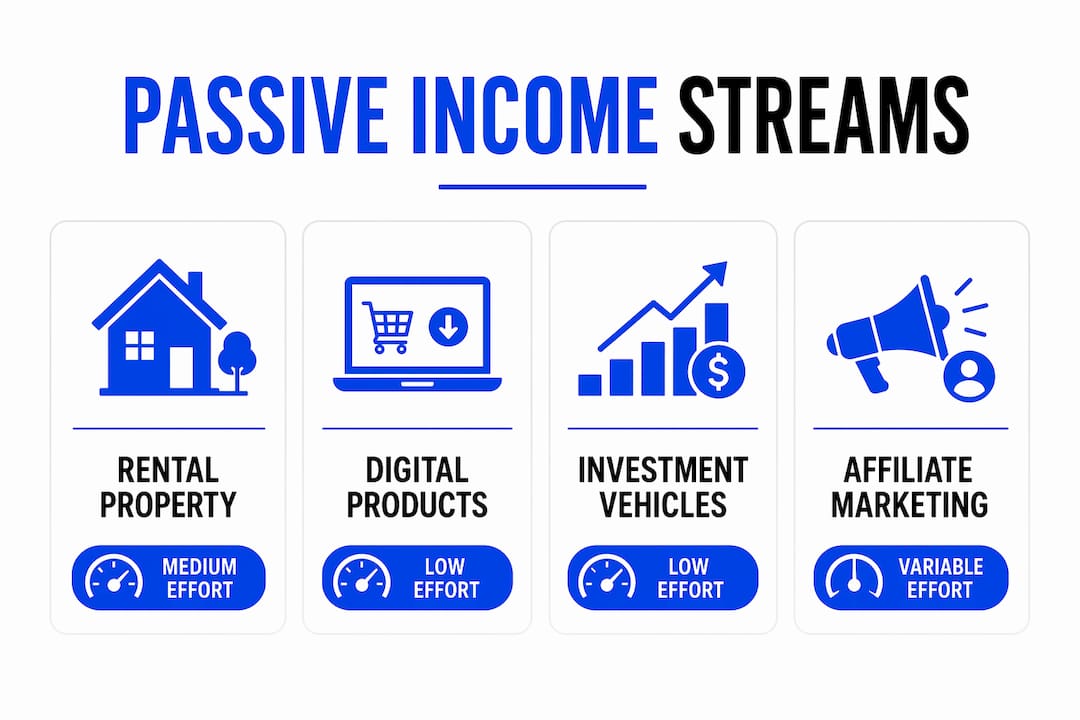
The four major categories of passive income are real estate, digital products, investment vehicles, and affiliate marketing. Each has a different effort profile, capital requirement, and earnings ceiling. Knowing the difference before you commit saves you from misallocating time and money.
Real estate is the most capital-intensive entry point. A rental property typically requires a 10–20% down payment on the purchase price, but it produces cash flow, appreciation, debt paydown, and depreciation benefits simultaneously. Digital products and affiliate marketing, by contrast, can launch with as little as $100–$500 in startup costs. The tradeoff is that digital streams require audience building and content creation before income appears.

Investment vehicles like dividend stocks and REITs sit between those two extremes. They require capital but no operational involvement. A REIT, for example, lets you collect rental income without owning or managing a single property. Dividend stocks pay quarterly distributions from corporate earnings, and the reinvestment of those dividends compounds returns over time.
Income stream | Effort level | Startup cost | Monthly potential |
Rental property | Medium (setup + management) | High (10–20% down) | $500–$2,000+ |
Dividend stocks | Low (research upfront) | Medium ($1,000+) | Varies by portfolio |
REITs | Very low | Low ($100+) | Varies by fund |
Digital products | High upfront, low ongoing | Low ($100–$500) | $50–$2,000+ |
Affiliate marketing | High upfront, low ongoing | Very low ($100–$300) | $50–$1,500+ |
Pro Tip: Match the income stream to your current assets. If you have capital but limited time, lean toward REITs or dividend stocks. If you have time but limited capital, digital products or affiliate marketing are the more realistic starting point.
How does the initial grind phase affect your results?
Passive income requires upfront labor. The “sleep” only comes after the grind. Skipping or underestimating that phase is the most common reason people abandon passive income projects before they produce results.
Sustainable methods like dropshipping and affiliate marketing require 60–90 days of active setup before generating consistent revenue. That window includes building the platform, creating content or product listings, driving initial traffic, and testing what converts. Investors who treat this phase as optional almost always quit too early.
The grind phase looks different depending on the stream:
Rental property: Sourcing the deal, financing, renovation, tenant placement, and lease execution. This can take 3–6 months from offer to first rent check.
Digital course or ebook: Research, content creation, platform setup, and marketing funnel build. Expect 60–90 days before consistent sales.
Affiliate marketing: Content production, SEO, and audience growth. Traffic typically takes 3–6 months to reach meaningful volume.
Dividend portfolio: Research and capital deployment. The grind here is patience, not labor.
The initial 60–90 days are critical. Failing to prepare for that period leads to burnout and project abandonment. Build a timeline before you start, and treat the setup phase as a second job with a defined end date.
Pro Tip: Separate truly passive streams from those requiring daily maintenance. Affiliate marketing with automated email sequences is passive. Manually posting on social media every day is not.
What factors should guide your choice of income stream?
Choosing a strategy aligned with your financial stage improves both sustainability and returns. A beginner with $2,000 in savings and no investment experience should not start with a rental property. That same person starting with high-yield savings accounts or I-bonds builds the capital base and financial discipline needed for larger investments later.
The IRS classification of passive income also shapes your tax strategy. IRS passive income rules distinguish between passive income and portfolio income, which affects how losses are applied. Rental losses, for example, can offset other passive income under specific conditions. Understanding this distinction before you invest prevents costly surprises at tax time.
Investor profile | Recommended stream | Capital required |
Beginner, low capital | High-yield savings, I-bonds | $500–$5,000 |
Intermediate, some capital | Dividend stocks, REITs | $5,000–$50,000 |
Established investor | Rental property, syndications | $50,000+ |
Skill-based (writer, developer) | Digital products, affiliate marketing | $100–$500 |
Start with one stream and build competence before diversifying. Spreading across five income streams simultaneously before any one of them is profitable confuses movement with progress. Depth before breadth is the right sequence. Once your first stream generates consistent monthly cash flow, you add the second. That compounding effect is what builds real financial independence over time.
For investors ready to move into real estate, understanding real estate income strategies before committing capital is the difference between a profitable first property and an expensive lesson.
How to practically start building passive income streams
Building income that earns money while you sleep requires a repeatable process, not a lucky break. These steps apply across most income categories.
Research your stream thoroughly. Spend two to four weeks studying your chosen method before spending a dollar. Read case studies, analyze real numbers, and talk to people already doing it. For rental properties, a step-by-step investment guide gives you a structured framework before you make an offer.
Deploy capital or create the asset. For real estate, this means securing financing and closing on a property. For digital products, it means building the product and the sales page. For dividend investing, it means funding a brokerage account and executing your first purchases.
Build systems that run without you. Digital passive income depends on automation and systematized workflows. Set up automated email sequences, payment processors, and content delivery before you consider the stream live. For rental properties, a property management company handles tenant communication, maintenance coordination, and rent collection so you are not the operator.
Avoid debt and reject shortcuts. Legitimate passive income streams are built on capital investment or asset creation. Any opportunity that promises fast returns with no effort or requires you to take on debt to participate is a warning sign, not an opportunity.
Monitor and adjust quarterly. Review your income streams every 90 days. Track cash flow, occupancy rates for rentals, conversion rates for digital products, and dividend yield for investment portfolios. Adjust what is underperforming and reinvest what is working.
Patience is not optional here. The investors who build real wealth from passive income sources are the ones who stay consistent through the first year when returns are modest. Understanding how to get started in real estate investing gives you a practical foundation for that first step.
For rental income specifically, projecting your returns before you buy is non-negotiable. A rental income projection tells you whether a property will cash flow positively from day one or drain your reserves for years.
Key Takeaways
Building passive income requires front-loaded effort, capital matched to your financial stage, and automated systems that generate revenue without daily management.
Point | Details |
Passive income is front-loaded | Expect 60–90 days of active setup before consistent revenue appears. |
Match stream to financial stage | Beginners start with savings and bonds; established investors use rentals and dividend stocks. |
Automation is the goal | Build systems and workflows that run without daily input to achieve true passivity. |
Avoid shortcuts and debt | Legitimate streams are built on capital or asset creation, never borrowed money or quick-return promises. |
Start with one stream | Build depth in one income source before diversifying to avoid spreading effort too thin. |
The uncomfortable truth about passive income timelines
Most people who fail at building passive income streams do not fail because they chose the wrong method. They fail because they underestimated the timeline and overestimated the speed of returns.
I have seen investors buy a rental property expecting immediate cash flow, then panic when the first month brings a vacancy and a repair bill. I have seen digital product creators publish an ebook and expect sales without traffic. The common thread is a mismatch between expectation and reality, not a flaw in the strategy itself.
The investors who succeed treat time as their most valuable asset. They invest heavily in the setup phase, build systems that reduce their ongoing involvement, and then let compounding do the work. A rental property held for 10 years with consistent debt paydown and appreciation produces wealth that no single paycheck can match. A dividend portfolio reinvested over 20 years grows in ways that feel almost unfair to people who started late.
Multiple streams do yield better results, but sequence matters. The first stream teaches you discipline, system building, and patience. The second stream benefits from everything you learned in the first. Trying to run three streams simultaneously before any one is profitable is the fastest path to burning out and abandoning all of them.
Stay focused, stay patient, and trust the math.
— Main
How 2ndstreetpropertymanagement helps investors build real estate income
Real estate is one of the most reliable ways to generate income that works while you are not. The challenge is that managing a rental property actively can consume more time than a second job, which defeats the purpose entirely.
2ndstreetpropertymanagement was built by investors for investors, which means the team understands exactly what you are trying to accomplish. The goal is not just to fill a vacancy. It is to protect your asset, maintain cash flow, and keep your involvement minimal so the income stays genuinely passive. From tenant screening and lease management to maintenance coordination and rent collection, 2ndstreetpropertymanagement handles the operational side so you can focus on growing your portfolio. Visit 2ndstreetpropertymanagement.com to learn how professional property management turns active landlording into a true passive income stream.
FAQ
What is passive income, exactly?
Passive income is money earned from rental activities or business ventures where you have no material participation, as defined by the IRS. It requires upfront work or capital investment but generates ongoing revenue with minimal daily effort.
How long does it take to earn passive income consistently?
Most digital and affiliate income streams require 60–90 days of active setup before producing consistent monthly revenue. Real estate income typically begins after property acquisition and tenant placement, which can take 3–6 months.
How much money do I need to start earning passive income?
Digital products and affiliate marketing can start with as little as $100–$500. Real estate requires a 10–20% down payment on a purchase price, making it a higher-capital entry point suited for established investors.
Which passive income stream is best for beginners?
Beginners with limited capital should start with high-yield savings accounts or bonds to build a capital base. As capital grows, dividend stocks and REITs offer low-effort income without the operational demands of rental properties.
Does passive income get taxed differently?
The IRS classifies passive income separately from ordinary and portfolio income, which affects how losses are applied and offset. Rental losses, for example, can offset other passive income under specific IRS rules, making tax planning a critical part of any passive income strategy.
Recommended
Comments