
Four Stages: Lease Enforcement Steps for U.S. Landlords and Property Managers


Effective lease enforcement follows four stages: informal contact, a written notice, negotiation or mediation, and legal filing as the last resort. If a direct conversation about the violation doesn’t fix the problem, document what happened and send a written notice immediately. State law governs how that notice must be served and how long the tenant has to respond, so the clock starts the moment you skip a step.
TL;DR:
Landlords should strictly follow the four-step ladder of lease enforcement: informal contact, written notice, negotiation or mediation, then legal eviction filing.
Notices must include specific details like the violated lease clause, description of the violation, cure action, deadline, and consequences, with proper serving methods.
Cure periods, notice timelines, and service requirements vary by state, so landlords must verify current local laws before proceeding.
Maintaining an organized, dated documentation trail is crucial for court success, especially to avoid losing cases over procedural errors or accepting rent after notices.
Effective enforcement is best supported by professional property management, which can handle documentation, notice service, legal coordination, and eviction logistics to protect investment return.
Table of Contents
What Are the Lease Enforcement Steps for Landlords?
Lease enforcement works best as a ladder, not a light switch. Jumping straight to eviction paperwork over a first-time noise complaint invites unnecessary conflict and sometimes a judge’s skepticism. Climbing the ladder in order protects you legally and usually resolves the issue faster than litigation would.
Stage 1: Informal contact (Day 1). Reach out directly, by phone, in person, or through a portal message, and describe the specific lease clause being violated. Many disputes over noise, guest policies, or minor property upkeep resolve here without a paper trail beyond your own notes. Still, write down the date, what was said, and what the tenant agreed to do.
Stage 2: Written notice (Day 3 to 7). If informal contact doesn’t fix the issue within a few days, escalate to a formal notice. This is where a cure or quit notice comes in: a written demand that the tenant stop the violation or correct it within a set period or face eviction proceedings. For nonpayment specifically, many states set unusually short cure windows, often just three to seven days, while other lease violations typically get longer cure periods under state landlord-tenant statutes.
Stage 3: Negotiation or mediation (Day 14 to 30). If the tenant responds to the notice but needs more time, or disputes the violation, this is the window to negotiate. A payment plan, a lease amendment, or a mediated agreement often costs far less than a court filing and preserves a tenant relationship worth keeping.
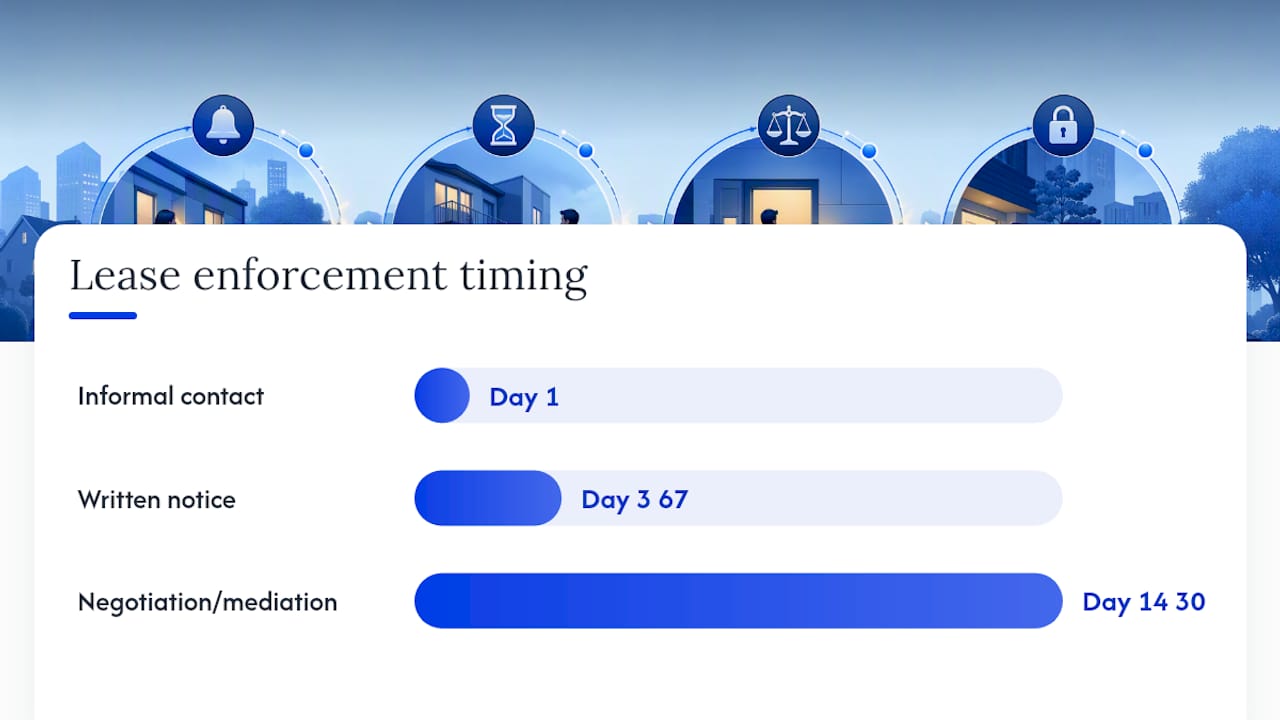
Stage 4: Legal filing. When the cure period expires without resolution, or negotiations stall, formal legal action becomes the only remaining option. This means filing for eviction (an unlawful detainer or similar action, depending on your state) with the appropriate court.
Here’s the escalation sequence condensed:
Document the violation and attempt informal, direct communication.
Send a written notice matching the violation type and your state’s required cure period.
Offer negotiation, mediation, or a documented payment plan if the tenant engages in good faith.
File in court only after notice periods expire and other options are exhausted.
Consult an attorney before Stage 4 if the violation involves anything beyond straightforward nonpayment, such as unauthorized occupants, property damage claims, or a tenant raising a habitability defense.
How Do You Write and Serve an Effective Lease Violation Notice?
A notice that skips a required element or gets served the wrong way can sink an otherwise solid case before it reaches a courtroom. Courts don’t grade on effort. They check for specific components and won’t forgive a shortcut.
Every enforceable notice should include:
The tenant’s full legal name as it appears on the lease.
The exact lease clause or provision being violated, quoted or clearly referenced.
A precise, factual description of the violation, including dates and specifics, not vague language like “disturbing neighbors.”
The specific action required to cure the violation.
A clear deadline, stated as a date, not “as soon as possible.”
The consequence of failing to cure, typically termination of tenancy and eviction filing.
Which notice type you use depends on the violation. A pay-or-quit notice applies to unpaid rent and gives the tenant a short window to pay the full amount owed. A cure-or-quit notice covers fixable lease violations, unauthorized pets, guest overstays, minor property damage, where the tenant gets a chance to correct the behavior. An unconditional quit notice applies to severe violations, often illegal activity or repeat offenses after prior cure notices, and typically doesn’t offer a chance to fix anything. Effective cure-or-quit notices spell out exactly what counts as curing the problem, so ambiguity doesn’t become the tenant’s defense later.
Proof of service matters as much as the notice content. Acceptable methods generally include certified mail with return receipt, personal delivery to the tenant, and posting on the door combined with mailing a copy (often called “nail and mail”). In many jurisdictions, a process server’s signed affidavit carries the most weight in court because it creates an independent, sworn record of when and how service happened.
Pro Tip: Keep a blank log template on hand specifically for service attempts. Note the date, time, method, and who witnessed it. That single habit has saved more eviction cases than any clever legal argument.
Why Do Notice Timelines Vary by State?
Cure periods, notice-to-quit windows, and acceptable service methods are set by state statute, not by your lease template. A notice that’s perfectly valid in one state can be worthless in another simply because the cure period was two days too short.
This variance exists because state legislatures balance landlord property rights against tenant housing stability differently. Some states demand extended cure periods for anything beyond nonpayment. Others allow shorter timelines but require stricter service documentation. Getting the number of days wrong, even by one day, is enough for a judge to dismiss the case and send you back to square one.
Before drafting anything, verify current rules through your state’s official judicial or housing authority website, or your local housing court’s self-help forms page. Many courts publish fillable notice and complaint templates that already meet local formatting requirements. If your property receives federal rental assistance, check HUD’s program-specific guidance as well, since those rules can layer additional requirements on top of state law.
Common service pitfalls to check before you file:
Confirm who legally qualifies as “the tenant” when the lease lists multiple occupants or someone has moved in without being added to the lease.
Verify your state accepts the service method you used, some states reject email or text notices entirely.
Keep the physical or digital proof of service (receipt, affidavit, photos of posting) even after the deadline passes.
Double-check the cure period calculation, since some states count only business days.
What Evidence Do You Need to Build a Lease Enforcement Case?
Judges expect an organized paper trail, and poor documentation is a frequent cause of delays or dismissals in enforcement hearings.
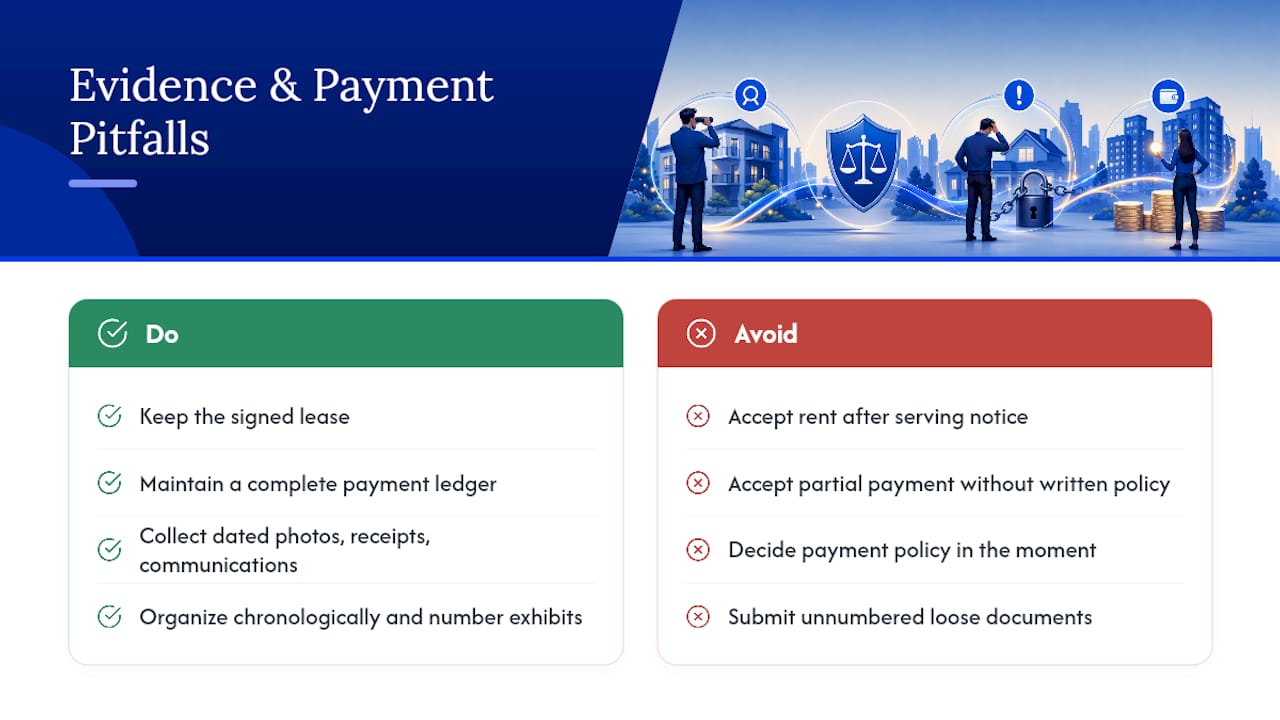
Your file should include the signed lease, a complete payment ledger, dated photos of any property damage, copies of every communication with the tenant, and any receipts tied to repairs or losses caused by the violation. Witness statements from neighbors or maintenance staff add weight when the violation involves noise, unauthorized occupants, or disruptive behavior.
Organize everything chronologically, starting from the lease signing date through the most recent notice, with exhibits numbered and indexed so you can hand a judge a clean timeline instead of a folder of loose paper.
One mistake trips up more landlords than any other: accepting a rent payment after serving a notice. Many courts treat that acceptance as a waiver of the entire notice, effectively resetting your case to zero. If a tenant offers a partial payment, decide in advance, ideally in writing with your management policy, whether you’ll accept it, and understand that accepting anything can undercut the eviction you just started.
Pro Tip: Set a documented policy right now for how your office handles payments after a notice is served. Deciding in the moment, under pressure from a tenant standing at your door, is how waivers happen.
When Should You Negotiate Instead of Evict?
Court is expensive, slow, and adversarial. When a tenant responds to a notice in good faith, negotiation often gets you paid faster and keeps a unit occupied instead of vacant during a filing period that can stretch for weeks.
Offer mediation when the dispute is about interpretation, not intent. If a tenant disputes whether a violation actually occurred, a neutral third party can resolve it faster than a courtroom, and many local housing authorities offer free or low-cost mediation services.
Draft a lease amendment when the underlying terms need to change. Adding an approved pet, formalizing an additional occupant, or adjusting a due date can eliminate the violation going forward without terminating the tenancy.
Put any payment plan or mutual termination in writing, signed by both parties. Include the exact amount owed, the payment schedule or move-out date, and what happens if either side doesn’t follow through.
Any agreement you reach needs the same rigor as the original lease: specific dollar amounts, dates, and consequences for missed terms. A verbal handshake agreement is nearly impossible to enforce later if the tenant stops paying again.
What Happens When You File an Eviction Case in Court?
Filing means submitting the signed lease, copies of every notice sent, your proof of service, and your organized evidence index to the appropriate court, usually a housing or civil court depending on your jurisdiction.
At the hearing, judges typically focus on three things: was the notice legally correct, was it served properly, and does the evidence support the claimed violation. This is exactly why the documentation habits from earlier stages matter. A judge reviewing a clean, chronological file moves through a case in minutes; a judge reviewing a messy one starts asking questions that can delay or sink your claim.
If the ruling favors the landlord, the court can grant:
Possession of the unit, meaning the tenant must vacate.
A money judgment for unpaid rent, damages, or court costs, depending on what you requested and your state’s rules.
Winning doesn’t mean the tenant leaves immediately. If they don’t vacate voluntarily, you typically need to request a writ of possession from the court, which authorizes the sheriff or local law enforcement to physically remove the tenant on a scheduled date. Self-help evictions, changing locks, removing belongings, or shutting off utilities without a court order, are illegal in every state and can expose you to significant liability regardless of how clearly the tenant violated the lease.
What Mistakes Most Often Derail Lease Enforcement?
The same handful of errors show up again and again in dismissed eviction cases, and nearly all of them are preventable with a five minute check before you act.
Using the wrong notice type or an unacceptable service method. Skipping a required notice or serving it incorrectly is the single most common reason courts dismiss enforcement cases, so confirm both against current state statute before sending anything.
Accepting rent after serving a notice. This routinely counts as a waiver, and it’s one of the easiest mistakes to avoid with a written office policy.
Enforcing inconsistently across tenants. Applying a rule to one tenant and not another with similar circumstances creates real exposure to discrimination claims, regardless of intent.
Skipping available court forms. Using the court’s own templates and preferred service method reduces procedural risk considerably compared to a homemade notice.
How 2nd Street Property Management Approaches Lease Enforcement
A disciplined enforcement process rests on habits repeated the same way every time: document the violation, send the correct notice, inspect the unit when relevant, escalate only when necessary, and loop in counsel before filing anything contested. That checklist doesn’t change based on how busy a week gets or how sympathetic a tenant’s excuse sounds.
For landlords managing several units without dedicated staff, tools that standardize leasing documentation close a lot of the gaps that cause dismissed cases. The same discipline applies to handling difficult tenants and working through a step-by-step response when a violation escalates past a simple conversation. None of this replaces an attorney’s judgment on a contested legal question, but consistent internal process is what keeps most disputes from ever reaching that point.
An Editorial Take on Lease Enforcement Done Right
The conventional advice on lease enforcement treats notice writing as the hard part. It isn’t. The hard part is discipline before the notice ever gets drafted: documenting the first informal conversation, resisting the urge to accept a rent payment out of guilt after serving a notice, and checking your own state’s cure period instead of copying a template found online.
Most enforcement failures trace back to a landlord who skipped the boring steps, the log entry, the certified mail receipt, the second confirmation of the correct notice period, because the violation felt obvious and the paperwork felt like a formality. Courts don’t share that instinct. They reward landlords who can produce a clean, dated record over landlords with a stronger emotional case but a thinner file.
If you take one thing from this, prioritize the documentation habit over the legal knowledge. You can look up a cure period in five minutes. You can’t reconstruct a communication log after the fact.
— Main
Get Enforcement Support From Professional Property Management
Running the full enforcement ladder alone, drafting notices, tracking cure deadlines, coordinating with attorneys, and managing eviction logistics, pulls owners away from the parts of the business that actually build wealth. Effective enforcement is best handled by a team that treats compliance and risk mitigation as core to protecting your return.

The residential property management services offered cover the tasks that eat the most landlord time: violation documentation, notice drafting and service, coordination with legal counsel when a case turns contested, and eviction logistics from filing through move-out. If your portfolio includes an HOA or condo association, association management support extends the same enforcement discipline to community rule violations.
A management proposal typically starts with a review of current lease terms and any open violations, followed by a plan for how notices, inspections, and escalations get handled going forward. Straightforward nonpayment cases and documented lease breaches are well within a manager’s scope; anything involving contested legal defenses, habitability disputes, or fair housing questions still calls for an attorney. Request a consultation with a property management company to see what a custom management plan looks like for your properties.
Sources
Verify notice requirements and cure periods against your own state statute before acting on anything here. Start with Cornell’s Legal Information Institute on cure-or-quit notices for definitions and legal standards, HUD’s program guidance for federally assisted housing rules, and LegalClarity’s eviction process primer for common procedural mistakes. For broader compliance planning across a portfolio, CR Equity AI’s real estate compliance guidance is worth a look.
This article is general information, not a substitute for advice from a qualified lawyer. Consult a qualified legal professional about your own circumstances before acting on anything here.
FAQ
How many lease violations can a tenant have before eviction?
There’s no universal number. Many leases and state laws allow escalating consequences, informal warning, then a cure-or-quit notice, then an unconditional quit notice, after repeated violations of the same lease provision within a set time frame.
Do lease violations expire or go away over time?
Some jurisdictions and lease agreements allow violations to be disregarded after a certain period without recurrence, but this varies significantly by state and lease language, so check your specific lease terms and local statute.
How long can someone live in a unit without being added to the lease?
There’s no single national rule. Many leases define an “unauthorized occupant” after a set number of consecutive days, often 14 to 30, at which point the situation becomes a lease violation requiring a cure-or-quit notice.
How can a tenant break a lease without a penalty in Georgia?
This depends on specific legal justifications like uninhabitable conditions, active military orders, or a landlord’s own lease violations. Tenants should confirm eligibility under Georgia’s landlord-tenant statute or with a local attorney before assuming penalty-free termination applies.
What happens if a landlord accepts rent after sending a notice?
In many jurisdictions, accepting rent after serving a notice is treated as a waiver of that notice, which can force the landlord to restart the enforcement process from the beginning.
Recommended

Comments