
What Is a Prorated Rent Charge and How Do You Calculate It?


Prorated rent is the portion of your monthly rent that reflects the number of days you actually occupy the unit during a partial month, instead of paying for a full 30 days when you only lived there for 12. It applies any time a lease starts or ends mid-month rather than exactly on the first.
The formula is simple: daily rent rate × number of days occupied = prorated rent. You get the daily rate by dividing the monthly rent by either 30 or the actual number of days in that month, depending on which method your landlord uses.
Here’s a quick example. Say your rent is $1,200 a month and you move in on the 21st of a 30-day month, giving you 10 days of occupancy.
Daily rate: $1,200 ÷ 30 = $40 per day
Prorated rent: $40 × 10 days = $400
That’s the entire concept in miniature. The rest of this guide covers the three calculation methods landlords actually use, worked examples for common move-in and move-out scenarios, and the policy details that keep this simple math from turning into a dispute.
Key Takeaways
Prorated rent equals the daily rental rate multiplied by the number of days occupied, and the method a landlord picks for calculating that daily rate determines the final dollar amount.
Point | Details |
Know the formula | Daily rate × days occupied gives the prorated amount, with the daily rate set by whichever method the lease specifies. |
Three methods exist | Banker’s 30-day, actual days-in-month, and annualized 365-day methods can each produce different totals for the same dates. |
Check the lease first | The lease usually controls the method; if it’s silent, ask in writing and check local landlord-tenant guidance. |
Get the math in writing | Request the per-diem formula on your signed move-in record, not just a final total, before you pay. |
Consistency comes from professional management | 2ndstreetpropertymanagement documents one proration method across an entire portfolio, applied the same way at every move-in and move-out. |
Table of Contents
Common Prorated Rent Practices Landlords and Tenants Should Know
Who Decides the Prorated Rent Method: Lease Terms or State Law?
A Property Manager’s Checklist for Setting a Clear Proration Policy
Why a Written Proration Policy Prevents Disputes Before They Start
How 2ndstreetpropertymanagement Handles Proration Policy for Your Portfolio
The Three Prorated Rent Calculation Methods Landlords Use
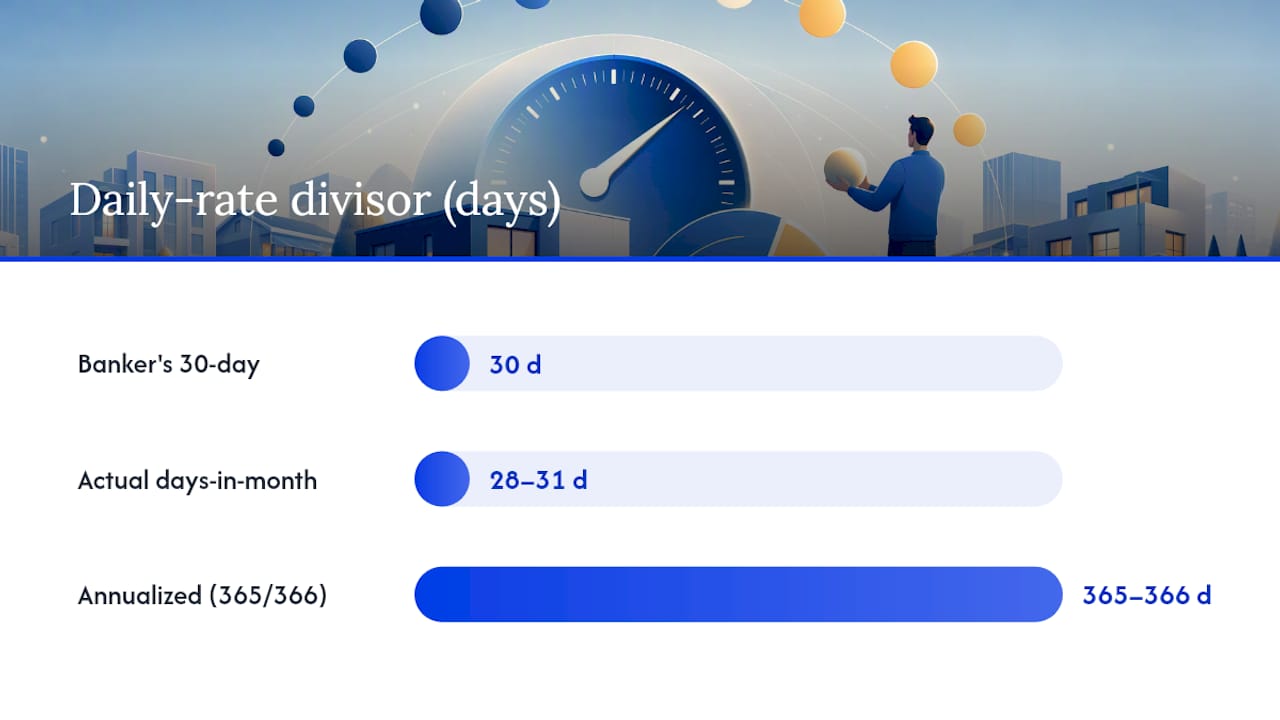
Not every landlord calculates prorated rent the same way, and that’s where most confusion starts. Three methods dominate the industry, and each one can produce a slightly different dollar figure for the exact same move-in date.
The Banker’s 30-day method treats every month as if it has 30 days, regardless of whether it’s February or July. You divide monthly rent by 30 to get the daily rate, then multiply by days occupied. It’s popular because it’s easy to standardize across a portfolio and produces round, predictable numbers every time.
The actual days-in-month method divides monthly rent by the real number of days in that specific month, whether it’s 28, 29, 30, or 31. This is generally viewed as the most mathematically accurate approach since it charges tenants based on what actually happened on the calendar, not a fixed assumption.
The annualized (365/366) method divides the annual rent (monthly rent × 12) by the days in the year, then multiplies by days occupied. This method smooths out month-to-month variation entirely, since every day of the year gets the exact same value regardless of which month it falls in.
Method | Formula | Best used when |
Banker’s 30-day | Monthly rent ÷ 30 × days occupied | Portfolio-wide simplicity is a priority |
Actual days-in-month | Monthly rent ÷ days in that month × days occupied | Precision matters more than round numbers |
Annualized (365/366) | (Monthly rent × 12) ÷ days in year × days occupied | Consistency across all 12 months is the goal |
These three approaches, along with their formulas, are laid out clearly in DiscoveryMark’s proration guide, which also notes that the resulting dollar amounts can diverge meaningfully depending on which one you pick. There’s no universal legal requirement forcing one method over another. The choice usually comes down to what’s written into the lease itself, or in a lease’s silence, whatever local convention your state tends to favor.
Pro Tip: Write the exact proration method into the lease agreement itself, not just into your internal accounting software. If the lease says “prorated using the actual days-in-month method,” there’s no room for a tenant to argue the math later.
Prorated Rent Formula Examples for Move-In and Move-Out
Numbers make this concept click faster than definitions do. Here are three scenarios you’ll run into constantly, worked out step by step.
Mid-month move-in. Rent is $1,500. Tenant moves in on June 16, a 30-day month, and is charged from that day through June 30 (15 days). Using the actual days-in-month method: $1,500 ÷ 30 = $50 per day. $50 × 15 = $750.
Mid-month move-out. Rent is $1,800. Tenant vacates on September 10, meaning they occupied the unit for 10 days (September 1 through September 10, counted inclusively). $1,800 ÷ 30 = $60 per day. $60 × 10 = $600.
31-day month versus February. Rent is $1,000. A tenant occupies the unit for 8 days in both January (31 days) and February (28 days). Under the actual days-in-month method, January’s daily rate is $1,000 ÷ 31 = $32.26, giving a prorated charge of $258.06. February’s daily rate is $1,000 ÷ 28 = $35.71, giving a prorated charge of $285.71 for the identical 8 days.
That third example is the one that surprises most tenants and even some new landlords. The OmniCalculator prorated rent tool confirms this same per-diem × days-occupied logic, and it’s exactly why the calendar month you’re prorating in matters as much as the number of days.
Counting conventions matter here too. Most landlords count the move-in day as day one of occupancy and the move-out day as the last day of responsibility, meaning both days get included in the total (an inclusive count). Rounding typically happens at the final dollar amount, rounded to the nearest cent, rather than rounding the daily rate itself, which can shift a bill by a few cents if applied inconsistently.

Method | Daily rate (Jan) | Daily rate (Feb) | Prorated amount (8 days) |
Banker’s 30-day | $32.26 | $32.26 | $258.06 |
Actual days-in-month | $32.26 | $35.71 | $258.06 (Jan) / $285.71 (Feb) |
Annualized (365 days) | $35.71 | $35.71 | $285.71 |
A $27 swing between January and February under the same rent and same days occupied isn’t rounding error. It’s the direct result of which method a property applies, which is exactly why picking one and sticking to it matters more than picking the “right” one.
Common Prorated Rent Practices Landlords and Tenants Should Know
Beyond the math, a handful of operational habits shape how prorated rent actually shows up on a bill. Some landlords collect first and last month’s rent up front and then bill the prorated amount separately at move-in. Others fold the prorated charge directly into the following month’s statement, so a tenant moving in mid-June sees a partial June charge combined with July’s full rent on one invoice.
According to Apartments, showing the actual formula, not just a final dollar total, on the move-in paperwork is one of the simplest ways to prevent confusion later. A tenant who sees “$50/day × 15 days = $750” trusts the number far more than one who’s just handed an invoice that says “$750 due.”
A few things worth checking before you sign anything or send a bill:
Confirm whether the move-in and move-out days are both counted as occupied days, or whether one is excluded.
Ask whether the daily rate rounds to the nearest cent or stays as a longer decimal until the final total.
Check whether the prorated charge appears on its own invoice or gets combined with the next full month’s rent.
Verify the security deposit is calculated separately from prorated rent, since some leases mistakenly conflate the two.
Look for a written proration method in the lease itself rather than relying on a verbal explanation.
Pro Tip: If a lease doesn’t specify a proration method anywhere in the document, ask in writing before you sign. A one-sentence email reply from the landlord confirming the formula becomes useful documentation if a disagreement ever comes up at move-out.
Who Decides the Prorated Rent Method: Lease Terms or State Law?
In most cases, the lease itself controls how rent gets prorated, since landlords and tenants are generally free to agree on any reasonable calculation method as part of the contract. If the lease spells out “actual days-in-month,” that’s the method that governs, full stop.
Problems arise when the lease says nothing at all about proration. In that gap, local custom or state-specific guidance can end up filling the void, and some states lean toward particular conventions, such as a 30-day standard, in practice even without an explicit statute. It’s worth checking your state’s landlord-tenant resources or a local housing authority if your lease is silent on the topic, since assuming a method that turns out to be wrong can create real friction at move-out.
A few practical steps protect both sides:
Read the lease’s rent section closely before signing, specifically looking for the word “prorate” or “proration.”
If it’s missing, ask the landlord or property manager to state the method in writing, even a short email works.
Keep a signed copy of the move-in record that shows the daily rate and total days charged.
For questions that touch on fair housing or nondiscriminatory billing practices, HUD’s fair housing overview is a solid starting point for understanding federal protections that apply regardless of the proration method chosen.
None of this requires a lawyer for a routine mid-month move. It requires a lease that says what it means and a landlord willing to put the math in writing.
A Property Manager’s Checklist for Setting a Clear Proration Policy
A proration policy is really a documentation problem wearing a math costume. The calculation itself takes seconds. What causes disputes is inconsistency: one tenant gets the 30-day method, another gets actual days, and nobody remembers which was promised to whom.
Here’s a checklist that keeps a proration policy defensible across an entire portfolio:
Pick one method and apply it to every unit, every lease, every time. Mixing methods across properties is where most disputes start.
Write the method into the lease template itself, using plain language a tenant can read without a calculator, e.g., “Rent will be prorated using the actual days-in-month method.”
Show the formula on the signed move-in record, not just the final dollar amount, so the tenant sees exactly how the number was reached.
Apply the same method at move-out as was used at move-in for that same tenant, to avoid the appearance of picking whichever number benefits the property.
Store the calculation with the lease file so it’s available if a small-claims dispute ever surfaces months or years later.
A sample clause you can adapt: “Rent for any partial month at the start or end of the lease term will be prorated by dividing the monthly rent by the actual number of days in that calendar month, then multiplying by the number of days occupied.”
Consistency here isn’t just about tenant relations, though that matters plenty. It’s about accounting accuracy across dozens or hundreds of units, and about having a clean, repeatable answer if a dispute ever escalates to small claims court. As one industry resource on the topic puts it:
Consistent policy eliminates ambiguity. Avoiding arbitrary rounding or switching methods mid-stream is what keeps tenant trust intact and keeps a landlord’s numbers defensible.
That guidance from the Wall Street Prep knowledge base echoes what shows up constantly in day-to-day management: the properties with the fewest billing complaints are almost always the ones with the most boring, repetitive, well-documented process. For portfolio-level consistency on other operational fronts, tracking rental property expenses the same way you standardize proration keeps your books clean and your defenses strong.
Why a Written Proration Policy Prevents Disputes Before They Start
The proration disputes that escalate rarely start with bad math. They start with a tenant who was told one thing verbally at move-in and then sees a different number on paper, or a property manager who used one method for the last tenant and a different one for the next.
The fix isn’t complicated. It’s procedural. Pick a method, put it in writing, show your work on the move-in record, and apply it the same way every single time. Landlords who skip this step aren’t usually trying to overcharge anyone. They’re just improvising month to month, and improvisation is exactly what erodes tenant trust when the numbers don’t match expectations.
One habit worth adopting immediately: include the per-diem formula directly in the tenant’s move-in packet, right next to the lease signature page. It takes one extra line of paperwork and eliminates the single most common source of billing confusion in the first 30 days of a tenancy.
How 2ndstreetpropertymanagement Handles Proration Policy for Your Portfolio
Writing a proration clause into a single lease is easy. Applying that same method consistently across a dozen units, a hundred units, or a mixed portfolio of single-family homes and condo associations is where most landlords lose the thread. That consistency is exactly what 2ndstreetpropertymanagement builds into every managed property from day one, rather than leaving the formula to whoever happens to be handling move-in paperwork that week.
Our team drafts the proration clause into your lease templates, applies the same calculation method at every move-in and move-out across your entire portfolio, and documents the math on every signed move-in record so nothing gets left to memory or guesswork later. That includes rent collection, lease updates, and the day-to-day tenant screening and maintenance coordination that keeps a property running smoothly between tenants. If your current lease language is silent on proration, or if you’re managing units where different methods have crept in over time, reach out to 2ndstreetpropertymanagement for a policy review and see what a consistent, defensible process looks like across your properties.
Frequently Asked Questions
What does prorated rent mean in simple terms? It means paying only for the days you actually occupy a rental unit during a partial month, calculated as a daily rate multiplied by days occupied, instead of paying a full month’s rent for partial occupancy.
Is prorated rent good or bad for tenants? It’s generally favorable for tenants, since it prevents paying for days you didn’t live in the unit. The only friction comes from confusion over which calculation method a landlord uses, which written documentation solves.
Can you give an example of how to prorate rent? Yes. For $1,500 monthly rent in a 30-day month, moving in on day 16 means 15 days occupied. Divide $1,500 by 30 to get $50 per day, then multiply by 15 days for a prorated charge of $750.
How do you calculate prorated rent for a partial month? Divide the monthly rent by either 30, the actual days in that month, or 365 for the year, depending on the method specified in the lease. Then multiply that daily rate by the number of days you occupied the unit.
Does the lease or state law decide the proration method? The lease usually decides, since landlords and tenants can agree on any reasonable method in the contract. When the lease says nothing about it, state or local practice may fill the gap, so it’s worth checking with local housing resources.
This article is general information, not a substitute for advice from a qualified financial advisor. Consult a qualified financial professional about your own circumstances before acting on anything here.
Sources
Recommended
Comments