
Rental Property Valuation Methods Explained for Landlords


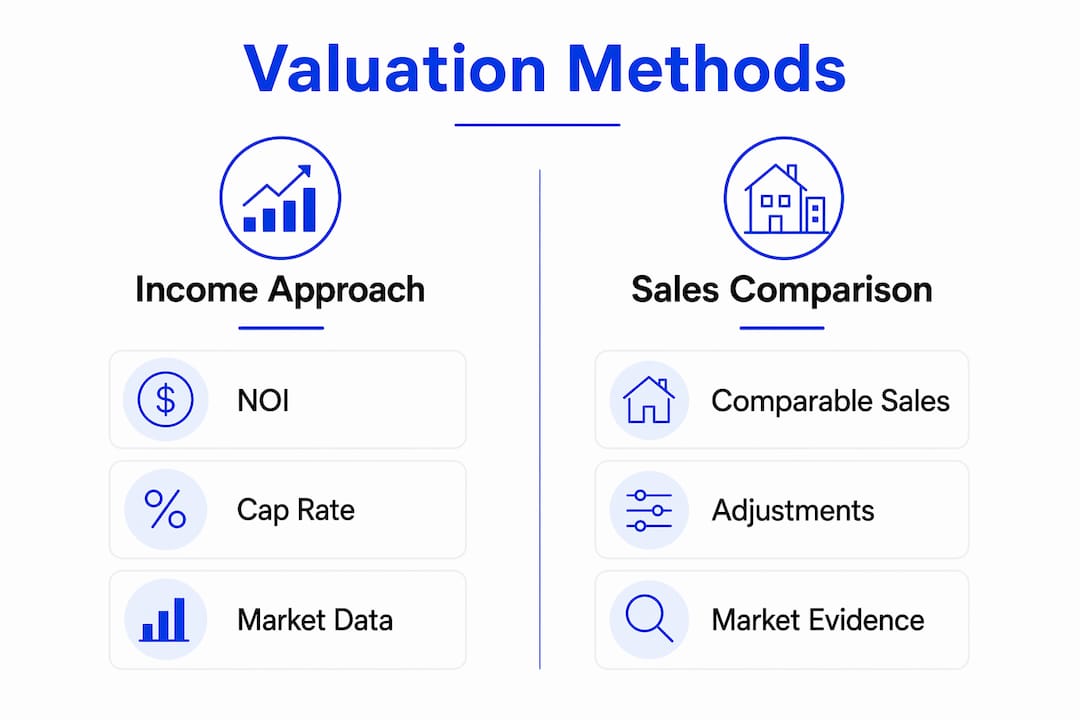
Rental property valuation methods are the formulas and approaches landlords use to determine an investment property’s market value based on income potential, comparable sales, and replacement cost. Three primary techniques dominate professional appraisal practice: the Income Approach, the Sales Comparison Approach, and the Cost Approach. Each method produces a different number, and knowing which one to trust, and when, separates disciplined investors from those who confuse activity with progress. For landlords making buy, hold, or sell decisions in 2026, understanding how to value rental properties is not optional. It is the foundation of every sound investment decision.
What are the rental property valuation methods explained by professionals?
The Income Approach is the most widely used method for income-producing properties. It converts a property’s net operating income into an estimated value using a capitalization rate. Net Operating Income is gross revenue minus operating expenses, excluding debt service and depreciation. The formula is straightforward: Property Value = NOI / Cap Rate.
Here is a simple example. A duplex generates $36,000 in annual gross rent. After subtracting $12,000 in operating expenses, the NOI is $24,000. If the local cap rate for similar properties is 6%, the estimated value is $400,000. That single number drives your offer price, your financing structure, and your return projections.

Cap rates are not fixed. Cap rates for multifamily properties in major U.S. markets range from 4% to 8% depending on location, asset class, and current market conditions. A lower cap rate signals a higher price relative to income, which is typical in high-demand urban markets. A higher cap rate means more income relative to price, which often reflects higher risk or a less competitive market.
The Income Approach works best for multifamily, commercial, and mixed-use rental properties where income data is reliable and verifiable. It is less useful for single-family rentals in thin markets where comparable income data is scarce.
Pro Tip: Separate repairs from capital expenditures before calculating NOI. Repairs are operating expenses, but CAPEX items like roof or HVAC replacements must be amortized over their useful life. Lumping them together makes your cash flow look artificially strong and your valuation dangerously optimistic.
A quick screening tool that complements the Income Approach is the Gross Rent Multiplier. GRM ranges optimally from 4 to 7, calculated as Purchase Price divided by Annual Gross Rent. A property priced at $300,000 with $60,000 in annual rent carries a GRM of 5, which signals reasonable investment potential. GRM does not replace a full income analysis, but it filters out overpriced deals in seconds.
How does the sales comparison approach work for rental properties?
The Sales Comparison Approach estimates value by comparing the subject property to recent sales of similar properties. It rests on the principle of substitution: a rational buyer will not pay more for a property than the cost of acquiring a comparable one. This method is the standard for single-family and small residential rental properties where transaction data is plentiful.
Selecting the right comparables requires discipline. The best comps are:
Recent: Closed within the past 3–6 months to reflect current market conditions
Nearby: Located within close geographic proximity, ideally the same neighborhood or submarket
Similar: Matching in key physical characteristics such as bed count, bath count, square footage, and lot size
Arm’s length: Representing open-market transactions, not foreclosures, estate sales, or related-party deals
Once you select your comps, you adjust them to reflect differences from the subject property. Adjustments apply to the comparables, not to the subject property. This is the most common mistake landlords make. If a comp has a garage and your property does not, you subtract the garage’s value from the comp’s sale price. You are asking: “What would this comp have sold for if it were more like my property?”
Unsupported adjustments weaken valuation reliability. Every adjustment needs market evidence, such as paired sales data showing what buyers actually paid for that feature. Guessing at adjustments introduces error that compounds across multiple comps.
Pro Tip: Use at least three comps and bracket the subject property. One comp should be slightly superior, one slightly inferior, and one roughly equal. This bracketing approach gives your adjusted value more credibility and reduces the risk of a skewed result.
The Sales Comparison Approach loses accuracy in thin markets where few comparable sales exist, or in rapidly shifting markets where six-month-old data no longer reflects current prices. In those cases, the Income Approach carries more weight.
What is the cost approach and when does it apply?
The Cost Approach estimates value by adding land value to the current replacement cost of improvements, then subtracting depreciation. The cost approach sums land value plus current replacement cost minus depreciation from physical, functional, and external sources. Physical depreciation is wear and tear. Functional obsolescence is a design flaw, like a four-bedroom house with one bathroom. External obsolescence is a market or environmental factor outside the property, like a new highway adjacent to the lot.
This method works best in specific scenarios. New construction is the clearest case, because little depreciation has accumulated and replacement cost closely mirrors market value. Special-purpose properties, such as churches, schools, or industrial facilities, also rely on the cost approach because comparable sales rarely exist.
The cost approach has a meaningful limitation for rental investors: it ignores income. A warehouse generating strong lease income may be worth far more than its replacement cost suggests. For that reason, appraisers use the cost approach as a ceiling check rather than a primary indicator for income-producing assets.
Approach | Best for | Primary input | Key limitation |
Income | Multifamily, commercial | NOI and cap rate | Sensitive to income accuracy |
Sales comparison | Single-family, residential | Recent comparable sales | Requires active transaction market |
Cost | New construction, special-purpose | Replacement cost and land value | Ignores income potential |
How do you reconcile multiple valuation methods?
Professional appraisals do not average the three approaches. Appraisers weight each method based on property type and data reliability. For a 20-unit apartment building, the income approach carries the most weight. For a single-family rental in a suburban neighborhood with 15 recent sales, the sales comparison approach dominates. The cost approach rarely drives final value for existing income properties but serves as a sanity check.
Reconciliation is a judgment call grounded in data quality. When two methods produce values within 5% of each other, you have strong confirmation. When they diverge by more than 10%, triangulation flags underwriting risks and signals that further due diligence is needed before committing capital.
Common reasons for large discrepancies include:
Seller-provided income projections that do not match market rents
Comps selected from a different submarket or time period
Depreciation estimates that do not reflect actual property condition
Cap rates pulled from national averages rather than local transaction data
The most reliable reconciliation process starts with validating your inputs. Confirm that your NOI reflects actual collected rents, not pro forma projections. Confirm that your comps closed within the past six months and sit within close proximity to the subject. When your inputs are solid, the methods converge naturally.
What practical steps improve rental property valuation accuracy?
Accurate valuation requires discipline at every step. Follow this process before finalizing any number:
Verify rental income with market comps. Use at least three current rental comps matching bed count, bath count, and location. Never accept a seller’s rent roll without cross-checking it against active listings and recent leases.
Apply a realistic vacancy rate. Vacancy rates often average 10% across most markets. Underwriting at 5% or less is optimistic and will inflate your NOI and your estimated value.
Separate repairs from CAPEX. Roof replacements, HVAC systems, and water heaters are capital expenditures. They belong in a reserve account, not your annual operating expense line. Mixing them distorts your NOI and your cap rate calculation. Review the hidden costs of rental property that most landlords overlook when building their expense models.
Use local cap rates, not national averages. A 6% cap rate in Dallas is not the same market signal as a 6% cap rate in Detroit. Pull cap rate data from recent local transactions in the same asset class. For a deeper breakdown, the guide on using cap rates effectively covers how to source and apply local data.
Target standard return benchmarks. For 2026, target cash-on-cash returns of 8–12% represent the standard investment benchmark for residential rentals. If your valuation produces a deal that falls well below that range, the price is too high or the income too low.
Cross-check with GRM. Run the Gross Rent Multiplier as a quick filter before committing to a full underwrite. A GRM above 10 in most markets deserves serious scrutiny.
Pro Tip: Expense growth usually exceeds rent growth by 0.5–1% annually. Build that assumption into your multi-year projections. A deal that works at year one may not work at year five if you ignore expense inflation.
Key Takeaways
Accurate rental property valuation requires using all three approaches, validating every input against real market data, and reconciling discrepancies with judgment rather than arithmetic.
Point | Details |
Income Approach drives commercial value | Use NOI divided by local cap rate to estimate value for multifamily and commercial properties. |
Sales comparison anchors residential deals | Select three recent, nearby, similar comps and adjust them to the subject, not the other way around. |
Cost approach serves as a ceiling check | Apply it to new construction or special-purpose properties; do not rely on it for income-producing assets. |
Reconcile with weighted judgment | Weight each method by property type and data quality; investigate any discrepancy larger than 10%. |
Validate every input before finalizing | Confirm rents with market comps, apply a 10% vacancy rate, and separate repairs from CAPEX reserves. |
The valuation mistake I see most often
The most common error landlords make is treating valuation as a one-time calculation rather than an ongoing discipline. They run the numbers once at acquisition, accept the seller’s income projections at face value, and never revisit the assumptions. That approach confuses movement with progress.
The most common valuation mistake is relying on seller-provided income projections without validating them against market data. I have seen landlords overpay by 15–20% simply because they trusted a rent roll that reflected aspirational rents, not actual collected income. The fix is not complicated. It requires three current rental comps, a realistic vacancy assumption, and an honest expense model that includes CAPEX reserves.
The second mistake is picking one method and ignoring the others. Relying on the sales comparison approach alone for a 12-unit apartment building is like evaluating a car using only its color. The income approach exists precisely because income-producing assets derive their value from cash flow, not from what a neighbor’s building sold for last year. Use all three methods, weight them appropriately, and let the reconciliation tell you where the risk lives.
The landlords who make the best decisions treat valuation as a process of elimination. They are not trying to confirm a price they already want to pay. They are trying to find the reasons not to pay it. That mindset, combined with validated data and triangulated methods, is what separates disciplined investors from those who learn expensive lessons. For a deeper look at where landlords go wrong, the breakdown of costly investing mistakes covers the patterns that repeat most often.
— Main
How 2ndstreetpropertymanagement supports your valuation process
Knowing the methods is one thing. Applying them accurately in a live market requires current data, local expertise, and ongoing monitoring of income and expenses.
2ndstreetpropertymanagement was built by investors for investors, which means the team understands that property value is not static. Rents shift, vacancy rates move, and expense assumptions go stale. Professional property management keeps your income data current, your expense records clean, and your cap rate assumptions grounded in real transactions. If you want a partner who treats your portfolio the way you would, visit 2ndstreetpropertymanagement.com to see how the team supports landlords at every stage of the investment cycle.
FAQ
What is the most accurate method for valuing a rental property?
No single method is most accurate on its own. Professional appraisals weight all three approaches based on property type and data quality, with the income approach dominating for commercial assets and sales comparison leading for residential rentals.
What is a good cap rate for a rental property in 2026?
Cap rates for multifamily properties in major U.S. markets range from 4% to 8%. The right cap rate depends on your local market, asset class, and risk tolerance, so always pull data from recent local transactions rather than national averages.
How do I calculate rental property value using NOI?
Divide your Net Operating Income by the local cap rate. If your property generates $30,000 in NOI and the local cap rate is 6%, the estimated value is $500,000. Accuracy depends entirely on using verified income and realistic expense figures.
What is the Gross Rent Multiplier and how do I use it?
GRM equals Purchase Price divided by Annual Gross Rent. A GRM between 4 and 7 generally signals reasonable investment potential. Use it as a quick filter before committing to a full underwrite, not as a substitute for a complete income analysis.
What affects rental property value the most?
Net operating income and local cap rates have the greatest impact on value for income-producing properties. Vacancy rates, expense accuracy, and the quality of comparable sales data also shift valuations significantly, which is why validating every input matters before finalizing any estimate.
Recommended
Comments