
How to Audit Rental Property Performance in 2026
- Bud Evans
- 2 days ago
- 8 min read

A rental property performance audit is a structured review of a property’s financial records, physical condition, and local market data to identify where money is being lost and where returns can grow. Most investors track rent collected and call it a day. That approach confuses movement with progress. The real measure of a rental investment is Net Operating Income (NOI), Cash-on-Cash Return, and Debt Service Coverage Ratio (DSCR). Together, these metrics tell you whether your property is genuinely profitable or just busy. This guide gives you a repeatable process to audit rental property performance and make decisions grounded in real numbers.
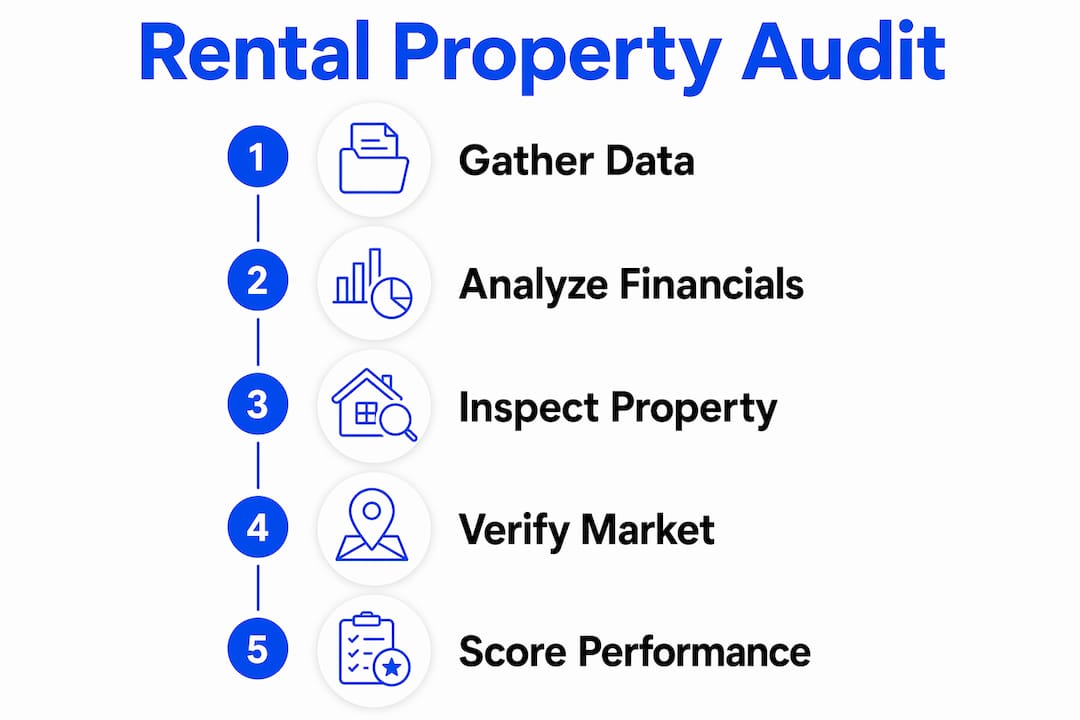
What key financial metrics should you audit for rental property performance?
Financial metrics are the foundation of any credible investment property analysis. Without them, you are comparing properties the way someone might compare cars using only color. The numbers tell the real story.
The four metrics that matter most
Net Operating Income (NOI) is gross rental income minus all operating expenses, excluding mortgage payments. If your property collects $36,000 per year and operating costs total $18,000, your NOI is $18,000. NOI tells you how much the property earns on its own, before debt.

Cap Rate converts NOI into a yield percentage relative to property value. Divide NOI by the current market value. A $200,000 property with $18,000 NOI carries a 9% cap rate. Cap rate is a fast comparison tool only when the underlying income and valuation data are verified. Never use it in isolation.
Cash-on-Cash Return measures the annual cash flow against your actual cash invested. If you put $50,000 down and net $5,000 in cash flow after debt service, your cash-on-cash return is 10%. Strong performers target 8–12% cash-on-cash return in 2026. That range signals a property is generating real wealth, not just covering its own costs.
Debt Service Coverage Ratio (DSCR) divides NOI by total annual debt payments. A DSCR of 1.25 means the property earns $1.25 for every $1.00 owed. Lenders and investors require DSCR above 1.25 as a baseline for financing viability. Anything below 1.0 means the property cannot cover its own debt.
Metric | Formula | 2026 Benchmark |
NOI | Gross Income – Operating Expenses | Positive and growing |
Cap Rate | NOI ÷ Property Value | Market-dependent |
Cash-on-Cash Return | Annual Cash Flow ÷ Cash Invested | 8–12% |
DSCR | NOI ÷ Annual Debt Service | Above 1.25 |
Pro Tip: Run your metrics on actual collected rent, not scheduled rent. The gap between the two reveals your real vacancy and collection loss.
How do you gather and verify market data for a rental property audit?
Accurate market data is what separates a real audit from a spreadsheet exercise. Investors who rely on optimistic projections without verifying market data routinely make bad offers and absorb preventable losses.
A credible rental market assessment requires at least three sales comparables and three rental comparables. Verification needs 3 sales comps from the last 3–6 months and 3 active rental comps that match your property’s bedroom count, bathroom count, and square footage. Fewer comps mean wider margins of error.
Here is where to find reliable data:
County assessor records provide verified sale prices and property characteristics without the noise of listing inflation.
Zillow and Rentometer offer rental rate ranges by zip code and bedroom count, useful for a quick market read.
Local property management insights give you on-the-ground vacancy rates and tenant demand trends that no algorithm captures.
MLS data through a licensed agent or investor network delivers the most accurate recent sales history.
Adjust your analysis for local vacancy rates and rent growth trends. A market with rising vacancy and flat rent growth changes your NOI projections significantly. Income-based valuation combined with sales comps and market trends produces the most defensible property value estimate.
Pro Tip: Set a calendar reminder every six months to pull fresh comps. Stale data from 12 months ago can make a declining market look stable.
How to execute a rental property audit step by step
A thorough property management audit covers three tracks simultaneously: financials, physical condition, and regulatory compliance. Skipping any one track produces an incomplete picture.
Collect all financial documents. Pull your income statement, cash flow statement, and rent roll for the past 12–24 months. Include utility bills, insurance premiums, property tax statements, and maintenance invoices. Reviewing NOI and cash flow trends consistently is the foundation of detecting problems before they compound.
Calculate your key metrics and flag red flags. Run NOI, cap rate, cash-on-cash return, and DSCR using verified numbers. Operating expenses exceeding 50% of gross rental income signal poor performance. If your expense ratio is climbing toward 60%, something is wrong with either cost control or income.
Inspect physical condition and maintenance history. Walk the property with a checklist. Review the last two years of maintenance records. Deferred maintenance directly impacts financial returns and tenant retention. A leaking roof that costs $800 to fix today can cost $12,000 in structural damage next year.
Verify regulatory compliance and risk exposure. Confirm the property meets local habitability codes, landlord-tenant law requirements, and any rent control ordinances. Unaddressed compliance gaps create liability that does not show up in your NOI until a lawsuit does.
Run market comparisons and stress tests. Compare your rents and expenses against current comps. Then run a sensitivity analysis with lower rents or higher vacancy to test whether the deal still works under adverse conditions. A 10% rent drop or a 15% vacancy increase should not destroy your cash flow.
Summarize findings and identify opportunities. Document every gap you found. Rank them by financial impact. A property with below-market rents and deferred maintenance has two clear levers to pull. Prioritize the one with the higher return per dollar spent.
Pro Tip: Use a dual-track audit format that scores financial performance and physical condition separately. A comprehensive property audit that evaluates both tracks together gives you the most accurate picture of where value is being lost.
What mistakes undermine a rental property performance audit?
Most audit failures come from the same handful of errors. Recognizing them before you start saves you from building a plan on a flawed foundation.
Using optimistic rent projections. Plugging in the rent you hope to charge rather than what the market supports inflates every downstream metric. Your NOI, cap rate, and cash-on-cash return all look better than reality.
Ignoring deferred maintenance. A property that looks profitable on paper but has aging HVAC, a worn roof, or outdated plumbing is carrying hidden liabilities. These costs will surface, and they will be larger than a proactive fix would have been.
Failing to verify income and expense data. Rent rolls can include tenants who are behind on payments. Expense reports can omit one-time costs that recur more often than “one time.” Verify every line item against bank statements and invoices.
Skipping vacancy and CapEx reserves. A property with 100% occupancy today will not stay that way. Budget a vacancy allowance of at least 5–8% of gross rents and a capital expenditure reserve for major system replacements.
Using stale market data. Comps from 12 months ago in a shifting market are not comps. They are historical artifacts. Your rental income audit is only as accurate as the data feeding it.
Skipping stress testing. Stress testing financial models against adverse scenarios is what separates disciplined investors from optimistic ones. If your model only works under best-case assumptions, it is not a model. It is a wish.
Pro Tip: Before finalizing any audit, ask yourself: “Does this deal still work if rents drop 10% and one unit sits vacant for 90 days?” If the answer is no, you have more work to do.
How do you use audit results to improve rental property performance?
An audit without action is just paperwork. The value of a landlord performance review comes from what you do with the findings.
Adjust rents to market rate. If your audit reveals rents 8–12% below current comps, a lease renewal is your opportunity to close that gap. Even a $75 monthly increase on a four-unit property adds $3,600 per year to your NOI. Learn how to maximize rental income with a structured approach to rent pricing.
Address operating expense inefficiencies. Review your maintenance cost categories and identify where costs are running above the 50% expense ratio benchmark. Preventive maintenance contracts often cost less than reactive repairs.
Strengthen tenant screening and lease terms. High turnover is one of the most expensive performance drains in rental investing. Tighter screening criteria and longer lease terms reduce vacancy loss and protect your cash flow.
Plan capital investments strategically. Your audit’s physical inspection findings should feed directly into a capital expenditure schedule. Prioritize improvements that increase rent potential or reduce ongoing maintenance costs.
Schedule audits regularly. A thorough due diligence process run annually keeps your performance data current and catches problems before they become expensive. Quarterly reviews of NOI and cash flow trends are a minimum standard for serious investors.
Use audit data in refinancing conversations. A well-documented audit with verified NOI and DSCR figures gives lenders confidence. It can support a cash-out refinance or a lower rate negotiation based on demonstrated performance.
The discipline that separates good investors from great ones
Most investors I have worked with run their numbers once at acquisition and then coast. They check the rent deposit, glance at the bank balance, and assume the property is performing. That assumption is where value quietly disappears.
The investors who consistently build wealth treat their portfolio like a business with quarterly reporting requirements. They do not wait for a problem to surface. They look for it. When an audit reveals that operating expenses have crept from 48% to 57% of gross income over two years, that is not a surprise. It is a trend that a disciplined review would have caught at 51%.
Physical and financial audits must run together. A property that looks profitable on paper but has deferred maintenance is a liability dressed as an asset. I have seen investors sell what looked like a strong performer only to discover the buyer’s inspection revealed $40,000 in deferred repairs that the seller had never tracked. The audit would have found it first.
The most valuable habit you can build is skeptical verification. Do not accept the numbers you want to see. Verify the numbers that are actually there. That discipline, applied consistently, is what turns a rental property from a side income into a real investment.
— Main
How 2ndstreetpropertymanagement supports your rental property audit

2ndstreetpropertymanagement is built by investors, for investors. The team understands that a rental property audit is not a one-time event. It is an ongoing discipline that requires accurate financial reporting, physical oversight, and current market knowledge working together. 2ndstreetpropertymanagement provides property performance reviews that cover NOI analysis, expense benchmarking, physical condition assessments, and local market comparisons. Whether you own a single rental or a growing portfolio, professional oversight keeps your investment property analysis grounded in verified data. Contact 2ndstreetpropertymanagement to schedule a property evaluation and find out exactly where your returns stand.
Key takeaways
A rental property audit is only as reliable as the data behind it. Verify every number, inspect every system, and test every assumption before drawing conclusions.
Point | Details |
Lead with financial metrics | NOI, cash-on-cash return, and DSCR are the three metrics that define real property performance. |
Verify market data rigorously | Use at least 3 sales comps and 3 rental comps from the last 3–6 months to support every valuation. |
Run a dual-track audit | Evaluate financial performance and physical condition together for an accurate performance picture. |
Stress test every model | Test your numbers against a 10% rent drop and elevated vacancy before finalizing any conclusion. |
Act on findings consistently | Schedule annual audits and quarterly NOI reviews to catch cost creep and income gaps early. |
FAQ
What is a rental property performance audit?
A rental property performance audit is a structured review of a property’s financials, physical condition, and market position to identify inefficiencies and opportunities to increase returns. It covers metrics like NOI, DSCR, and cash-on-cash return alongside physical inspections and market comparisons.
How often should landlords audit their rental properties?
Landlords should conduct a full audit annually and review key financial metrics like NOI and cash flow quarterly. Regular reviews catch cost increases and rent gaps before they compound into larger losses.
What is a healthy expense ratio for a rental property?
Operating expenses should stay around 50% of gross rental income. An expense ratio consistently above that threshold signals a performance problem that requires investigation.
What does a good DSCR look like for a rental property?
A DSCR above 1.25 is the standard benchmark for a well-performing rental property. It means the property generates $1.25 in income for every $1.00 in debt obligations, which satisfies most lenders and confirms financial stability.
What are the most common mistakes in a rental property audit?
The most common errors include using unverified rent projections, ignoring deferred maintenance, skipping stress tests, and relying on stale market comps. Avoiding these top rental property mistakes keeps your audit conclusions grounded in reality.
Recommended