
Real Estate Asset Management Explained for Investors


Most investors who own rental properties think they understand asset management. They have a property manager handling tenants, collecting rent, and coordinating repairs. That feels like the job. It is not. Real estate asset management explained properly looks very different from day-to-day operations. It is the strategic financial layer that sits above property management, governing investment decisions, capital deployment, hold periods, and exit timing. If you are building a real estate portfolio and you are not actively practicing asset management, you are likely confusing movement with progress.
Table of Contents
Key takeaways
Point | Details |
Asset management is not property management | Asset managers set investment strategy; property managers execute daily operations. |
NOI drives property value | Increasing Net Operating Income directly increases asset value under standard valuation methods. |
Metrics guide every decision | Vacancy rates, cash-on-cash return, and IRR are the instruments that tell you when to hold, refinance, or sell. |
Capital planning accuracy matters | Condition-based capital planning reduces forecasting variance to 10 to 15%, versus 30 to 50% with age-based estimates. |
Execution requires a system | Effective asset management requires regular reporting cycles, clear KPIs, and a closed loop between underwriting assumptions and actual results. |
Real estate asset management explained from the ground up
Understanding property asset management starts with a clear definition. Real estate asset management is the strategic oversight of a property or portfolio with the goal of maximizing investor returns across the full investment lifecycle. That means from acquisition through operations and all the way to disposition. Asset management sets business plan objectives like hold period, NOI targets, and exit strategy, while property management executes operations and reports upward.
The asset manager’s role is fundamentally financial. They are not fixing leaky faucets or screening tenants. They are asking: Is this property performing against the underwriting model? Should we refinance now or wait? Does the capital expenditure plan support the exit price we need? These are investment-level questions, and they require a different skill set and mindset than operational management.
Key responsibilities of a real estate asset manager include:
Business plan development: Defining the investment thesis, target returns, hold period, and value-add strategy for each asset
Financial performance tracking: Monitoring NOI, cash flow, occupancy, and expense ratios against underwriting assumptions on a quarterly basis
Capital events decisioning: Evaluating when to refinance, recapitalize, or sell based on market conditions and portfolio objectives
Lender and investor relations: Maintaining transparency through regular reporting and managing debt covenants
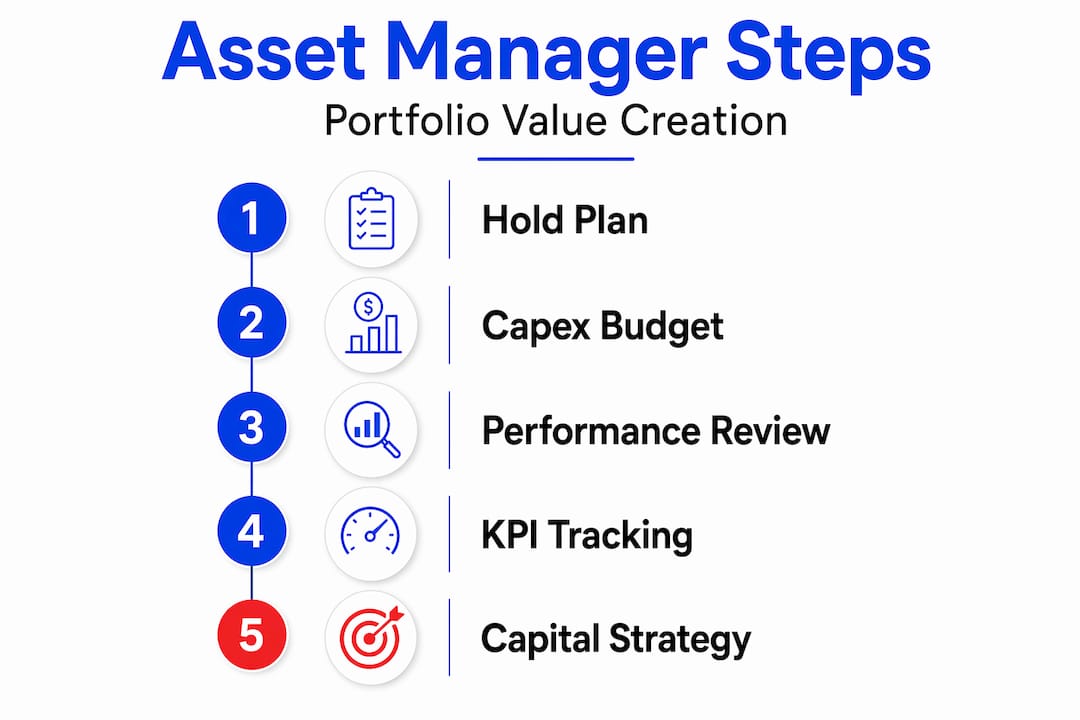
Typical asset management responsibilities cover hold period planning, capex budgets, quarterly performance monitoring, and refinancing or disposition decisions. This is not a passive role. It requires active engagement with every financial lever the property offers.
Pro Tip: Set a formal quarterly review cadence for each asset in your portfolio. Review actual NOI against your underwriting model and document the variance. That discipline alone separates serious investors from casual landlords.
The financial metrics that drive every decision
What is asset management in real estate without a command of the numbers? Metrics are not just reporting tools. They are decision triggers. Every strategic move an asset manager makes should trace back to a specific data point.

Here are the core metrics and what they tell you:
Metric | What it measures | Why it matters |
Net Operating Income (NOI) | Revenue minus operating expenses | Increasing NOI directly increases asset value under cap rate valuation |
Cash-on-cash return | Annual cash flow divided by equity invested | Tells you how hard your capital is working right now |
Internal Rate of Return (IRR) | Time-weighted total return on investment | The benchmark for evaluating the full lifecycle performance |
Vacancy rate | Percentage of units unoccupied | A leading indicator for revenue risk and leasing strategy adjustments |
Expense ratio | Operating expenses as a percentage of gross income | Signals operational efficiency and management quality |
KPI tracking such as vacancy rate and NOI allows asset managers to isolate property performance and identify when strategic timing for refinancing or sale is right. These numbers are not backward-looking scorecards. They are forward-looking signals.
Capital planning is where metrics translate into real money. Condition-based capital planning reduces forecasting variance to 10 to 15%, compared to 30 to 50% with traditional age-based estimates. That difference in accuracy can mean the gap between a profitable exit and a value-destroying surprise capital call right before a sale.
Pro Tip: Build a simple tracking spreadsheet that compares your original underwriting assumptions to actual monthly results for each property. When variances exceed 5%, treat that as a trigger to reassess your strategy, not just your operations.
Asset management vs. property management: where the lines are drawn
This distinction is where most investors get confused, and the confusion is costly. Think of it this way: property management is the engine, and asset management is the navigation system. Both are necessary. Neither replaces the other.
Here is a direct comparison:
Dimension | Asset management | Property management |
Primary focus | Investment returns and capital strategy | Daily operations and tenant relations |
Decision scope | Hold period, exit strategy, financing | Leasing, maintenance, rent collection |
Reporting direction | To investors and lenders | To the asset manager or owner |
Time horizon | Multi-year investment lifecycle | Month-to-month operational performance |
Capital authority | Approves major capex and financing decisions | Executes approved budgets |
Asset management governs investment-level decisions and capital strategy, while property management handles execution. For an individual landlord owning a few rentals, these roles often collapse into one person. That is fine, but you still need to perform both functions consciously and separately.
Consider a practical example. A property manager flags that the HVAC system is aging and recommends replacement at $18,000. That is an operational observation. The asset manager’s job is to evaluate whether spending $18,000 now supports the business plan. If the exit is planned for 18 months from now, a full replacement may not pencil out versus a repair. If the hold period is 10 years, deferring it creates a larger problem. That is an investment-level decision that requires asset management thinking, not just operational response.
Institutional investors typically employ dedicated asset managers separate from their property management teams. Individual investors and smaller operators often wear both hats. Either way, the strategic function must exist and be performed deliberately. You can learn more about how property management advantages support this division of responsibilities.
Strategic value creation through the investment lifecycle
This is where real estate management strategies move from theory to wealth creation. Asset managers do not just monitor performance. They actively engineer value at every stage of the investment lifecycle.
Here is how that plays out across the key levers:
Capital improvements: Every renovation or upgrade should be evaluated for its impact on NOI and exit valuation. A $50,000 kitchen renovation that supports a $200 per unit rent increase across 20 units generates $48,000 in additional annual NOI. At a 5% cap rate, that adds $960,000 to the property’s value. That is asset management thinking applied to a capex decision.
Financing structure: Asset managers actively manage leasing, debt, and disposition timing to meet investor goals. Refinancing at the right point in the rate cycle can free up equity for reinvestment or reduce debt service enough to materially improve cash flow. Waiting too long or acting too early both carry real costs.
Disposition timing: Exit strategy is not a decision you make when you are ready to sell. It is baked into the original business plan and revisited at every quarterly review. Market conditions, tax positioning, depreciation recapture exposure, and portfolio strategy all factor into when and how you sell.
Investor reporting: Transparent, consistent reporting builds trust and supports future capital raises. Asset management acts as a fiduciary overlay that aligns day-to-day operations with investor wealth objectives through reporting, budgeting, and tax oversight. If you manage outside capital, this is not optional.
Wealth integration: Real estate asset management does not operate in isolation. It connects to broader wealth strategies in real estate that account for depreciation, tax-deferred exchanges, and portfolio diversification across asset classes.
How to manage real estate assets effectively in practice
Best practices for asset management are not complicated, but they do require discipline. Here is a practical framework for implementing asset management functions whether you manage one property or twenty.
Create a written business plan for each asset. Document your target hold period, NOI goals, planned capital improvements, and exit strategy at acquisition. This becomes your performance benchmark.
Establish a monthly and quarterly reporting rhythm. Track actual NOI, vacancy, and expenses against your underwriting model every month. Conduct a deeper strategic review quarterly to assess whether the business plan still holds.
Separate operational decisions from investment decisions. When a capital request comes from your property manager, evaluate it through the lens of your business plan before approving. Ask: Does this support our exit strategy and return targets?
Use condition-based capital planning. Instead of estimating replacement costs by age alone, assess actual condition. This produces far more accurate forecasting and prevents capital surprises at the worst possible time.
Review your financing structure annually. Interest rates, property values, and your equity position change. An annual debt review ensures your financing structure still serves your investment objectives.
Build or hire the asset management function explicitly. If you are a solo investor, block dedicated time each quarter for asset management work. If your portfolio has grown beyond what you can manage strategically, consider whether outsourcing or hiring is the right move.
My take on what separates serious investors from the rest
I have worked with enough real estate investors to recognize a clear pattern. The ones who build lasting wealth treat every property as a standalone business with its own financial model, performance targets, and strategic plan. The ones who stagnate treat their portfolio like a collection of addresses and hope the market does the heavy lifting.
What I have learned is that asset management is not a luxury for institutional players. It is the discipline that determines whether your real estate actually builds wealth or just creates the illusion of it. A property that generates cash flow but is managed without a clear exit strategy, financing plan, or capital improvement roadmap is a business without a direction.
The uncomfortable truth is that most individual investors underinvest in this function because it feels less tangible than fixing a unit or signing a lease. But tracking NOI and occupancy regularly and adjusting strategy based on variances is exactly what separates the investors who compound wealth from those who plateau. Every tenant-related request, every capital expenditure, every refinancing conversation is an investment decision first and an operational one second. When you start seeing your portfolio that way, your decision quality improves immediately.
— Main
Work with a team built for investor-level thinking

At 2ndstreetpropertymanagement, we were built by investors for investors. That means we understand the difference between managing a property and managing an investment. Our approach connects exit strategy protection with the day-to-day execution that keeps your asset performing against plan. Whether you need full-service property management, strategic oversight support, or a team that reports in the language of NOI and IRR, we are built for that conversation. Explore how we support serious investors at 2ndstreetpropertymanagement.com.
FAQ
What is asset management in real estate?
Real estate asset management is the strategic oversight of a property or portfolio with the goal of maximizing investor returns. It covers business planning, financial performance monitoring, capital expenditure decisions, financing, and exit strategy across the full investment lifecycle.
How is asset management different from property management?
Asset management operates at the investment level, setting strategy and governing capital decisions. Property management handles day-to-day operations like leasing, maintenance, and rent collection. Asset managers oversee property managers but do not perform operational tasks themselves.
What metrics do real estate asset managers track?
The core metrics include Net Operating Income, cash-on-cash return, Internal Rate of Return, vacancy rate, and expense ratio. NOI is the central focus because it directly drives property valuation under cap rate methods.
How often should you review asset performance?
Monthly tracking of NOI, vacancy, and expenses against your underwriting model is standard practice. A deeper strategic review should happen quarterly to assess whether your business plan still reflects current market conditions and investment objectives.
Can individual landlords practice real estate asset management?
Yes. Individual landlords and smaller investors can and should apply asset management principles. The key is to separate strategic investment decisions from operational responses and to maintain a written business plan with clear performance benchmarks for each property.
Recommended
The Investor’s Exit Strategy: How Property Management Protects Your Future Sale
Wealth Strategies in Real Estate: Building Long-Term Wealth Through Smart Investing
Unlock Real Estate Passive Income: Your Guide to Smart Investing
Rental Property Investing: A Simple Back‑of‑the‑Envelope Framework to Find Good Deals
Comments