
650+ Credit Score to Rent: Sample Bands and Policy for Landlords


There is no legal minimum credit score to rent an apartment. You set that number yourself, and the smartest approach is a written score-band policy: roughly 650+ as preferred, 600-649 as acceptable with conditions, and below 600 evaluated individually with guarantors, added deposits, or rental-payment history. Pair every score with income verification and rental-payment data before you decide.
TL;DR:
Setting a credit score cutoff below 600 automatically excludes many reliable tenants and should be supplemented with rental history and income data.
Combining a credit score with rental payment history and verified income provides a more accurate risk assessment than relying on credit alone.
Using rigid score cutoffs can lead to fair housing violations; individualized review and documented exceptions protect against discrimination claims.
Establishing clear, written screening policies and training staff ensures consistent application and legal compliance.
For applicants with low scores or thin files, considering guarantors, larger deposits, or rent-reporting enrollment can help secure suitable tenants.
Table of Contents
Why Combine Credit Score With Rental History and Income Data
[What to Do With Low-Credit or Thin-File Applicants — explore options like bad credit car title loans as alternative financial products some applicants might use.](#what-to-do-with-low-credit-or-thin-file-applicants-explore-options-like-bad-credit-car-title-loanshttpscashtitleexpresscomtopicsbad-credit-car-title-loans-as-alternative-financial-products-some-applicants-might-use)
Building an Operational Screening Policy You Can Actually Use
How to Set a Written Credit Score to Rent Threshold
You are legally free to set any credit score to rent threshold you want, because no standard or legal minimum exists. That freedom is exactly why so many landlords get it wrong. A blanket cutoff feels efficient, but it quietly filters out applicants who would have paid rent reliably.
Start with sample bands and adjust them to your property, not the other way around:
720+: Preferred tier. Approve with standard terms, no extra conditions.
650-719: A score in this range is often viewed as good, so approve with standard terms unless other red flags appear.
600-649: Acceptable with conditions. Consider a slightly higher deposit or a guarantor if income verification is thin.
Below 600: Do not auto-reject. Move to individualized review: guarantor, larger deposit, or documented rental-payment history.
Tighten these bands for luxury units, high rent-to-income markets, or properties where a single missed payment strains your cash flow. Loosen them in high-vacancy markets or for units that have sat empty for 60+ days, where the cost of an extra month of vacancy usually exceeds the cost of a slightly riskier tenant. A property renting for $3,500 a month can absorb a default far worse than one renting for $900, so your bands should reflect that math, not a copy-pasted number from a blog post.
Pro Tip: Write your bands down before you start screening applicants this season. Deciding thresholds in the moment, applicant by applicant, is how fair-housing complaints happen.
Why Combine Credit Score With Rental History and Income Data
A credit score alone tells you how someone handled credit accounts. It says almost nothing about whether they will pay a landlord specifically, which is why combining data sources changes your outcomes.
Experian’s RentBureau analysis found applicants with a VantageScore of 700 or higher defaulted at just 1.56%, compared to roughly 11% for both the 501-699 range and applicants with no score at all. That gap matters because it shows credit score and rental-payment history measure different risks, and the combination predicts far better than either alone.
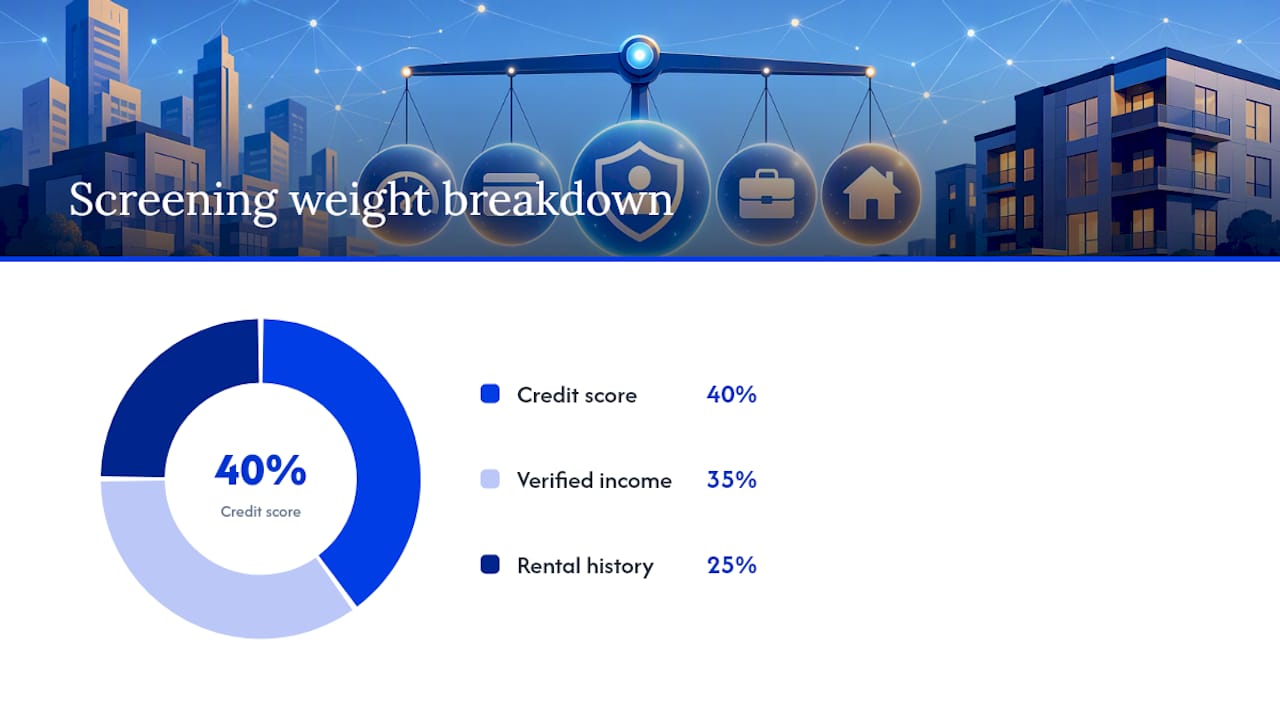
A workable weighting model for your file:
40% credit score and history (payment history, utilization, derogatory marks)
35% verified income (2.5x to 3x rent is a common standard)
25% rental-payment history (on-time payments from a previous landlord or rent-reporting bureau)
To document this properly, request pay stubs or bank statements directly, call the previous landlord rather than relying on a name in an application, and pull rental-payment records if the applicant has enrolled in rent reporting with a prior address. Log every verification step in the applicant’s file, not just your final decision.
What to Do With Low-Credit or Thin-File Applicants — explore options like bad credit car title loans as alternative financial products some applicants might use.
Rejecting every applicant under your threshold fills vacancies slower and pushes away tenants who simply haven’t built a credit file yet, students, recent immigrants, and people rebuilding after a hardship. HUD guidance points toward individualized assessment instead of an automatic no.
Verified rental history. Two years of on-time payments from a prior landlord can offset a middling score.
Guarantor with income multiple. Require the guarantor to earn 3x to 4x the rent and sign a lease addendum making them jointly liable.
Larger security deposit. Where local law permits it, an additional half month to full month of deposit reduces your exposure.
Short-term lease. A six-month term lets you evaluate payment behavior before committing to a full year.
Rent-reporting enrollment. Applicants who agree to have payments reported build a track record, and you gain a compliance-friendly paper trail.
Check your state and local rules before applying any of these. Some jurisdictions cap security deposits at a fixed number of months’ rent, and a few restrict how guarantor income can be calculated. When in doubt, the tenant screening mistakes landlords commonly make list is worth reviewing before you finalize a policy.
What Fair Housing Law Requires When You Use Credit Scores
HUD advises against blanket numeric cutoffs and recommends individualized assessments precisely because rigid score lines can produce discriminatory impacts, even without discriminatory intent. If your credit-score cutoff disproportionately screens out applicants in a protected class, you carry legal exposure regardless of how objective the number felt.
By the numbers: Experian’s RentBureau data shows the default-rate gap between scoreable and unscoreable applicants (roughly 1.56% versus 11%) is wide enough that treating every low-score applicant identically ignores real, measurable differences in risk within that group.
When you deny an applicant or condition their lease based on a consumer report, the FCRA requires an adverse-action notice naming the reporting agency, the applicant’s right to a free copy of the report, and their right to dispute inaccuracies.
Send the notice promptly, ideally within a few business days of the decision.
Attach the actual consumer report to the applicant’s file, not just a summary.
Document the specific reason for denial or conditional approval in writing.
Keep signed copies of your published screening criteria on hand for every applicant.
Our adverse action notice guide breaks down the 30-day compliance window in more detail.
Building an Operational Screening Policy You Can Actually Use
A policy only protects you if your staff applies it the same way every time. That means writing it down, posting it, and training on it, not keeping it in your head.
Publish your written criteria and give every applicant a copy at the time they apply.
Collect signed consent before pulling any credit or background report.
Verify income independently, never on the applicant’s stated number alone.
Log every decision, including approvals, with the reasoning behind it.
Attach the consumer report used to each applicant’s permanent file.
Send adverse-action notices within your stated timeline, every time.
Sample policy language you can adapt: “Applicants with a credit score of 650 or above qualify under standard terms. Applicants scoring 600-649 may qualify with a guarantor or additional deposit. Applicants below 600 receive individualized review considering verified rental history and income.” That single paragraph, applied consistently, does more for your legal position than any spreadsheet of exceptions.
Pro Tip: Train new leasing staff on your written criteria before their first showing, not after their first complaint. Our tenant screening checklist is a solid training reference for that first week.
Spotting Fraud Before It Costs You a Lease
Not every thin credit file is innocent. TransUnion research found applicants with 15 or more credit inquiries in a seven-day window charged off at roughly 32%, compared to a 9% baseline, which makes inquiry velocity one of the strongest fraud signals available to you.
Watch for these red flags together, not in isolation:
A sudden burst of new credit inquiries in the past two weeks.
A credit file with almost no history despite an applicant claiming years of steady employment.
A date of birth or Social Security number that doesn’t match across the application and the report.
When you see two or more of these signals, pause and request original pay stubs, a direct employer callback, or a government ID review rather than issuing an immediate denial. Our income verification steps for landlords cover the verification calls worth making before you sign anything.
How 2nd Street Property Management Applies These Standards
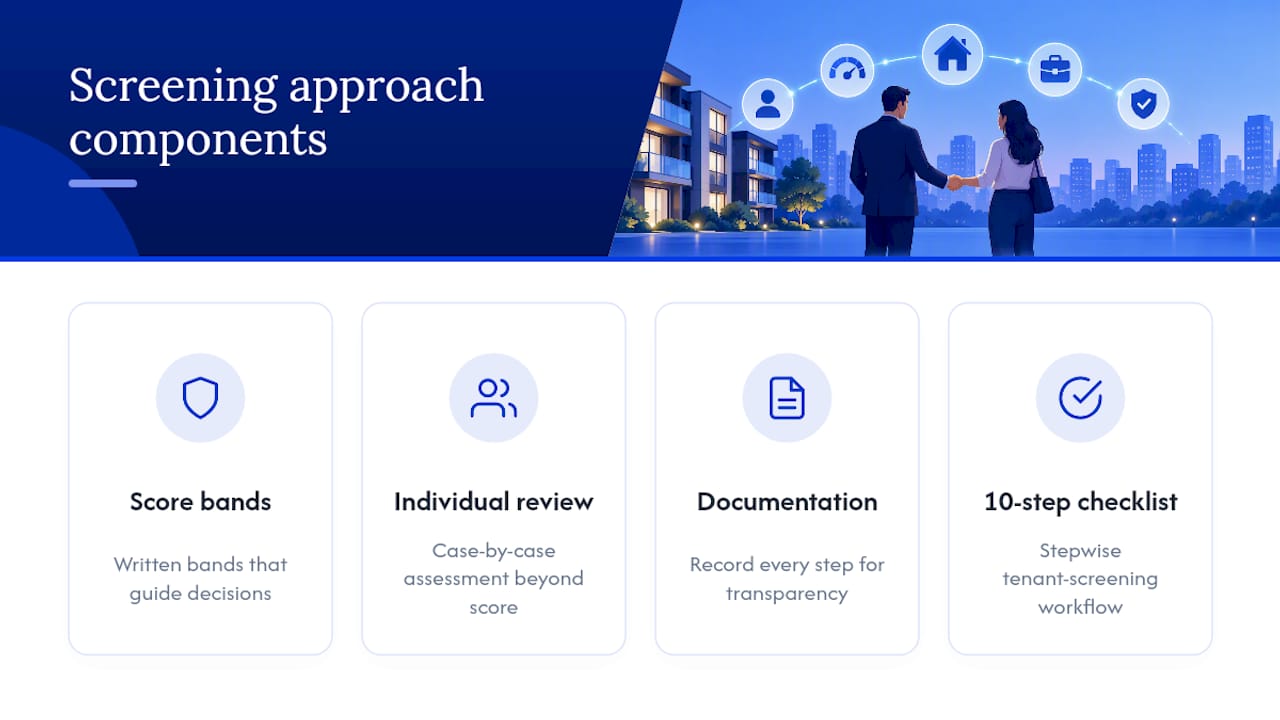
We built our screening approach around the same framework covered here: written score bands, individualized review, and documentation at every step. Our 10-step tenant screening checklist and tenant background check guidance walk through exactly how an investor-minded manager balances occupancy against risk.
Why Rigid Cutoffs Cost You More Than They Save
Landlords who treat a credit score to rent decision as a single hard line usually end up defending that line in a dispute they didn’t need to have. The applicants worth fighting for are the ones just below your number, and documented exceptions protect you better than blanket rules ever will. Write the policy down, apply it consistently, and let the screening checklist do the heavy lifting.
— Main
Get Help Setting and Enforcing Your Screening Policy
Building a defensible credit-score policy is one thing. Applying it consistently across every application, every month, without a compliance slip, is another. 2ndstreetpropertymanagement was built by investors who screen, lease, and collect rent on their own portfolios, so the score bands and adverse-action steps covered above aren’t theory to us, they’re the daily operating standard.

Our team handles tenant screening, rent collection, leasing, and compliance support services for landlords who prefer assistance with FCRA timeline tracking. If you own rental property and want your screening criteria reviewed or built from scratch, request a policy review through 2ndstreetpropertymanagement and get a straight answer on what your current process is missing.
Sources
FAQ
What Is a Good Credit Score to Rent Screening Threshold?
Most landlords treat 650 or higher as a preferred tier, since scores in that range are often viewed as good credit standing. Scores between 600 and 649 typically qualify with conditions like a guarantor or added deposit rather than automatic denial.
Do Landlords Have to Check Credit Scores Before Renting?
No law requires a credit check, but most landlords use one alongside income verification and rental history to reduce default risk. Skipping it entirely means relying only on self-reported information, which carries far more risk.
What Counts as an Adverse Action Notice?
An adverse-action notice tells an applicant a decision was based partly on a consumer report and must name the reporting agency along with the applicant’s dispute rights under the FCRA. It should go out promptly after the decision, with the report attached to the applicant’s file.
Can a Landlord Reject an Applicant for Having No Credit History?
Rejecting solely for a thin or missing credit file risks a fair-housing complaint, since HUD favors individualized review over blanket cutoffs. A better approach pairs verified income and rental-payment history with a guarantor requirement instead of an outright denial.
How Much Does 2nd Street Property Management Charge for Screening Services?
Pricing for residential property management and tenant screening is available directly through 2ndstreetpropertymanagement, since fees vary by property type and service scope. Reach out through the site for a proposal specific to your portfolio.
Recommended

Comments