
Condo Boards: 6 Step RFP for Condo Association Management to Keep Control


Most condo boards need professional management the moment volunteer bandwidth can’t keep up with financial reporting, vendor coordination, and compliance deadlines. Condo association management means hiring a firm to run daily operations and financial stewardship while your board keeps every policy decision. Before you sign anything, pull your declaration and bylaws, confirm what state law requires, and start comparing proposals through a written RFP.
TL;DR:
Many condo boards should hire professional management only when volunteer capacity cannot keep up with financial reporting, vendor coordination, and compliance requirements.
Management primarily handles assessment billing, financial reporting, recordkeeping, meeting admin, and routine vendor tasks, while major policy decisions stay with the board.
Costs vary based on unit count, amenities, building complexity, and regional labor markets, so proposals must be compared with attention to included services and potential extra fees.
An effective RFP should solicit management ratios, response standards, insurance details, transition plans, and references, with boards verifying vendor boundaries and communication protocols.
Warning signs of mismanagement include late reports, unreconciled accounts, deferred maintenance, opaque vendor relationships, and decision-making outside the management agreement.
Table of Contents
What Condo Association Management Actually Covers
A condo association manager implements the policies your board adopts. That’s the core distinction the Community Associations Institute draws, and it’s the one most new board members miss. The manager runs the building. Your board still runs the association.
That line matters because it defines who’s accountable when something goes wrong. A manager who starts making unilateral calls on special assessments, contract awards, or rule changes has stepped outside their role, whether or not anyone objects in the moment.
Day-to-day, a typical manager handles:
Assessment billing and collections, including delinquency follow-up
Accounts payable and monthly bank reconciliation
Financial reporting delivered to the board on a set schedule
Recordkeeping: owner rosters, meeting minutes, contracts, insurance certificates
Meeting administration, from notices to board packets
Vendor coordination for routine maintenance and repairs
What a manager can’t do, absent explicit contract language, is approve major contracts, change assessment rates, or set new rules. Those stay board-reserved decisions. If your management agreement grants broader authority, that delegation should be spelled out in writing, not assumed. Our guide to the property manager role breaks this boundary down further if your board is still drafting scope language.
The Three Pillars: Financial, Administrative, and Physical Management
Break a management contract into its actual working parts and you get three categories: money, paperwork, and the building itself. Every credible proposal should map clearly to all three.
Financial stewardship is the pillar boards scrutinize hardest, and rightly so. It includes:
Budget preparation, with final numbers requiring board approval
Reserve fund tracking against your funding plan
Monthly financial reporting with variance explanations
Assessment collection and delinquency management
Bank reconciliations, ideally with dual sign-off controls
Administrative operations keep the community running smoothly between board meetings. This covers owner communications, roster and records maintenance, meeting notices and packet preparation, and acting as the point of contact with your insurance broker. Checking your condo master policy coverage limits and exclusions should be part of this routine, not an afterthought after a claim goes sideways.
Physical asset management is where deferred maintenance either gets caught early or festers. Managers coordinate inspections, schedule preventive maintenance, manage contractor relationships, and administer capital projects. That last one deserves a specific note: for major repairs, a manager’s job is to coordinate bids, schedules, documentation, and contractor performance, while your board approves scope and funding.
Pro Tip: Ask any prospective firm for a sample monthly financial package before you sign. If it doesn’t include a reserve fund summary and a variance explanation, keep looking.
Why Boards Outsource: The Real Benefits
Volunteer board members have day jobs. That’s the practical reason professional management exists, and it’s worth being honest about rather than dressing it up as something more strategic.
Frees volunteer directors from bookkeeping, collections calls, and vendor scheduling
Adds financial controls, like dual-approval reconciliations, that reduce fraud risk
Gives your association access to a vetted vendor network and established emergency procedures
Brings consistency to recordkeeping, so institutional knowledge doesn’t leave when a board term ends
None of that removes your board’s fiduciary duty. Whether a management company is even required depends on your governing documents and state law, and hiring one is a governance choice, not a liability transfer. Your board still owns every decision a manager implements.
What Condo Management Actually Costs
Management fees usually break into a few distinct categories, and conflating them is how boards end up comparing proposals that aren’t actually comparable.
Monthly management fee: charged per unit or as a flat rate, covering routine administrative and financial duties
Bookkeeping or finance add-ons: sometimes bundled, sometimes billed separately for detailed reporting
Transition or setup fees: a one-time charge for onboarding, records transfer, and system setup
Project fees: separate billing for capital project oversight beyond routine scope
What drives the number up: unit count, amenity complexity (pools, elevators, fitness centers), building age and system complexity, whether onsite staffing is required, and your regional labor market. A 40-unit walkup with no amenities costs less to manage than a 200-unit high-rise with a doorman and a parking garage, and any proposal that doesn’t reflect that difference deserves a second look.
When comparing quotes, check what’s actually included versus billed as an extra. Ask about response time standards, get specific examples of what triggers additional fees, and confirm the firm’s insurance coverage limits. Our breakdown of property management fee structures walks through this comparison in more detail.
How to Choose a Management Company: The RFP Checklist
The single biggest mistake boards make when hiring a manager is taking sales meetings instead of running a structured comparison. A sales presentation tells you how a firm wants to be seen. A written RFP, sent to multiple firms with the same questions, tells you what they’ll actually deliver.
Here’s the process:
Write one RFP and send it to every firm you’re considering. Include your unit count, building systems, amenities, current staffing, known problems, and expected services. Every firm answers the same document, so you’re comparing apples to apples.
Compare management ratios. How many units does each portfolio manager handle? A manager juggling 15 properties responds differently than one handling four.
Compare response standards. What’s the guaranteed acknowledgment time for a maintenance request versus an emergency?
Check insurance and licensing. Confirm coverage limits, state licensing where required, and professional credentials like CMCA or AMS designations.
Review the transition plan. How does the firm handle records transfer, vendor contract assignment, and resident communication during onboarding?
Read the termination terms closely. What notice period applies, and what happens to your records if the relationship ends?
During interviews, push past the pitch. Verify who actually attends your board meetings, who covers for that person during vacation or turnover, what the emergency acknowledgment time looks like in practice, and whether bank reconciliations require dual approval.
Ask for one more thing: a recent client reference with a building of similar size and complexity, plus a sample monthly board package. That combination tells you more than an hour of sales talk ever will, since a proposal presentation is far less informative than seeing the actual reporting a firm produces every month.
Pro Tip: Send your RFP to several firms, even if you’re leaning toward one. The comparison itself often surfaces questions you wouldn’t have thought to ask.
Signs Your Current Management Isn’t Working
Some problems announce themselves. Others hide in the numbers until a reserve study forces the issue. Watch for:
Unexplained line items on monthly financial statements
Reports that arrive late, or don’t arrive at all
Bank accounts that won’t reconcile cleanly month to month
Maintenance requests that get deferred repeatedly without explanation
Reserve planning that hasn’t been updated or reviewed in years
Vendor relationships that lack transparency, including undisclosed markups
A manager making decisions that belong to the board, without documented authority
If you spot one of these, document it. Note it in board minutes, submit written requests for the specific records in question, and issue a formal notice if the pattern continues. Our red flags checklist covers many of the same warning signs from the financial and maintenance side.
If the pattern doesn’t resolve after formal notice, it’s time to issue a new RFP and follow your contract’s termination procedures. Waiting rarely improves the outcome, and every month of deferred maintenance or unreconciled accounts compounds the eventual fix.
How We Approach Governance and Capital Projects
The governance line, manager implements, board decides, isn’t a technicality. It’s the mechanism that keeps accountability clear when a repair goes over budget or a vendor underperforms.
A community manager should also disclose potential conflicts of interest in vendor relationships in writing, before a contract is signed, not after a board member asks.
That same discipline applies to capital projects. A qualified specialist, whether an engineer or a structural consultant, should diagnose the technical problem first. Once your board approves scope and funding based on that diagnosis, a manager’s job is procurement and oversight: running bids, tracking schedules, and monitoring contractor performance. A manager should never substitute their own judgment for a technical assessment they’re not licensed to make.
Keeping the Board, Management, and Residents on the Same Page
Communication breakdowns cause more board friction than actual management failures. A board that hears about a maintenance decision secondhand, from a resident complaint rather than a manager update, starts questioning everything else too.
Set a communication cadence in your management contract, not as an informal expectation. That typically means a monthly financial and operations report to the board, a defined channel for residents to submit requests, and a published response time standard for both routine and urgent issues.
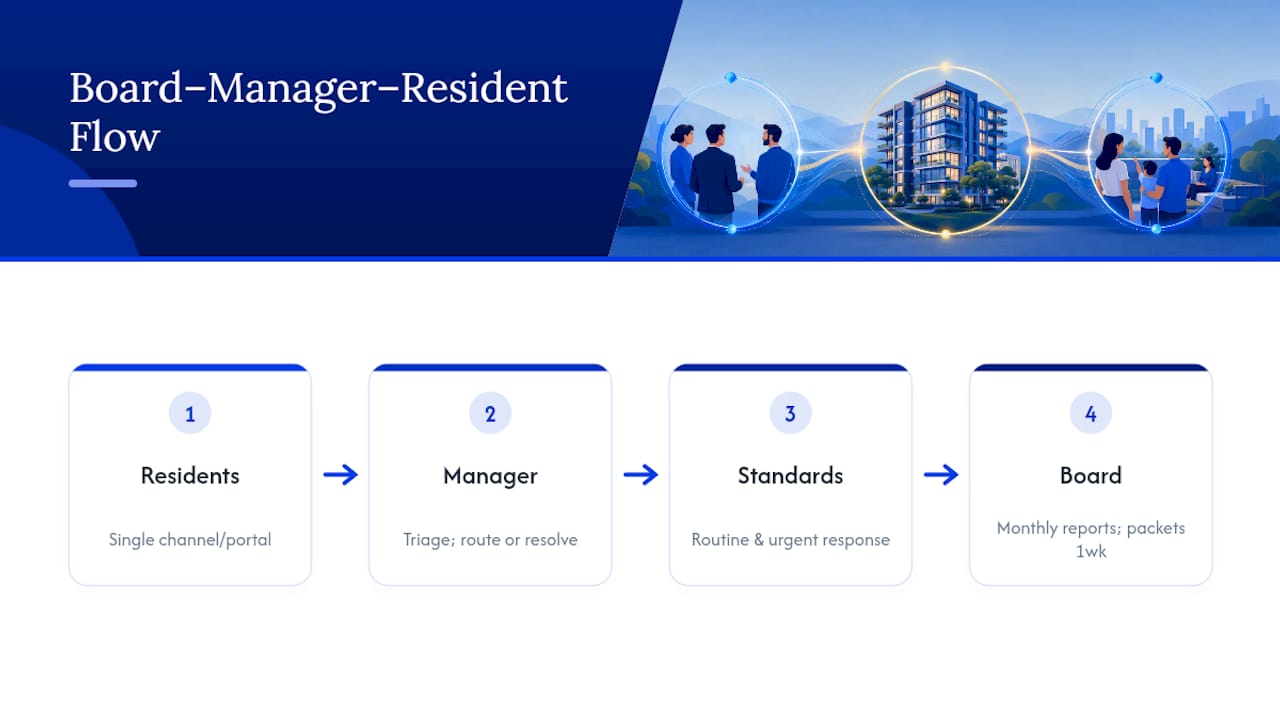
Residents need a single point of contact, not a guessing game between the board and the management office. Most associations route this through a dedicated line or portal, with the manager triaging and looping in board members only when a decision requires their input. Board members, in turn, should resist the urge to field individual resident complaints directly. Redirecting residents to the established channel protects the manager’s ability to track and prioritize requests consistently.
Board meetings themselves are the other communication layer that gets neglected. A packet delivered 24 hours before a meeting doesn’t give directors time to review financials or raise questions. Push for packets at least a week out, with the manager available to answer clarifying questions before the meeting starts, not during it.
Handling Disputes Without Letting Them Fester
Condo communities generate disagreements. Noise complaints, pet policy violations, parking disputes, and disagreements over rule enforcement are routine, not exceptional. What separates a well-run association from a dysfunctional one is how consistently those disputes get handled.
Rule enforcement needs to be documented and applied the same way every time, regardless of who’s involved. A manager who enforces a parking rule against one owner but lets a board member’s guest slide will erode trust fast, and that inconsistency is one of the fastest ways a community loses confidence in its management.
For disputes between owners, most governing documents outline a formal complaint process: written submission, a documented response window, and escalation to the board if the issue isn’t resolved at the management level. Skipping that structure in favor of informal fixes usually creates more problems, because there’s no record if the same issue resurfaces.
Some associations build in mediation before disputes reach a hearing or legal action. It’s often cheaper and faster than formal proceedings, and it keeps the relationship between neighbors from hardening into something adversarial. Whatever process your documents specify, the manager’s role is to apply it consistently and keep the paper trail, while the board makes the final call on anything that requires a policy judgment.
Getting Ready Before the Emergency, Not During It
A burst pipe at 2 a.m. is not the moment to discover your management company has no after-hours protocol. Emergency preparedness has to be built into the management contract itself, with specifics, not a vague promise of “24/7 support.”
Ask exactly what counts as an emergency in the contract, who gets contacted first, and what the acknowledgment time is. A firm that guarantees a callback within 30 minutes for a flooding unit is offering something concrete you can hold them to. Vague language isn’t.
Your association should also have a written plan for building-wide emergencies: fire, major water damage, extended power outages, or severe weather events common to your region. That plan should specify who notifies residents, how, and what temporary measures (shutting off water to a floor, posting building access changes) fall under management’s authority versus requiring board sign-off.

Insurance ties directly into this. Knowing your master policy’s coverage and exclusions before an emergency hits, not after, determines whether your association or an individual owner ends up covering a repair bill. Confirm your manager reviews this annually, not just when a claim is already in process.
Staying on the Right Side of the Law
Condo associations operate under a layered set of legal obligations: state condominium statutes, your own declaration and bylaws, and often municipal codes covering fire safety, elevators, and building maintenance. A management company’s job includes flagging compliance deadlines your board might otherwise miss, from annual reserve study requirements in some states to insurance disclosure rules tied to unit sales.
Recordkeeping obligations matter more than most new board members realize. Meeting minutes, financial records, and contracts often need to be retained for specific periods and made available to owners on request. A resale certificate review process, for instance, depends entirely on whether those records are organized and current when a unit sale triggers the request.
Fair housing compliance is another area where boards can create liability without realizing it, particularly around rule enforcement and accommodation requests. A manager should flag these situations for legal review rather than making a unilateral call, since the cost of getting it wrong is far higher than the cost of a short legal consult.
None of this replaces your association’s own attorney. A management company’s compliance awareness is a safeguard, not a substitute for legal counsel on anything with real exposure.
Where the Conventional Advice Falls Short
Most guidance on hiring a condo manager treats the decision like a vendor purchase: get three quotes, pick the cheapest reasonable one, move on. That framing misses what actually determines whether the relationship works.
The real predictor isn’t the fee schedule. It’s whether the firm treats your board as the decision-maker or quietly starts making calls that belong to you. Boards that skip the RFP process and hire on referral alone often don’t discover this until a year in, when a manager has already approved a vendor contract nobody voted on.
Cost comparisons matter, but they’re the easy part. The harder work is verifying management ratios, insisting on a sample board package before signing, and checking references from buildings with genuinely similar complexity, not just similar unit counts. Boards that skip this step tend to end up managing their manager, which defeats the purpose of hiring one.
Prioritize governance clarity first. A firm that documents its boundaries and discloses vendor relationships in writing will almost always outperform a cheaper option that treats those disclosures as optional.
— Main
How 2nd Street Property Management Supports Condo Boards
Some property management companies offer options for boards that want operational relief without giving up financial oversight, built by investors who understand what keeps a reserve fund healthy. Association management services can cover the day-to-day work condo boards struggle to keep up with: assessment collection, bank reconciliation, vendor coordination, and capital project administration, with regular reporting to the board.
If your board is ready to compare options, start by pulling together your unit count, amenities, and the specific challenges you’re trying to solve, whether that’s deferred maintenance, inconsistent reporting, or a management relationship that’s drifted past its contract boundaries. Reach out through our association management page to request a proposal and a sample board package built around your building’s actual profile.
Sources
FAQ
What does a condo association manager do?
A condo association manager implements board-adopted policies and runs daily operations: assessment collection, financial reporting, vendor coordination, and recordkeeping. Policy decisions, like rule changes or contract approvals, stay with the board unless the management agreement specifically delegates that authority.
How much does condo association management cost?
Fees vary by unit count, amenities, and building complexity, and typically include a monthly management fee plus separate charges for bookkeeping add-ons, transition setup, or capital project oversight. 2nd Street Property Management’s current pricing for association management is available directly on its website, since costs depend on your building’s specific profile.
Does a condo association need a management company?
It depends on your declaration, bylaws, and state law, not a universal rule. Hiring a manager is a governance choice your board makes based on volunteer capacity and building complexity, and the board retains its legal obligations either way.
What are common red flags of HOA mismanagement?
Warning signs include unexplained financial line items, late or missing reports, accounts that won’t reconcile, deferred maintenance, and opaque vendor relationships. A manager making board-level decisions without documented authority is also a serious flag worth raising immediately.
How do boards choose between competing management proposals?
Send the same written RFP to multiple firms and compare management ratios, response time standards, insurance coverage, and termination terms side by side. Ask for a sample monthly board package and a client reference from a building of similar complexity before making a final decision.
Recommended

Comments