
Cash Flow Goals for Real Estate Investors: 2026 Guide


Cash flow goals are the specific, measurable financial targets real estate investors set to maintain liquidity, cover operating costs, and build long-term portfolio stability. Without them, you confuse movement with progress. You collect rent, pay bills, and assume things are fine until a $12,000 roof repair or a two-month vacancy proves otherwise. The most effective investors treat cash flow planning as a discipline, not an afterthought. Tools like Tiller for personal cash tracking, Upflow for forecasting, and frameworks like the 13-week rolling forecast give you the structure to set targets that actually protect your properties.
What are common cash flow goals in real estate investing?
Cash flow goals in real estate fall into three categories: liquidity goals, working capital goals, and forecasting goals. Each one addresses a different layer of financial risk.
Liquidity goals focus on cash reserves. Best-practice reserves for stable businesses sit at 3–6 months of fixed operating expenses. Real estate investors often need more. Because rental income is lumpy and repairs are unpredictable, real estate cash reserves should start at a minimum of 8 weeks of expenses and scale up based on portfolio risk. A single-family rental in a seasonal market needs a different reserve floor than a 10-unit multifamily building with stable occupancy.

Working capital goals target the timing of money moving in and out. Reducing Days Sales Outstanding (DSO) means collecting rent faster. Extending accounts payable terms from net-30 to net-45 or net-60 keeps cash in your account longer. Both levers improve your monthly cash position without changing your revenue at all.
Forecasting goals measure how accurately you predict cash movements. A good forecasting goal is achieving 90% adherence between your projected and actual cash balances over a rolling 13-week period. That level of accuracy tells you your assumptions about rent timing, vacancy, and expense cycles are grounded in reality.
The biggest mistake investors make is setting vague financial goals that feel motivating but drive no behavior. “Improve cash flow this year” is not a goal. “Maintain 10 weeks of operating reserves and reduce rent collection lag to under 5 days” is a goal. Specificity is what separates targets that change your operations from ones that collect dust.
Maintain 3–6 months of operating expense reserves (or 8–16 weeks for seasonal portfolios)
Reduce DSO to under 7 days for monthly rent collection
Extend vendor and contractor payment terms to net-45 where possible
Achieve 90% forecast accuracy on your 13-week rolling cash projection
Align expense timing with peak rental income months to avoid cash gaps
How to build a 13-week rolling cash flow forecast
The 13-week rolling forecast is the industry standard for short-term cash management. It covers one quarter, which is long enough to spot seasonal patterns and upcoming obligations, and short enough to stay accurate. Budgets tell you what you planned to spend. A cash flow forecast tells you when money actually moves. That timing difference is everything in real estate.
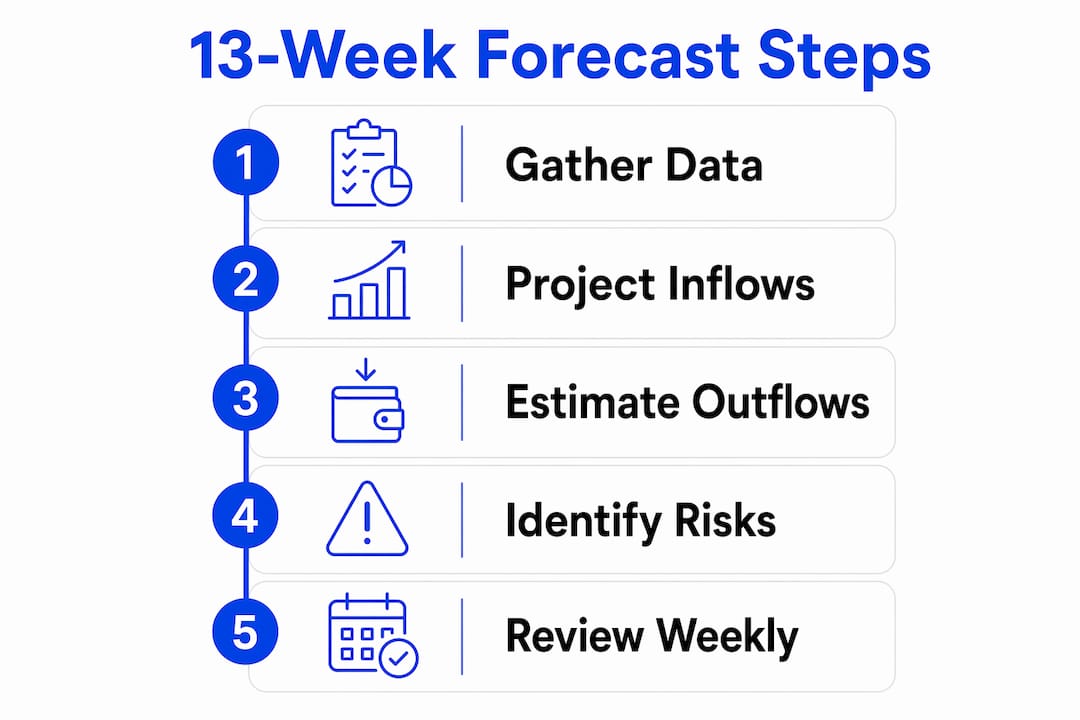
Here is how to build one for your rental portfolio:
Start with your opening bank balance. Use your actual bank balance on the first day of the forecast period, not an accounting balance. Cash flow planning works with real money, not accruals.
List every expected cash inflow by date. Include rent payments, security deposit releases, and any other income. Note the expected collection date, not the due date. If tenants consistently pay on the 5th instead of the 1st, reflect that reality.
List every committed cash outflow by date. Mortgage payments, insurance premiums, property taxes, utility bills, landscaping contracts, and management fees all belong here. Add a line for estimated maintenance based on your historical average.
Calculate a running cash balance. Subtract outflows from inflows week by week. This running total shows you exactly when your balance dips and by how much.
Update it weekly with actual bank data. Replace projected figures with real transactions every Monday. This keeps the forecast accurate and forces you to confront variances before they compound.
Pro Tip: Model at least one stress scenario in your forecast each quarter. Plug in a 30-day vacancy or a $8,000 HVAC replacement and see how your cash balance responds. If it goes negative, you need to adjust your reserves before the event happens, not after.
The key distinction here is one that Tiller makes clearly: budgeting tracks spending against a plan, while cash flow planning manages the timing of actual cash movements. Many investors run a tight budget and still face liquidity shortfalls because they track profit, not cash. A property can be profitable on paper and still leave you scrambling to cover a contractor invoice due before rent arrives.
Strategies to improve cash flow and hit your financial targets
Reaching your financial flow objectives requires working both sides of the cash equation: accelerating inflows and extending outflows. The CFO playbook for cash improvement is built on exactly these two levers, combined with disciplined reserve building.
Accelerate inflows:
Automate rent reminders 3 days before the due date and again on the due date. Automated reminders reduce DSO without requiring manual follow-up.
Offer ACH payment options to tenants. Electronic transfers clear faster than checks and reduce collection lag.
Charge late fees consistently. Consistent enforcement changes tenant behavior and protects your cash timing.
Review your rental property returns annually to confirm rents reflect current market rates. Below-market rents are a hidden cash drain.
Extend outflows:
Negotiate net-45 or net-60 terms with contractors and vendors you use regularly. Stretching payables by two weeks meaningfully improves your monthly cash position.
Batch non-urgent repairs into scheduled maintenance windows rather than responding to every minor issue immediately.
Time large capital expenditures to follow peak rent collection months when your balance is highest.
Build and protect reserves:
Set a hard minimum reserve floor and treat it as untouchable operating capital, not a savings account.
Use a line of credit as a buffer for timing gaps, not as a substitute for reserves. A line of credit used as a lifeline signals a structural cash problem.
Remove recurring expenses that no longer serve the property. Subscription services, unused software licenses, and redundant vendor contracts quietly drain cash month after month.
Pro Tip: Separate your reserve account from your operating account at the bank level. When the money is in a different account, you are far less likely to spend it on something that feels urgent but is not truly critical.
Mastering cash flow in real estate is not about finding one big fix. It is about stacking small improvements across collections, payables, and reserves until the combined effect creates a buffer that absorbs the unexpected.
How to monitor and adjust your cash flow goals over time
Setting cash targets is step one. Reviewing them consistently is what makes them work. A weekly 30-minute review of your cash flow forecast every Monday is the most effective cadence. It is frequent enough to catch problems early and short enough to stay sustainable. Monthly reviews leave too much time for small variances to become real crises.
Track these key performance indicators in every review:
Cash reserve balance: Is it above your minimum floor? If not, what caused the drawdown?
DSO: How many days elapsed between rent due dates and actual collection? Is that number trending up or down?
Payable days: Are you paying vendors on the latest terms available, or earlier than necessary?
Forecast accuracy: How close was your projected balance to your actual balance this week? Large variances signal bad assumptions that need correcting.
Adjust your goals when your portfolio changes. Adding a property, entering a new market, or taking on a major renovation all shift your cash risk profile. A goal calibrated for two single-family rentals does not fit a six-unit portfolio with a mix of short-term and long-term tenants. Review your targets at least quarterly and rebuild your forecast assumptions from scratch at least once a year.
If you manage properties with a partner or a small team, document your cash flow goals in writing and share them. Goals that live only in your head do not drive team behavior. A one-page cash flow policy that states your reserve floor, your DSO target, and your review schedule gives everyone a shared standard to work from.
Using a dedicated rental property cash flow tool makes this review process faster and more consistent. Manual spreadsheets work, but they require discipline to maintain. Purpose-built tools reduce the friction that causes investors to skip their weekly review.
Key Takeaways
Effective cash flow goals combine specific liquidity targets, disciplined forecasting, and a consistent weekly review routine to protect rental property performance.
Point | Details |
Set specific targets | Replace vague goals with measurable metrics like DSO under 7 days and 10 weeks of reserves. |
Use a 13-week forecast | Update it weekly with real bank data to catch cash shortfalls before they occur. |
Work both cash levers | Accelerate rent collection and extend vendor payment terms to improve monthly cash position. |
Build a hard reserve floor | Start at 8 weeks of operating expenses and scale up based on portfolio risk and seasonality. |
Review every Monday | A 30-minute weekly review catches variances early and keeps your goals connected to reality. |
The uncomfortable truth about cash flow goals most investors ignore
Most investors I work with understand cash flow in theory. They know rent should exceed expenses. What they miss is the timing layer. A property can generate solid annual returns and still leave you unable to pay a contractor in october because three tenants paid late and a tax installment hit the same week. That is not a revenue problem. It is a cash timing problem, and no profit metric will warn you about it in advance.
The investors who build real financial resilience are the ones who prioritize liquidity over paper profit. They set a reserve floor and defend it. They run a 13-week forecast even when things feel fine, because the forecast is most valuable before the problem appears. They review their numbers on a fixed schedule, not when something goes wrong.
The other mistake I see constantly is treating cash flow goals as a one-time exercise. You set targets in january, file them away, and revisit them when something breaks. That approach guarantees your goals will be misaligned with your actual portfolio within six months. Markets shift, tenants change, and expenses surprise you. Your goals need to keep pace.
The discipline is not complicated. It is a 30-minute Monday review, a forecast you update weekly, and a reserve account you do not touch unless the situation is genuinely critical. That routine, applied consistently, is what separates investors who weather downturns from those who sell at the worst possible time.
— Main
How 2ndstreetpropertymanagement supports your cash flow performance
2ndstreetpropertymanagement is built by investors, for investors. The team understands that consistent rent collection, tight vendor management, and clear financial reporting are not administrative details. They are the foundation of your cash flow health. Professional property management directly improves the metrics that matter most: faster collections, better payable terms with trusted contractors, and real-time visibility into your property’s cash position. If you want to protect your rental cash flow from hidden fees and operational gaps, 2ndstreetpropertymanagement provides the structure to make that happen. Visit 2ndstreetpropertymanagement.com to learn how the team can support your investment goals.
FAQ
What are cash flow goals in real estate investing?
Cash flow goals are specific, measurable financial targets that define how much liquidity a rental property must maintain, how fast rent must be collected, and how accurately cash movements must be forecasted. They replace vague intentions with operational standards that drive real decisions.
How much cash reserve should a rental property owner keep?
Best-practice reserves for stable businesses are 3–6 months of operating expenses. Real estate investors should start at a minimum of 8 weeks and increase that floor based on seasonality, vacancy risk, and portfolio size.
What is a 13-week rolling cash flow forecast?
A 13-week rolling forecast is a short-term cash management tool that maps expected inflows and outflows week by week over one quarter. It is updated weekly with actual bank data to maintain accuracy and flag upcoming cash shortfalls.
How is cash flow planning different from budgeting?
Budgeting tracks spending against a plan. Cash flow planning manages the timing of when money actually moves in and out of your accounts. A property can be on budget and still face a liquidity gap if rent arrives after a major expense is due.
How often should I review my cash flow goals?
A weekly 30-minute review every Monday is the recommended cadence. This frequency catches variances early without creating the overreaction risk that comes from daily monitoring.
Recommended
Comments