
How to Structure a Real Estate Partnership That Works
- Rey Rey Rodriguez

- 1 day ago
- 10 min read

For most U.S. property owners forming a partnership to hold rental real estate, a manager-managed LLC taxed as a partnership is the best default: it limits personal liability for all members, preserves pass-through tax treatment through the IRS, and lets a sponsor or operator run daily decisions without requiring a vote from every passive investor.
Immediate next steps:
Form your entity in a business-friendly state, then register as a foreign entity where the property sits
Draft a written operating agreement covering capital contributions, distributions, decision rights, and exit mechanics before you close on any property
Consult a real estate attorney and CPA to confirm your entity choice, tax elections, and whether your capital raise triggers Reg D securities obligations
Evaluate whether professional property management through 2ndstreetpropertymanagement fits your structure from day one
Pro Tip: If you are raising capital from passive investors, get a securities-law review before you accept a single dollar. Passive investors plus a profit motive can turn a real estate deal into a securities offering faster than most owners expect.
Table of Contents
How do you structure a real estate partnership?
LLCs dominate U.S. real estate because they combine liability protection, pass-through taxation, and management flexibility in one entity. The table below maps the most common structures across the dimensions that matter to owners, lenders, and investors.

Structure | Liability Protection | Tax Treatment | Management/Control | Lender Preference | Ideal Use Case | Formation Cost/Complexity |
Manager-managed LLC | All members protected | Pass-through (Form 1065/K-1) | Sponsor controls; investors passive | High; SPE-friendly | Sponsor + passive investors; buy-and-hold | Moderate |
Limited Partnership (LP) | LP protected; GP exposed | Pass-through | GP controls; LPs passive | Moderate | Institutional capital raises; funds | Moderate–High |
General Partnership | None; unlimited for all | Pass-through | All partners share control | Low | Small deals, trusted partners only | Low |
Joint Venture (JV) | Depends on entity used | Pass-through if LLC-based | Negotiated per deal | Moderate | Single project; defined endpoint | Low–Moderate |
S Corporation | Shareholders protected | Pass-through | Board/officers | Low for real estate | Active management company; not direct ownership | Moderate |
C Corporation | Shareholders protected | Double taxation risk | Board/officers | Low for direct RE | Blocker entity for tax-exempt investors | High |
SPE (Single-Purpose Entity) | Isolated per asset | Pass-through | Sponsor-controlled | Very High | Syndications; lender-required isolation | Moderate |
When to choose each:
Manager-managed LLC: Your default for sponsor-led deals with passive investors
LP: When institutional capital or fund structures require it
General partnership: Only for small deals between partners who know each other well and accept full personal exposure
Joint venture: One-off projects or flips where partners want a defined endpoint without a permanent entity
SPE: Required by many commercial lenders to isolate asset-level risk
Pro Tip: Choose manager-managed over member-managed when you have passive investors. A manager-managed LLC centralizes authority with the sponsor and prevents decision gridlock. Lenders also prefer it because they know exactly who has signing authority.
How liability and taxes shift with each structure
The general partner role carries unlimited personal liability in both general partnerships and LPs. That means a creditor can pursue a GP’s personal bank accounts, home equity, and other assets if the entity cannot pay. Limited partners, by contrast, risk only what they invested, provided they stay out of day-to-day management decisions.
Key liability and tax points:
In a manager-managed LLC, every member gets limited liability regardless of their involvement level
Pass-through taxation means the entity files Form 1065 and issues Schedule K-1s; income and losses flow to each partner’s individual return
C corporations create double taxation: the entity pays corporate tax, then shareholders pay again on dividends. For direct real estate ownership, that structure erodes long-term returns significantly
C corps are better used as management companies or blocker entities for tax-exempt investors (pension funds, endowments) that cannot receive pass-through income
State-level taxes add complexity: franchise taxes, gross receipts taxes, and foreign entity registration fees vary widely by state
For deeper context on how pass-through depreciation and cost segregation interact with your partnership returns, the real estate tax benefits breakdown from 2ndstreetpropertymanagement is worth reading before you finalize your entity election.
Pro Tip: If your deal includes a tax-exempt investor, ask your CPA about using a C corp blocker entity above the LLC. Without it, unrelated business taxable income (UBTI) can disqualify the investor’s tax-exempt status.
What belongs in your partnership or operating agreement
A written agreement is not optional. Verbal handshake deals leave partners personally exposed and create costly disputes when exits, capital calls, or disagreements arise.
Checklist of clauses every agreement needs:
Clause | What to specify |
Capital contributions | Cash, property, or services; assigned dollar value; equity percentage |
Capital calls | Trigger conditions, notice period, remedy for non-contributing partners (dilution or buyout) |
Distributions and waterfall | Return of capital first, then preferred return at a typical hurdle IRR, then promote to operator |
Decision rights | Day-to-day vs. major decisions; voting thresholds (majority, supermajority, unanimous) |
Reporting and compliance | Frequency of financial statements, annual K-1 delivery, audit rights |
Transfer and exit | Buy-sell triggers, valuation method (formula, appraisal, or agreed annual price) |
Dispute resolution | Mediation before arbitration; designate administrator (e.g., American Arbitration Association) |
Dissolution | Creditor priority, asset liquidation process, right of remaining partners to continue |
Waterfall design matters more than most first-time sponsors realize. Return of capital to limited partners comes first, then a preferred return at the agreed hurdle rate, then the operator’s promote. Getting that sequence wrong destroys investor trust before the first distribution.
Pro Tip: Draft the buy-sell mechanism and vesting schedule for the promote before you close your first acquisition. Exit clause disputes are far cheaper to resolve on paper than in court.
When does raising investor capital become a securities issue?
Accepting capital from passive investors can convert your real estate deal into a securities offering under federal law. The trigger is not the dollar amount; it is the structure. Passive investors contributing money to a profit-seeking venture managed by someone else fits the classic definition of an investment contract.
Practical steps to reduce regulatory risk:
Rely on Rule 506(b) (up to 35 non-accredited investors, no general solicitation) or Rule 506© (accredited investors only, general solicitation allowed) under Reg D
Document each investor’s accredited status with third-party verification or signed representations
Avoid general solicitation unless you are using 506© and have verified every investor’s accreditation
Have investors sign subscription agreements that include representations about their financial sophistication and investment intent
File a Form D with the SEC within 15 days of the first sale
Red flags that suggest you need securities counsel immediately: more than a handful of passive investors, any public advertising of the deal, or investors who have no prior relationship with the sponsor.
How to pick the right structure for your specific deal
Use this checklist before you file anything with the state.
Count your investors and define their roles. Two active co-owners? A general partnership or member-managed LLC may work. Five or more passive investors? You need a manager-managed LLC or LP.
Clarify your capital-raising plan. Private investors you know personally point to Rule 506(b). Broader outreach requires 506© and accredited-only investors.
Identify your lender’s requirements. Most commercial lenders want a single-purpose entity with a clear management structure and a registered agent on file.
Map your tax goals. Pass-through losses from depreciation are most valuable to active investors. If any investor is tax-exempt, plan for a blocker entity.
Set your exit timeline. Short-term flips favor JV agreements. Long-term holds favor LLCs with buy-sell provisions.
Ask your attorney: Does this structure support the waterfall and promote I want? Will it require a management company above the property LLC?
Questions for your CPA:
What is the impact on each investor’s tax basis at contribution and exit?
Do we need to register in multiple states, and what are the franchise tax implications?
Should we elect S-corp taxation on the management entity to reduce self-employment taxes?
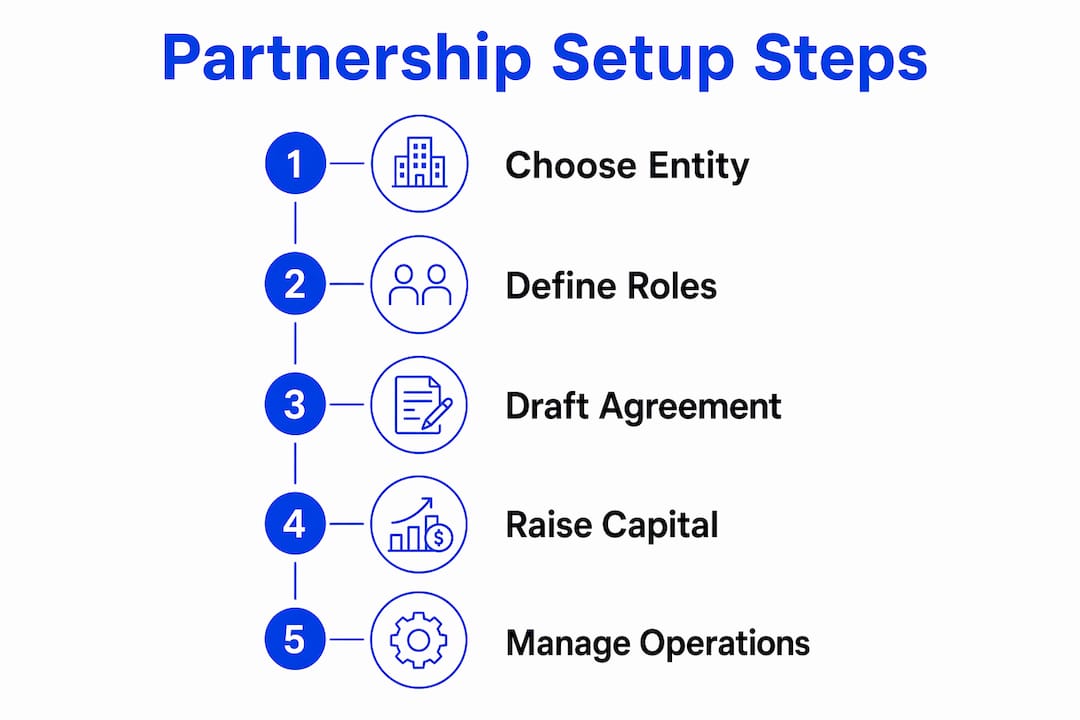
Formation steps, timeline, and what it costs
Choose your entity type and formation state (Delaware and Wyoming are popular for LLCs; form where you operate if it is a single-state deal)
File articles of organization or certificate of limited partnership with the state
Draft and execute the operating or partnership agreement with counsel
Obtain an EIN from the IRS (online, same day)
Open a dedicated business bank account (never commingle personal and entity funds)
Register as a foreign entity in any state where the property is located
Obtain property and liability insurance in the entity’s name
Set up accounting and reporting (QuickBooks, Buildium, or similar)
Step | Typical Timeline | Estimated Cost |
State filing | 1 business day | $50 filing fee |
Operating agreement drafting | 1–3 weeks | — |
EIN | Same day (online) | Free |
Bank account onboarding | 3–7 business days | Varies by bank |
Foreign entity registration | 1–2 weeks | — |
Accounting setup | 1 week | — |
Syndications and funds often use a multi-entity structure: a property-level SPE, a sponsor-controlled management entity, and investor ownership interests layered above. Budget additional legal fees of $5,000–$15,000 for that level of complexity.
Pro Tip: Start the entity formation process at least 30 days before your target closing date. Lenders review partnership documents during underwriting, and delays in entity setup can push your closing.
How to vet partners and build governance that holds
Partner selection discipline is where most partnership failures begin. Misaligned risk tolerance or unclear capital-call mechanics cause more disputes than bad markets do.
Vetting checklist:
Pull credit reports and run litigation searches on all prospective partners
Verify track record with similar asset types and deal sizes
Check investment horizon alignment: a partner who needs liquidity in three years is a poor fit for a ten-year hold
Confirm net worth and income for any partner who will sign personal guarantees on debt
Governance rules to build in from day one:
Define who hires and fires the property manager
Set a reporting cadence: monthly financials, quarterly partner calls, annual audits
Specify delegated authority limits: what dollar threshold requires a partner vote?
Write escalation paths for disputes before they happen
Red flags that predict future disputes:
Any partner who resists putting the agreement in writing
Unclear or missing capital call mechanics
A promote structure the passive investors do not fully understand
No defined exit or buyout mechanism
Avoiding costly partnership mistakes from the start is far less expensive than unwinding a bad structure after the first disagreement.
Pro Tip: Require annual partner meetings in the agreement. Documented decisions protect the entity’s liability shield and give you a paper trail if a dispute escalates.
When should you hire a professional property manager?
The partnership agreement governs who manages the asset. But the agreement should also specify whether that management is handled in-house or delegated to a professional property management firm.
Signs you need a professional manager:
The portfolio exceeds a single unit or property type
Any partner wants a genuinely passive role
Tenant screening, lease enforcement, or eviction handling exceeds the sponsor’s bandwidth
Lenders or institutional investors expect professional oversight as a condition of their participation
Factor | Owner-Managed | Professional Manager |
Monthly cost | Lower direct cost | Management fee (typically 8–12% of gross rents) |
Time commitment | High; daily involvement | Minimal for sponsors |
Tenant retention | Variable | Generally higher with systems in place |
Compliance and reporting | Sponsor-dependent | Standardized; audit-ready |
Investor confidence | Lower for passive investors | Higher; signals professional operation |
Management fees interact directly with your waterfall. Define in the operating agreement whether management fees are paid before or after the preferred return calculation, and require the manager to deliver standardized monthly reports that satisfy both lender covenants and investor reporting obligations.
2ndstreetpropertymanagement is built by investors for investors, which means the reporting standards and fee structures are designed to fit inside partnership waterfalls, not work against them. For short-term rental structures, the management overlay is especially important given the compliance and revenue-management complexity involved.
Pro Tip: Negotiate the property management agreement before closing, not after. Lenders often want to see it as part of underwriting, and having it in place signals operational readiness to both lenders and passive investors.
Key Takeaways
A manager-managed LLC taxed as a partnership is the strongest default structure for U.S. property owners combining sponsor control, liability protection, and pass-through tax benefits in a single entity.
Point | Details |
Default structure | Use a manager-managed LLC for most sponsor-led deals with passive investors. |
Written agreement is mandatory | Document capital calls, waterfalls, exit mechanics, and dispute resolution before closing. |
Securities review when raising capital | Passive investors plus a profit motive may trigger Reg D obligations; verify accredited status. |
Formation timeline | Budget 30 days minimum; state filings take 1 business day and attorney fees run $1,500–$5,000. |
Professional management fits the structure | Define management fees and reporting standards in the operating agreement from day one. |
What investor-operators at 2ndstreetpropertymanagement have learned
The most common structural mistake is not choosing the wrong entity. It is choosing the right entity and then leaving the operating agreement vague on the two things that actually cause disputes: capital calls and exits.
When capital call mechanics are undefined, a partner who cannot fund a surprise repair becomes a crisis instead of a process. When exit terms are missing, a partner who wants out in year three can hold the entire asset hostage. Both problems are solved on paper in a few paragraphs. Neither is solved easily in court.
The second pattern worth noting: sponsors who use manager-managed LLCs and hire professional property management from the start close loans faster. Lenders see a clear management structure, a registered agent, and a professional operator. That combination signals a deal that will perform, not one that will call the lender with problems.
Aligning the promote structure so passive investors see their preferred return before the operator earns a dollar of promote is not just fair. It is the fastest way to build the kind of investor trust that funds your next deal without a lengthy pitch process.
Consult a qualified real estate attorney and CPA before finalizing any structure. For operational onboarding and property management support that fits inside your partnership governance from day one, 2ndstreetpropertymanagement is ready to help.
Useful sources for deeper reading
U.S. Small Business Administration: Choose a business structure — foundational overview of GP vs. LP liability
CBIZ: Structuring Real Estate Partnerships and Funds for Success — LLC preference, SPE structures, and state tax considerations
DLA Piper: Real Estate Partnerships — waterfall design and investor protections
U.S. Chamber of Commerce: Business partnership structures — written agreement requirements and dispute resolution
IRS Form 1065 instructions — partnership tax return and K-1 mechanics
SEC Regulation D overview — Rule 506(b) and 506© exemptions for private placements
NAR: Partnerships and Teams — partnership best practices for real estate professionals
2ndstreetpropertymanagement: Real estate investment strategies — operational guidance for investor-operators
OwnInAZ: Real estate purchase contract guide — purchase contract mechanics relevant to acquisition and closing steps
This article is general information, not legal, tax, or securities advice. Confirm current rules and requirements with a licensed attorney, CPA, and securities counsel for your specific situation.
Recommended
Comments