
HUD 2026 Service Animal Rules for U.S. Landlords & Businesses

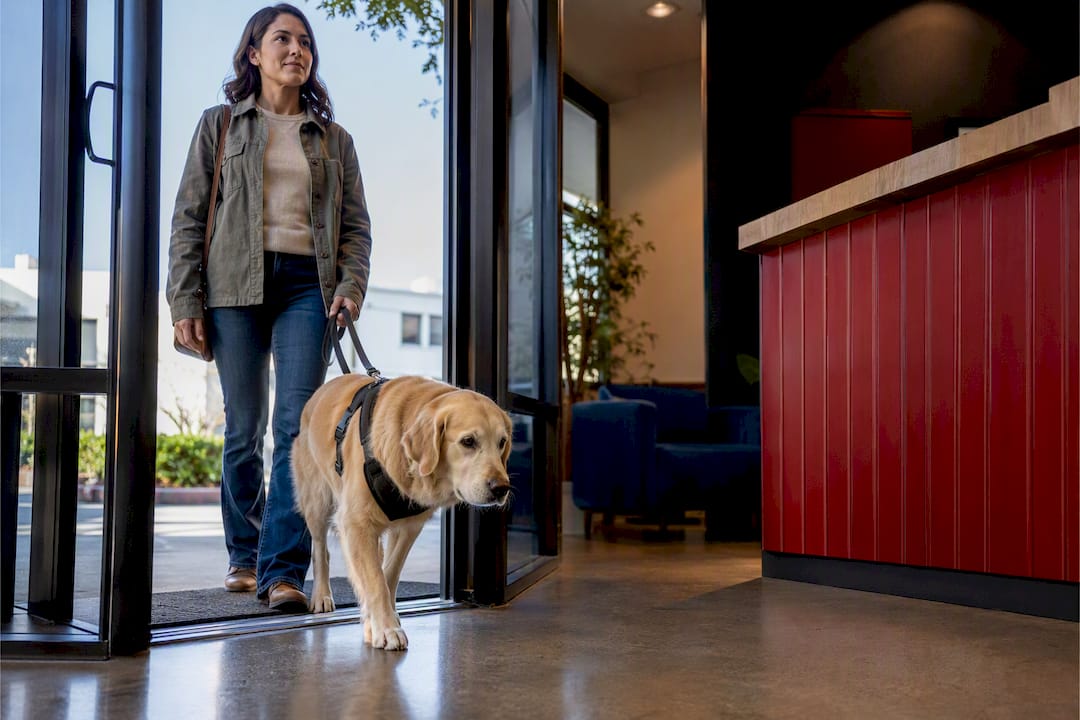
Under federal law, a service animal is a dog (and in limited cases a miniature horse) trained to perform tasks for a person with a disability, and public accommodations must generally let them in without extra fees. Staff may ask only two questions when the animal’s role isn’t obvious. Housing and air travel run on separate rulebooks, and HUD’s 2026 memo now requires that emotional support animals must be trained to perform disability-related tasks to receive protection.
TL;DR:
Service animals are limited to dogs trained to perform specific tasks related to a disability, with miniature horses considered in rare cases, while cats and untrained animals are not eligible.
Businesses can only ask two questions about the animal and cannot exclude it based on allergies or fears, but they may remove the animal for unmanageable or unhousebroken behavior.
HUD’s 2026 memo restricts enforcement to animals trained to perform disability-related tasks, reducing protections for untrained emotional support animals in housing.
Airlines can require training and health documentation for service animals, impose pet fees, and deny emotional support animals from flying as they are treated as pets.
State and local laws may extend protections beyond federal standards, requiring property managers and landlords to verify if their policies meet the stricter local regulations.
Table of Contents
What Counts as a Service Animal Under the ADA?
The ADA’s definition has been narrow since March 2011: a service animal is a dog individually trained to perform work or tasks directly related to a person’s disability. Miniature horses get accommodated in limited circumstances, evaluated case by case for size, weight, and whether the facility can reasonably handle them. That’s it. Cats, birds, reptiles, and untrained companion animals don’t qualify, no matter how much comfort they provide.
Tasks have to be specific and trained, not just comforting. Common examples include:
Guiding a person who is blind or has low vision
Alerting a person who is deaf to sounds
Pulling a wheelchair or providing balance support
Detecting oncoming seizures and positioning for safety
Interrupting anxiety attacks or self-harming behavior through trained action
That last one matters. A dog trained to nudge a handler out of a panic spiral qualifies as a service animal. A dog that just makes someone feel calm by being present does not. That distinction, drawn straight from ADA guidance, separates true service animals from emotional support animals throughout this entire article.
Where Can Service Animals Go, and When Can They Be Excluded?
The general rule is broad access: any area of a public accommodation open to customers, clients, or program participants has to be open to a handler and their service animal too. Restaurants, retail stores, hotels, government offices, and rental leasing offices all fall under this.
Exclusions are narrow and behavior-based, not preference-based. An animal can be removed if it’s out of control and the handler doesn’t correct it, or if it isn’t housebroken. Entities can also restrict access where the animal’s presence would fundamentally alter a service, like sterile operating rooms or burn units.
Here’s what businesses get wrong constantly: allergies and fear of dogs are not valid grounds for exclusion under ADA rules. If a genuine conflict exists between two customers, the business has to find a reasonable solution for both, not automatically remove the service animal. And when an animal is excluded, the handler still gets access to the goods or services themselves, just without the animal physically present.
What Can Staff Legally Ask a Handler?
When the disability or the task isn’t obvious, staff have exactly two questions available under Title III:
Is the dog a service animal required because of a disability?
What work or task has the dog been trained to perform?
That’s the ceiling. Staff cannot demand medical records, ask about the specific diagnosis, require a demonstration of the task, or insist on certification paperwork, because no federal certification or registry exists for service animals. Anyone selling a “service animal ID card” online is selling a novelty item, not a legal credential.
Housing works differently. Under the Fair Housing Act, when a disability or disability-related need isn’t obvious, a landlord may request reliable documentation supporting the need for an assistance animal. That’s a real distinction, not a loophole: retail staff get two questions, but housing providers can ask for more when the situation calls for it.
A workable script for front-line staff: “Is that a service animal for a disability, and what task does it perform?” Nothing more, and nothing about diagnosis.
Housing Rules and HUD’s 2026 Enforcement Shift
Housing has always run on a more flexible standard than storefronts, because the Fair Housing Act covers both service animals and emotional support animals as potential reasonable accommodations. That flexibility just tightened considerably.
HUD’s May 22, 2026 memorandum rescinded the agency’s 2013 and 2020 ESA guidance. Going forward, HUD will find reasonable cause on animal-related complaints only when the animal has been trained to perform disability-related tasks, not simply for providing emotional comfort.
For landlords, that changes the practical calculus:
The prior presumption favoring untrained ESAs at the federal enforcement level has been rescinded
State and local laws, plus private FHA lawsuits, still operate independently of HUD’s posture
Courts may still interpret the FHA more generously than HUD’s current enforcement stance, so documented, consistent decisions still matter
Pro Tip: Update your accommodation request form now, before your next request lands. Waiting until a tenant asks puts you in reactive mode on a policy that’s still shifting.
Air Travel: What the DOT Final Rule Actually Requires
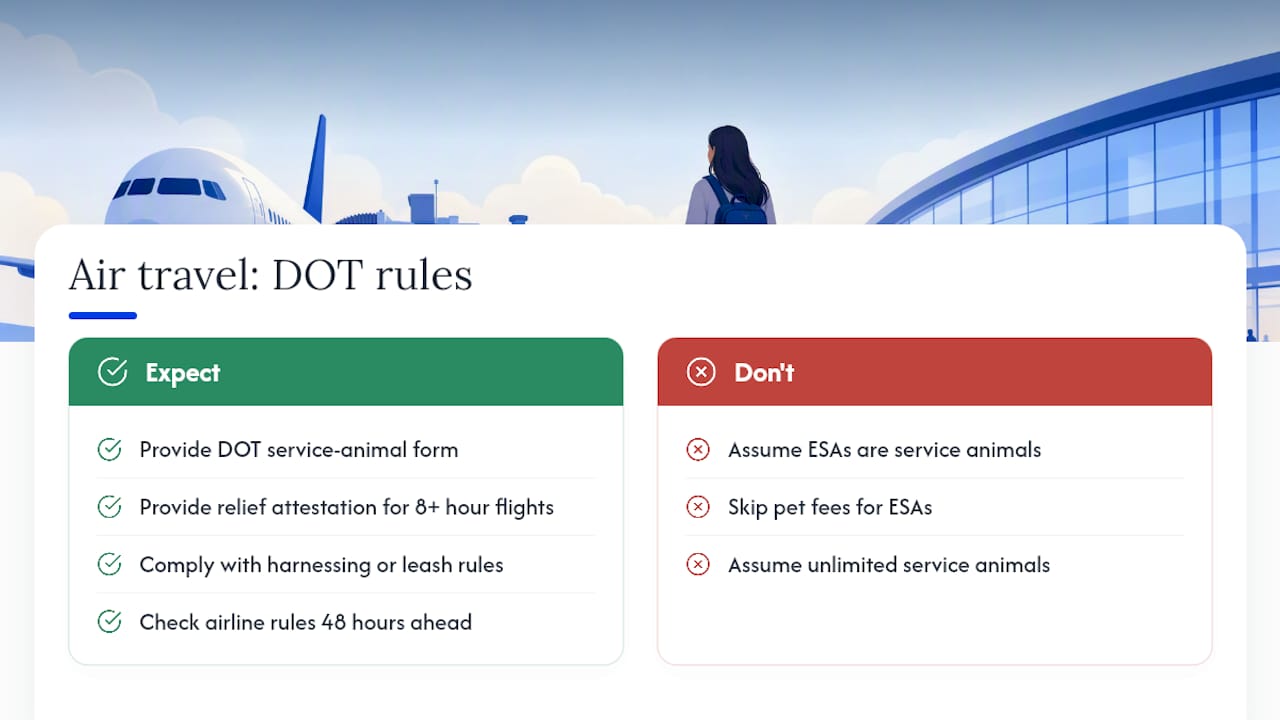
Air travel has its own separate rulebook, and it’s stricter than either the ADA or the FHA. The DOT’s final rule defines a service animal, for flying purposes, as a dog trained to do work or perform a task for a disabled passenger. Emotional support animals are treated as pets, meaning airlines can charge pet fees and impose pet-specific restrictions on them.
Airlines are allowed to require the DOT’s standard service animal form confirming training, health, and behavior. For flights of eight hours or longer, carriers can also require a relief attestation confirming the dog can either avoid relieving itself for the duration or do so in a way that doesn’t create a health hazard. Carriers may limit the number of service animals per passenger and require harnessing or leashing consistent with safety needs. Advance notice requirements vary by airline, so checking 48 hours ahead is a smart habit rather than a universal mandate.
Do State and Local Laws Change These Rules?
Yes, and this is where a lot of landlords and businesses get caught off guard. Federal law sets the floor, not the ceiling. States and municipalities can, and often do, extend broader protection to emotional support animals in housing than HUD’s current enforcement posture requires, or impose different documentation standards for service animals in public spaces.
Before finalizing any policy, check these sources:
Your state attorney general’s consumer protection or civil rights page
Your local or county housing authority’s published guidance
Municipal codes covering public accommodations and animal access
Recent state-level court decisions interpreting your jurisdiction’s fair housing statute
If local law is stricter than federal guidance, you comply with the stricter standard for that jurisdiction. That’s not optional, and it’s the single most common gap in landlord policies built off a generic template.
Compliance Checklists for Businesses, Landlords, and Individuals
Different roles need different action lists. Front-line staff, property owners, and handlers each carry distinct obligations under these rules.
For staff: Ask only the two permitted questions, never charge a service animal fee, and remove an animal only for genuine out-of-control behavior or a housebreaking failure, never for allergies or discomfort.
For landlords: Request documentation through a consistent screening process when need isn’t obvious, apply the same evaluation timeline to every request, and put denials in writing with the reasoning attached.
Log the accommodation request date and method received
Send a written acknowledgment within a set timeframe (5 to 10 business days is common practice)
Document what information was requested and why
Record the final decision and route any denial through legal counsel before it goes to the tenant
Pro Tip: Keep every accommodation request and response in a dedicated file, separate from general maintenance records. If a complaint ever reaches HUD or a court, that paper trail is your strongest asset.
For individuals: Put accommodation requests in writing, keep copies of everything you send and receive, and know your complaint paths run through HUD, the Department of Justice, the DOT, or civil court, depending on which law applies to your situation.
What Property Managers Should Prioritize Right Now
The biggest mistake I see property managers make is treating HUD’s 2026 memo as a green light to deny every ESA request outright. It isn’t. It’s an enforcement posture change, not a rewrite of the statute, and private lawsuits under the FHA haven’t disappeared just because HUD’s administrative presumption shifted.
The smarter move is updating your lease language and accommodation workflow now, before a request forces your hand. Build a documentation template, set a firm evaluation timeline, and apply it identically to every tenant. When you’re leaning toward a denial, get counsel involved before you send anything in writing. Consistency is what protects you in a dispute, not aggression.
— Main
Let 2nd Street Property Management Handle Your ESA and Service Animal Policy
2nd Street Property Management gives Southern New Jersey landlords something a generic lease template can’t: a documented, defensible accommodation process built by investors who’ve actually managed these requests. Instead of guessing whether your current pet policy holds up under HUD’s 2026 posture, you get a policy review, updated screening steps, and a consistent evaluation timeline applied across every unit you own.

That structure matters most the moment a request actually lands in your inbox, not after; for guidance on pet policies and design, see how to create pet-friendly rental units. Our team walks through your current lease language and screening checklist, flags where your documentation trail has gaps, and builds a workflow that holds up whether the request is a legitimate service animal, an ESA claim, or something in between. If you manage rentals, condos, or Section 8 units and want your policy reviewed before your next request instead of after, reach out to 2nd Street Property Management to schedule a policy consultation.
Primary Sources for Service Animal Rules
Read the original guidance directly rather than relying on secondhand summaries:
ADA Requirements: Service Animals — the federal definition and permitted inquiries
DOT final rule on service animals in air travel — airline requirements and forms
45 C.F.R. § 84.73 — the regulatory text behind access, inquiries, and fee rules
Sources
Recommended
Comments