
Real Estate Notes: What Every Landlord Must Know


A real estate note is a promissory note secured by real property. When you buy one, you step into the lender’s seat: you collect principal and interest payments, and if the borrower stops paying, you hold the foreclosure rights. That single shift changes everything about how you earn, what you manage, and what can go wrong.

For landlords weighing their next move, notes offer a genuine alternative to owning rentals — but they swap tenant headaches for legal and workout responsibilities that are just as demanding in their own way.
Two core use cases:
Performing notes: Buy at significant but moderate discounts of unpaid principal balance (UPB) and collect steady monthly payments without managing a single tenant.
Non-performing notes (NPNs): Buy at steeper discounts of UPB, then restructure, negotiate, or foreclose to generate potentially high returns on successful workouts.
When notes make sense for landlords: You want passive cash flow without maintenance calls, you have capital but limited bandwidth, or you’re comfortable with legal processes and patient enough to work through a borrower situation. When they don’t: you prefer hands-on control, you need predictable monthly income without workout risk, or you’d rather own appreciating assets. That’s where professional property management — like what 2ndstreetpropertymanagement offers — keeps your rentals performing without the pivot.
Table of Contents
What real estate notes are and how ownership actually works
A real estate note has two legal components working together. The promissory note is the borrower’s written promise to repay: it specifies the loan amount, interest rate, payment schedule, and default terms. The mortgage or deed of trust is the security instrument that pledges the property as collateral and grants foreclosure rights if the borrower defaults.
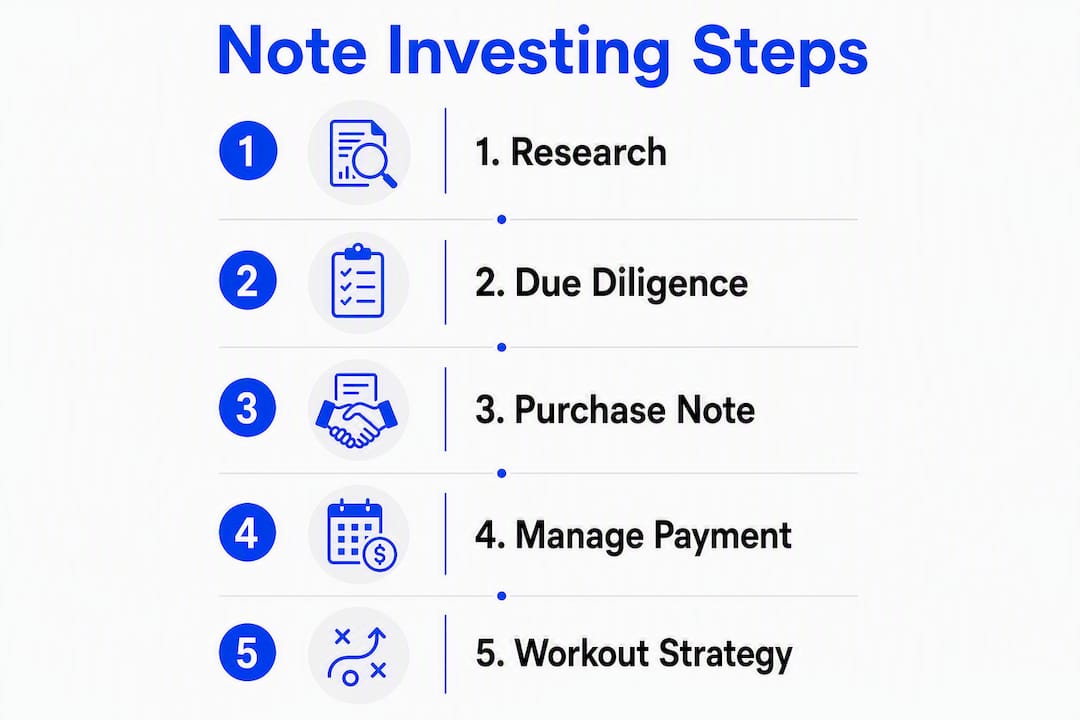
When you buy a note, you receive an assignment of both documents. You don’t own the property, but you control the debt secured by it. Payments flow to you (or your servicer), and if the borrower defaults, you can enforce the mortgage.
Lien position matters enormously. A first-lien note sits ahead of all other creditors in a default scenario. A second-lien note gets paid only after the first lien is satisfied — which means in a foreclosure with limited equity, second-lien holders can be wiped out entirely.
Performing notes trade at discounted prices that reflect interest rate, remaining term, borrower credit quality, and loan-to-value. These appeal to passive income investors who want predictable cash flow.
Non-performing notes trade at deeper discounts reflecting uncertainty: non-payment, unclear resolution paths, and legal costs.
Entry points vary: partial interests and smaller performing notes are available at comparatively low minimums, while whole NPNs usually require higher capital.
How note investing compares to owning rental property
Note investing shifts you from landlord to what practitioners call “lienlord.” You eliminate physical maintenance, tenant screening, and rent collection — but you take on borrower negotiations, legal filings, and servicer oversight. Neither path is passive in the truest sense.
Factor | Rental Property | Note Investing |
Day-to-day work | Tenants, maintenance, vendors | Servicer oversight, borrower contact, legal filings |
Primary risk | Vacancy, tenant damage, turnover | Borrower default, lien defects, foreclosure costs |
Typical yield source | Rent minus expenses | Interest payments or workout gains |
Appreciation upside | Yes | No (notes are fixed-value instruments) |
Capital required | Down payment + reserves | Purchase price + legal/workout reserves |
Regulatory complexity | Landlord-tenant law, fair housing | Foreclosure law, servicer licensing, bankruptcy rules |
Who fits each strategy:
Hands-on landlord: Rental ownership with professional management gives you appreciation, depreciation benefits, and equity buildup.
Passive income investor: Performing notes deliver monthly cash flow without property management, though servicing oversight is still required.
Opportunistic workout specialist: NPNs at steep discounts, resolved through modification or foreclosure, can produce outsized returns — but demand legal competency and patience.
Due-diligence checklist before you buy a note
Due diligence on notes is unregulated and highly variable — sellers disclose what they choose to, and document quality ranges from pristine to chaotic. A repeatable checklist is your only protection.
Verify original documents. Obtain the original promissory note, mortgage or deed of trust, recorded assignments, and full payment history. Confirm the chain of assignment is complete and unbroken.
Order a title search. Identify all senior liens: property taxes, HOA assessments, mechanic’s liens, and any prior mortgages. A gap in the chain of title can make the note legally unenforceable.
Get a BPO or appraisal. Calculate your investment-to-value (ITV) ratio. Target ITV below 70% for performing notes and below 50% for NPNs to preserve downside protection.
Check borrower status. Review payment history, search PACER for bankruptcy filings, and gather whatever income or employment information is available. A borrower in active Chapter 13 triggers an automatic stay that halts enforcement.
Confirm lien position. First-lien notes are far safer. If you’re buying a second lien, model the scenario where the first lien forecloses and leaves you with nothing.
Review note terms. Confirm interest rate, maturity date, prepayment terms, and default triggers. You inherit these terms as written — they generally cannot be changed unilaterally.
After closing:
Record the assignment of mortgage with the county recorder immediately.
Transfer servicing to a licensed loan servicer before the next payment date.
Audit the full collateral file against your checklist.
Pro Tip: Get a title policy endorsement at closing rather than a new policy — it adds you as an insured and updates the coverage date at a fraction of the cost of a new policy.
For a deeper framework on real estate due diligence, the 2ndstreetpropertymanagement guide covers the full process.
Where notes are bought and sold in the U.S.
Notes trade across several distinct channels, each with different pricing, paperwork quality, and minimum requirements.
Banks and credit unions: Workout departments sell both performing and non-performing notes to reduce balance-sheet risk. Paperwork quality is generally high, but minimums can be large and processes slow.
Note marketplaces: Online platforms aggregate notes from multiple sellers. Competition is higher, but deal flow is consistent and accessible for individual investors.
Servicers: Loan servicers sometimes sell notes they manage on behalf of other investors. These can be off-market and negotiable.
Government pool sales (HUD, Fannie Mae, Freddie Mac): Large pools of NPNs, typically requiring significant capital and institutional-level due diligence. Not practical for most individual investors.
Private sellers and owner-financed notes: Sellers who carried financing when they sold a property may want liquidity. These can offer the best discounts and the most flexible terms, but document quality varies widely.
Pricing drivers: Discount to UPB is determined by interest rate relative to current market rates, remaining term, payment history, ITV, lien position, and your target yield. A note with a below-market rate, long remaining term, and high ITV will trade at a steeper discount than a short-term, first-lien note with a strong payment history.
Practical expectations: Partials (buying a portion of the payment stream) can lower entry costs. Recourse vs. non-recourse terms affect seller liability if the note defaults after sale — most secondary-market transactions are non-recourse.
Workout strategies for non-performing notes, step by step
Resolving an NPN is a decision tree, not a single path. Your choice depends on the borrower’s capacity, the property’s condition, and how much time and legal cost you can absorb.
Loan modification (reperform). Negotiate new terms the borrower can sustain: lower rate, extended term, or capitalized arrears. A re-performing note can then be held for income or sold at a premium to its NPN purchase price.
Short payoff. The borrower pays a lump sum less than the full UPB to satisfy the debt. Clean and fast when the borrower has access to funds but not enough to pay in full.
Deed-in-lieu of foreclosure. The borrower voluntarily transfers the property to you. Faster and cheaper than foreclosure, but requires the borrower’s cooperation and a clear title.
Foreclosure and REO sale. The legal remedy of last resort. In judicial foreclosure states, this can take 12–18 months and cost $5,000–$15,000 in legal fees before you can sell the property.
Successful workouts may produce substantial returns depending on the discount paid and the resolution path. Variability largely reflects underlying costs and risks.
Pro Tip: Budget at minimum $10,000–$15,000 in legal and holding costs for any NPN before you bid. Underwriting those costs into your offer price is what separates disciplined note investors from ones who confuse a steep discount with a guaranteed return.
For early-stage borrower engagement before formal foreclosure, the pre-foreclosure call approach is a practical framework worth reviewing.
U.S. legal, tax, and state-specific rules you must check
Foreclosure timelines vary by state. Judicial foreclosure states (New York, New Jersey, Florida, Illinois) require court proceedings — these can take over a year and incur several thousands in legal fees. Non-judicial states (Texas, California, Georgia) use a trustee sale process that can close in 60–120 days. Know which process governs your collateral before you bid. A detailed breakdown of the foreclosure process and timeline is worth reviewing for any state you’re targeting.
Deficiency rules: Some states prohibit lenders from pursuing borrowers for the balance remaining after a foreclosure sale. Check your state’s anti-deficiency statutes before assuming you can recover a shortfall.
Bankruptcy stays: A borrower filing Chapter 13 triggers an automatic stay that halts all collection and foreclosure activity. Search PACER for filings as part of pre-closing diligence and budget for potential delays.
Licensing: Simply buying a note on the secondary market generally does not require a lending license. Actively servicing notes — collecting payments, modifying loans — may trigger state servicer licensing requirements. Use a licensed third-party servicer to stay compliant.
Tax treatment: Interest income from notes is taxed as ordinary income. If you sell a note at a gain, that gain may qualify for capital gains treatment depending on holding period. Depreciation is only available after you acquire the physical property through foreclosure or deed-in-lieu. Self-directed IRAs can hold notes, which can defer or eliminate tax on note income.
Pro Tip: Engage a real estate attorney and a CPA before closing any NPN deal — not after. The cost of an hour of legal review is trivial compared to discovering a title defect or a bankruptcy filing post-close.
This article is general information, not legal or tax advice. Confirm current rules with a qualified attorney or tax professional for your specific situation.
Is note investing right for you? A decision checklist
Work through these criteria honestly before committing capital.
Involvement level: Do you want to eliminate tenant management entirely, or do you prefer direct control over your asset? Notes remove tenants but add legal complexity.
Liquidity needs: Notes are illiquid. Selling a note mid-stream is possible but takes time. Rental income is more predictable month to month.
Risk tolerance: Can you absorb a 12–18 month foreclosure timeline and $10,000–$15,000 in legal costs without it breaking your deal? If not, NPNs are not your play.
Capital reserves: Beyond the purchase price, do you have reserves for legal fees, property repairs (if you end up with REO), and holding costs?
Yield target: Performing notes offer moderate, predictable yields. NPNs offer higher potential returns with higher variance. Know which profile matches your goals.
When to choose professional property management instead:
You own rentals that are cash-flowing but consuming too much of your time.
You want appreciation and depreciation benefits that notes don’t provide.
You prefer a known monthly income stream over workout uncertainty.
You’re scaling a rental portfolio and need operational infrastructure, not a new asset class.
For effective real estate investing strategies, 2ndstreetpropertymanagement has a practical breakdown of when to manage, when to delegate, and when to pivot.
Key Takeaways
Note investing is a legitimate alternative to rental ownership, but it trades tenant management for legal and workout complexity — and the due diligence burden is entirely on you.
Point | Details |
Performing vs. non-performing | Performing notes trade at 70%–95% of UPB; NPNs trade at 30%–65% with workout returns of 15%–50%+. |
ITV targets protect you | Keep ITV below 70% for performing notes and below 50% for NPNs to preserve downside protection. |
Foreclosure costs are real | Judicial states can take 12–18 months and cost $5,000–$15,000 — budget this before you bid on any NPN. |
Post-close steps are mandatory | Record the assignment, transfer servicing to a licensed servicer, and audit the collateral file immediately after closing. |
2ndstreetpropertymanagement | For landlords who prefer rental cash flow over note workouts, professional property management is the practical alternative. |
Why 2ndstreetpropertymanagement tracks the note market
At 2ndstreetpropertymanagement, we were built by investors for investors. We track note market activity because our clients face the same core question: is my capital better deployed in a note or in a managed rental? That question only has a good answer when you understand both sides clearly.
What we’ve seen consistently is that landlords who pivot to notes underestimate the legal and servicer infrastructure required. Notes are not passive by default. The investors who do well in notes are the same ones who do well in rentals: disciplined, process-driven, and honest about their bandwidth.
For many landlords, the better move is keeping their rental portfolio and outsourcing the operational execution — tenant screening, rent collection, maintenance coordination, and Section 8 compliance — to a team that does it every day. That’s exactly what we do in Southern New Jersey and the surrounding region.
How 2ndstreetpropertymanagement helps landlords who prefer rental cash flow
If you’ve worked through this guide and decided that rental ownership is still your path, the question becomes execution. Managing rentals well requires systems, relationships, and regulatory knowledge that take years to build.

2ndstreetpropertymanagement handles the full operational stack for residential landlords: tenant screening, rent collection, leasing, maintenance coordination, Section 8 housing management, condo and HOA association management, and vendor oversight. You keep the asset, the appreciation, and the depreciation benefits. We handle everything that turns a good investment into a daily job.
Investors who work with us stop trading time for rent checks and start scaling. If you own residential rentals in Southern New Jersey and want to see what professional management actually looks like, contact our team for a consultation.
Useful sources and next reading
What to Consider When Buying Real Estate Promissory Notes — Holland & Knight legal overview of note purchase strategy, due diligence, and exit planning.
Mortgage Note: What It Is and How It Works — Investopedia primer on note structure and legal components.
How to Buy Real Estate Notes in 6 Steps — Practical step-by-step acquisition guide including financing options.
Foreclosure Process, Timeline, and Options — State-by-state foreclosure mechanics for note buyers.
Due Diligence in Real Estate Investing — 2ndstreetpropertymanagement’s full due-diligence framework for investors.
Real Estate Investing: Steps to Get Started — For investors deciding between notes, rentals, and managed properties.
PACER (pacer.gov): Search federal court records for borrower bankruptcy filings before closing any note transaction.
Recommended
Comments