
Passive Rental Income Explained for Landlords and Investors
- Rey Rey Rodriguez
- 10 hours ago
- 13 min read

Rental income is usually semi-passive, not fully passive—and the distinction matters more than most landlords expect. The IRS classifies rental activity as passive under Section 469 of the tax code, which means losses from your rentals generally can’t offset your W-2 or business income unless you qualify for specific exceptions. On the operational side, you’re always trading either your time or a slice of your cash flow: self-managing a single-family home can run 5–10 hours a month on a quiet month and far more during a turnover, while hiring a property manager typically costs 8–12% of monthly rent. Neither path is free. The good news is that with the right buy criteria, financing structure, and operations in place, rental income can get very close to genuinely passive.

Table of Contents
What “passive rental income” actually means: key terms and formulas
How U.S. tax rules treat rental income — and the tests that change everything
Is rental income really “passive”? The management-effort spectrum
How to calculate whether a rental produces passive cash: a $1,000/month worked example
What startup costs and timeline should you expect before cash flow stabilizes?
A practical checklist to make your rental income as passive as possible
What professional property management actually does — and the real trade-offs
What landlords actually experience — a perspective worth hearing
2ndstreetpropertymanagement helps you turn rental properties into real passive income
What “passive rental income” actually means: key terms and formulas
“Passive income from rentals explained” is a phrase that gets thrown around loosely. Before you can evaluate a deal or a tax strategy, you need a working vocabulary.
Core terms:
Gross rent: The total rent collected before any deductions.
Vacancy allowance: A reserve for periods the unit sits empty; a realistic target is 3–5% vacancy for well-managed single-family rentals.
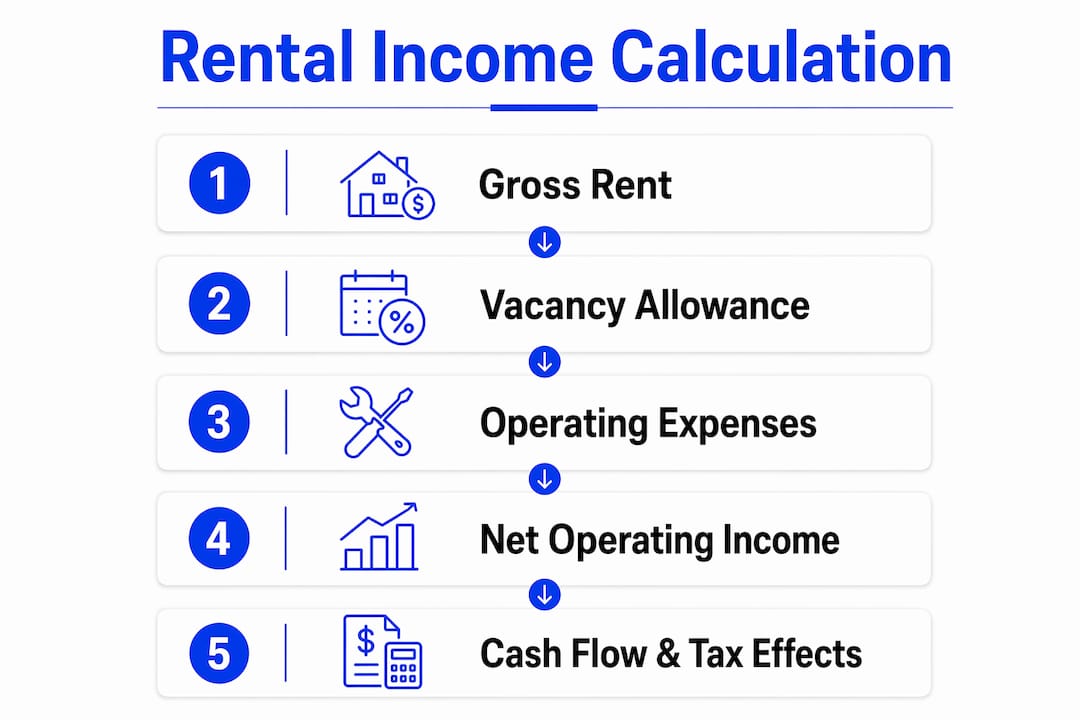
Net Operating Income (NOI): Gross rent minus vacancy minus operating expenses (property tax, insurance, maintenance, management fees, reserves). Debt service is excluded.
Cash flow: NOI minus your mortgage payment (principal + interest). This is the money you actually pocket.
Cash-on-cash return: Annual cash flow divided by total cash invested. A 6–8% cash-on-cash return is considered solid for most markets.
Cap rate: NOI divided by property value. Used to compare properties independent of financing.
Depreciation: The IRS allows you to deduct the cost of a residential rental building over 27.5 years. This creates a paper loss that reduces taxable income without reducing your bank balance.
Reserves: Money set aside for capital repairs (roof, HVAC, appliances). Industry practice is 5–10% of gross rent.
Material participation: The IRS standard for determining whether you’re actively involved in an activity. Rental activities generally fail this test by default.
Quick formula chain:
Gross Rent − Vacancy − Operating Expenses = NOI NOI − Debt Service = Cash Flow Cash Flow ÷ Cash Invested = Cash-on-Cash Return
Two-line numeric example: A property renting for $1,800/month with a 5% vacancy allowance and $720 in monthly operating expenses produces NOI of $990/month ($1,800 × 0.95 − $720). Subtract a $700 mortgage payment and you’re left with $290/month in cash flow.
How U.S. tax rules treat rental income — and the tests that change everything
Rental income is reported on Schedule E of Form 1040, not Schedule C. That placement matters because it signals to the IRS that your rental activity is passive by default under Section 469, regardless of how many hours you spend managing it.
Passive activity loss rules (Section 469): Passive losses can only offset passive income. If your rental shows a tax loss on paper (which is common once depreciation is factored in), you generally cannot use that loss to reduce your salary or self-employment income. Disallowed losses carry forward to future years and are fully released when you sell the property.
The $25,000 special allowance: There’s a meaningful exception for smaller landlords. If your modified adjusted gross income (MAGI) is $100,000 or below and you actively participate in your rental (a lower bar than material participation — it means you make management decisions, even if you use a manager), you can deduct up to $25,000 in rental losses against ordinary income. This allowance phases out between $100,000 and $150,000 MAGI and disappears entirely above $150,000.
The Real Estate Professional exception: If you spend more than 750 hours per year in real estate activities and more than half of your total working time in those activities, the IRS treats your rental income as non-passive. Losses become fully deductible against any income. This is a high bar — it’s designed for people whose primary occupation is real estate.
Depreciation and the paper-loss effect: Depreciation is where the tax math gets interesting. A property generating positive cash flow can simultaneously show a tax loss because depreciation is a non-cash deduction. The table below shows how this works.
Item | Monthly | Annual |
Gross rent | $1,800 | — |
Vacancy (5%) | −$90 | — |
Operating expenses | −$720 | — |
NOI | $990 | — |
Mortgage payment | −$700 | — |
Cash flow | $290 | $3,480 |
Taxable income (paper) | — | −$3,793 |
The property produces $3,480 in real cash but shows a $3,793 paper loss for tax purposes. That loss carries forward if you can’t use it this year. One important caveat: when you sell, the IRS recaptures depreciation at a 25% rate, so the tax benefit shifts timing rather than eliminating the liability entirely. Work with a CPA who understands rental real estate before assuming depreciation is a free lunch.
Short-term rental exception: When you rent a property with an average guest stay of seven days or fewer and provide hotel-like services, the IRS may reclassify that activity as an active business reported on Schedule C. That means self-employment tax applies, but losses may be deductible against ordinary income without the passive activity limits. The rules here are nuanced; consult IRS Publication 527 and a tax professional for your specific situation.
This article is general information, not tax or legal advice. Confirm current rules with the IRS or a qualified tax professional for your own situation.
Is rental income really “passive”? The management-effort spectrum
The honest answer is that rental ownership sits on a spectrum, and where you land depends almost entirely on how you structure operations.
The spectrum in practice:
Self-managed, single-family long-term rental: Expect 5–10 hours/month during stable tenancy, 20–40 hours during a turnover (advertising, showings, screening, lease signing, move-in inspection, repairs).
Self-managed, small multifamily (2–4 units): Multiply the above by unit count. A four-unit building can easily consume 15–25 hours/month when one unit turns.
Professionally managed, long-term rental: Owner time drops to 1–3 hours/month — reviewing statements, approving larger repairs, and occasional strategic decisions. This is the closest most landlords get to true passive income.
Short-term rental (Airbnb-style): Guest communication, cleaning coordination, dynamic pricing, and regulatory compliance make this the most time-intensive model. Without a co-host or management platform, it functions more like a hospitality business than a passive investment.
Industry analysts consistently describe rental income as “semi-passive” — you either spend time managing or pay a manager to do it. Both are legitimate strategies; neither produces income with zero effort.
Pro Tip: Before you buy, decide which side of that trade-off you’re on. If you’re buying properties for income and want genuine passivity, budget for management fees from day one and underwrite the deal with those fees already subtracted from NOI. A deal that only works if you self-manage isn’t a passive investment — it’s a part-time job.

How to calculate whether a rental produces passive cash: a $1,000/month worked example
Most investors focus on gross rent. That’s the equivalent of evaluating a car by its horsepower and ignoring fuel costs, insurance, and maintenance. The number that tells you whether a property can generate real cash flow is what’s left after every legitimate cost is subtracted.
Step-by-step calculation:
Start with gross monthly rent.
Subtract vacancy allowance (use 5% as a baseline; adjust for your market).
Subtract operating expenses: property tax, insurance, maintenance, management fee, and reserves. Industry benchmarks put operating expenses at 40–45% of gross rent for single-family rentals.
The result is NOI.
Subtract monthly debt service (principal + interest on your mortgage).
The result is cash flow.
Formulas:
Cap Rate = (Annual NOI ÷ Property Value) × 100
Cash-on-Cash Return = (Annual Cash Flow ÷ Total Cash Invested) × 100
Use cap rate to compare properties without the distortion of financing. Use cash-on-cash to measure the return on your actual dollars invested.
Worked example: targeting $1,000/month net cash flow
Input | Amount |
Gross monthly rent | $2,800 |
Monthly mortgage payment | −$1,100 |
Monthly cash flow | $384 |
At $2,800/month rent, this property produces $384/month — well short of $1,000. To reach $1,000/month net cash flow, you’d need either a lower mortgage payment (larger down payment or lower purchase price), higher rents, or a combination. Running the math in reverse: $1,000 target cash flow + $1,100 debt service = $2,100 NOI needed. At a 42% expense ratio on a 5% vacancy, that requires roughly $3,700/month in gross rent. That’s the deal you’re looking for. Use a rental property cash flow tool to model different scenarios before you make an offer.
What startup costs and timeline should you expect before cash flow stabilizes?
Rental income doesn’t become passive on day one. There’s a ramp-up period, and underestimating it is one of the most common mistakes first-time landlords make.
Startup costs (one-time):
Down payment: typically 20–25% for investment properties
Closing costs: roughly 2–5% of purchase price
Initial repairs and make-ready: varies widely; budget $3,000–$10,000+ for older properties
Inspection and legal fees: $500–$1,500 depending on complexity
Furnishing (if short-term rental): $5,000–$20,000+ for a fully furnished unit
Recurring costs (monthly):
Mortgage principal and interest
Property taxes (typically escrowed)
Landlord insurance
Maintenance and repairs (budget 1% of property value annually as a baseline)
Property management fee (8–12% of monthly rent if outsourced)
Vacancy allowance (5% of gross rent)
Capital reserves (5–10% of gross rent)
Timeline to steady passive cash flow:
Phase | Typical Duration | What’s Happening |
Acquisition and make-ready | 1–3 months | Closing, repairs, marketing |
Lease-up | 2–6 weeks | Tenant screening and placement |
Stabilization | 6–12 months | First lease cycle, systems established |
Steady-state passive cash flow | Month 12+ | Predictable income, reserves built |
Most landlords don’t experience genuinely stable cash flow until after the first full lease cycle. Budget reserves accordingly, and don’t count on month-one cash flow to cover personal expenses. DSCR (Debt Service Coverage Ratio) loans and asset-based financing can make the acquisition phase easier for investors without traditional W-2 income, since qualification is based on the property’s projected rent rather than personal income.
Risks that undermine passivity and how to mitigate them
Every risk on this list has one thing in common: it converts passive income into active problem-solving. Knowing them in advance is how you stay ahead.
Eviction costs and time: A single avoidable eviction can cost $3,500–$10,000 in direct expense, plus 2–4 months of lost rent. Mitigation: rigorous tenant screening before placement, not after a problem appears. A thorough background check process is the highest-ROI preventive action you can take.
Deferred maintenance and surprise capital expenses: A roof, HVAC system, or water heater that fails without warning can wipe out a year’s cash flow. Mitigation: maintain a capital reserve of 5–10% of gross rent and conduct annual property inspections to catch issues early.
Vacancy and tenant turnover: Every month a unit sits empty is a month of lost income with fixed costs still running. Mitigation: price competitively, respond to maintenance requests quickly, and offer lease renewals 60–90 days before expiration.
Regulatory and local ordinance exposure: Rent control laws, short-term rental restrictions, and habitability codes vary by municipality and change frequently. Mitigation: stay current with local landlord-tenant law and consult a local attorney when ordinances shift.
Insurance premium spikes: Landlord insurance premiums have risen sharply in many markets. Mitigation: review your policy annually, shop coverage every 2–3 years, and confirm your policy covers loss of rent.
Interest-rate risk: If you hold an adjustable-rate mortgage or plan to refinance, rising rates compress cash flow. Mitigation: lock in fixed-rate financing when possible and stress-test your NOI at higher debt service levels before buying.
Tax/timing mismatch: Depreciation creates paper losses that don’t match your actual cash-flow timing, and recapture on sale can produce a large tax bill in a year when you feel cash-rich. Mitigation: work with a CPA experienced in real estate annually, not just at tax time.
A practical checklist to make your rental income as passive as possible
Passivity is built in layers: the deal itself, the financing, the operations, and the team. Get all four right and the income largely runs itself.
Buy criteria and financing:
Underwrite every deal using NOI and cash flow, never gross rent alone.
Confirm the property cash-flows after management fees are included in operating expenses.
Use DSCR or asset-based financing if you’re self-employed or hold multiple properties — it keeps qualification tied to the property, not your personal tax returns.
Build reserves into your budget before you close, not after the first repair bill arrives.
Target markets with strong rental demand and low regulatory risk.
Operational systems:
Standardize rent collection through an online portal (ACH or card) so you’re not chasing checks.
Build a vendor bench before you need it: a licensed plumber, electrician, and HVAC technician on call.
Use a consistent lease template reviewed by a local attorney.
Set a financial reporting cadence: monthly income/expense statement, annual tax summary.
Establish tenant screening standards in writing and apply them uniformly to every applicant.
Questions to ask a property manager before signing:
What is your monthly management fee, and what does it include?
What is your leasing fee for placing a new tenant?
Do you mark up vendor invoices, and if so, by how much?
What is your maintenance approval limit before you contact me?
What is your average response time for maintenance requests?
How do you handle evictions, and who covers the legal costs?
How often do you provide owner statements, and in what format?
A manager who can’t answer these questions clearly is a manager worth passing on.
What professional property management actually does — and the real trade-offs
Professional management converts your time into a fee. Whether that trade-off makes financial sense depends on your hourly opportunity cost and how much avoidable loss a manager can prevent.
Core services a full-service manager provides:
Tenant marketing, screening, and placement
Lease execution and move-in/move-out inspections
Rent collection and delinquency management
Maintenance coordination and vendor oversight
Owner accounting, monthly statements, and year-end tax documents
Legal compliance monitoring (fair housing, habitability codes, local ordinances)
Eviction management when necessary
Typical fee structure:
Monthly management fee: a percentage of collected rent
Leasing fee: a charge based on a percentage or month’s rent for placing a new tenant
Maintenance markup: some managers add a markup to vendor invoices; others pass costs through at cost
The net trade-off is real but often misunderstood. A manager charging 10% of rent on a $1,800/month property costs $180/month. If that manager reduces vacancy by even one week per year and prevents one eviction over a five-year hold, the math often favors professional management by a wide margin.
Two scenarios, same property:
Metric | Self-Managed | Professionally Managed |
Vacancy loss | $1,800 | $1,080 |
Management fee | $0 | $2,160 |
Owner hours/year | — | ~20 |
The self-managed owner nets roughly $640 more per year but spends 100 additional hours doing it. At any reasonable valuation of your time, professional management wins on a total-return basis for most investors.
Contract items to negotiate before signing:
Termination clause: 30–60 day notice without penalty if performance is poor.
Vendor markup cap: specify a maximum percentage or require pass-through pricing.
Maintenance approval limit: set a dollar threshold (commonly $200–$500) below which the manager acts without calling you.
Reporting cadence: monthly statements, annual 1099, and on-demand access to your owner portal.
Eviction handling: clarify who files, who pays court costs, and what the manager’s role is throughout.
Insurance requirements: confirm the manager carries errors and omissions (E&O) and general liability coverage.
Understanding how management fees affect cash flow before you sign is the difference between a deal that works and one that quietly bleeds margin. Property management’s role in maximizing returns goes well beyond collecting rent — it’s a systematic approach to protecting NOI at every touchpoint.
Key Takeaways
Rental income is semi-passive by default: you trade either your time or a management fee, and the IRS classifies it as passive under Section 469 regardless of how many hours you put in.
Point | Details |
Passivity requires a trade-off | You pay with time (self-manage) or money (8–12% management fee); neither is free. |
IRS classification is passive by default | Rental income reports on Schedule E; losses are limited by Section 469 unless you qualify for the $25,000 allowance or Real Estate Professional exception. |
Depreciation shifts tax timing | A property can show a paper loss while generating positive cash flow; recapture applies on sale, so tax planning with a CPA is necessary. |
Underwrite on NOI, not gross rent | Operating expenses typically run 40–45% of gross rent for single-family rentals; reserves and vacancy must be included before you evaluate a deal. |
2ndstreetpropertymanagement converts semi-passive to passive | Full-service management (tenant screening, rent collection, maintenance, reporting) reduces owner hours from — to ~20 per year for a typical single-family rental. |
What landlords actually experience — a perspective worth hearing
The gap between what rental income looks like on a spreadsheet and what it feels like in practice is wider than most new landlords expect. The spreadsheet shows $290/month in cash flow. What it doesn’t show is the Saturday morning call about a broken water heater, the two weeks of lost rent during a turnover you didn’t budget for, or the tenant who paid on time for eight months and then stopped.
None of that means rental property is a bad investment. It means the investors who do well are the ones who treat it like a business from day one. They build systems before they need them, screen tenants before they’re desperate to fill a vacancy, and hire professionals for the work that falls outside their expertise. The landlords who struggle are almost always the ones who bought based on gross rent, skipped the reserves, and assumed the management would “figure itself out.” It doesn’t. The paper profit and the real cash flow only align when the operations behind them are deliberate. That’s the part most articles skip over, and it’s the part that determines whether you’re building wealth or just staying busy.
2ndstreetpropertymanagement helps you turn rental properties into real passive income
Owning rentals in Southern New Jersey means navigating tenant laws, maintenance vendors, and cash-flow math that changes with every lease cycle. 2ndstreetpropertymanagement was built by investors who’ve done exactly that — which means the services are designed around what actually protects your NOI, not just what sounds good in a brochure.
The full-service offering covers tenant screening and placement, rent collection, maintenance coordination, vendor oversight, Section 8 housing management, and monthly financial reporting. The fee structure is straightforward: a monthly management fee in the 8–12% range of collected rent, a leasing fee for new placements, and no hidden markups on vendor invoices. Three questions worth asking during your first conversation: What is your average vacancy rate for properties you manage? How do you handle maintenance emergencies after hours? And what does your owner portal show me in real time? If the answers are specific and verifiable, you’re talking to the right team.
Ready to see what professional management does for your cash flow? Get a portfolio review from 2ndstreetpropertymanagement and find out exactly what your properties could net under full-service management.
Useful sources and further reading
These primary sources are worth bookmarking if you’re serious about understanding rental income taxation and operations.
IRS Topic No. 425 — Passive Activities, Losses and Credits: The IRS’s own explanation of Section 469, passive activity loss rules, and the real estate professional exception. Start here for tax classification questions.
IRS Publication 527 — Residential Rental Property: The definitive IRS guide covering what counts as rental income, which expenses are deductible, depreciation rules, and personal-use limitations. Updated annually.
IRS Topic No. 414 — Rental Income and Expenses: A concise IRS overview of what must be reported as rental income and what qualifies as a deductible expense.
IRS Publication 925 — Passive Activity and At-Risk Rules: The full technical guidance on material participation, passive loss limitations, and at-risk rules. Useful if you’re evaluating the Real Estate Professional exception.
Schedule E (Form 1040) — Supplemental Income and Loss: The actual form where rental income and expenses are reported. Reviewing the instructions clarifies what the IRS expects landlords to track.
Investopedia — Is Rental Income Really Passive?: A clear editorial breakdown of the semi-passive reality, with expert commentary on the time-vs-fee trade-off.
SmartScreen — Income Maximization for Rental Properties: Practical benchmarks for vacancy rates, operating expense ratios, and ROI targets for single-family rentals.
SimsVentures — Passive Income from Rental Property: A strategy-focused guide on buy criteria, financing structures, and operational systems for achieving genuine passivity.
2ndstreetpropertymanagement — Comprehensive Property Management Solutions: Operational detail on what full-service management covers and how it protects owner cash flow in practice.
Recommended