
Leasing Software That Fills Vacancies and Protects Assets


Hiring a professional leasing and tenant-placement service is the right move for most rental investors. If one extra month of vacancy costs more than the placement fee, or if you lack the local systems to screen applicants consistently, a professional service pays for itself before the first lease is signed.
Who should hire a leasing service now:
Remote or portfolio investors: You need documented screening, multi-channel marketing, and move-in coordination you cannot run from a distance.
Local landlords without systems: If your process is ad-hoc, one bad placement can cost far more than a year of management fees.
Your next step: contact 2ndstreetpropertymanagement to request their screening policy and SLA documentation before you sign anything with any provider.
Table of Contents
What does a leasing service actually do for your rental?
A tenant-placement service handles every step between a vacant unit and a signed lease. That includes pricing the unit against current market comps, writing and distributing the listing across multiple channels, coordinating showings, processing applications, running the full screening sequence, drafting the lease, and managing move-in day logistics.

Where the scope ends depends on the contract. A standalone placement service typically stops at move-in and charges a one-time fee. Full-service property management continues through rent collection, maintenance, renewals, and lease administration. The distinction matters when you are comparing proposals: confirm in writing exactly which tasks transfer to you after the tenant moves in.
Digital tools sit inside this workflow at specific points. Automated applicant intake, API-connected screening reports, and digital lease signing are now standard in professional operations. They reduce turnaround time and create an audit trail that protects you in a Fair Housing dispute.
Why hire a professional instead of leasing it yourself?
Speed and consistency are the two arguments that close this debate for most investors. According to 2025 NARPM industry data, property managers who implement a structured, automated screening and leasing process achieve targeted leasing speed 2.6× faster than ad-hoc/manual approaches. Every extra week of vacancy is lost rent, and that loss compounds across a portfolio.
The risk argument is just as concrete. Placing an unqualified tenant quickly often produces higher long-term costs from unpaid rent, property damage, and eviction proceedings than a longer, careful search would have. Professional services enforce consistent, documented criteria on every applicant, which removes the ad-hoc judgment calls that create both bad placements and Fair Housing liability.
Scalability is the third factor. A landlord managing one property can absorb a slow, manual process. A landlord with three or more units cannot. Professional leasing services offer SLA-backed timelines and replacement guarantees that a solo landlord rarely achieves.
Pro Tip: Calculate your vacancy breakeven before comparing fees. Divide your monthly rent by 30 to get your daily vacancy cost. If one extra week of vacancy exceeds the placement fee, the service pays for itself on speed alone, before you account for screening quality.
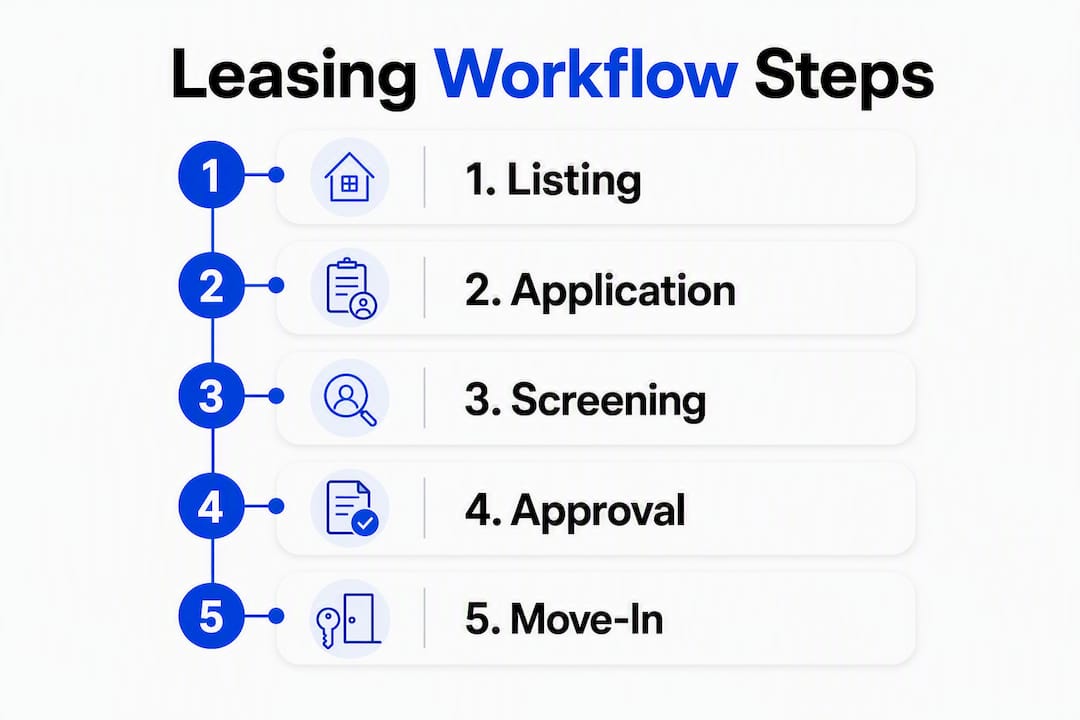
How a professional leasing process works from listing to move-in
A well-run placement follows a clear sequence. Gaps in that sequence are where delays and bad placements happen.
Prepare and price: Condition assessment, repair coordination, and market-rate pricing using current comparable rentals.
List and market: Professional photography, listing copy, and distribution across high-traffic rental platforms.
Qualify leads: Pre-screening inquiries against minimum criteria before scheduling showings.
Screen applicants: Full screening sequence covering income verification, credit report, criminal and eviction history, identity verification, and landlord references.
Approve and execute the lease: Applicant approval, lease drafting, and digital signing.
Move-in coordination: Condition report, key handoff, utility confirmation, and onboarding documentation.
The manual version of this workflow contains an average of 18 distinct steps and 8 handoff points, and each handoff introduces delay risk. A provider who has not automated the hand-off points between steps 3 and 5 will consistently miss their own timelines.
A structured tenant onboarding process can reduce future tenant disputes by up to 35% by ensuring the resident fully understands rules, communications, and disclosures from day one.
Metric | Manual Workflow | Automated Workflow |
Screening initiation time | ~18 hours | Under 2 minutes |
Workflow steps | 18 steps | Reduced via automation |
Handoff points (delay risk) | 8 | Minimized |
Lease execution rate | Baseline | +31% with digital signing |
Pro Tip: When reviewing vendor proposals, ask specifically: “How does your system trigger screening once an application is submitted?” If the answer involves a staff member manually initiating the report, that single step can add 18 hours of delay per applicant. Require API-connected screening as a baseline.
How screening standards keep you Fair Housing–compliant
Standardized criteria are not just an operational preference. They are your legal protection. When every applicant is evaluated against the same documented income threshold, credit floor, criminal background policy, and eviction history standard, you remove the ad-hoc judgments that create disparate-impact liability under the Fair Housing Act.
Every provider you evaluate should be able to hand you a written scoring model on request. That document should specify the income-to-rent ratio required, the minimum credit score accepted, the criminal background policy with its reasoning, and the eviction history threshold. These criteria need to be applied consistently and documented for every applicant, not just the ones who are declined.
Vendor screening integrations matter here. Credit and criminal background checks should pull through API connections to reporting services, not manual lookups. That integration creates a timestamped, consistent record for every applicant. Review the tenant background check process your provider uses and confirm it covers all five screening dimensions before you sign.
Use a landlord screening checklist to compare any provider’s documented criteria against a proven standard.
What leasing fees and timelines should you realistically expect?
Standalone tenant placement fees typically fall between 50% and 100% of one month’s rent as a one-time charge. Some providers offer flat-fee structures. Others tie the fee to a performance guarantee, refunding or replacing the tenant if the placement fails within a defined window.
Fee Structure | Typical Range | Key Condition |
Percent of monthly rent | 50%–100% of one month’s rent | One-time, paid at lease signing |
Flat fee | Varies by market | Confirm what is included |
Guarantee/replacement | Included or add-on | Confirm replacement window and documentation requirements |
Time-to-lease depends on market conditions, season, property condition, and how automated the provider’s workflow is. Digital lease signing alone increases execution rates by 31%, dramatically reducing lease turnaround.
When reviewing a guarantee, confirm: what triggers the replacement, what documentation you must provide, how long the replacement window lasts, and whether the fee is refunded or credited. Vague guarantee language is a red flag.
How to evaluate and choose the right leasing service
Use this question list in your first call with any provider. The answers reveal operational depth faster than any marketing brochure.
What is your average time-to-lease for a property like mine in this market?
Walk me through your screening process step by step. Which checks are automated?
Can you provide your written screening criteria document today?
How do you handle Fair Housing compliance training for your leasing staff?
What does your placement guarantee cover, and what are the conditions?
How do you market the property, and which platforms do you list on?
What is your digital lease signing process, and how quickly can a lease be executed once approved?
Can you provide references from landlords with similar portfolios?
Red flags to watch for: inconsistent answers about screening criteria, guarantees described verbally but not in writing, no documented SLA for time-to-lease, and an inability to name the screening platforms they use.
Your contract should include: written screening criteria, replacement guarantee terms with specific conditions, timeline SLAs, data security commitments for applicant information, fee refund policy, and evidence of Fair Housing training. Setting explicit automation goals before signing increases the likelihood of hitting leasing speed targets, so ask the provider to commit to measurable KPIs in the agreement.
Avoid the common screening mistakes that cost landlords thousands by validating every point above before you sign.
Special cases: Section 8, problem-tenant histories, and HOA properties
Section 8 and housing subsidy programs add paperwork and inspection timelines that a standard placement process typically does not account for. Confirm your provider has experience with HUD inspections, HAP contract execution, and the specific documentation requirements for your local housing authority. These steps can add two to four weeks to a placement if the provider is not already set up for them.
Problem-tenant histories require a different vetting strategy. A provider should be able to explain how they weight prior evictions, what deposit strategy they recommend for higher-risk profiles, and whether they carry errors-and-omissions insurance that covers screening decisions.
Multi-unit and HOA properties add access rules, shared-space coordination, and sometimes board approval requirements for new tenants. Your provider needs a vendor network capable of scheduling inspections and coordinating access without creating delays. Expect additional fees or longer timelines for any of these scenarios, and confirm the provider’s capabilities in writing before the listing goes live.
Key Takeaways
Professional leasing services pay for themselves when vacancy cost exceeds the placement fee and when consistent, documented screening is the difference between a reliable tenant and a costly eviction.
Point | Details |
Hire when vacancy cost exceeds the fee | One extra month of vacancy often costs more than a 50%–100% placement fee. |
Require written screening criteria | Every provider must supply a documented scoring model covering income, credit, criminal, and eviction standards. |
Demand automation at key handoffs | Automated screening initiation cuts initiation time from 18 hours to under 2 minutes. |
Confirm guarantee terms in writing | Verbal guarantees are unenforceable; require replacement window, conditions, and fee policy in the contract. |
2ndstreetpropertymanagement | Built by investors for investors in Southern New Jersey, with documented screening policy and SLA-backed leasing services available on request. |
The investor’s perspective on leasing services
The conventional wisdom says speed is the goal. Get the unit filled, collect the rent, move on. That framing confuses movement with progress.
The investors who build durable portfolios think about leasing differently. They treat the placement decision as the single highest-leverage moment in a tenancy. A well-screened tenant in year one prevents an eviction in year two, a damage claim in year three, and a cash-flow gap that forces a bad refinancing decision in year four. The downstream effects of one poor placement compound in ways that never show up in a simple vacancy-cost calculation.
The providers worth hiring understand this. They do not compete on speed alone. They compete on the quality of their screening documentation, the consistency of their criteria, and the transparency of their SLA commitments. Those are the signals that separate a professional operation from one that fills units and moves on.
Why 2ndstreetpropertymanagement is built for investors like you
2ndstreetpropertymanagement was built by investors, which means the leasing process is designed around asset protection first and speed second. The service covers the full placement sequence: market pricing, professional listing, multi-channel marketing, applicant screening with documented criteria, digital lease execution, and move-in coordination. Section 8 experience is included, not an add-on.
The investor-built approach shows up in the documentation. Screening criteria, SLA timelines, and replacement guarantee terms are available on request before you commit. That transparency is the due diligence standard every landlord should hold every provider to.
Serving Southern New Jersey and regional suburbs, 2ndstreetpropertymanagement is ready to walk you through the leasing process, share the screening policy, and confirm SLA commitments in writing. Contact 2ndstreetpropertymanagement to request your screening policy review and start the conversation today.
Useful sources and further reading
Property Mgmt Tenant Screening Leasing — 20 Steps (2026) | US Tech Automations — Source for 2025 NARPM automation data, handoff-point analysis, and digital signing statistics.
Expert Tenant Placement Services | Showdigs — Placement fee benchmarks and asset-protection framing.
Property Management Checklist: The Complete Guide for 2026 | CheckFlow — Onboarding dispute-reduction data and recurring workflow automation guidance.
Leasing Services for Small Landlords | Blue Castle Property Management — Owner-profile decision framework for when leasing services make financial sense.
Tenant Screening Service for Landlords: 2026 Guide — External partner resource on screening service benefits and compliance considerations.
Landlord Tenant Screening Checklist: 2026 Guide | 2ndstreetpropertymanagement — Request this from any provider as a baseline comparison document.
The Role of Tenant Background Check in Reducing Risk | 2ndstreetpropertymanagement — Background-check component breakdown for evaluating vendor screening depth.
Recommended

Comments