
How Long Can You Rent a House For? A Landlord's Guide


As a landlord, you can set almost any fixed lease length you choose — but leases longer than one year are subject to the Statute of Frauds, which means they must be in writing and signed to be enforceable in every U.S. state. The practical ranges most residential investors use fall into four categories:
Month-to-month (periodic tenancy): No fixed end date; either party can terminate with proper notice, often about a month depending on state law.
Short fixed-term (typically several months up to one year): The most common residential lease length; balances rent-reset flexibility with tenant stability.
Multi-year fixed-term (2–5 years): Less common for residential; useful when locking in a reliable tenant or recovering a major renovation cost.
Long or ground leases (up to 99 years in most states): Rare in residential investing; relevant primarily for development deals and land-only arrangements.
2ndstreetpropertymanagement works with investors across Southern New Jersey to match lease term to asset profile, local ordinance requirements, and ROI targets — starting with the legal foundation below.
Key Takeaways
Leases longer than one year must be in writing and signed to be enforceable in every U.S. state — that single rule shapes every other lease length decision a landlord makes.
Point | Details |
Writing required over one year | Any lease exceeding one year must be signed and in writing; oral agreements convert to month-to-month. |
Check local ordinances first | Rent stabilization and just-cause eviction rules can override your lease terms regardless of what it says. |
Match term to payback period | Divide your renovation cost by the monthly rent premium to find your minimum enforceable lease length. |
Build in renewal options | A 12-month base with a pre-agreed renewal option gives stability and a rent-reset mechanism. |
2ndstreetpropertymanagement | Provides lease drafting, ordinance checks, and tenant screening for investors in Southern New Jersey. |
Table of Contents
How long can you rent a house for under U.S. law?
The one-year threshold is the single most important legal trigger for landlords. Under the Statute of Frauds, any residential lease that runs longer than one year must be documented in a signed writing to hold up in court. This rule applies in every state, though the specific statutory language varies.
Wisconsin Statute 704 states this plainly: a lease for more than one year is unenforceable unless it is in writing and signed by the parties. If a tenant takes possession under an oral agreement that was supposed to run two years, Wisconsin courts treat the arrangement as a periodic tenancy — typically month-to-month when rent is paid monthly.
Virginia’s Residential Landlord and Tenant Act adds a nuance worth knowing: acceptance of rent or possession can give an unsigned rental agreement the same legal effect as a signed one — and a lease that provides for more than one year may be treated as effective for only one year in certain circumstances. That is a meaningful trap for landlords who rely on handshakes.
On the upper end, most states impose no numerical cap on private lease length, but roughly a dozen states do set statutory ceilings. The most common ceiling is 99 years. When a lease exceeds that limit, courts typically enforce it up to the statutory maximum and void only the excess years rather than the entire agreement. California caps most private-property leases at 99 years and agricultural leases at 51 years — a distinction the California Department of Real Estate documents explicitly in its reference handbook.
What lease structures do residential landlords actually use?
Leasehold estate law recognizes four core tenancy types. Here is how they map to residential investing practice:
Tenancy Type | Typical Duration | Investor Pros | Investor Cons |
Fixed-term (estate for years) | 6, 12, or 24 months | Predictable cash flow; enforceable end date | No mid-term rent reset; turnover at expiration |
Periodic (month-to-month) | Ongoing; 30-day notice | Flexible rent resets; easy exit | Higher turnover risk; less stability |
Tenancy at will | Indefinite | Useful in transition periods | No income certainty; terminable anytime |
Long/ground lease | 10–99 years | Stable for development deals | Locks in rent; complex lender requirements |
The typical fixed-term lease in residential investing often runs about a year, as it provides an annual rent-reset opportunity while managing vacancy risk. Lenders also prefer written, fixed-term leases when underwriting rental income for financing purposes.
One operational detail landlords often overlook is that when a fixed-term lease expires and rent is accepted without a new agreement, many states convert the tenancy to a periodic one. This conversion removes fixed-term protections and can affect eviction timelines.
Holdover prevention: Send a renewal offer or non-renewal notice at least 60 days before expiration.
Periodic tenancy notice: Many states require about 30 days’ written notice to terminate a month-to-month tenancy; some jurisdictions impose longer notice periods for tenants with extended occupancy.
How should you choose lease length to protect your ROI?
Baker McKenzie’s practice guidance frames the core tradeoff clearly: short leases raise turnover and management costs, while long leases may lock in below-market rents in an appreciating market. The right term is the one that lets you recover your capital costs before the lease expires.
Here is the basic framework:
Estimate your turnover cost. Vacancy, cleaning, repairs, marketing, and leasing fees typically run $2,000–$4,000 per turnover for a single-family home. See the hidden costs breakdown for a detailed inventory.
Calculate your improvement payback period. Divide the renovation cost by the monthly rent premium it supports. That number is your minimum lease length.
Factor in market direction. In a fast-appreciating market, a 12-month term lets you reset rent annually. In a flat or softening market, a 2–3 year term locks in a reliable tenant and avoids repeated vacancy costs.
Check lender covenants. Some loan structures require minimum lease terms or restrict month-to-month arrangements. Confirm with your lender before committing to a term.
For a deeper look at how lease length fits into overall deal analysis, the back-of-the-envelope framework at 2ndstreetpropertymanagement walks through the full return calculation.
Pro Tip: If you are recovering a significant capital improvement, use a 24-month lease with a 12-month renewal option rather than a straight 24-month term. You get the payback runway on the front end and a rent-reset opportunity at month 12 if the market moves.
What local rules can override your lease terms?
Local ordinances can and often do override privately negotiated lease provisions. Before committing to any multi-year term, run these checks:
Rent control or stabilization ordinances: Cities including New York, Los Angeles, and San Francisco cap annual rent increases regardless of what your lease says. The NYC rent freeze example shows how a city-level decision can immediately affect investor returns.
Just-cause eviction requirements: Some jurisdictions require landlords to prove a qualifying reason before terminating any tenancy, including a fixed-term lease that has expired.
Vacancy decontrol rules: A few cities reset rent to market only upon vacancy; others cap increases even between tenants.
Local minimum notice periods: Some municipalities require 60 or 90 days’ notice to terminate, longer than the state default.
Your local-checks checklist before signing a multi-year lease:
Search your county or city website for a rent ordinance or rent guidelines board.
Review your state’s landlord-tenant code for default notice and termination rules.
If your property is in a covered jurisdiction, have a local attorney review the lease before execution.
What must a lease longer than one year include to be enforceable?
Required elements for a lease exceeding one year:
Full legal description of the property
Full names of all parties (landlord and tenant)
Clear commencement and expiration dates
Rent amount and payment schedule
Security deposit terms and conditions
Renewal, extension, and termination options
Assignment and subletting restrictions
Maintenance and repair allocation
Insurance and indemnity requirements
Default and remedies provisions
Notice addresses for both parties
Signatures of all parties
Texas guidance notes that landlords in some cases must also deliver a signed copy of the lease to the tenant within three business days of execution. Electronic signatures are valid in most states under the ESIGN Act and state equivalents, but confirm your state’s specific requirements. For ground leases or any term exceeding five years, recording a memorandum of lease with the county recorder protects lender priority and puts third parties on notice.
What does re-leasing actually cost you?
Longer fixed terms reduce turnover costs but limit rent resets. Month-to-month arrangements give you pricing flexibility at the cost of more frequent turnover. Here is what a typical re-leasing cycle costs a single-family landlord:
Vacancy (15–30 days at market rent): Lost income of $1,500–$3,000 on a $1,800/month property.
Cleaning and make-ready repairs: $300–$1,500 depending on condition.
Marketing and listing fees: $200–$500 for online listings and photography.
Tenant screening: $50–$150 per applicant.
Leasing fee (if using a manager): Typically one month’s rent.
Administrative time: 5–15 hours of landlord or manager time.
Total per-turnover cost: roughly $3,500–$6,500 for a typical single-family home. If your property rents for $1,800/month and you incur $5,000 in turnover costs, you need at least three months of uninterrupted occupancy just to recover that expense. That math alone makes a 12-month minimum term the rational floor for most residential investors.
How do you decide between month-to-month, short-term, and multi-year?
Start with one rule: match the lease term to your current priority, then adjust for market conditions.
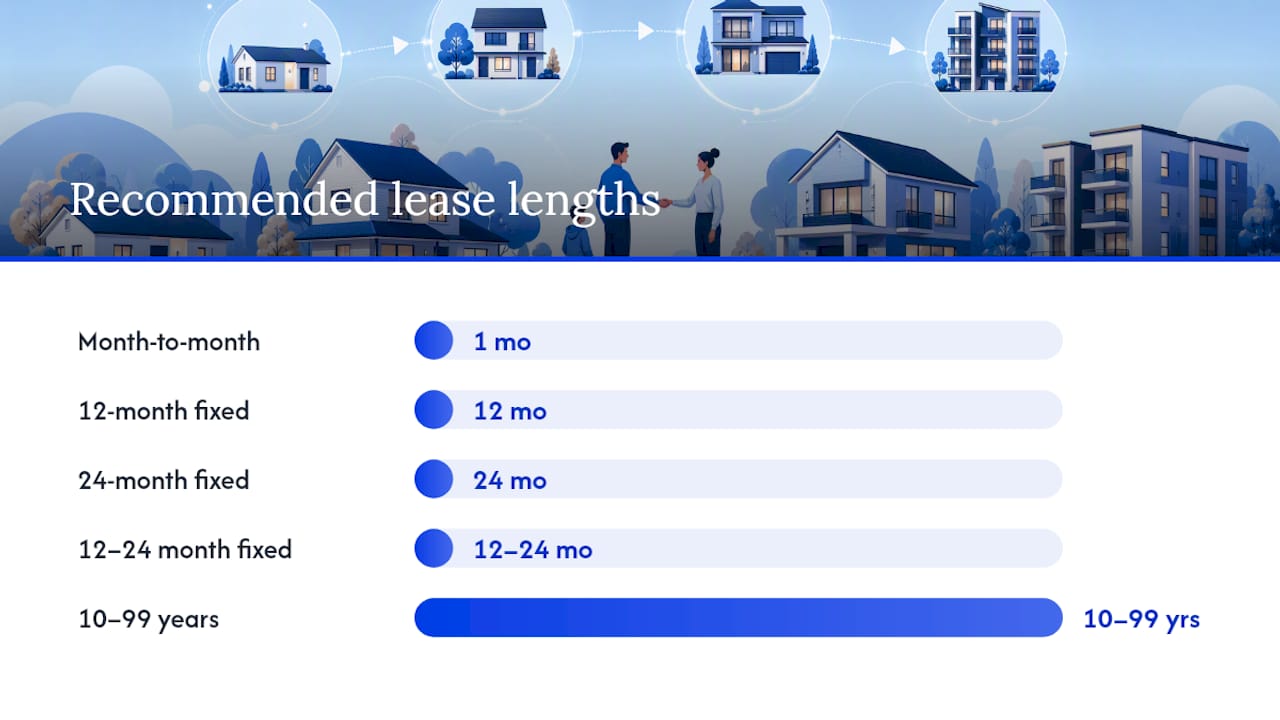
Asset Profile | Market Condition | Investor Priority | Recommended Term |
Single-family, stabilized | Appreciating | Rent agility | 12-month fixed |
Single-family, post-renovation | Any | Cost recovery | 24-month fixed |
Small multifamily | Soft/flat | Cash flow stability | 12–24 month fixed |
Any property, transitional | Any | Flexibility | Month-to-month |
Ground lease / land-only | Long-term hold | Development | 10–99 years |
For short-term rental strategies and how they compare to annual leasing, the long-term vs. short-term rental breakdown at 2ndstreetpropertymanagement covers the full tradeoff. Short-term rentals in vacation markets also carry their own local licensing and ordinance requirements — the ADU short-term rental guide is a useful reference for that setup.
Operational considerations by term type:
Month-to-month: Requires active rent monitoring and faster tenant screening cycles; best when you anticipate a sale or renovation within 12 months.
12-month fixed: Standard enforcement procedures apply; coordinate lease renewals 60–90 days before expiration.
Multi-year fixed: Conduct more thorough tenant screening upfront; include clear default and cure provisions since you are committed for longer.
Pro Tip: Structure multi-year leases as a 12-month base term with a 12-month renewal option at a pre-agreed rent increase (e.g., 3%). You get the stability of a long-term tenant with a built-in rent-reset mechanism that both parties agree to in advance.
How 2ndstreetpropertymanagement advises investors on lease length
2ndstreetpropertymanagement advises clients on lease length selection tied directly to ROI targets and local compliance requirements in Southern New Jersey. The company’s investor-founded background means the guidance is grounded in the same financial logic landlords use to evaluate deals, not just legal minimums.
Services that support lease execution and term strategy include:
Lease drafting: Preparation of enforceable fixed-term and periodic leases that satisfy Statute of Frauds requirements and include all essential terms.
Local ordinance checks: Review of applicable county and municipal rent rules before committing to a multi-year term.
Tenant screening: Credit, background, and income verification to match tenant quality to the lease length you are offering.
Lease enforcement and renewal management: Proactive notice scheduling, holdover prevention, and renewal negotiation to protect your income stream.
Section 8 and subsidized housing leasing: Specialized lease structures for HUD-assisted tenancies with their own term and compliance requirements.
The lease length decision most landlords get backwards
Most landlords pick a lease term based on habit — 12 months because that is what everyone does — rather than running the actual math on their property. That is a defensible default, but it leaves real money on the table in two specific situations.
The first is post-renovation. If you just spent $10,000 upgrading a unit, a 12-month lease at a $150/month premium gives you $1,800 in recovery before the tenant can leave. A 24-month lease at the same premium gives you $3,600. Neither fully recovers the investment, but the 24-month term cuts your exposure in half and gives you a tenant who has already committed to staying through the payback period.
The second is in soft markets. Landlords in flat or declining rental markets often chase month-to-month flexibility, thinking they can adjust quickly. What they actually get is more frequent vacancy, higher turnover costs, and tenants who sense the instability and leave sooner. A 12–18 month fixed term in a soft market is often the more profitable choice, not the more cautious one.
The conventional wisdom that “shorter is more flexible” confuses movement with progress. Flexibility only has value when you have somewhere better to go. If the market is not moving, the turnover cost of that flexibility is pure loss.
Property management that puts lease strategy to work
Knowing the right lease length is one thing. Executing it — with compliant drafting, local ordinance checks, and tenant screening that matches the term you are offering — is where most self-managing landlords lose ground.
2ndstreetpropertymanagement handles the full leasing cycle for residential investors in Southern New Jersey: from drafting enforceable fixed-term and periodic leases to running local ordinance checks before you commit to a multi-year term. The company’s investor-founded model means every recommendation is tied to your cash flow and ROI, not just legal compliance. If you want a lease strategy review for your portfolio, contact 2ndstreetpropertymanagement to get started.
Sources
The following primary sources back the legal and practical guidance in this article:
This article is general information, not a substitute for advice from a qualified lawyer. Consult a qualified legal professional about your own circumstances before acting on anything here.
Recommended
Comments