
Habitability Standards for Landlords: 2026 Compliance Guide


The implied warranty of habitability requires you to keep every rental unit safe and fit for human habitation — and that duty is automatic, continuous, and non-waivable in nearly every U.S. jurisdiction. You cannot contract around it. An “as-is” clause in your lease does not eliminate it. The moment a tenant notifies you of a qualifying defect, your legal clock starts running.
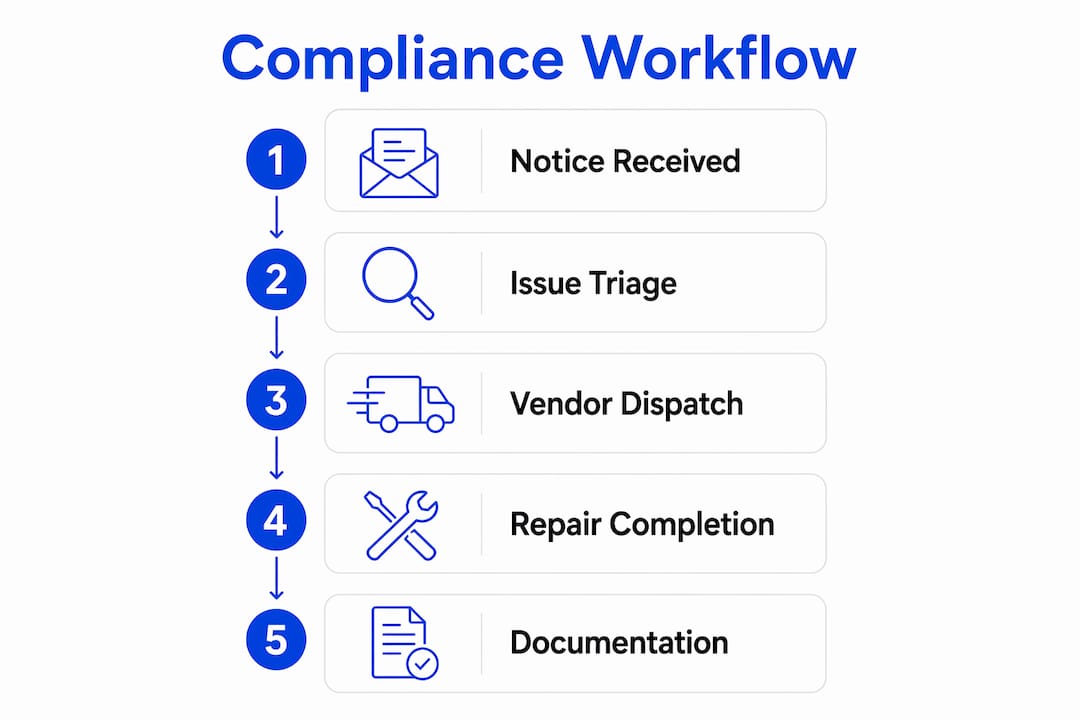
When you receive notice of a habitability issue, take these steps immediately:
Receive written notice. If the tenant reported verbally, follow up in writing to create a dated record.
Assess severity. Determine whether the issue is an emergency (no heat in winter, sewage backup, gas leak), urgent (broken lock, non-functional hot water), or routine (minor plumbing drip).
Arrange repairs. Emergency conditions require same-day vendor dispatch. Urgent issues typically demand a 24–72-hour response.
Document every action. Log the notice date, your response, the vendor assigned, and the completion date with photos.
Tenant remedies for unaddressed defects include repair-and-deduct, rent withholding or escrow, code enforcement complaints, civil suits for damages, and lease termination in severe cases. Anti-retaliation laws in most states prohibit eviction or utility shutoff in response to a tenant’s good-faith habitability complaint. The U.S. Department of Housing and Urban Development (HUD), state Attorney General habitability guides (such as the California AG’s habitability resources), and the National Low Income Housing Coalition (NLIHC) are the three most authoritative starting points for jurisdiction-specific guidance.
Table of Contents
What does the implied warranty of habitability mean for you?
How habitability rules vary by state and what recent laws require
What remedies can tenants use, and what consequences do landlords face?
Ready-to-use templates and checklists for habitability compliance
What professional property management does differently to reduce habitability risk
The case for treating habitability as asset management, not compliance theater
What does the implied warranty of habitability mean for you?
The implied warranty of habitability is a legal doctrine requiring landlords to maintain rental property in a condition fit for human habitation, typically tied to substantial compliance with local building and housing codes. It is not a clause you add to a lease. It exists by operation of law.

Three legal effects matter most. First, the warranty is automatic — it attaches to every residential tenancy regardless of what the lease says. Second, it is continuous — your obligation does not end at move-in; it persists throughout the tenancy. Third, it is non-waivable. Courts consistently void “as-is” clauses and tenant signature waivers as against public policy. A tenant who signed a lease acknowledging the unit’s condition at move-in still retains full habitability protections under state law.
The doctrine ties directly to rent obligations. Courts treat a tenant’s duty to pay rent as conditional on your fulfillment of the warranty. When you fail to repair a qualifying defect, you hand the tenant a legal defense for withholding rent or terminating the lease. That is not a technicality — it is a structural feature of landlord-tenant law that courts take seriously.
State statutes and municipal housing codes define the specific conditions that constitute a habitability violation. Florida’s statute (§ 83.51) and California’s Civil Code § 1941.1 are two of the most cited examples, but every state has its own version. The practical takeaway: always check your state statute and your local municipal housing code, because local codes can impose stricter standards than the state baseline. State AG offices and HUD publications are the most reliable starting points for jurisdiction-specific rules.
The core habitability items every landlord must maintain
Statutory habitability language across U.S. states converges on a consistent set of required conditions. Think of this list as your minimum operating standard — not a ceiling.
Plumbing. Hot and cold running water, functional sewage disposal, and no persistent leaks. A unit without hot water is a habitability violation in every state.
Electrical systems. Safe wiring, functioning outlets, and adequate lighting in common areas. Exposed wiring or a panel that trips repeatedly under normal load is not a cosmetic issue.
Heating. Functional heat during winter months. Many states specify a minimum indoor temperature (commonly 68°F during daytime hours), so check your local code for the exact threshold.
Structural safety. Sound roof, walls that keep out rain and wind, floors and stairways in good repair, and railings that can bear normal loads.
Locks and windows. Working locks on all exterior doors and windows. A broken deadbolt is an emergency, not a routine repair.
Smoke and CO detectors. Functional smoke alarms on every floor and carbon monoxide detectors in units with fuel-burning appliances. Test them at every move-in and document it.
Pest control and sanitation. Adequate extermination for rodents, roaches, bed bugs, and other vermin. Sufficient trash receptacles and clean common areas.
Ventilation. Adequate airflow to prevent moisture buildup and mold. Visible mold or persistent dampness from inadequate ventilation is a health hazard, not a cosmetic defect.
Landlord-provided appliances. Any appliance you supply (stove, refrigerator, dishwasher) must be in safe working order. If it breaks, repair is your responsibility.
Two common gray areas landlords get wrong:
Cosmetic issues vs. habitability defects. Scuffed paint, worn carpet, or an aging but functional fixture is cosmetic. A leaking roof, a non-functional heater, or a sewage backup is a habitability defect. The test is whether the condition materially affects health or safety.
Tenant-caused damage. If the tenant’s own actions caused the defect, the repair cost may shift to them. Document the condition at move-in with photos and a signed inspection report so you have a baseline for comparison.
Pro Tip: Install a property management odor and sanitation protocol — including guidance on housekeeping odor issues — as part of your move-out inspection process. Odor from mold, pests, or sanitation failures can signal a habitability defect that is not yet visible.
How habitability rules vary by state and what recent laws require
The federal baseline — primarily HUD’s housing quality standards for subsidized housing — sets a floor. But for market-rate rentals, state statutes and municipal housing codes control the specifics. The implied warranty is recognized in nearly every state, yet the remedies available to tenants, the required repair timelines, and the specific features mandated differ significantly.
The broad pattern works like this: your state statute defines the minimum habitability conditions and the tenant’s available remedies. Your local municipal housing or building code may layer additional requirements on top. When the two conflict, the stricter standard typically governs. If you own property in multiple municipalities, you may face different inspection schedules, notice requirements, and code thresholds within the same state.
Recent legislative activity has accelerated in several states. Washington State’s Residential Landlord-Tenant Act (RCW 59.18) has been updated with rent stabilization measures and expanded tenant protections. Several states have enacted or proposed “Tenant Safety Act” or “Safe at Home Act” type statutes that codify minimum repair timelines and expand tenant remedies. Because these laws change frequently, your state AG’s website is the only reliable source for current statutory language.
State | Key statute or policy | Where to verify |
California | Civil Code § 1941.1 (habitability); § 1942 (repair-and-deduct) | CA Attorney General |
Florida | § 83.51 Florida Statutes (landlord maintenance obligations) | |
Washington | RCW 59.18 (Residential Landlord-Tenant Act) | WA Attorney General |
New York | RPL (warranty of habitability) | NY AG landlord-tenant resources |
How to determine which standard controls your property:
Start with your state statute (search “[state] landlord tenant habitability statute”).
Check your city or county housing/building code for any local overlay.
When the two differ, apply the stricter requirement.
Consult local code enforcement or a licensed attorney when you are uncertain — especially before responding to a formal tenant complaint.
What does a legally sound repair workflow look like?
Receiving a tenant complaint and acting on it correctly are two different things. A documented, step-by-step process protects you legally and operationally.
Receive written notice. Ask tenants to submit all repair requests in writing (email or a maintenance portal). If a tenant calls, follow up with a written confirmation of what was reported and when.
Triage severity. Classify the issue: emergency (immediate threat to health or safety), urgent (significant inconvenience or risk of worsening damage), or routine (non-critical maintenance).
Confirm responsibility. Verify whether the defect falls under your maintenance obligations or whether tenant-caused damage shifts the cost. Check your lease and the move-in inspection report.
Dispatch the appropriate vendor. For emergencies, contact a licensed contractor same-day. For urgent issues, schedule within 24–72 hours. For routine repairs, schedule within a reasonable period — typically 7–14 days, though your state statute may specify a shorter window.
Document and follow up. Log the vendor assigned, the scheduled date, the completion date, and attach photos of the repaired condition. Send the tenant a written completion notice.
Repair timelines courts consider reasonable vary by severity. Emergencies require immediate action; courts expect a “reasonable” response for non-emergencies, and what is reasonable depends on your jurisdiction and the nature of the defect. Do not assume a two-week window is always safe for urgent repairs.
Entry notice rules are equally important. Landlords must generally give 24 hours’ notice before entering a rental unit, except in genuine emergencies. Entering without notice — even to make a repair — can expose you to a quiet-enjoyment claim. When you do need emergency access, document the reason and the time of entry immediately afterward.
Pro Tip: Require all tenant repair requests in writing and respond in writing every time. Verbal-only exchanges leave you unable to prove timely response if a dispute escalates. A simple email thread is sufficient — the key is a dated, written record on both sides.
What remedies can tenants use, and what consequences do landlords face?
When you fail to address a habitability defect after proper notice, tenants have real legal tools — and courts use them. Understanding the full range of tenant remedies is the clearest argument for proactive compliance.
Repair-and-deduct. In states that allow it (including California under Civil Code § 1942), a tenant can hire a contractor to fix the defect and deduct the cost from rent, up to a statutory cap. California caps this at one month’s rent, and tenants may use it no more than twice in any 12-month period.
Rent withholding or escrow. A tenant may stop paying rent or pay into a court-supervised escrow account until repairs are made. Courts treat the rent obligation as conditional on your fulfillment of the warranty.
Code enforcement complaint. A tenant can report the condition to the local housing or building department. An inspector may issue a violation notice, a repair order, or in severe cases, a condemnation order that forces the unit off the rental market.
Civil suit for damages. Tenants can sue for the difference between the rent paid and the fair rental value of the unit in its defective condition, plus out-of-pocket costs and, in some states, punitive damages.
Lease termination. In cases of severe or uncorrected habitability failures, a tenant may be entitled to terminate the lease without penalty.
Anti-retaliation protections add another layer of risk. If you raise rent, reduce services, or initiate eviction proceedings after a tenant reports a habitability complaint to you or to a government agency, most states presume retaliation. Statutory penalties for retaliatory eviction can include actual damages, punitive damages, and attorney fees — sometimes two to three times the monthly rent.
Poor documentation is what turns a manageable repair dispute into an expensive legal judgment. Delays compound the problem: the longer a defect goes unaddressed after notice, the harder it is to argue you responded reasonably.
How to prevent habitability violations before they happen
Reactive repairs cost more than proactive maintenance — in money, time, and legal exposure. A structured prevention framework is one of the highest-ROI habits you can build as a landlord.
Seasonal and annual maintenance checklist:
Spring: Inspect roof for winter damage, clean gutters, test AC systems, check window seals.
Summer: Service HVAC filters, inspect exterior for pest entry points, verify ventilation in attics and crawl spaces.
Fall: Service heating systems before the first cold snap, test smoke and CO detectors, inspect weatherstripping.
Winter: Monitor plumbing in unheated spaces, respond to ice dam reports promptly, verify heat is functional in all units.
Annual: Full electrical inspection, plumbing check for slow leaks, pest prevention treatment, smoke/CO detector battery replacement.
Recordkeeping essentials:
Log every tenant notice with the date received, the issue described, and your response date.
Attach vendor invoices, photos of the completed repair, and any permit documentation.
Retain repair records for at least three years — longer if your state statute specifies a different period or if a dispute is pending.
Store records in a cloud-based system so they are accessible and timestamped.
Vendor management:
Maintain a roster of licensed, insured contractors for each trade (plumbing, electrical, HVAC, roofing).
Verify licenses and insurance annually.
Keep a vendor performance log noting response times and quality of work.
For HVAC-specific compliance, particularly in states like Florida where air conditioning responsibilities are a common source of habitability disputes, confirm your lease clearly defines which systems you maintain and schedule seasonal service before tenant complaints arise.
Pro Tip: Adopt a standardized maintenance coordination process with written intake, triage rules, and a vendor dispatch log. Retain all invoices and photos for a minimum of three years. That paper trail is your primary defense in any habitability dispute.
Ready-to-use templates and checklists for habitability compliance
Standardized templates do two things: they speed your response time and they create a consistent paper trail. Three documents cover the core of your habitability compliance process.
Template 1: Tenant written repair notice
Fields to include: tenant name and unit number, date of notice, description of the problem (what, where, when first noticed), photos attached (yes/no), tenant signature, and preferred contact method for scheduling.
Template 2: Landlord repair acknowledgment
Fields to include: date received, issue summary, severity classification (emergency/urgent/routine), assigned vendor name and license number, scheduled repair date, and landlord or manager signature. Send this to the tenant within 24 hours of receiving their notice.
Template 3: Post-repair completion notice
Fields to include: repair completion date, description of work performed, vendor invoice number, photos of completed repair attached (yes/no), and a request for tenant confirmation that the issue is resolved.
Store completed templates in a digital tenant file organized by unit and date. A cloud-based folder structure (e.g., Unit 1A > 2026 > Repairs) makes retrieval fast if a dispute arises.
Template | Primary purpose | Minimum fields |
Tenant repair notice | Creates dated record of reported defect | Date, description, photos, tenant signature |
Landlord acknowledgment | Confirms receipt and sets timeline | Severity, vendor, scheduled date, manager signature |
Completion notice | Closes the repair loop with documentation | Completion date, work description, invoice reference |
Compact inspection checklist (pass/fail):
Smoke detectors functional on every floor: Pass / Fail
CO detectors present in required rooms: Pass / Fail
All exterior locks operational: Pass / Fail
Hot and cold water functional: Pass / Fail
Heating system operational: Pass / Fail
No visible mold or moisture intrusion: Pass / Fail
Electrical outlets and panels in safe condition: Pass / Fail
Stairs, railings, and floors structurally sound: Pass / Fail
No evidence of pest activity: Pass / Fail
Landlord-provided appliances operational: Pass / Fail
Run this checklist at every move-in, move-out, and annual inspection. Sign and date it each time. For a deeper look at disclosure requirements that pair with your inspection process, your state statute is the primary reference.
What professional property management does differently to reduce habitability risk
The gap between a landlord who manages reactively and one who manages systematically shows up most clearly in habitability compliance. Professional managers do not just fix problems faster — they build processes that prevent most problems from becoming legal issues in the first place.
The operational flow looks like this: intake (written notice received and logged) → triage (severity classified within hours) → vendor dispatch (licensed contractor assigned with a confirmed timeline) → quality assurance (completed work inspected against code standards) → record closure (invoice, photos, and completion notice filed in the tenant record).
Consider the cost difference between proactive and reactive maintenance. A seasonal HVAC service call typically costs a fraction of an emergency repair during a heat wave — and the emergency version often comes with a habitability complaint attached. Catching a slow roof leak during an annual inspection costs far less than the water damage, mold remediation, and potential rent abatement that follow an undetected failure.
Vendor oversight is where many self-managing landlords fall short. A professional manager maintains a credentialed vendor roster, verifies licenses and insurance annually, and tracks vendor performance over time. When a repair fails a quality check, the vendor is called back — and that callback is documented. That level of governance is what creates a defensible record if a tenant dispute escalates to code enforcement or litigation.
2ndstreetpropertymanagement provides exactly this kind of structured management for landlords and investors in Southern New Jersey. Services include maintenance coordination, vendor oversight, 24/7 repair triage, tenant screening, and full documentation management — all designed to keep your properties compliant and your liability exposure low. For landlords managing Section 8 or subsidized units, where HUD’s Housing Quality Standards (HQS) add a federal layer of habitability requirements, that systematic approach is not optional. For a broader look at property management strategies that reduce risk across your portfolio, the operational principles are the same regardless of portfolio size.
Key Takeaways
Habitability compliance is not optional — the implied warranty is automatic, non-waivable, and tied directly to your tenant’s rent obligation in nearly every U.S. jurisdiction.
Point | Details |
Warranty is non-waivable | “As-is” lease clauses do not eliminate habitability duties; courts void them as against public policy. |
Written records are your defense | Require written tenant notices and document every repair with dates, vendor names, invoices, and photos. |
Timelines depend on severity | Emergencies require same-day action; urgent issues demand 24–72 hours; routine repairs need a reasonable window per your state statute. |
State and local codes both apply | Check your state statute and your municipal housing code; the stricter standard governs your obligations. |
2ndstreetpropertymanagement | Provides maintenance coordination, vendor oversight, and documentation management to reduce habitability risk for landlords in Southern New Jersey. |
The case for treating habitability as asset management, not compliance theater
Most landlords think about habitability the wrong way. They treat it as a legal obligation to satisfy when a tenant complains — a box to check, a repair to make, a dispute to close. That framing confuses movement with progress.
The landlords who build durable portfolios treat habitability compliance as core asset management. A property that is consistently maintained holds its value, attracts better tenants, and generates fewer disputes. A property that is reactively patched degrades faster, cycles through tenants more often, and accumulates deferred maintenance that eventually becomes a capital expense. The legal risk is real, but the financial logic is just as compelling.
What most guides understate is the documentation piece. Landlords lose habitability disputes not because they failed to make repairs, but because they cannot prove they responded in time. A verbal conversation with a tenant, a handshake with a contractor, a repair made without a dated invoice — these are the gaps that turn a defensible position into an expensive settlement. The process matters as much as the repair itself.
The other thing worth saying plainly: anti-retaliation laws have teeth. Raising rent or filing an eviction notice shortly after a tenant reports a habitability issue is one of the fastest ways to convert a repair dispute into a statutory-penalty case. Courts presume retaliation in those circumstances, and the burden shifts to you to prove otherwise. The safest position is a documented, timely repair and a written record showing you treated the complaint as a maintenance issue, not a personal conflict.
For landlords managing rental property maintenance obligations across multiple units, the investment in a standardized process pays for itself many times over — in avoided legal fees, reduced vacancy, and a property that holds its value.
How 2ndstreetpropertymanagement helps you stay compliant
Managing habitability compliance across a rental portfolio takes more than good intentions. It takes systems: a written intake process, a credentialed vendor roster, documented triage, and a record-closure workflow that holds up under scrutiny.
2ndstreetpropertymanagement is built for investors who want their properties managed the way they would manage them if they had the time and infrastructure to do it right. For landlords in Southern New Jersey, the services most directly tied to habitability compliance include:
24/7 maintenance triage so emergency repairs are dispatched same-day, not the next business day.
Vendor oversight with licensed, insured contractors and a performance log for every trade.
Written documentation for every repair notice, vendor assignment, and completion — stored and retrievable.
Tenant screening that reduces the likelihood of disputes from the start.
Section 8 and HUD compliance management for subsidized units with federal habitability requirements.
If you want to see how a structured management process reduces your habitability exposure, request a consultation with 2ndstreetpropertymanagement. You can also review the comprehensive property management solutions available for rental property owners to understand exactly what a managed process looks like in practice.
Authoritative resources for habitability compliance
Use these primary sources when verifying jurisdiction-specific rules, drafting notices, or preparing for a code enforcement inspection.
U.S. Department of Housing and Urban Development (HUD) — Federal housing quality standards, fair housing guidance, and resources for subsidized housing compliance.
California AG Landlord-Tenant Issues — One of the most detailed state AG habitability guides in the country; useful as a model even for landlords in other states.
California AG Know Your Rights: Habitability Guide — Plain-language checklist of required conditions under Civil Code § 1941.1.
LII/WEX: Implied Warranty of Habitability — Concise legal definition and doctrine overview from Cornell Law School’s Legal Information Institute.
LII/WEX: Landlord-Tenant Law — Overview of landlord-tenant law including remedies and anti-retaliation protections.
National Low Income Housing Coalition (NLIHC) — Policy research and advocacy resources on housing quality and tenant protections.
Florida Statutes § 83.51 — Florida’s landlord maintenance obligations statute; a useful model for reading statutory habitability language.
Washington State AG: Landlord-Tenant — Current Washington state landlord-tenant law including recent rent stabilization and habitability updates.
Justia: Landlords’ Legal Rights and Duties — Practical overview of entry notice rules, repair timelines, and quiet enjoyment obligations.
When consulting any of these resources, note the effective date of the statute or guidance. State laws change, and a guide published two years ago may not reflect a recent legislative amendment. Always cross-reference with your state AG’s current page and your local municipal building department before responding to a formal complaint or drafting a legal notice.
This article provides general legal information, not legal advice. Verify current rules with your state AG, local code enforcement office, or a licensed attorney for your specific situation.
Recommended

Comments