
Debt Payoff Strategies That Actually Work in 2026


Debt payoff is the process of systematically eliminating what you owe to free up cash flow, reduce financial stress, and build lasting wealth. For real estate investors and families alike, carrying high-interest debt is a direct drag on ROI and long-term net worth. The two most proven debt reduction methods are the avalanche and snowball techniques, and avalanche beats snowball in 84% of cases, with median interest savings between $500 and $2,000. Choosing the right method, preparing your finances correctly, and executing with discipline separates people who eliminate debt from those who confuse movement with progress.
What are the most effective debt payoff strategies?
The debt avalanche method targets your highest-interest debt first while making minimum payments on everything else. Once that balance hits zero, you redirect its full payment toward the next highest-rate debt. This approach saves the most money mathematically because you cut off the most expensive interest charges first.

The debt snowball method works differently. You pay off your smallest balance first, regardless of interest rate. Each cleared account delivers a psychological win that builds momentum. Snowball’s quick wins improve long-term adherence, especially when your interest rates are similar across accounts.
The right choice depends on your situation. Avalanche wins when your interest rates vary widely, say 8% on a car loan versus 24% on a credit card. Snowball wins when you need early motivation to stay the course, or when your rates are clustered close together.
Feature | Debt Avalanche | Debt Snowball |
Payment target | Highest interest rate first | Smallest balance first |
Interest savings | Maximum savings | Lower savings |
Motivation style | Math-driven | Quick-win driven |
Best for | Wide rate variation | Similar rates or low motivation |
Adherence risk | Higher dropout if slow | Lower dropout due to early wins |
Pro Tip: Pick the method you can realistically stick with for at least 24 months. A plan you follow beats a perfect plan you abandon.
How do you prepare before paying down debt aggressively?
Preparation separates people who finish their payoff plan from those who restart it repeatedly. Before you make a single extra payment, you need a clear picture of every debt you carry.
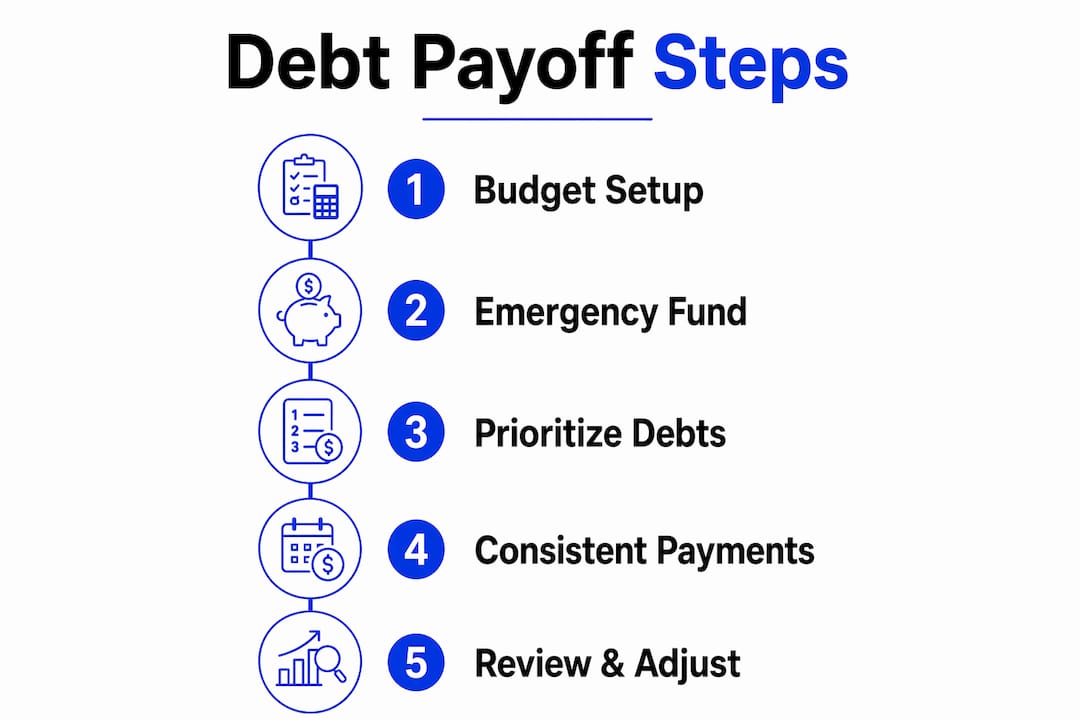
Start by listing every balance, interest rate, and minimum payment in one place. A simple spreadsheet works. This step alone reveals which debts cost you the most and gives you a target order for the avalanche or snowball approach.
Next, build a $1,000 starter emergency fund before attacking debt aggressively. Without a cash buffer, one car repair or medical bill forces you back onto a credit card, creating a cycle that undoes months of progress. This fund is not optional. It is the foundation that keeps your payoff plan intact.
List all debts: Record balance, interest rate, minimum payment, and lender for each account.
Calculate your debt-to-income ratio: Divide total monthly debt payments by gross monthly income. A ratio above 43% signals financial stress.
Set a realistic timeline: Plan 50% longer than your initial estimate to account for life events, income changes, and unexpected expenses.
Apply the 50/30/20 rule: Allocate 50% of take-home pay to needs, 30% to wants, and 20% to debt repayment and savings.
Identify professional help thresholds: If unsecured debt equals 50% or more of gross income, or you cannot pay it off within 5 years, consult a nonprofit credit counselor.
Pro Tip: Your first payoff estimate is almost always too optimistic. Add 50% more time to your target date before you commit to a plan. You will feel relief, not failure, when life happens.
What are the practical steps to execute your payoff plan?
Execution is where most plans break down. The mechanics are simple, but consistency is the real challenge. Follow these steps in order and you will make measurable progress every month.
Make every minimum payment on time. Missing a minimum triggers fees, damages your credit score, and can trigger penalty interest rates. Paying only minimums extends your payoff timeline and increases total interest paid, but you must never skip them.
Choose one target debt. Apply every extra dollar to this single account. Splitting extra payments across multiple debts slows your progress on all of them.
Automate your payments. Set minimum payments on autopilot for every account. Automate your extra payment to your target debt on payday so it leaves before you spend it.
Roll payments forward. Once a debt is cleared, add its former payment to your next target. A $200 car payment that disappears becomes $200 extra on your credit card. This compounding effect, sometimes called the debt snowball effect, accelerates your timeline significantly.
Negotiate with creditors. Creditors often lower rates or waive fees when you call before falling behind. Medical providers and credit card issuers are especially open to flexible arrangements. One phone call can save hundreds of dollars.
Track progress monthly. Use a spreadsheet, a budgeting app, or a debt payoff calculator to update balances every month. Seeing the numbers drop is one of the strongest motivators to keep going.
Avoid new debt. Freeze discretionary credit card use during your payoff period. If you must use credit, pay the full balance before the statement closes.
The real estate investor parallel is direct. Just as you would not buy a second rental property while bleeding cash flow on a poorly structured first one, you should not add new consumer debt while paying down existing balances. Debt paydown increases your borrowing capacity for future investments. For a deeper look at how this plays out in real estate, the buy vs. pay off debate is worth reading before your next acquisition decision.
When should you consider debt consolidation or relief?
Debt consolidation combines multiple balances into one loan, ideally at a lower interest rate. Consolidation loan rates range from 7% to 36% with terms up to 7 years. The strategy only makes financial sense if your new rate is meaningfully lower than your current weighted average rate.
Consolidation is not a cure. It simplifies payments and can reduce rates, but it does nothing to fix the spending habits that created the debt. Without a budget, most people who consolidate accumulate new balances within two years.
Watch for these costs before signing any consolidation agreement:
Origination fees: Lenders charge 1%–8% of the loan amount upfront. On a $20,000 loan, that is up to $1,600 gone before you make a payment.
Balance transfer fees: Credit card balance transfers typically cost 3%–5% of the transferred amount.
Prepayment penalties: Some lenders charge a fee if you pay off the loan early.
Promotional rate expiration: A 0% balance transfer offer that converts to 25% after 12 months can leave you worse off if you have not cleared the balance.
Debt relief, which includes negotiated settlements or structured repayment programs through nonprofit agencies, is appropriate when consolidation is not enough. If your unsecured debt exceeds 50% of gross income or a 5-year payoff is not realistic, professional debt relief is the right call, not a last resort. Some property investors also find that managing debt strategically matters more than simply reducing it as fast as possible.
What mistakes derail debt payoff plans?
The most common mistake is underestimating how long payoff takes. Life does not pause for your debt plan. Job changes, medical bills, and home repairs all compete for the same dollars you earmarked for extra payments.
Wiping out your emergency fund: Paying debt aggressively without a cash buffer forces you back to credit cards when emergencies hit. Keep that $1,000 reserve intact at all times.
Skipping minimum payments: One missed payment triggers late fees and can raise your interest rate to a penalty level. This single mistake can add months to your payoff timeline.
Ignoring psychological momentum: If the avalanche method feels discouraging because your highest-rate debt has a large balance, switch to snowball. Finishing the plan matters more than following the mathematically perfect method.
Treating consolidation as a finish line: Consolidating debt and then continuing old spending patterns is one of the fastest ways to double your total debt load.
Failing to adapt: Review your plan every 90 days. Income changes, windfalls, and rate changes all affect your optimal path.
Pro Tip: When you hit a setback, do not restart from zero. Adjust your timeline, keep making minimum payments, and resume extra payments as soon as cash flow allows. Consistency over perfection is the rule.
Key Takeaways
The most effective debt payoff plan combines the right elimination method, a $1,000 emergency buffer, consistent minimum payments, and a timeline that accounts for real life.
Point | Details |
Choose your method deliberately | Avalanche saves more interest; snowball builds momentum. Pick the one you will actually follow for 24+ months. |
Build a cash buffer first | A $1,000 emergency fund prevents new high-interest debt from derailing your plan mid-execution. |
Roll payments forward | After clearing each debt, redirect its full payment to the next target to accelerate your timeline. |
Vet consolidation carefully | Origination and balance transfer fees of 1%–8% can erase savings if you do not clear the balance within the loan term. |
Plan for a longer timeline | Budget 50% more time than your initial estimate to account for income changes and unexpected expenses. |
The uncomfortable truth about debt payoff I’ve learned
Most people treat debt payoff as a math problem. It is not. It is a behavior problem with a math component.
I have watched investors run the avalanche numbers perfectly, set up a spreadsheet, and abandon the plan within four months because the target debt was a $15,000 credit card that barely moved. They were doing everything right and felt nothing. Switching to snowball, clearing two smaller accounts first, and then returning to that credit card with momentum made the difference. The math was slightly less optimal. The result was a paid-off card.
The other thing I have seen derail otherwise solid plans is the emergency fund shortcut. Investors skip the $1,000 buffer because they want to throw everything at debt immediately. Then the HVAC fails or a tenant skips rent, and they charge $2,400 to a card they just paid down. That is not progress. That is a loop.
Real estate investors have one advantage here that most personal finance advice ignores. Your rental income, if managed well, can serve as both a debt payoff accelerator and an emergency buffer. The key is treating that income with the same discipline you apply to your payoff plan. For context on how building wealth through real estate intersects with debt management, the framework matters as much as the numbers.
Stick to the plan. Adjust the timeline when life demands it. Do not confuse a slower month with failure.
— Main
How 2ndstreetpropertymanagement supports your financial goals
Real estate investors who manage debt well build equity faster, qualify for better financing, and generate stronger cash flow from their portfolios. 2ndstreetpropertymanagement works with investors at every stage of that process, from structuring property acquisitions to managing rental income that can directly accelerate debt paydown.

If you are working toward financial freedom and want to understand how your real estate assets fit into your debt reduction plan, 2ndstreetpropertymanagement offers the investor-focused perspective you need. Visit 2ndstreetpropertymanagement to learn how property management done right supports every financial goal on your list.
FAQ
What is the fastest way to pay off debt?
The fastest method is the debt avalanche: target your highest-interest balance first while making minimums on all others. This cuts the most expensive interest charges and shortens your total payoff timeline.
How much extra should I pay each month to eliminate debt faster?
Any consistent extra payment accelerates payoff. Even $50–$100 per month above the minimum reduces principal faster and saves significant interest over the life of the debt.
When does debt consolidation make sense?
Consolidation makes sense when you can secure a rate meaningfully lower than your current weighted average. Consolidation loan rates range from 7% to 36%, so the math only works if your new rate beats your existing rates.
Should I pay off debt or invest in real estate first?
The answer depends on your interest rates and available returns. High-interest consumer debt above 10% typically warrants payoff before new investment. Lower-rate debt may be worth carrying if your real estate returns exceed the cost of that debt.
What is the 50% debt-to-income rule?
If your unsecured debt equals 50% or more of your gross income, or you cannot realistically pay it off within 5 years, professional debt relief or credit counseling is the recommended next step.
Recommended
Comments