
Cosigner vs Guarantor: 80x Rent Guaranties and Landlord Screening


A cosigner is liable for a debt starting the day the paperwork is signed. A guarantor typically only owes money after the primary borrower defaults, though the caveat matters: many guaranties are written “of payment,” which lets a landlord or lender chase the guarantor almost as fast as a cosigner. If you’re weighing whether to back someone’s lease or loan, the comparison and negotiation checklist below tell you what to check before you sign anything.
TL;DR:
Cosigners are liable immediately and share all debts, including late fees and damages, with no discretion once they sign the lease or loan.
Guarantors are usually only pursued after the primary borrower defaults, with liability triggered by nonpayment and generally not affecting their credit unless called upon.
Loan obligations from cosigning appear immediately on credit reports and impact debt-to-income ratios, whereas guarantors typically do not unless they pay and get reported.
Landlords often require higher income proof from guarantors, sometimes making them demonstrate income around 80 times the monthly rent to qualify.
Negotiating specific limits on guaranty scope and term, and maintaining proof of timely payments, can reduce long-term risks for both backers and tenants.
Table of Contents
Cosigner vs Guarantor: What Each Term Actually Means
A cosigner signs the lease or promissory note directly, alongside the primary tenant or borrower. That signature creates joint and several liability, a legal phrase that means the landlord or lender can pursue either party, or both at once, for the full amount owed. Your name shows up on the account itself. If the tenant skips three months of rent, you’re not a backup plan. You’re a co-defendant.
A guarantor is different on paper, if not always in practice. Instead of signing the lease, a guarantor signs a separate guaranty agreement, a standalone contract that says: if the tenant or borrower fails to pay, I will. According to Equifax’s comparison of the two roles, that liability is usually contingent on default rather than immediate, though a “guaranty of payment” can be enforced almost as quickly as a cosigner’s obligation once the borrower misses a payment.
A few distinctions worth keeping straight:
Cosigner: signs the lease or loan directly, liable from day one, no ownership or occupancy rights beyond what the primary signer has.
Co-borrower: similar to a cosigner but usually implies shared benefit from the loan (a joint car purchase, for instance).
Guarantor: signs a separate guaranty, liability triggered by default, and per Investopedia’s definition of a guarantor, typically has no ownership or possession rights in the underlying property or asset at all.
Guarantor vs Cosigner: The Practical Differences That Matter Most
The legal labels matter less than what happens when a payment gets missed. Here’s where the two roles diverge in ways that actually affect your wallet and your credit file.
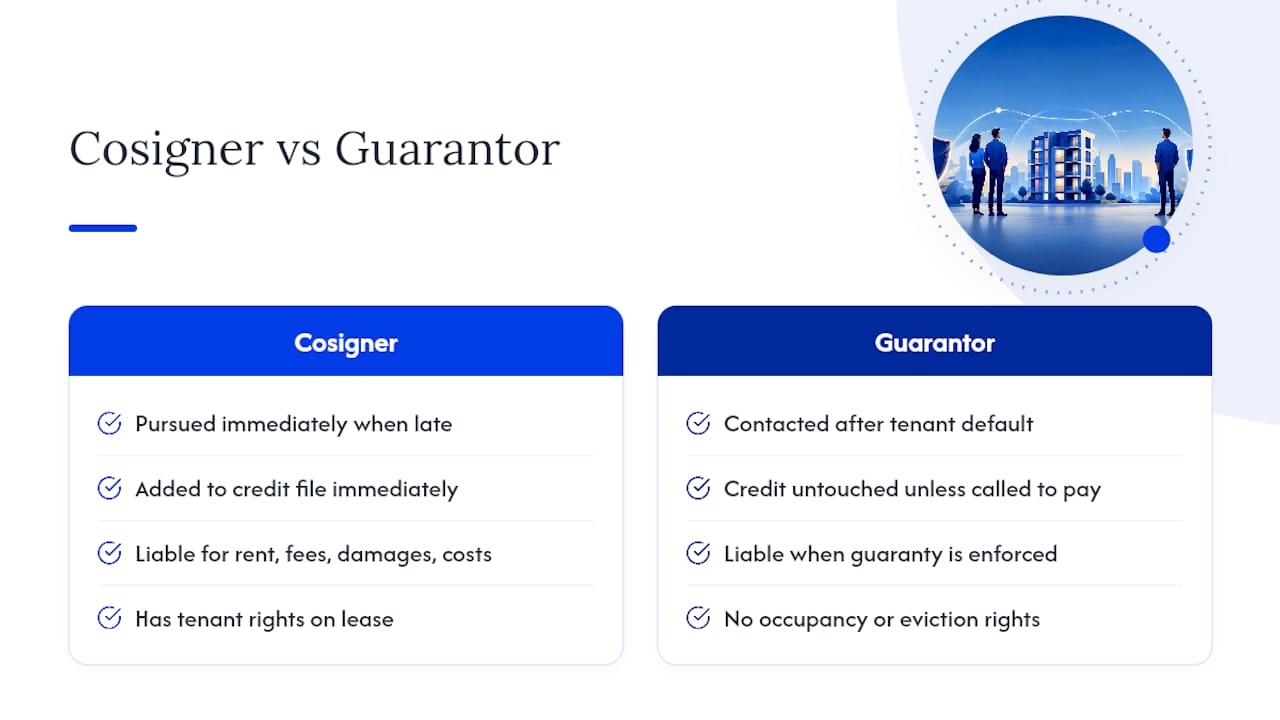
Liability timing. A landlord can typically pursue a cosigner for unpaid rent the moment it’s late, since the cosigner is already a party to the lease. A guarantor generally isn’t contacted until the tenant has defaulted and the landlord has exhausted (or at least attempted) standard collection steps against the tenant. Guaranties of payment shrink that gap considerably.
Credit reporting. Cosigned loans are usually added to the cosigner’s credit file immediately, per OneMain Financial’s explanation of the difference, which means your credit utilization and account count change right away, even if the primary borrower never misses a payment. A guarantor’s credit typically stays untouched while payments are on time. It only takes a hit if the guarantor gets called on to pay and that collection or judgment gets reported.
Scope of liability. Joint and several liability doesn’t stop at unpaid rent. It usually extends to late fees, damages beyond the security deposit, and collection or attorney costs the landlord incurs chasing the debt. A cosigner can be on the hook for all of it.
Occupancy and legal rights. A cosigner named on the lease generally has the same tenant rights as the person living there, even if they never move in. A guarantor has none of that. No right to occupy, no standing to challenge an eviction, nothing beyond the financial exposure they signed up for.
Income thresholds. Landlords often set higher qualifying income for guarantors than for cosigners or tenants. In competitive rental markets, some landlords ask guarantors to show income equal to roughly 80 times the monthly rent, far above the 3x standard applied to tenants and cosigners.
What Backing Someone’s Debt Does to Your Credit and Future Borrowing
Cosigning or guaranteeing isn’t a one-time favor. It follows you.
A missed payment or collection account tied to a cosigned lease or loan can stay on your credit report for years, dragging down your score the same way a personal default would.
Mortgage underwriters typically count a cosigned obligation in your debt-to-income ratio unless you can prove the primary borrower has been paying reliably, often via 12 months of canceled checks or bank statements showing consistent payments from their own account, as underwriting guidance suggests.
Guarantors usually escape the DTI hit entirely unless they’ve actually been called on to pay, since the obligation isn’t on their credit file to begin with.
Bankruptcy offers little shelter here. If the primary borrower discharges the debt, the cosigner or guarantor can still be pursued for the balance in most cases.
Backers who do pay generally retain a right of subrogation, the legal ability to sue the original borrower to recover what they paid on that person’s behalf.
The CFPB’s guidance on credit products makes clear that backing someone else’s debt changes your own borrowing profile, sometimes for years after the original lease or loan has ended.
How Landlords Apply These Rules, and How to Negotiate Better Terms
Landlords lean on cosigners and guarantors mainly when an applicant’s income or credit history falls short of standard thresholds, typically income at three times the rent. If you’re being asked to back someone, or asking someone to back you, a few negotiation moves limit exposure on both sides.
Limit the guaranty to the original lease term. Open-ended guaranties that automatically roll into every renewal are the single biggest risk for a backer. Push for language that requires a fresh guaranty signature at each renewal.
Get a written release condition. Ask what circumstances end the guaranty, whether that’s a certain number of on-time payments or a formal amendment once the tenant’s income improves.
Define the scope in writing. Make sure the document specifies whether the guaranty covers rent only, or also damages, fees, and collection costs.
Watch for ambiguous renewal clauses. Vague language about “continuing” obligations is a red flag that the landlord may try to hold you liable well past the original term.
Pro Tip: Keep copies of every rent payment record for the person you’re backing. If the lease ever gets renewed or disputed, proof of on-time payments is your strongest argument for getting released from the guaranty.
Screening Practices That Reduce Risk for Landlords
A property management company built its screening process for investors who’ve been burned by loose guaranty language before. A vague guaranty agreement or an unverified income statement creates disputes months or years down the road, usually right when a landlord can least afford one.
Strong screening includes:
Fraud-resistant income verification that cross-checks pay stubs, bank statements, and employer contact information rather than accepting documents at face value.
Written landlord reference letters that confirm payment history at a previous address.
Guaranty documents that explicitly limit the backer’s obligation to the original lease term, with a fresh signature required at renewal.
Clear scope language covering rent, damages, and collection costs so there’s no ambiguity if a dispute reaches court.
Managers who document guaranty scope this precisely resolve fewer collection disputes and spend less time in landlord-tenant court over “I didn’t agree to that.”
Choosing the Right Backer for the Right Situation
A cosigner usually fits when the applicant might eventually share the lease, such as a partner or roommate with thin credit. A guarantor fits better when a parent or relative wants to back the rent without living there or taking on tenant rights. Before signing anything, confirm the scope, the term length, and your release conditions in writing.

Where 2ndstreetpropertymanagement Fits Into the Picture
If you’re a landlord trying to write a guaranty that actually protects you, or a property owner unsure whether your current screening catches weak backers before they sign, that’s exactly the gap 2ndstreetpropertymanagement was built to close. As a property management company built by investors for investors, the team applies the same fraud-resistant verification standards discussed above to every application it processes, not a generic checklist borrowed from a template.

That means income verification that actually gets confirmed with employers, guaranty documentation that limits scope and term instead of leaving it open-ended, and rent collection procedures designed to catch a missed payment before it becomes a six-month collections mess. The income verification steps 2ndstreetpropertymanagement uses and the full tenant screening checklist are the same standards applied to every property under management. If you own residential rentals in the region and want a second opinion on how your current guaranty language holds up, get in touch with 2ndstreetpropertymanagement to talk through your screening process. For investors also reviewing rent-roll performance before adjusting qualifying income thresholds, CR Equity AI’s guide to rent roll analysis is a useful companion resource.
Sources
For deeper reading, check the FTC’s consumer guidance on cosigning, Equifax’s cosigner vs. guarantor breakdown, and LegalClarity’s legal analysis.
This article is general information, not a substitute for advice from a qualified financial advisor. Consult a qualified financial professional about your own circumstances before acting on anything here.
FAQ
What is the disadvantage of being a cosigner?
You become immediately and fully liable for the debt, meaning missed payments hit your credit report and you can be sued for the full balance even if you never benefited from the loan or lease.
Can I sue someone I cosigned for?
Yes. If you pay on their behalf, you generally have a right of subrogation that lets you sue the primary borrower to recover what you paid.
Why don’t landlords like cosigners?
Some landlords actually prefer guarantors for higher-risk applicants because a guaranty with a defined income threshold, often far above standard rent multipliers, offers stronger financial assurance without adding another named tenant with occupancy rights.
Does being a cosigner show up on your credit report?
Yes. A cosigned loan or lease is typically added to your credit file right away, unlike a guaranty, which usually stays off your report unless you’re called on to pay.
Recommended
Comments